by ropeway-admin | Aug 14, 2026 | Conveyors
An incline conveyor belt is a continuous belt system. Engineered to move bulk material or packaged goods between two different elevations. Unlike a flat conveyor, its angle is the single design variable that dictates capacity, belt selection, and drive power. Whether the load stays put or slides back. The problem engineers have faced time and again when designing inclined belt conveyor systems is that the physics become more of an obstacle the steeper the angle.
This guide from M&M Ropeways breaks down the belt types, the real angle limits, and how high-angle conveyors bypass those limits without spilling a single kilogram.
What Is an Incline Conveyor Belt?
An incline conveyor belt is a mechanical handling system that lifts material from a lower to a higher elevation. How? By using a moving belt looped around powered pulleys. The belt runs along a supporting structure set at a fixed angle to the horizontal, driven by a motor at one end and tensioned by idlers along its length. The goal is to replace trucks, forklifts, and manual lifting with a steady, low-labor flow of material.
In practice, it does much more than that:
- Moves bulk solids like coal, ore, cement clinker, aggregate, and grain uphill
- Feeds crushers, screens, silos, hoppers, and loading bays
- Bridges elevation gaps inside factories, mines, ports, and tunnelling projects
- Reduces the ground footprint of material transport corridors
The belt itself is where most of the engineering intelligence sits. The conveyor can only run as steep as its surface pattern, sidewall geometry, and cover compound allow it to before the force of gravity overcomes the friction that is holding the load in place.
What Are the Main Types of Incline Conveyor Belts?
Incline conveyor belts fall into five distinct families. Each is engineered for a specific angle band and material profile. The type you pick is dictated by two variables: the incline angle and the flow characteristics of the material.
| Belt Type |
Typical Angle Range |
Best Suited For |
Common Applications |
| Flat (smooth) belt |
0°–18° |
Free-flowing bulk with high internal friction |
Overland conveyors, factory floors |
| Chevron / patterned belt |
18°–30° |
Granular, non-sticky materials |
Agriculture, aggregate, sand |
| Cleated belt |
30°–45° |
Packaged goods, small lumps, powders |
Food, recycling, waste handling |
| Corrugated sidewall belt |
40°–90° |
Bulk solids in confined vertical runs |
Ports, power plants, quarries |
| Sandwich belt (high-angle) |
Up to 90° (vertical) |
Heavy-tonnage bulk in tight footprints |
Mining, tunnelling, hydropower |
Each family exists because a single belt design cannot solve for every angle. At each point of transition, a new belt architecture takes over from the one that had been holding the material up until that point.
What Is the Maximum Angle for a Standard Incline Conveyor Belt?
Standard flat incline conveyor belts hold reliably between 18° and 20°. You can stretch that to 30°, but only if the material behaves, and even then you are at the outer edge. Cross that edge and the failure pattern is predictable: the load rolls back, drive power spikes to hold it, and belt wear ramps up fast. CEMA’s Belt Conveyors for Bulk Materials handbook plays it safe and caps the practical design range at 10° to 20° for most bulk solids. The gap most operators miss is between the number on the spec sheet and the number the site can actually sustain. A belt qualified at 25° should not be run at 25° in the field. Why? Because humidity, dust, fines migration, feed-rate spikes, and belt stretch each cost you a degree or two off that ceiling. So it’s better to stack them together, and they can wipe out your safety margin before anyone spots it.
Which is why senior designers leave a 3° to 5° buffer below the tested limit. That buffer is what keeps the belt running when the site drifts away from lab conditions, which it always does. Angle limits by belt architecture:
- Smooth flat belt: 18° to 20° reliable, 25° absolute
- Chevron patterned belt: up to 30°
- Cleated belt: up to 45°
- Corrugated sidewall belt: up to 90°
Beyond these limits, the belt itself is no longer the solution. The geometry of the system has to change.
At What Angle Does Material Slide Off a Conveyor Belt?
Material begins to slide off a conveyor belt when the incline angle exceeds the material’s angle of repose. This is the natural slope formed by a freely heaped pile of that material. For most bulk solids, this ranges between 25° and 45°, depending on particle shape, moisture content, and lump size.
The physics is simple here. Like gravity pulls the load down the slope. Friction between the load and the belt surface holds it in place once the sine of the incline angle exceeds the coefficient of friction -gravity WINS and rollback BEGINS.
Below are the typical angle-of-repose values:
- Dry sand: 30° to 35°
- Crushed stone/aggregate: 35° to 40°
- Coal (run-of-mine): 35° to 45°
- Cement clinker: 30° to 35°
- Wet clay or sticky ore: highly variable, often lower than expected
For a moving belt, the effective slip angle drops further because vibration, belt sag, and idler transitions all reduce grip. This is why the conveyable angle is almost always well below the material’s static angle of repose, usually by 5° to 10°.
What Is the Difference Between Cleated and Sidewall Conveyor Belts?
Cleated conveyor belts use raised transverse ribs to trap material behind them. Sidewall conveyor belts add a corrugated wall along both edges of the belt, forming a moving bucket that contains the material on all three sides.
The difference sounds small, but in the field it separated a belt that handles 45° from one that handles 90°.
| Parameter |
Cleated Belt |
Corrugated Sidewall Belt |
| Maximum angle |
40°–45° |
Up to 90° (vertical) |
| Material containment |
Rear only (behind each cleat) |
Three-sided pocket |
| Lump size tolerance |
Small to medium, cleats damage on large lumps |
Limited by pocket depth |
| Capacity |
Moderate |
Higher for vertical lifts |
| Cleaning & maintenance |
Straightforward |
Harder, sidewalls need dedicated cleaners |
| CAPEX |
Lower |
Higher |
The lump-size trap catches most first-time buyers. Cleats are usually pure rubber or PVC without a reinforcing ply, so a single oversized lump can shear one off. Sidewall belts run into the same issue: pocket depth caps lump size, and once you exceed it, the wall itself starts tearing. On heavy-tonnage mining feed, both belts hit their ceiling, and this is exactly the point where a high-angle conveyor takes over.
What Is a High-Angle Conveyor and How Does It Overcome Angle Limits?
A high-angle conveyor is a specialised system that transports bulk material at slope angles unreachable by conventional inclined belt conveyor systems, ranging from 30° right up to vertical. The most engineered variant is the Sandwich Belt High Angle Conveyor, which uses two belts running face-to-face to trap the material between them. The mechanism is elegant. The bottom belt carries the load. The top belt presses down on it, generating radial hugging pressure. That pressure multiplies the friction between belt and material, so gravity can no longer pull the load backward, no matter how steep the run. Material is squeezed, not scooped.
Key operating advantages:
- Unlimited angle: reliable operation up to fully vertical
- Unlimited capacity: rates above 10,000 t/h with wide belts
- Gentle on fragile material: hugging pressure is uniform, not impacting
- Smooth belt surfaces: continuous cleaning with standard scrapers and plows
- Standard hardware: conventional idlers, pulleys, and drives keep replacement parts economical
M&M Ropeways manufactures and supplies the Sandwich Belt High Angle Conveyor in partnership with Dos Santos International (USA). This is the firm that invented the sandwich belt principle and holds the patented Snake and Adder Snake designs. Among the few high-angle conveying technologies, this one has actually been used on rough infrastructure and mining sites all over the world.
Where Are High-Angle Conveyors Used in Mining and Heavy Industry?
High-angle conveyors show up everywhere vertical lift is needed in a space that’s too tight for a more conventional incline system. They are deployed in open-pit mines, underground shafts, cement plants, and hydropower projects, primarily because the site geometry restricts long, shallow conveyor runs, which cannot be extended.
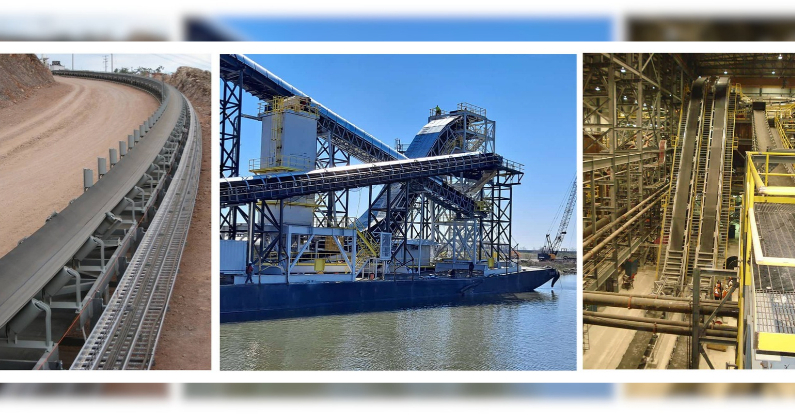
An example of a high-angle conveyor used in mining applications
- Open-pit mines: lifting ore from deep pits directly to surface processing
- Underground mining: hauling muck through steep incline drifts
- Cement plants: moving clinker and limestone up silos and preheater towers
- Hydropower and dam construction: transferring aggregate up steep valley walls
- Tunnelling projects: clearing spoil through vertical shafts
- Ports and stockyards: feeding stackers and reclaimers at height
A high-angle system also cuts spillage, eliminates multiple transfer points, and reduces the exposed dust corridor, all reasons environmental permitting authorities increasingly favour them over trucking or open haulage. On sites where an aerial ropeway conveyor is a better fit, particularly for very long spans over difficult terrain, capacities of up to 25,000 t/h with tower spacing up to 2,500 m are achievable.
How Do You Choose the Right Incline Conveyor for Your Project?
Choosing the right incline conveyor comes down to matching five parameters against the site reality in order. What are they? Angle, material, capacity, footprint, and life-cycle cost. Within two years, the system either underperforms or exceeds its budget if you make any one of these mistakes.
The system of selection:
- Angle required: Measure the vertical rise and horizontal run available. If the angle exceeds 20°, a smooth flat belt is already off the table.
- Material profile: Note lump size, moisture, abrasiveness, and angle of repose. Sticky or oversized lumps rule out cleated belts.
- Capacity target: Below 500 t/h, sidewall belts are viable. Above that, sandwich belt or aerial ropeway conveyor designs make more sense.
- Footprint constraint: A 60° high-angle system requires nearly twice as much ground length as a 30° conveyor running 100 metres.
- Total life-cycle cost: Examine factors other than capital expenditures, such as drive power, maintenance access, and belt replacement frequency.
Skipping this framework is the reason so many inclined systems get replaced within five years of commissioning, because the initial angle was pushed too close to the theoretical limit.
Conclusion
Incline conveyor belts are a foundational piece of bulk material handling, but their limits are strict, around 20° for standard flat belts and 45° for cleated systems. Beyond that, only sidewall belts, sandwich belts, and aerial ropeway conveyors can move material reliably.
M&M Ropeways designs, manufactures, and installs the full range of these systems. This includes the Sandwich Belt High Angle Conveyor built in cooperation with Dos Santos International, USA, engineered for the steepest. Moreover, there are the highest-tonnage material handling challenges in mining, cement, hydropower, and tunnelling projects.
So, planning an incline or high-angle conveyor project? Talk to the M&M Ropeways engineering team for a system sized to your site angle, tonnage, and material profile.
by ropeway-admin | Aug 13, 2026 | Ropeways, Uncategorized
India’s ropeway industry is heating up. Hill states have projects in the pipeline. Religious towns want them. Tourism boards are lining up bids. The Union Budget 2022-23 launched the Parvatmala Pariyojana. Under it, the government plans over 250 ropeway projects across 1,200 km in five years, as per the Press Information Bureau. A ropeway is more than steel and cable. It is soil tests, wildlife surveys, tower alignment studies, and thick files of paperwork. Design happens in offices. Approvals happen in ministries. Projects can sit for months. Sometimes years. Not because the engineering fails. Because one file is missing or wrong.
This guide breaks down the 6 Documents You Need Before Applying for Ropeway Project Approval. Each one has a job. Each one carries weight. Get these six ready, and your ropeway project in India moves fast. Miss even one, and it sits.
Why Paperwork Matters More Than the Cable
You can build a ropeway faster than you can approve one. That is where most developers get stuck. Take Nandi Hills in Karnataka. According to The Hans India, the project has faced years of delays while awaiting forest and wildlife clearances from the Centre. The Palampur ropeway in Himachal, according to The Tribune, has been pending for years despite Central approval.
The pattern is clear. Every delay eats capital. Interest keeps ticking. Contractors keep waiting. Costs go up every month. Regulators do not run on trust. They run on files. Every stage of the ropeway approval process demands hard proof. Skip a step, and the file returns. To plan smarter from day one, read our guide on key factors every planner must know. That is why solid ropeway construction starts with solid paperwork. Not the other way around.
The 6 Documents That Decide Your Project’s Fate
Not every paper matters equally. Some decide the fate of your file. Six documents sit at the top of that list. These are the ones ropeway project approval authorities check first. They cover technical, environmental, legal, and safety ground. Miss one, and the rest do not save you. Let us break each one down.
1. Detailed Project Report (DPR)
The Detailed Project Report is the backbone of every aerial ropeway project. Consultants prepare it. Regulators judge you by it. It carries the full story of your project, the route, the engineering design, the money, and the risk. Without a DPR, no file moves forward.
A strong DPR must cover the following:
- Route alignment and terrain survey.
- Traffic demand and passenger load.
- Engineering design and technical drawings.
- Cost estimates and financial model.
- Construction schedule with milestones.
- Risks and how you plan to handle them.
NHLML mandates a DPR before any Parvatmala bid. It is the first serious ropeway project document on the table. As per the Press Information Bureau, the Sonprayag-Kedarnath and Govindghat-Hemkund projects were among the first approved under Parvatmala. Yours must match that standard. Skip a section, and the file gets returned.
2. Feasibility Study Report
Feasibility comes before the DPR. It answers one question. Should this project even exist? A ropeway feasibility study looks at the land, the demand, and the numbers. If any one of these fails, the project stops here. The report must include:
- Topographical and geotechnical surveys.
- Wind, snow, and seismic load data.
- Passenger or material load forecast.
- Ridership and revenue projections.
- Preliminary alignment options.
- Environmental sensitivity mapping.
A weak feasibility leads to a weak DPR. A weak DPR leads to rejection. Every cable car project approval starts here. To understand which routes make economic sense, read our post on ropeway vs road cost comparison. Get this stage right, and the rest of the ropeway approval process becomes easier.
3. Environmental Impact Assessment (EIA)
An environmental impact assessment is required for most large ropeway projects in India. It falls under the EIA Notification, 2006. You file it through the PARIVESH portal. Your EIA must document:
- Baseline air, water, and soil data.
- Flora and fauna survey.
- Noise and vibration impact.
- Waste management plan.
- Compensatory mitigation measures.
- Public consultation records.
A public hearing usually follows. Regulators look for honest data. Clever wording does not help. Ropeways carry a lower ground footprint than roads in hill terrain. Even so, the EIA process cannot be skipped. If your data is weak, the file comes back with tough questions.
4. Forest Clearance Certificate
If your route touches forest land, this document is non-negotiable. The Forest (Conservation) Act, 1980, applies. Any aerial ropeway project through a forest area needs central government approval first.
Forest clearance moves in two stages:
- Stage I – in-principle approval
- Stage II – final diversion approval
Attach these with your application:
- Forest land diversion proposal.
- Compensatory afforestation plan.
- Wildlife mitigation report.
- NOC from Gram Sabha (where applicable).
- Biodiversity impact statement.
Even terminal stations and tower footprints need diversion approval. As per Swarajya (October 2025), the Shimla ropeway project secured Stage-I clearance for 6.19 hectares of forest land. This stage is often the slowest. For ropeway construction through difficult hilly terrain, delays get worse. Plan the file early, not late.
5. Land Acquisition and Ownership Documents
You cannot install a tower on someone else’s land. Regulators want clean title from day one. Any gap in ownership records can hold up the entire ropeway project approval file. This step sounds basic. Developers still miss it. Keep these documents ready:
- Land ownership records or lease deeds
- NOC from private landowners
- Revenue department certificates
- Panchayat or municipal permissions
- Right-of-way documents
- Site plan with survey numbers
For PPP tourism projects under Parvatmala, the government usually provides land through the concession agreement. Even then, the developer still files the full ownership trail. Land acquisition for ropeway projects gets messier in hill regions where records are often old or unclear. Sort this out early. It saves months later.
6. Statutory NOCs and Safety Clearances
This is a bundle, not a single paper. Every ropeway project approval file must carry a full stack of NOCs. Miss one, and commissioning gets frozen at the last mile. Regulators check these before green-lighting operations. Collect all of these:
- Height clearance from AAI.
- Defence clearance for border or sensitive zones.
- Consent from the State Pollution Control Board.
- Wildlife Board NOC (near sanctuaries).
- Structural safety certificate from a licensed engineer.
- Fire safety and electrical safety approvals.
- Local municipal building permits.
The Shillong Peak Ropeway is one example. As per North East News, it secured NOCs from AAI, the Air Force, and the Army before work started. That is the model to follow. Safety on the ground matters as much as safety on paper. For execution-stage protocols, read our guide on essential safety measures during ropeway installation. One missing NOC can freeze the entire ropeway approval process.
These six documents form the core of every ropeway project approval file in India. Miss the details, and delays start piling up. Get them right, and your project moves.
How M & M Ropeways Supports Your Project
M & M Ropeways is a leading ropeway manufacturer in India. The company designs, manufactures, and installs aerial ropeways and cable cranes. Single loads range from 100 kg up to 10,000 kg. Some spans reach 6,400 meters on a single drive. For the Indian Army, we installed ropeways at 18,000 feet on the Siachen Glacier. Those systems ran below minus 35 degrees Celsius. Our clients include the Indian Army, hydropower firms, state PWDs, cement majors, and tourism boards. We deliver aerial ropeway projects for hydropower construction, mining, dams, tunneling, tourism, and rural connectivity in the mountains. Where most projects trip up is paperwork. Our team supports clients through the design, manufacturing, and installation stages of every project. Planning a ropeway project in India? Contact M & M Ropeways for design, manufacturing, and delivery support.
Key Takeaways
India’s ropeway push is just picking up speed. More projects will come. More states will join. But the process stays the same. Every file goes through the same checkpoint: the 6 Documents You Need Before Applying for Ropeway Project Approval. Skip one, and the file stops.
Start early. Build the DPR carefully. Finish the feasibility with real data. File the EIA with honest inputs. Chase the forest clearance from day one. Keep land papers clean. Collect every NOC before you need it. Projects that respect paperwork move fast. The rest wait.
M & M Ropeways has built ropeways in India, Nepal, Bhutan, and Africa. Planning one? Our team can support you with design, manufacturing, and installation.
Common Questions, Clear Answers
Question 1. Who gives approval for a ropeway project in India?
Multiple authorities are involved. Here is the breakdown:
- MoRTH governs the Parvatmala Pariyojana. NHLML runs the execution.
- MoEFCC grants environmental clearance. Filing is done through the PARIVESH portal.
- MoEFCC also grants forest clearance under the Forest (Conservation) Act, 1980.
- AAI issues height clearance where applicable.
- Defence forces provide clearance near the border or sensitive zones.
- State pollution control boards issue consent to establish and operate.
- Local bodies and Gram Sabhas issue site-level NOCs.
The project owner is often a state tourism board, an urban development authority, or a central PSU.
Question 2. How long does it take to get ropeway project approval in India?
There is no fixed timeline. It shifts with location, land type, and forest coverage. There is no fixed number. As per Deccan Herald, the Sonprayag-Kedarnath and Govindghat-Hemkund projects are expected to take 4-6 years to complete after approval. Both fall under Parvatmala. Approvals alone can stretch across months or years. Forest and wildlife clearances are usually the slowest stage. The Palampur ropeway in Himachal is one clear example. As reported by The Tribune, the project has been pending for years despite central approval.
by ropeway-admin | Aug 10, 2026 | Cable cranes
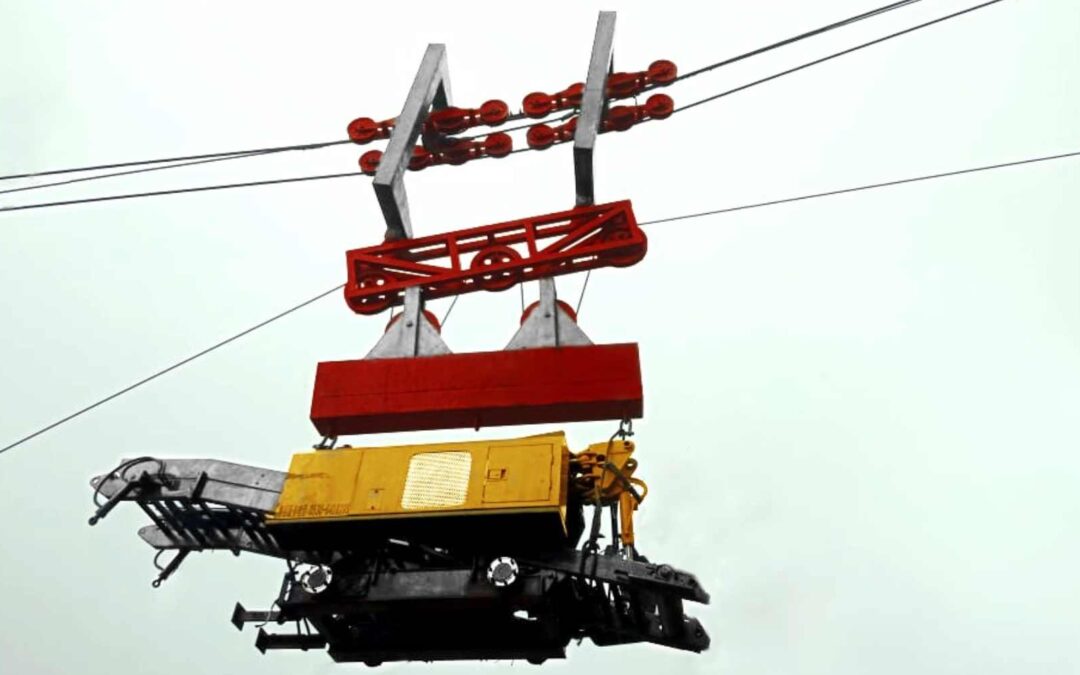
Every mining site hits the same problem sooner or later. The ore sits on one side. The processing plant sits on the other side. In between is land that no truck, no conveyor, and no normal crane can safely cross. It’s not a small inconvenience either. Transportation can account for 40 to 60% of total operating costs at an open-pit mining site, making it one of the biggest line items in the entire operation. That’s when mining teams start asking whether a cable crane in India is the right fit for their site.
It’s not always an easy call. A cable crane for mining can solve a terrain problem that nothing else can, but it also means fixed infrastructure and one decision that shapes how your site runs for decades. This guide goes through when mining cable cranes do make sense, what factors tend to shape their cost, and what you should double-check before you actually commit.
Let’s break this down, starting with where a cable crane actually earns its place on a mining site.
When a Cable Crane Actually Makes Sense for Mining
Not every mine needs a cable crane. But for the right site, it solves a problem nothing else can.
- Moving Overburden on Steep Ground
When waste rock that is sitting above your ore has to travel across a valley or move down a grade that’s too steep for trucks, a cable crane is not only the best choice, it can be the only real one. This kind of situation is one of the main reasons mining ropeway systems are used in hilly areas across India.
For a closer look at how these systems integrate with existing site infrastructure, see our guide on Integrating Aerial Ropeways and Conveyors for Mining Operations.
- Moving Ore From Pit to Plant, Non-Stop
A lot of open pit and quarry locations have the extraction point on one side of a river, gorge, or ridge, and the processing plant sits on the opposite side. In other words, a cable crane goes on a steady cycle, moving a fixed tonnage of ore transport along the distance without really depending on road conditions, weather, or the traffic in between the two points.
- When Building a Road Costs More Than the Mine Can Justify
Roads through hilly or forest terrain in India can cost ₹15–25 crore per kilometer once you include cutting, grading, drainage, and yearly monsoon repairs. For a mid-size mine, that number can match or beat a full cable crane installation, and unlike a cable crane, the road still needs rebuilding every year after monsoon damage.
When a Cable Crane Is the Wrong Choice
A cable crane isn’t the right call for every site. If your mine already has good road access, its fixed cost may not pay off fast enough to justify the switch. The same applies if you only move small, occasional loads rather than steady volume. Cable cranes earn their keep on distance and hard terrain, not on convenience alone.
What Shapes Cable Crane Costs
Once you know a cable crane fits your site, cost becomes a design question rather than a guessing game. A handful of factors decide what that build costs actually, and they rarely work in isolation.
If you’re also weighing a cable crane against a ground-based option, see Cable Cranes vs. Traditional Cranes: Are You Using the Right One? For now, check out the table below.
| Cost Factor |
What It Involves |
Impact on Cost |
| Load Capacity |
Weight moved per trip, from a few tons up to 30-50 tons |
Higher, steadier loads raise cost |
| Span Distance |
Distance the crane covers, often over 1 km, sometimes past 1,600m |
Longer spans need more steel and foundation work |
| Terrain Complexity |
Single slope vs. multiple ridges or gorges |
Complex terrain needs custom engineering |
| Site Access |
How easily equipment and materials reach the site during construction |
Harder access raises installation cost |
The Cost of Waiting on a Cable Crane Decision
A decision left unmade doesn’t pause the cost. It just lets it keep running in the background. Truck transport costs can eat up a large share of a mining site’s operating budget through fuel alone, and that spend continues every single day a cable crane isn’t in place to replace it. Every monsoon season, a site continues to rely on haul roads instead of an all-weather system. It risks the same washouts, delays, and repair bills it faced the year before. Coal India’s coal production dropped 1.7% in FY26, partly due to a long, intense monsoon season disrupting mining, even though it still supplies over 80% of India’s domestic coal.
Sites that commit to a decision early often complete cable crane installation before the next monsoon or extraction cycle begins, avoiding an entire additional year of the same transport losses. Delaying the decision doesn’t reduce the expense; it simply pushes the same ongoing cost further down the calendar while the underlying terrain problem stays exactly as it was.
What Indian Mining Sites Should Check Before Deciding
A few practical questions separate a smart cable crane investment from a costly mistake.
- Ore and overburden volume: how much material moves, and how steady is that volume month to month? Cable cranes work best against predictable loads
- Monsoon disruption: Do haul roads wash out or turn unsafe for weeks every year, and what does that downtime actually cost in lost production?
- Environmental clearance timeline: cable cranes disturb far less land than roads, which can speed up approval for projects working under a tight deadline
- Project length: cable cranes are built to last decades; a mining lease running 15-20+ years changes how the investment spreads out over time
- A real site survey: terrain mapping, load numbers, and span length- needs to come from an actual study of the site, not an assumption based on a similar-looking mine elsewhere.
Why Prefer M & M Ropeways for Mining Cable Cranes
M & M Ropeways, a leading cable crane manufacturer in India, has been at it for over 35 years, designing, building, and installing cable cranes and aerial ropeways across India’s toughest terrain, with more than 120 finished projects across mining, hydropower, and construction.
Cable cranes are built in-house, and they are designed based on OITAF guidelines, certified under ISO 9001:2015, ISO 9000:2015, and ISO 14001:2015. That kind of experience turns into systems engineered around what happens in real Indian mining settings, steep hill terrain, heavy monsoons, and workplaces where a normal road just isn’t realistic. Every project starts with a genuine look at a site’s terrain, load needs, and timeline, so the system delivered matches what the mine actually needs.
Summary
A cable crane for mining earns its place on sites where terrain, not budget, is the real obstacle: steep overburden removal, pit-to-plant ore transport across gorges, or roads that cost more to maintain than they’re worth. Cost still matters, and it comes down to load capacity, span distance, terrain, and site access, but it’s a design question to work through once fit is confirmed, not the first thing to weigh.
If your mining site is weighing this decision, reach out to M & M Ropeways for a technical evaluation based on your own terrain and tonnage. CONTACT M & M Ropeways to schedule a consultation.
Frequently Asked Questions
When does a mine actually need a cable crane instead of trucks?
When terrain rules out road access entirely, or when road construction and yearly monsoon repair would cost more than the mine can justify. Steep overburden removal and pit-to-plant ore transport across gorges or rivers are the most common cases.
Does the cable crane cost in India change by region?
Yes. Terrain matters more than location alone. A cable crane built for the steep, wet terrain of Himachal Pradesh or the Northeast usually needs different tower engineering than one built for flatter ground, even at a similar span and load.
Is a cable crane more expensive than building a road?
Often, no, once the full picture is considered. Roads through hilly mining land can cost several crore per kilometer and need yearly monsoon repair. A cable crane costs more upfront per meter but needs far less ongoing upkeep.
How long does it take to install a mining cable crane?
Most projects move from planning to full operation in 12-18 months, depending on the overall span, the terrain, and where the environmental clearances sit.
Can an existing mine add a cable crane to its current setup?
Yes, in most cases like that. Cable cranes often run alongside trucks or conveyors that are already in service, covering the specific land segment where ground transport doesn’t really make sense.
by ropeway-admin | Jul 30, 2026 | Ropeways, Uncategorized
How many ropeway projects has India identified under Parvatmala? The pipeline covers over 200 locations across hilly states and urban corridors. As of early 2026, a growing number have cleared feasibility studies, entered bidding, or reached the award stage. A ₹1.25 lakh crore investment pipeline backs this push. Yet many contractors still struggle to navigate the process. The steps stay buried under jargon. DPR, DBFOT, HAM, and EMD each represent a distinct stage, and missing any one of them can cost a bidder the entire project.
This guide walks through the practical side of how to apply for ropeway project funding under India’s Parvatmala, NHLML, and state government schemes in 2026. It breaks the Parvatmala ropeway project application 2026 cycle into clear steps, covers the NHLML ropeway project funding India routes, the indigenous content rule, and what a bidder needs to be ready for before submitting anything.
What Is the National Ropeways Development Programme?
The National Ropeways Development Programme India carries a second name. People mostly know it as Parvatmala Pariyojana, launched under the Union Budget 2022-23, with one clear aim. Build ropeway infrastructure where roads struggle.
The scale here is large. The programme targets over 250 ropeway projects. Together, they cover close to 1,200 km, backed by an investment pipeline of nearly ₹1.25 lakh crore. This is spread across a five-year horizon. The Centre backs around 60% of project costs through the PPP route. The rest, along with execution risk, sits with private developers.
Quite a few states have already signed on. Uttarakhand, Himachal Pradesh, Jammu & Kashmir, Uttar Pradesh, and Assam are among those running active routes under the Parvatmala Pariyojana ropeway state list projects. Each state has identified specific routes for development.
The National Highways Logistics Management Limited, or NHLML, executes this programme on the ground, operating as a subsidiary fully owned by the National Highways Authority of India. Some search results surface a different body here. They confuse NHLML with NHIDCL, a separate corporation that handles highways near international borders. NHLML, not NHIDCL, owns ropeway tenders, feasibility studies, and DPR contracts.
The PPP Models: DBFOT and HAM Explained
Parvatmala projects run on two main structures, both falling under the broader ropeway PPP model, the DBFOT HAM India government framework.
- DBFOT (Design, Build, Finance, Operate, Transfer): The concessionaire takes on the full load here, designing and building the ropeway while arranging its own financing. It then runs the system for a fixed period, earning revenue from user fares. The Sonprayag-Kedarnath project is a live example. Adani Enterprises secured it at ₹4,081.28 crore, with a 29-year concession running after construction wraps up.
- HAM (Hybrid Annuity Mode): This one works differently. The authority pays the developer in annuity instalments, stretched out across the operations period. This cuts the revenue risk that pure DBFOT carries. The Prayagraj ropeway used this model. It cost roughly ₹251 crore.
The choice between these two structures depends on footfall. High-traffic pilgrim routes lean DBFOT. Routes with uncertain demand often shift to HAM, where annuity payments smooth out the risk.
From Tender to Contract: The Ropeway Bidding Process
Knowing how to bid for the ropeway project in India 2026 starts with the right order of steps.
Step 1: Track the pipeline: Watch NHLML and state project lists closely. So far, thirteen states have signed MoUs, with UP, Himachal, Uttarakhand, J&K, and Assam among them.
Step 2: Monitor the DPR stage: NHLML floats a tender for the ropeway project’s DPR (detailed project report), India. It covers feasibility, alignment, and cost estimation. Recent DPR tenders carried bid security of nearly ₹5 lakh.
Step 3: Register on e-procurement portals: The NHLML ropeway tender process contractor route runs through the central e-tender system. State projects may need GeM registration too. Set accounts up early.
Step 4: Meet pre-qualification criteria: Authorities assess technical capacity, net financial worth, and bid security. Net worth bars often sit near 30% of the project cost. Firms lacking direct experience often partner with an established ropeway manufacturer in India.
Step 5: Submit the bid: Most tenders use a two-cover system. Cover one holds technical documents and EMD proof. Cover two holds the financial offer.
Step 6: Sign the agreement: Selected bidders sign a concession agreement or EPC contract. Performance security replaces the EMD. Construction typically runs four to six years.
Each step builds on the last. Skip one, and the whole bid risks rejection.
The Make in India Rule: 50% Indigenous Components
Parvatmala aligns with the Make in India ropeway 50 percent indigenous component mandate directly. The programme requires that at least half of the components in any ropeway be manufactured in India.
This shapes procurement planning in a real way. Bidders relying on overseas gondolas or drive systems need a fix. A domestic manufacturing or assembly partner helps here. Industry estimates show why this matters. Foreign OEM costs can run 60-65% of the total project cost. Local sourcing, then, becomes a real cost advantage, not just a compliance checkbox.
Firms designing and building aerial ropeways and cable cranes in-house clear this bar without scrambling for a last-minute supplier. That edge matters more as competition for Parvatmala contracts grows.
Outside Parvatmala: How State Governments Fund Their Own Ropeway Projects
Parvatmala is not the only path for state government ropeway grant hilly areas in India. Several states run their own programmes too, often working alongside the central pipeline rather than replacing it.
Three states show how this works in practice.
#1. Himachal Pradesh:
Routes projects through the Ropeways and Rapid Transport System Development Corporation (RTDC). The Shimla-Parwanoo ropeway moved through this body. So did the Shimla Urban Ropeway.
#2. Uttarakhand:
Signed its own MoU (Memorandum of Understanding) through the Uttarakhand Tourism Development Board (UTDB). Seven priority locations were identified this way, beyond the Kedarnath and Hemkund Sahib projects already underway.
#3. Sikkim:
Follows a different funding line altogether. Its ropeway projects draw on PM-DevINE (Prime Minister’s Development Initiative for North East Region), a scheme that runs separately from Parvatmala’s main budget. Routes like Pelling to Sanga-Choeling fall under this scheme.
Practical Tip: For any state-level search, check two places at once.
- The central NHLML (National Highways Logistics Management Limited) pipeline first.
- Then, the specific state tourism department or PWD (Public Works Department).
A good number of these projects end up funded from both sides at once, central and state money working together.
What Makes a Bid Genuinely Competitive: Beyond the Lowest Price
Cost alone rarely wins these tenders. Evaluation committees weigh technical strength, too.
Terrain experience matters more than general infrastructure work. Ropeway engineering is a narrow skill, covering tower design, rope dynamics, and high-altitude wind loading. OITAF (International Organization for Transportation by Rope) compliant engineering signals real credibility here.
In-house manufacturing helps in two ways. It cuts costs. And it eases the indigenous content burden. M & M Ropeways brings exactly this kind of strength. The company has over three decades of field experience. It designs, manufactures, and installs aerial ropeways and cable cranes across tough terrain, spanning Siachen Glacier installations to major hydropower sites. Developers entering the Parvatmala pipeline often need a partner like this, one that already meets BIS (Bureau of Indian Standards) and OITAF standards. Building that expertise from scratch, under tender deadlines, rarely works.
Preparing a bid? Structuring a joint venture? Evaluating a ropeway manufacturer in India for a technical partnership? Reach out to M & M Ropeways. Field-proven engineering, applied right, is often what separates a winning bid from a rejected one.
Quick Answers to Common Funding Questions
Question 1. Who is eligible to bid for a Parvatmala ropeway project?
Answer. Any company or consortium meeting the technical and financial qualification bar can bid. This usually means past cable-transit experience. Or comparable infrastructure work. It also means a minimum net worth and the ability to furnish bid security (EMD). Companies lacking direct ropeway experience often team up with an established manufacturer or technical partner to qualify.
Question 2. Is funding available for ropeway projects outside Parvatmala?
Answer. Yes. States run their own routes, too. Take Himachal Pradesh. It works through its Ropeways and Rapid Transport System Development Corporation (RTDC). Sikkim takes a different route, drawing on PM-DevINE (Prime Minister’s Development Initiative for North East Region). Plenty of projects get backed from both sides at once, with central and state funds working together.
Question 3. How long does it take to get a ropeway project approved and built?
Answer. The DPR (Detailed Project Report) and feasibility stage alone can run several months to over a year. Once a concession is awarded, construction begins. Major Parvatmala projects typically take four to six years. This depends on terrain, altitude, and technology used.
Question 4. Does a contractor need to manufacture ropeway components in India?
Answer. Yes, at least in part. The Make in India mandate requires a minimum 50% indigenous component share. Bidders without domestic manufacturing capacity usually need a partner. An Indian manufacturer helps meet this requirement and keeps the bid cost-competitive.
by ropeway-admin | Jul 27, 2026 | Ropeways
Signing a ropeway annual maintenance contract determines three things: what gets maintained, how fast someone shows up when it fails, and who pays for what falls outside the scope. Get any one of these wrong. See how the contract works against you. AMC should never feel like a formality, but most operators think this alike. But it’s not. Because it’s a technical and legal commitment that governs passenger safety, regulatory compliance, and operational uptime for the entire contract term.
This guide from M&M Ropeways breaks down every single clause, commitment, and RED FLAG that should be considered before an operator puts pen to an aerial ropeway AMC service agreement.
What Does a Ropeway AMC Truly Cover & What Does It Not?
A comprehensive ropeway maintenance contract covers scheduled preventive maintenance, emergency breakdown response, system inspections, and parts replacement within agreed parameters. What it does not always cover is the part that causes operators the most financial pain.
Cable car maintenance contracts typically operate on a two-tier coverage model. Routine preventive services form the base package, while structural inspections, rope replacements, and electrical overhauls are treated as billable extras unless explicitly stated otherwise. Operators who do not verify this distinction before signing carry financial exposure they may not anticipate.
Typical inclusions in a ropeway AMC:
- Scheduled preventive maintenance visits (monthly, quarterly, annual)
- Lubrication of rope, sheaves, and grip assemblies
- Inspection of haul ropes, track ropes, and tensioning systems
- Brake system testing and adjustment
- Drive unit and gearbox checks
- Control panel and safety circuit diagnostics
- Cabin (gondola) structural and suspension point inspection
Common exclusions operators miss:
- Full rope replacement (often treated as a capital expense, not AMC)
- Structural tower repairs caused by seismic events or severe weather
- Third-party electrical faults upstream of the drive system
- Upgrades, software changes, or SCADA system modifications
- Costs arising from operator misuse or overloading beyond rated
So, it would be better to ask the AMC provider to produce a line-by-line scope document before signing it. Any item not explicitly listed as included should be treated as excluded.
What is a Realistic Ropeway Preventive Maintenance Schedule?
The ropeway preventive maintenance schedule defines how often inspections occur and what each visit must accomplish. Frequency is not arbitrary here. It should be derived from OITAF guidelines, manufacturer specifications, and the operational load profile of the system.
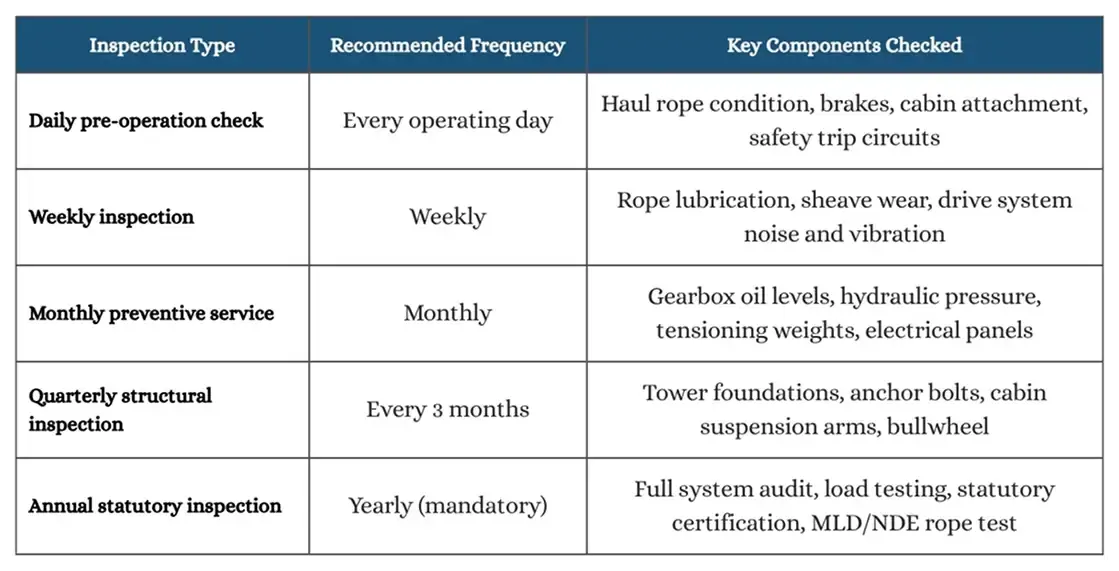
If your AMC says “periodic maintenance” and nothing more, you have no contractual basis to question how often the provider visits. That ambiguity always favors the service company. Push for explicit visit schedules in the agreement itself, and ensure that all service logs remain your documentation, not theirs.
OEM vs. Third-Party Ropeway AMC: Which One Should You Choose?
The decision between an OEM maintenance contract and a third-party service agreement is one of the most consequential choices an operator makes. For ropeway systems, the answer is less straightforward than it is for standard industrial equipment.
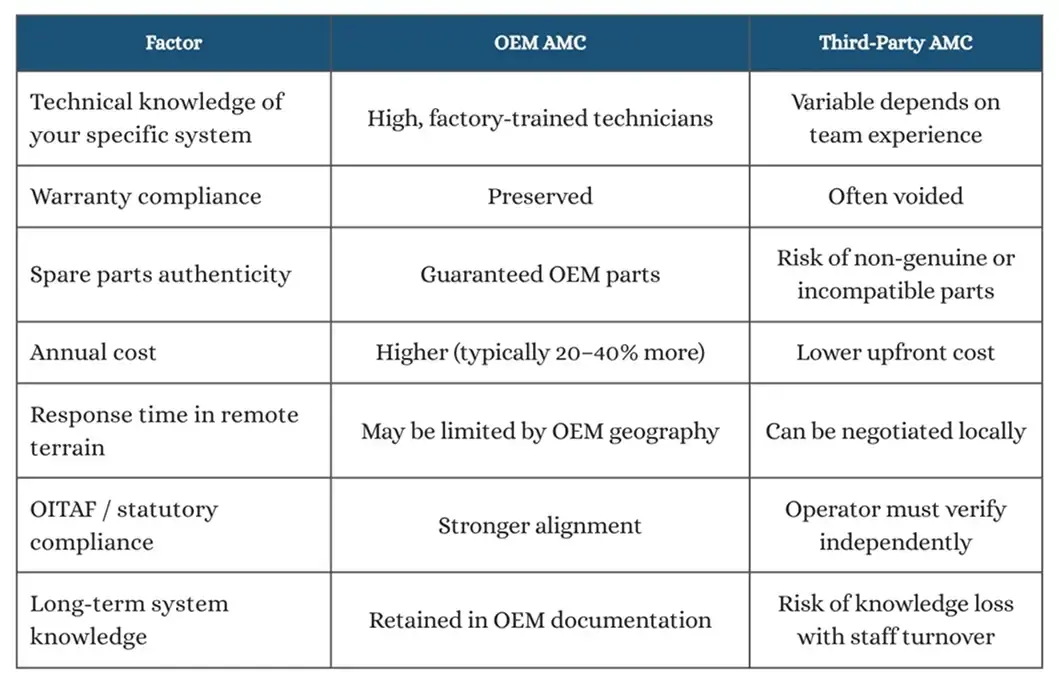
Before choosing between OEM and third-party maintenance, ask one question your comparison guide probably skipped: how long does it actually take their technician to reach your site? An OEM-based overseas or in a distant Indian city may carry every technical credential and still leave your system grounded for three days. A qualified regional provider with a realistic 6-hour SLA is worth more in practice, even if it costs more per visit.
What Should the Cable Car Downtime Response Time SLA Specify?
The Service Level Agreement (SLA) defines what the service provider must do when the system fails and how fast. Most operators skim it. Most operators regret that. Before signing any ropeway AMC, the SLA deserves more attention than any other clause in the document. A robust downtime response SLA must specify three distinct timelines:
- Acknowledgement time: How long before the provider confirms receipt of the fault report (should be under 2 hours for passenger systems)
- Technician on-site time: How long before a qualified engineer physically arrives at the installation (4–24 hours depending on location)
- System restoration time: Maximum time within which the system must be restored to operational status, or escalation triggered
If the provider misses the response window and your contract carries no penalty clause, you have no leverage and no remedy. An AMC that defines timelines without consequences is written in the provider’s favor, not yours. Liquidated damages or credit provisions must be part of the signed document before any work begins.
How Should a Ropeway Spare Parts Supply Agreement Be Structured?
Spare parts availability is the single biggest operational risk in ropeway maintenance and the most overlooked clause in most AMC agreements. The problem operators underestimate is not the cost of parts. It is how long they take to arrive.
Gearboxes, haul rope splicing materials, hydraulic control modules, bullwheel bearings, and drive motor components. Each of these carries an import lead time of 8 to 20 weeks when sourced from European OEMs. For any system that is grounded and waiting on one of these parts, that timeline is commercially catastrophic.
A well-structured ropeway spare parts supply agreement must address the following:
- Minimum on-site inventory: Which consumable and critical parts must be physically present at the installation site at all times. Rope clamps, sheave liners, and grip components are the starting point, not the complete list.
- Parts classification: Tier 1 covers consumables replaced at every service visit. Tier 2 covers wear parts on 12- to 24-month replacement cycles. Tier 3 covers critical capital components with multi-year lifecycles that must be sourced and cleared well in advance.
- Parts sourcing clarity: Whether parts supplied are OEM-genuine or equivalent-specification alternatives, and which party has approval authority when a substitution is proposed.
- Emergency supply protocol: Named contacts, defined escalation paths, and maximum lead time commitments for parts dispatch when the system is grounded.
- Parts ownership: Whether buffer stock held on-site belongs to the operator or the service provider and how costs are calculated and settled when parts are consumed.
Extended ropeway downtime in India is rarely caused by a lack of qualified technicians. In most cases, the technician arrives, identifies the fault, and then waits. The missing variable is almost always a critical spare part that was never stocked on site. Operators who treat spare parts protocols as seriously as SLA response times cut their mean time to restore significantly.
What Safety Compliance and Inspection Frequency Must the AMC Guarantee?
Inspection frequency and safety compliance are not AMC clauses to negotiate down. They are statutory requirements. Passenger ropeways in India operate under state-level regulations and OITAF guidelines where applicable. The AMC must reflect those obligations in full, not approximate them. The AMC must explicitly state:
- That all inspections will be conducted as per OITAF guidelines and applicable IS/BIS standards
- Who holds responsibility for obtaining statutory inspection clearances, whether the operator or the AMC provider
- Whether non-destructive evaluation (NDE) of ropes and structural steel is included in the annual inspection scope
- Documentation handover: all inspection reports, maintenance logs, and test certificates must remain in the operator’s custody
- That the service provider carries adequate professional liability insurance for maintenance activities
If a statutory inspection uncovers a defect that triggers a regulatory shutdown, the AMC must already define who bears the remediation cost and within what timeline. That clarity cannot be negotiated after the fact. Contracts that leave this ambiguous do not create disputes eventually. They guarantee them.
What Is the AMC Checklist Every Ropeway Operator Should Use?
Before signing any ropeway annual maintenance contract, run this checklist against the proposed agreement. Every item should have a clear, written answer in the contract document.
| Sr. No. |
Checklist Item |
What to Look For |
| 1 |
Scope of services |
Explicit list of included and excluded activities — no vague “general maintenance” language |
| 2 |
Preventive maintenance schedule |
Named frequencies (monthly, quarterly, annual) with visit checklists attached |
| 3 |
Response time SLA |
Acknowledgement, on-site arrival, and system restoration times – with penalty clauses |
| 4 |
Spare parts protocol |
On-site buffer inventory list, parts sourcing policy, emergency supply procedure |
| 5 |
OEM vs third-party clarity |
Parts authenticity declaration, warranty impact statement |
| 6 |
Statutory compliance responsibility |
Named party responsible for OITAF/IS compliance and statutory certificate renewal |
| 7 |
Documentation ownership |
All service reports, test records, and maintenance logs belong to the operator |
| 8 |
Personnel qualifications |
Minimum qualification and experience levels for lead technicians |
| 9 |
Liability and insurance |
Provider’s professional indemnity and third-party liability coverage |
| 10 |
Exit and renewal terms |
Notice period for termination, auto-renewal conditions, escalation caps |
Why the Manufacturer’s Role in After-Sales Matters More Than Operators Realize
The quality of a ropeway AMC is determined as much by who built the system as by who maintains it. Manufacturers with genuine after-sales infrastructure, trained service teams, accessible spare parts networks, and long-term support commitment create fundamentally lower maintenance risk from day one.
Before signing any AMC, verify that the manufacturer maintains in-house service capabilities, can supply parts for systems over a decade old, and has experience in terrain comparable to your installation.
M&M Ropeways, a leading ropeway manufacturing company, builds after-sales support into the delivery model. With over 100 systems installed across diverse and high-altitude terrain, the service infrastructure is built around where these systems actually operate.
Final Word: The AMC Is as Important as the System Itself
A ropeway is a long-life infrastructure investment, typically 20 to 30 years with proper maintenance. The AMC determines whether that lifespan is achieved or compromised. Operators who invest as much diligence in evaluating the maintenance contract as they do in evaluating the system specification will find that unplanned downtime, regulatory penalties, and premature component failure are manageable, not inevitable.
Read every clause. Negotiate every SLA. Confirm every spare parts protocol. The signature on a ropeway AMC carries weight that extends far beyond the contract term.
Need AMC guidance from people who built the system? Talk to the M&M Ropeways after-sales team. Contact us today.