by ropeway-admin | Sep 18, 2026 | Cable cranes
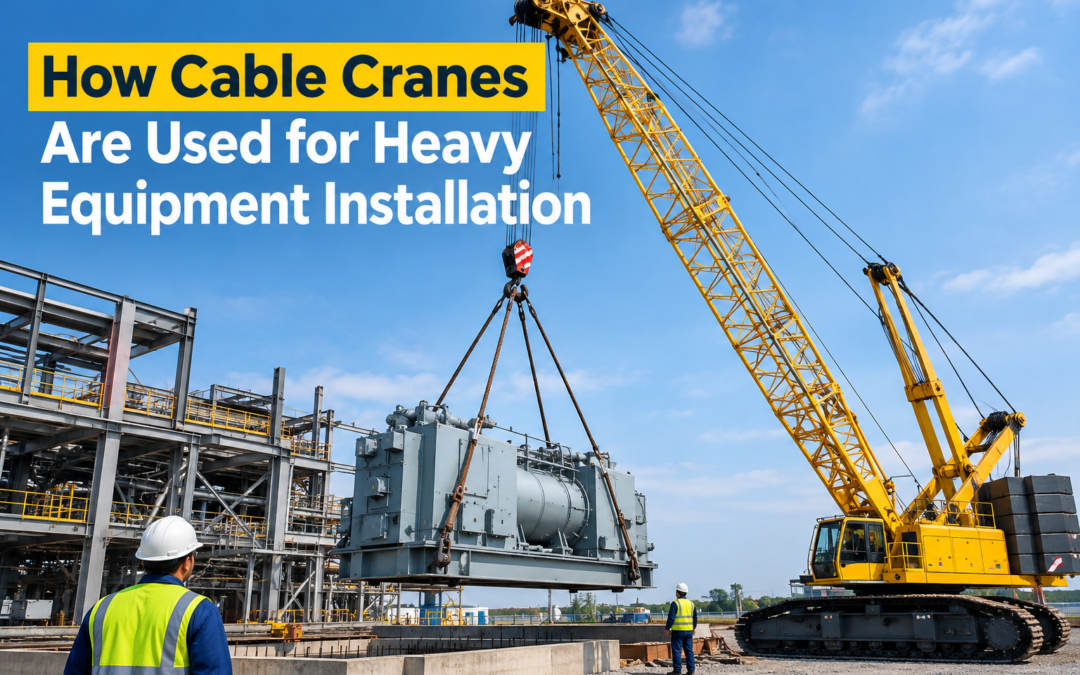
A cable crane installs heavy equipment by suspending it from a track rope stretched across a site and moving it into position using a separate hoisting rope. All without needing roads, ground, a crane pad underneath, or clearance of forest areas. This makes it the standard solution where mobile or crawler cranes simply cannot reach the installation point. This becomes especially clear on hydropower plants, dams, and tunnelling sites. Turbines, transformers, and penstock sections need to land in exact positions across valleys, gorges, or unstable slopes, and a cable crane is often the only equipment capable of making that happen.
This guide from M&M Ropeways walks through how cable cranes lift, position, and place heavy equipment on sites where conventional cranes cannot operate.
What Is a Cable Crane, and How Does It Install Equipment?
So, what is a cable crane actually? A cable crane is a ropeway system built to lift and place loads. It works through three ropes with distinct jobs. The track rope stays fixed between two towers or anchor points and acts as the overhead path. A crab, or carriage, runs along this track rope, pulled back and forth by a haul rope. A third rope, the hoisting rope, lifts and lowers the load independently of the crab’s horizontal movement. It’s this split between horizontal travel and vertical lift that gives a cable crane real control over placement, rather than just dragging the load across a fixed line. These systems are built to OITAF guidelines, the global standard body for rope transportation. OITAF is the one that sets the rules for load limits, rope tension, and structural safety across the industry.
How Does a Cable Crane Actually Lift and Position Heavy Equipment?
Installation with a cable crane follows a controlled sequence, not a single swinging lift. First, the equipment is rigged and connected to the hoisting rope at the loading point. The crane then drifts along the track rope to the precise coordinates above the install site. Once it’s in position overhead, the hoisting rope lowers the load at a controlled speed. While operators make fine adjustments to line it up with foundation bolts, mounting points, or existing structures.
This is where cable cranes offer a real advantage over conventional lifting equipment. A mobile or crawler crane lifts and places a load on a single boom and hook, which means the load can swing with wind, momentum, or ground vibration during the final approach. A cable crane separates horizontal and vertical motion into two independently controlled ropes. The crane locks the load’s position along the track before the hoisting rope even begins lowering it.
That two-stage control removes the swing risk that makes free-hook placement of delicate machinery, like a turbine runner or a transformer core, a genuinely tense moment on a conventional lift. For equipment where even a few centimetres of misalignment means rework, that difference in control matters more than raw lifting capacity.
What Types of Heavy Equipment Can Be Installed Using Cable Cranes?
Cable cranes are the ones that are made to handle a wide range of heavy machinery and structural components. Particularly on sites where equipment must travel across a valley, river, or gorge before installation.
Common examples include:
- Turbines and generator units for hydropower and pumped storage plants
- Transformers and switchgear assemblies
- Penstock pipe sections during erection
- Dam gates and hoisting mechanisms
- Prefabricated structural steel and girder sections
- Tunnelling equipment and support machinery
- Gantry and winch components for other installation systems
The common thread across all of these is weight combined with inaccessibility. If the equipment is heavy enough to need a crane and the site is remote enough to rule one out, a cable crane usually becomes the practical answer.
Cable Crane vs. Mobile/Crawler Crane: Which One Installs Equipment Better?
Neither system is universally better. The “right” pick depends a lot on the ground situation, the travel distance, and how precisely the equipment has to be positioned to land. Mobile and crawler cranes work well on graded, accessible ground with short lift radii. Cable cranes take over once terrain, distance, or ground conditions rule that option out.
| Factor |
Cable Crane |
Mobile / Crawler Crane |
| Site access needed |
None – works over valleys, rivers, and slopes without roads |
Requires graded ground and access roads |
| Effective span |
Up to several kilometres in a single line |
Limited to boom length and working radius, typically under 100 m |
| Load control during placement |
Independent horizontal and vertical control, minimal swing |
Single-point hook lift, more susceptible to swing |
| Weather resilience |
Operates in most conditions across long spans |
Boom lifts are more restricted by high wind at height. |
| Setup for remote sites |
Higher upfront setup, but built once for the full project duration |
Faster setup, but limited if terrain changes across the site |
| Best suited for |
Hydropower, dams, tunnelling, pipelines, and mountain sites |
Flat or accessible industrial and urban sites |
Why Are Cable Cranes Used for Equipment Installation in Hydropower and Dam Projects?
Hydropower and dam sites almost always sit in terrain that rules out conventional cranes altogether. Powerhouses are frequently built at the base of gorges or valleys, with penstocks running down steep slopes from an intake located far above. Getting a turbine, transformer, or penstock section to its exact final position often means crossing that same terrain that made road access impossible in the first place.
A cable crane set up along the project’s main axis solves this in one continuous installation rather than repeated short lifts. The system can lower a load-bearing structural section into a valley, position a transformer inside a powerhouse pit, or lower penstock segments along a slope for welding and alignment, all from one fixed track. This is also why cable cranes tend to stay in place through the full construction phase of a hydropower or PSP project, rather than being brought in for a single lift like a mobile crane would be.
How Much Weight Can a Cable Crane Lift During Installation?
Cable crane capacity really comes down to how the system is designed. But most modern setups handle loads anywhere from a few hundred kilograms to several tonnes on a single line. For heavier-duty projects built to specific requirements, that capacity goes well beyond even this. M&M Ropeways has designed, manufactured, and installed cable cranes with single-load capacities ranging from 100 kg all the way to 10,000 kg. By covering distances of up to 6,400 metres on a single drive.
That range matters because equipment installation projects rarely involve one uniform load. One hydropower project might require a cable crane for penstock parts weighing a few hundred kilos early on and later for a transformer unit or turbine component weighing several tonnes. A system engineered with headroom across that full range avoids the cost and delay of switching equipment mid-project.
Is Equipment Installation by Cable Crane Safe and Precise?
Yes, when the system is engineered to OITAF standards and operated by trained personnel, cable crane installation is both safe and precise enough for critical machinery like turbines and transformers. The independent control of horizontal and vertical movement, discussed earlier, is the core reason. Because the load’s position along the track is fixed before it descends, the final placement becomes a controlled vertical drop rather than a multi-axis swing.
This matters more for equipment installation than for bulk material transport. Moving concrete or aggregate tolerates some imprecision. Positioning a transformer onto its foundation bolts or aligning a penstock section for welding does not. ISO-certified manufacturing, combined with OITAF-compliant design, gives project engineers a documented safety and quality basis for using cable cranes on installations where the cost of a misaligned lift is measured in weeks of rework, not minutes.
How Do You Choose the Right Cable Crane Manufacturer for Equipment Installation?
Selecting a cable crane manufacturer for equipment installation should come down to five checks:
- Certification: Look for ISO 9001 and ISO 14001 compliance, plus design that meets OITAF standards
- Capacity range: A manufacturer who can actually engineer for both light and heavy loads within the same project
- Track record on difficult terrain: A proven history of installations in mountains, valleys, or other extreme conditions
- After-sales support: Not just installation, but real availability of spare parts and a fast maintenance response when something goes wrong
- Operator training: Whether the manufacturer trains your team to run and maintain the system independently
M&M Ropeways is a cable crane manufacturer in India that meets all five, with ISO 9001:2015, ISO 9000:2015, and ISO 14001:2015 certification, OITAF-compliant design, and installations ranging from standard construction sites to the Siachen Glacier at 18,000 feet, in temperatures below minus 35 degrees Celsius, for the Indian Army. That project record is a rare benchmark for what a cable crane system can be engineered to withstand.
The Final Verdict
Heavy equipment installation on difficult terrain is not a transport problem. It’s a positioning problem, plain and simple, and cable cranes exist specifically to solve it. If your project involves turbines, transformers, penstock sections, or structural components that need to reach a site no road can access, a cable crane manufacturer with proven engineering and OITAF-compliant systems can work out the right solution for your terrain and load requirements.
M&M Ropeways designs, manufactures, and installs cable crane systems for exactly this kind of project, across India and internationally.
by ropeway-admin | Aug 10, 2026 | Cable cranes
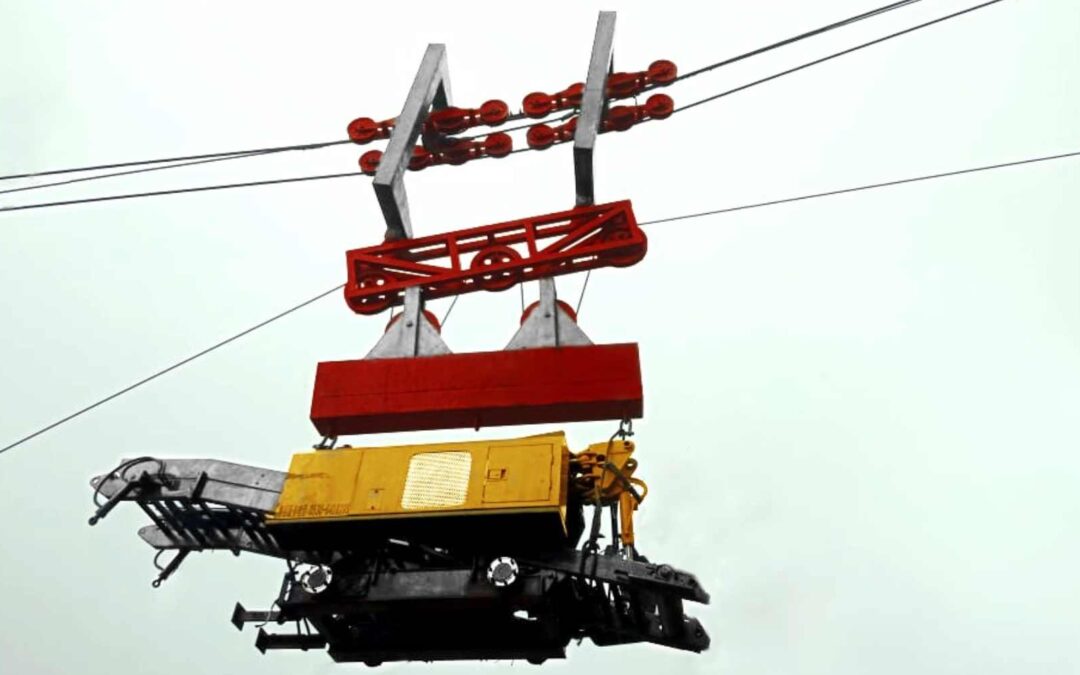
Every mining site hits the same problem sooner or later. The ore sits on one side. The processing plant sits on the other side. In between is land that no truck, no conveyor, and no normal crane can safely cross. It’s not a small inconvenience either. Transportation can account for 40 to 60% of total operating costs at an open-pit mining site, making it one of the biggest line items in the entire operation. That’s when mining teams start asking whether a cable crane in India is the right fit for their site.
It’s not always an easy call. A cable crane for mining can solve a terrain problem that nothing else can, but it also means fixed infrastructure and one decision that shapes how your site runs for decades. This guide goes through when mining cable cranes do make sense, what factors tend to shape their cost, and what you should double-check before you actually commit.
Let’s break this down, starting with where a cable crane actually earns its place on a mining site.
When a Cable Crane Actually Makes Sense for Mining
Not every mine needs a cable crane. But for the right site, it solves a problem nothing else can.
- Moving Overburden on Steep Ground
When waste rock that is sitting above your ore has to travel across a valley or move down a grade that’s too steep for trucks, a cable crane is not only the best choice, it can be the only real one. This kind of situation is one of the main reasons mining ropeway systems are used in hilly areas across India.
For a closer look at how these systems integrate with existing site infrastructure, see our guide on Integrating Aerial Ropeways and Conveyors for Mining Operations.
- Moving Ore From Pit to Plant, Non-Stop
A lot of open pit and quarry locations have the extraction point on one side of a river, gorge, or ridge, and the processing plant sits on the opposite side. In other words, a cable crane goes on a steady cycle, moving a fixed tonnage of ore transport along the distance without really depending on road conditions, weather, or the traffic in between the two points.
- When Building a Road Costs More Than the Mine Can Justify
Roads through hilly or forest terrain in India can cost ₹15–25 crore per kilometer once you include cutting, grading, drainage, and yearly monsoon repairs. For a mid-size mine, that number can match or beat a full cable crane installation, and unlike a cable crane, the road still needs rebuilding every year after monsoon damage.
When a Cable Crane Is the Wrong Choice
A cable crane isn’t the right call for every site. If your mine already has good road access, its fixed cost may not pay off fast enough to justify the switch. The same applies if you only move small, occasional loads rather than steady volume. Cable cranes earn their keep on distance and hard terrain, not on convenience alone.
What Shapes Cable Crane Costs
Once you know a cable crane fits your site, cost becomes a design question rather than a guessing game. A handful of factors decide what that build costs actually, and they rarely work in isolation.
If you’re also weighing a cable crane against a ground-based option, see Cable Cranes vs. Traditional Cranes: Are You Using the Right One? For now, check out the table below.
| Cost Factor |
What It Involves |
Impact on Cost |
| Load Capacity |
Weight moved per trip, from a few tons up to 30-50 tons |
Higher, steadier loads raise cost |
| Span Distance |
Distance the crane covers, often over 1 km, sometimes past 1,600m |
Longer spans need more steel and foundation work |
| Terrain Complexity |
Single slope vs. multiple ridges or gorges |
Complex terrain needs custom engineering |
| Site Access |
How easily equipment and materials reach the site during construction |
Harder access raises installation cost |
The Cost of Waiting on a Cable Crane Decision
A decision left unmade doesn’t pause the cost. It just lets it keep running in the background. Truck transport costs can eat up a large share of a mining site’s operating budget through fuel alone, and that spend continues every single day a cable crane isn’t in place to replace it. Every monsoon season, a site continues to rely on haul roads instead of an all-weather system. It risks the same washouts, delays, and repair bills it faced the year before. Coal India’s coal production dropped 1.7% in FY26, partly due to a long, intense monsoon season disrupting mining, even though it still supplies over 80% of India’s domestic coal.
Sites that commit to a decision early often complete cable crane installation before the next monsoon or extraction cycle begins, avoiding an entire additional year of the same transport losses. Delaying the decision doesn’t reduce the expense; it simply pushes the same ongoing cost further down the calendar while the underlying terrain problem stays exactly as it was.
What Indian Mining Sites Should Check Before Deciding
A few practical questions separate a smart cable crane investment from a costly mistake.
- Ore and overburden volume: how much material moves, and how steady is that volume month to month? Cable cranes work best against predictable loads
- Monsoon disruption: Do haul roads wash out or turn unsafe for weeks every year, and what does that downtime actually cost in lost production?
- Environmental clearance timeline: cable cranes disturb far less land than roads, which can speed up approval for projects working under a tight deadline
- Project length: cable cranes are built to last decades; a mining lease running 15-20+ years changes how the investment spreads out over time
- A real site survey: terrain mapping, load numbers, and span length- needs to come from an actual study of the site, not an assumption based on a similar-looking mine elsewhere.
Why Prefer M & M Ropeways for Mining Cable Cranes
M & M Ropeways, a leading cable crane manufacturer in India, has been at it for over 35 years, designing, building, and installing cable cranes and aerial ropeways across India’s toughest terrain, with more than 120 finished projects across mining, hydropower, and construction.
Cable cranes are built in-house, and they are designed based on OITAF guidelines, certified under ISO 9001:2015, ISO 9000:2015, and ISO 14001:2015. That kind of experience turns into systems engineered around what happens in real Indian mining settings, steep hill terrain, heavy monsoons, and workplaces where a normal road just isn’t realistic. Every project starts with a genuine look at a site’s terrain, load needs, and timeline, so the system delivered matches what the mine actually needs.
Summary
A cable crane for mining earns its place on sites where terrain, not budget, is the real obstacle: steep overburden removal, pit-to-plant ore transport across gorges, or roads that cost more to maintain than they’re worth. Cost still matters, and it comes down to load capacity, span distance, terrain, and site access, but it’s a design question to work through once fit is confirmed, not the first thing to weigh.
If your mining site is weighing this decision, reach out to M & M Ropeways for a technical evaluation based on your own terrain and tonnage. CONTACT M & M Ropeways to schedule a consultation.
Frequently Asked Questions
When does a mine actually need a cable crane instead of trucks?
When terrain rules out road access entirely, or when road construction and yearly monsoon repair would cost more than the mine can justify. Steep overburden removal and pit-to-plant ore transport across gorges or rivers are the most common cases.
Does the cable crane cost in India change by region?
Yes. Terrain matters more than location alone. A cable crane built for the steep, wet terrain of Himachal Pradesh or the Northeast usually needs different tower engineering than one built for flatter ground, even at a similar span and load.
Is a cable crane more expensive than building a road?
Often, no, once the full picture is considered. Roads through hilly mining land can cost several crore per kilometer and need yearly monsoon repair. A cable crane costs more upfront per meter but needs far less ongoing upkeep.
How long does it take to install a mining cable crane?
Most projects move from planning to full operation in 12-18 months, depending on the overall span, the terrain, and where the environmental clearances sit.
Can an existing mine add a cable crane to its current setup?
Yes, in most cases like that. Cable cranes often run alongside trucks or conveyors that are already in service, covering the specific land segment where ground transport doesn’t really make sense.
by ropeway-admin | Jul 14, 2026 | Cable cranes
Why Cable Cars Could Be the Future of Public Transport in India
It is 9 AM in Bengaluru, and you left home 45 minutes ago. And it is not surprising that you have just covered 2 kilometers.
For millions of Indians, this is not an occasional bad day. It is Tuesday.
It is every Tuesday. Traffic jams in cities have become a part of life. People have simply stopped thinking that it will get better.
India has 11 cities in the top 50 most congested cities. Our roads are fuller than ever. Indian metro projects are years behind schedule. Getting land for infrastructure is one of the most expensive and time-consuming problems for any government.
So here is a question worth asking: what if the ANSWER is not on the ground at all?
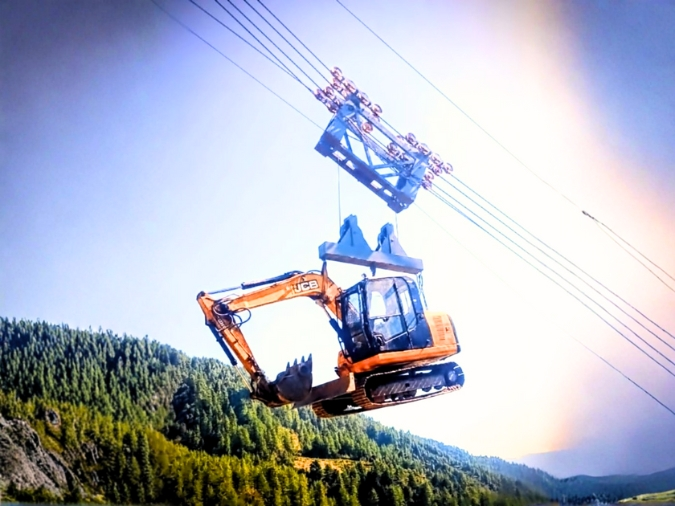
Cable car public transport in India is no longer just an idea for mountain tourism. Aerial ropeways are becoming a part of the conversation about how to get around cities. The government is actually supporting the idea of using cable cars for mobility. And there are strong reasons why this idea is being talked about more.
Let us look at why.
Cable Cars Are Not Just for Hill Stations Anymore
Most Indians picture a cable car and think of Gulmarg – Or maybe a temple on a hill somewhere in Uttarakhand. That association made great sense for decades. Ropeways in India were built almost entirely for tourism and pilgrimage access. They were fun to ride, scenic to view, and seasonal. This kind of image is now changing quickly.
Urban planners, state governments, and the central government are all looking at urban ropeways in India as a daily commuter solution. Now, it is not just a weekend attraction anymore. Many cities have streets, rivers to cross, steep hills, and roads that cannot be made any wider. So they are asking, why not build ropeways above everything?
And this is more than a thought experiment. The change is already taking place in places.
In countries, cities like Medellín in Colombia and La Paz in Bolivia have been using cable cars as a normal way for people to get around for more than ten years. Indeed, these places have been running cable cars as mainstream public transit.
India is watching. More importantly, India is building.
What Is Making India Ready for Cable Cars Right Now?
India’s cities are growing faster than their roads.
- By the year 2030, the number of people living in India’s cities is going to be around 600 million people. This is going to put a lot of pressure on the roads and other things that are already being used a lot. In the mountainous areas of India, it is very hard to build new roads and metros. Building roads and metros in these areas of India is also very complex and expensive.
- Adding more roads or metro lines is not always the answer. And especially true when 30% of the country is hilly or mountainous terrain. These are common places where conventional construction becomes either impossible or unaffordably expensive.
Here, Parvatmala Pariyojana ropeway projects change the equation.
- The Union Budget for 2022-23 made this announcement. The scheme will look at more than 200 ropeway projects all over India. They are going to spend Rs 1.25 lakh crore on the Union Budget 2022-23 scheme. More importantly, it does not just cover hill areas. It explicitly targets congested urban corridors where metros and roads have hit their limits.
- For the first time in India’s infrastructure history, ropeways have a dedicated national program behind them. The funding and the targets are set. And the projects are no longer on paper. They are under construction.
You can read more of such content in detail in our blog on the future of transportation with ropeway technology in India.
Cable Cars vs Metro vs Roads: The Numbers Spinning the Wheel
This is the comparison most people have not seen laid out clearly. So here it is.
Cost of Construction
Ropeways are usually less expensive to build compared to metro lines. This is especially true in areas with a lot of traffic or hills. The cost of metro projects in India can be very different from one city to another. It also depends on the route. Whether the metro is underground or above ground. Ropeways are different. They do not have these costs.
Ropeways are a choice because they do not cost as much. The infrastructure needs fewer civil structures, no tunnelling, and a much smaller ground footprint. This means that ropeways are a lot cheaper to build for every kilometre of ropeway.
Land Acquisition
This is where ropeways have a clear structural advantage. Aerial cable cars operate in their own dedicated right-of-way, which is the sky. They require no extensive ground track infrastructure. In a country where land acquisition is one of the biggest reasons infrastructure projects stall for years, this is not a minor point.
Speed of Deployment
Cable cars can typically move from approval to operation faster than metro projects, which in India often stretch across eight to twelve years. Ropeways have a simpler construction process, fewer dependencies, and a smaller regulatory surface to navigate.
Environmental Impact
Ropeways run on electricity with no direct corridor emissions. Since they are built above ground, they cause far less surface disruption and require minimal clearing of land or vegetation below for cities already dealing with poor air quality, that matters.
Passenger Capacity
Modern gondola systems can move up to 3,000 passengers per hour per direction. That is not metro-level volume. But for corridors where a metro will never be built, it is a genuinely useful number.
The honest framing is this: ropeways are not metro replacements. They are practical, deployable solutions for corridors where metros are too expensive, too slow, or simply not feasible.
Projects Already Proving the Point
The best argument for urban ropeways in India is not theory. It is what is already being built.
Varanasi Kashi Ropeway
This is India’s first urban public transport ropeway and the most important proof of concept the country has right now. The ropeway is 3.75 km long. It connects Varanasi Cantonment Railway Station to Godowlia Chowk, which is in the middle of Varanasi city. Moreover, it is one of the most crowded cities in India. The ropeway there is designed to carry a lot of people at a time and runs for 16 hours every day. The journey that currently takes close to 45 minutes by road is expected to take around 16 minutes once operational.
This is not a tourism project. It is a commuter infrastructure investment in a city where road widening is simply not an option.
Dehradun to Mussoorie
The Dehradun-Mussoorie ropeway is being built to serve one of the most heavily trafficked hill routes in North India. Millions of people travel on this route annually. The project aims to capture a meaningful share of that traffic. And offer a faster, cleaner alternative to the busy road.
Shimla
Himachal Pradesh is planning a long ropeway corridor connecting Tara Devi to Sanjauli across multiple stations. The project is designed specifically to reduce road congestion in a city that has been struggling with traffic and tourist inflow for years.
India’s ropeway sector is clearly moving from theory to implementation. These are not isolated pilots. They are part of a growing national pipeline of projects spanning both congested cities and difficult hill terrain.
What Are the Challenges Worth Knowing?
No honest assessment of cable car public transport in India leaves out the limitations. And there are a few worth knowing.
Capacity Has a Ceiling
Ropeways are not made to replace high-volume mass transit for real. Like a gondola setup moving 3,000 passengers per hour per direction can be helpful, but it is just nowhere close to what a busy metro or suburban rail corridor carries every day. Ropeways tend to work the best as feeder systems, like a connector route, or as point-to-point solutions in places where heavier transit cannot reasonably go.
To understand how these systems work beyond urban centres, read our detailed piece on How Ropeway Systems Enhance Connectivity in Remote and Hilly Areas.
Weather Can Be a Factor
Operations sometimes get messed up when it’s extreme out there, like heavy winds or storms. On top of that, most modern systems have safety protocols in place that pause everything when conditions go past certain thresholds. This is manageable, but it is a real operational consideration, especially in hilly regions.
Public Awareness Is Still Catching Up
Most Indians see ropeways as something to do when they are on vacation. It is a hard fact that building trust in ropeways as a commute option will take some time, consistent safety records, and clear communication from the people who operate the ropeways and the government.
None of these is a reason to dismiss ropeways. Cities like Medellín and La Paz solved exactly these challenges over time. India can too. But solving these problems will take careful planning.
Conclusion: The Sky Is Not the Limit. It Is the Route.
Cable cars will not fix every problem that India has with mobility around cities. But for cramped corridors, hilly ground, and those tight urban pockets where acquiring land becomes this decade-long war, ropeways give you something rather rare. An Answer that feels practical, affordable, and ready to deploy.
The government has recognised this. Projects in Varanasi, Dehradun, and Shimla are no longer proposals. They are under construction. The question is no longer whether cable car public transport in India has a future. It clearly does. The question is how fast India moves on it.
M&M Ropeways has been part of this industry for over 35 years, with 120+ projects delivered across some of the most challenging terrains in the country. Our systems are ISO and OITAF certified, built to operate in conditions as extreme as -35°C, and trusted by both government bodies and private developers.
If ropeway infrastructure is on your radar, we would be glad to talk. Contact today.
by ropeway-admin | May 29, 2026 | Cable cranes
When you need to move a lot of material around sites, you usually hear about two main options: material handling ropeways and conveyor systems. These two systems have been used for some time, and they work well. You can find them in mines, cement plants, limestone plants, and construction sites. They can both handle large amounts of material and keep working for a long time.
What works well for one site might not be the best choice for another site.
Terrain, distance, elevation change, and throughput requirements all influence which system is really the best on the ground. Research published in ScienceDirect confirms that material handling costs account for 15% to 70% of total manufacturing expenses in industrial operations. If you pick the wrong system, it can cost even more.
So, between a material handling ropeway vs. a conveyor system, which one is more efficient for your operation? Let us take a look at this.
The Basics of Material Handling Ropeways and Conveyor Systems
To really get the difference between the two, we need to know what each system is used for.
Conveyor Systems
Conveyor systems are a way to move materials on the ground. They work well on land or on land that is not too steep. They keep moving in a continuous loop, taking materials from where they are taken out of the ground to where they are processed or stored.
Modern conveyor systems handle capacities between 500 TPH and 11,000 TPH. This depends on how wide the belt is and how fast it moves. They are widely used across coal, iron ore, limestone, and copper concentrate operations where the terrain is predictable and the distances are manageable.
The limitation is clear, though. Standard belt conveyors handle inclines only up to 18 degrees. Beyond that, performance drops and material spillage become a substantive issue.
Material Handling Ropeways
This design removes terrain as a barrier. Aerial ropeways work well in certain areas. They operate efficiently on slopes, when crossing rivers, in forests, and in mountains, where building infrastructure on the ground is hard or too costly.
Industrial material ropeways move a lot of material. Between 100 tons per hour and 450 tons per hour. They keep working over long distances. From 2 kilometres to over 75 kilometres. Ropeways handle material well.
For operations where ground conveyors fall short, M & M Ropeways offers the Sandwich Belt High Angle Conveyor. A system that bridges both technologies by handling inclines up to 90 degrees.
Key Differences Between Ropeways and Conveyor Systems
A ropeway vs belt conveyor comparison rarely comes down to one number. The meaningful differences sit in infrastructure requirements, land usage, and how each system handles the terrain between two points.
There are other meaningful differences. These are mainly about infrastructure needs, land use, and how each system deals with the ground between two places.
Infrastructure Requirements
Conveyor systems need a continuous ground-level structure. That means they need foundations and frames to hold them up and a clear path from the start to the end. If the ground is not flat, that is a problem, and more engineering is needed. Ropeways are different; they just need a few points to attach to and some towers to hold them up. The cable does all the work. It goes across valleys, rivers, and hills without touching the ground in the middle.
Land Usage
Conveyors take up a lot of space on the land they travel on. For every metre of the path, the land has to be cleaned up and made flat. People have to look after it. Ropeways pass over the land. They do not take up space on the ground, which makes Ropeways a lot better for places that are very sensitive to the environment or have many rules to follow.
Installation Complexity
When you are talking about Installation Complexity, you have to think about Conveyors. They need extensive civil work before you can even start installing the parts. Ropeways can be installed and commissioned in a fraction of the time, particularly on difficult terrain where road access is limited or absent entirely.
Flexibility and Scalability
Belt conveyor systems are fixed to their route. Rerouting one is a major project. Ropeways offer more adaptability. You can move loading points along the cable. You can also add carriers to increase capacity. This can be done without rebuilding the system.
At a Glance: Ropeway vs Belt Conveyor
| Factor |
Material Handling Ropeway |
Belt Conveyor System |
| Infrastructure |
Towers and anchor points only |
Full ground-level structure required |
| Land usage |
Minimal (passes over terrain) |
High (requires a cleared route) |
| Installation |
Faster, less civil work |
Extensive civil and foundation work |
| Terrain flexibility |
Works on any gradient |
Limited to 18 degrees incline |
| Scalability |
Add carriers, adjust loading points |
Rerouting requires a major overhaul |
Cost Comparison: Ropeways vs Conveyor Systems
Initial Installation Cost
Conveyor systems carry a higher upfront cost on flat terrain. A system handling 300 TPH over 1,000 feet can run between $275,000 and $400,000 in equipment and structure alone.
Maintenance and Operational Cost
Aerial ropeways are a way to cut down on costs. They can save you around 30 to 40 percent on operational costs when you compare them to conventional transport methods. With energy savings reaching up to 90 percent on descending load routes.
Long-Term ROI and Cost Per Ton
For operations running continuously over long distances and difficult terrain, ropeways deliver a lower cost per ton transported over time. Conveyors offer a stronger ROI on flat, high-volume, short-distance routes where civil work is minimal, and throughput is the priority.
The terrain between your two points determines which investment pays back faster.
Best Use Cases: When to Choose What?
Choose a Material Handling Ropeway When:
- The terrain is uneven or mountainous.
- The transport distance is long.
- Environmental or land restrictions apply.
- Projects in India’s hilly regions.
Choose a Conveyor System When:
- The terrain is flat or mildly inclined.
- The operation is high-volume and continuous.
- The distance is short to medium.
If the site is flat and the volumes are high, conveyors win. If the terrain is difficult and the distance is long, ropeways are the stronger investment.
Why Many Operations Use Both Systems Together
For most industrial sites, the choice between a ropeway and a conveyor is not binary. Many mining and bulk material operations use both.
Conveyors handle the extraction zone in a very efficient way. They do their job well. Once the material gets to the bottom of a tough area, a ropeway takes over. The ropeway carries the material across valleys and steep hills or areas where we cannot disturb the environment to the processing facility, on the side. Conveyors and ropeways do what they were made to do. Each conveyor and ropeway system does what it was built for.
The critical point in this setup is the transfer station where both systems meet. Modern automated transfer stations synchronize flow rates between the conveyor and the ropeway. Sensors monitor material volume, adjust belt speeds, and regulate carrier loading to maintain consistent throughput without delays.
M & M Ropeways offers advanced monitoring and control systems that track belt speed, material flow, tension forces, and equipment health across both systems simultaneously. For a detailed breakdown of how this integration works across mining operations, refer to our blog on Integrating Aerial Ropeways and Conveyors in Mining.
The Bottoms Up
Most operations do not get this decision wrong because of the budget. They get it wrong because no one mapped the system to the site before the order was placed.
M&M Ropeways designs both material handling ropeways and conveyor systems. Before we recommend anything, we look at your terrain, your distance, and your throughput needs.
If you are still weighing a material handling ropeway vs. a conveyor system for your project, let us make that decision easier.
Talk to M&M Ropeways. Get a site-specific recommendation.
by ropeway-admin | May 29, 2026 | Cable cranes
India’s mountain tourism is growing fast. More travelers are heading to hill stations, pilgrimage sites, and high-altitude destinations every year. But getting visitors there, safely and efficiently, is still a challenge most developers underestimate.
Roads take years to build. Plus, they disturb ecosystems. And in many terrains, they simply are not feasible. That is where aerial infrastructure steps in.
Chairlift systems for tourism are becoming a serious part of how India plans and develops its scenic and religious destinations. They are a cost-effective option, reliable to operate, and designed for areas where traditional transport cannot go.
Fixed chair lifts (in particular) are proving to be one of the most practical tools in this space. From pilgrimage hilltops to mountain resorts, a well-installed chairlift ropeway for scenic tourist destinations does more than move people. It opens up entire zones for tourism development.
This blog breaks down exactly how fixed chair lifts fit into tourism infrastructure and what developers need to know before they invest.
Decoding Chairlifts Systems in Tourism
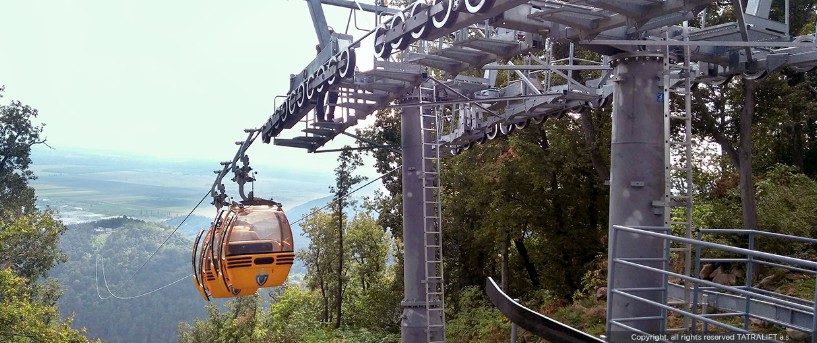
A chairlift system is an aerial transport solution. It moves passengers along a fixed cable route, suspended above the ground. Chairs or cabins are attached to a steel haul rope that runs continuously between two terminals, carrying visitors from one elevation to another with minimal infrastructure on the ground.
There are two broad types:
- Fixed grip chairlifts have chairs that are always attached to the cable. These chairlifts move at the same speed all the time.
- Detachable chairlifts are different. They let the chairs come off the cable when they get to the stations. This means the chairs can slow down. It is easier for people to get on the detachable chairlift.
Both serve tourism infrastructure. But for different terrain profiles and budget brackets.
To understand which system suits your project, explore M&M Ropeways’ Ropeway Systems page and our dedicated Chairlift Product page.
Why Tourism Infrastructure Needs Fixed Chair Lifts
India’s tourism industry is growing into areas that our current infrastructure cannot handle well. Many of the country’s amazing places are on hilltops, mountain ridges, and high areas where building roads is very costly, damages the environment, or just can’t be done. To solve this issue, fixed chair lifts are being used more and more.
Access to Remote and High-Altitude Destinations
A chairlift ropeway for scenic tourist destinations can link a base point to a hilltop viewpoint or religious site in a matter of minutes. The route, which used to require an hour of hard work, now provides an enjoyable journey through beautiful scenery. The destination now becomes accessible to elderly visitors and families with young children, and people who normally would not visit.
Visitor Flow and Crowd Management
Fixed chair lifts run at a constant, predictable speed. Developers need to understand that system dependability stands as their most vital requirement. Uncontrolled crowd movement at pilgrimage sites and popular hill stations creates major problems for safety and visitor experience. The fixed chairlift system operates as a permanent visitor flow mechanism that delivers controlled passage for people who travel in both directions. People can walk around the area because the way they move forms into two patterns of foot traffic.
Eco-Friendly Footprint
Fixed chairlifts run without fuel emissions. Their installation footprint is tower-based. It means far less ground disturbance compared to cutting a mountain road. India’s government is already acting on this logic. The Parvatmala Pariyojana targets 200 new ropeway projects by 2030, built specifically to create sustainable access in mountain regions.
Ropeway solutions for hill stations are no longer supplementary. They are becoming the foundation of how tourism infrastructure gets planned in India today.
Key Benefits of Fixed Chair Lifts in Tourism Development
Tourism developers need to answer one specific question before they proceed with their infrastructure development plans. What do we actually get out of this? With fixed chair lifts, the answer is more layered than most expect.
Cost-Effective to Install and Maintain
Fixed grip systems operate as the least expensive chairlift system for tourism. It possesses fewer operational components than detachable systems, while its mechanical operations are less complex than those of gondola systems. That simplicity translates directly into lower installation costs and a lighter maintenance burden over time. For state tourism boards and private resort developers working within tight project budgets, that financial headroom matters. You receive a dependable system that lasts for many years without paying extra for unnecessary advanced features
Year-Round Operational Flexibility
Fixed chair lifts are not seasonal equipment. That is a common misconception worth addressing. While they are well known in ski environments, they serve summer hiking trails, pilgrimage routes, and nature tourism circuits just as effectively. A destination that runs its chairlift through all twelve months gets far more return on its infrastructure investment than one that operates only in peak season.
Compact Terminal Design
The loading and unloading stations of a fixed chair lift require very little ground space. That compact footprint opens up installation possibilities in terrain-sensitive and ecologically protected zones where larger infrastructure would never receive environmental clearance. It is a practical advantage that often makes the difference between a project getting approved or stalling indefinitely.
Longer Visitor Dwell Time and a Stronger Local Economy
This is the benefit that tourism economists pay close attention to. When visitors can access more of a destination without physical strain, they stay longer. They visit more sites, eat more meals, and spend more money locally. A fixed chairlift effectively extends the tourist circuit within a destination. That ripple effect on the local economy is one of the strongest arguments for the benefits of chair lifts in tourism development, and it is one that project planners should be putting in front of their stakeholders.
Fixed Chair Lift vs Gondola: Which One Does Tourism Need?
| Parameter |
Fixed Chair Lift |
Gondola |
| Cost |
Lower |
Higher |
| Best For |
Open scenic terrain, short-to-medium routes |
Weather-sensitive, family-heavy, long routes |
| Terrain Fit |
Gentle to moderate slopes |
Steep, exposed, extreme altitude |
- When looking at fixed chair lift vs gondola tourism decisions, cost is usually the first filter. Fixed chair lifts come in at a noticeably lower installation and maintenance cost.
- Terrain is the second filter. Fixed chair lifts perform well on gentle to moderate slopes with open, scenic profiles. Gondolas are better suited for steeper, more exposed routes where enclosed cabins protect passengers from harsh weather.
- The third thing to consider is the kind of people who will be visiting. If a lot of your visitors are families with kids, or where weather conditions are unpredictable, a gondola is a good idea.
- A fixed chair lift is better when people want to feel like they’re outside, and that is part of the fun.
The thing is, neither system is better for everyone. You have to think about the terrain you are dealing with, how much money you have to spend, and what kind of people are going to be visiting you.
Safety Standards and Maintenance
Safety is always on our minds when making infrastructure decisions. Operators might not always say it, but it plays a huge role in choosing vendors and approving projects.
- In India, the rules for fixed chairlift systems are set by the Bureau of Indian Standards and the Ministry of Road Transport and Highways (MoRTH).
- On the technical side, fixed chair lifts come equipped with redundant braking systems that activate automatically if the primary drive fails. Rope speed is monitored continuously during operation.
With proper upkeep, a well-installed fixed chairlift has an operational lifespan of 30 to 50 years. For a tourism destination, it is a long-term infrastructure with a serious return on investment.
The Bottom Line
Fixed chair lifts are not a new idea. But the role they play in tourism infrastructure is being rediscovered at exactly the right time. It opens destinations that roads cannot reach. They manage visitor flow without complicated systems. The equipment has a service life between 30 and 50 years, and its maintenance requirements allow operation in distant areas. For any serious tourism infrastructure plan, ignoring them is leaving real value on the table.
The benefits of chair lifts in tourism development extend beyond their function to transport people between two locations. They reshape how a destination functions, who it can welcome, and how long visitors choose to stay.
The choices we make today about infrastructure will decide how our hill station project, pilgrimage route, or scenic tourism circuit turns out in the future.
If you are thinking about starting a project, we can help you make choices. Get in touch with our team of experts now.
Chair lifts are really good for tourism. They do not just take people from one place to another. Chair lifts change the place. They help decide who can come and how long people want to stay.
The things we do now will affect our hill station project, pilgrimage route, or scenic tourism circuit, on.
If you want to start something, we can help you make good decisions. You can talk to our team of experts now.
by ropeway-admin | May 28, 2026 | Cable cranes
Ask a project engineer what a ropeway is. Then ask what a cableway is. Chances are, you get the same answer for both. Most people, tourists, planners, and even industry professionals, treat these two words as identical. Sometimes that works. Often it does not.
And honestly? That confusion is obvious.
Both systems move people and materials through the air using steel cables. Both hang from towers. Both cross terrain that roads and railways cannot touch. So the overlap is real.
Cableway vs Ropeway: What’s the Difference? In India, that answer changes depending on who is reading the document. A government tender says ROPEWAY. A mining contract says CABLEWAY. Use the wrong one, and the confusion that follows is the least of your problems.
This guide clears it up. You will understand exactly what each system is, how they differ, and which one your project actually needs. We will start with the foundation, what an aerial ropeway is, and where it ends, and where a cableway BEGINS.
What Is a Ropeway? Moving People and Goods Through the Air
A ropeway is a cable-based transport system where carriers hang from steel cables supported by towers. A separate haul rope drives the movement. The terrain below does not matter: valleys, rivers, and steep gradients are all CROSSABLE from the air.
Every ropeway falls into one of two categories.
- Passenger ropeways carry people. Gondola cabins, chairlifts, and cable cars, all built around the rider. Vaishno Devi, Kedarnath, Gangtok – these systems already move millions across terrain that roads struggle to serve.
- Material handling ropeways carry goods. Mining sites, hydropower projects, and dam construction zones use a material handling ropeway to move ore, concrete, and timber across terrain where trucks cannot go.
What Is a Cableway? An Industrial Transport System Explained
An aerial cableway is also a cable-suspended transport system. On the surface, it sounds identical to a ropeway. But in technical practice, the word carries a more specific meaning.
A cableway is built for work, not for passengers.
The classic aerial cableway system uses a stationary track rope for support and a moving haul rope for propulsion. The carriers are open trolleys, buckets, or cradles. NO SEATS. No boarding GATES. Just heavy material moving efficiently across impossible terrain.
This is why industrial cableway systems appear in mining operations, cement factories, dam construction sites, and hydropower supply lines. A cableway for bulk material handling can carry thousands of kilograms per trip, across distances no road-based equipment can match.
Nothing illustrates this better than the Siachen Glacier. The Indian army operates at 18,000 feet in temperatures that drop to minus 35 degrees Celsius. No road connects those posts. Helicopters lose reliability at that altitude and in those weather conditions. Aerial cableways step in and do what nothing else can: keep supplies MOVING when everything else STOPS.
Explore: Aerial Cableways in the Army & Industrial Cableway Systems
Cableway vs Ropeway: Understanding The Core Differences
Both systems use cables. Both hang carriers in the air. But the similarities stop there. Here is where cableway vs ropeway actually separates.
| Parameter |
Ropeway |
Cableway |
| Terminology |
Broader, globally used umbrella term. |
Leans towards industrial, military, and European engineering contexts. |
| Primary Use Case |
Tourism, pilgrimage, ski resorts, rural connectivity, urban transit. |
Mining, dam construction, hydropower, cement, and bulk material transport. |
| Load Capacity |
Designed for people and lighter goods. |
Heavy tonnage, up to 10,000 kg per haul. |
| System Design |
Enclosed cabins, ergonomic seating, boarding stations, and passenger safety systems. |
Open trolleys, load buckets, and cradles are built for operational efficiency. |
| Cable Configuration |
Mono-cable or bi-cable ropeway setups. |
Stationary track rope + moving haul rope, aerial cableway system. |
| India Naming |
Dominant public terms, Parvatmala Yojana, tourism boards, and state tenders. |
Used in technical docs, military contracts, mining, and forestry projects. |
Choosing the wrong system for your terrain and load requirement is an expensive mistake. M&M Ropeways has spent decades getting that decision right, across dam sites, hill stations, army deployments, and hydropower corridors. Talk to our team before your next project.
Why Everyone Gets These Two Terms Mixed Up
Here is the honest answer: Both are cable-based aerial transport systems built on the same core engineering principle. Towers, steel cables, suspended carriers, and haul rope. The foundation is identical.
So yes, a single system can be called either, depending on who is writing the document. A project engineer might call it a cableway. The tourism board promoting it will call it a ropeway. Both are technically acceptable.
Regional naming makes it worse. In Japan, both systems are called ‘ropeway’. In Britain, the cable car vs the ropeway is a common debate. In America, “aerial tramway” is the preferred term. Same physical system, four different names depending on which country you are standing in.
In India’s infrastructure world, context settles it faster than any dictionary. Tourism project? Ropeway. Mining contract? Cableway. Military deployment? Cableway. Hill station gondola? Ropeway. The application determines the word, not the other way around.
That is why working with an experienced ropeway manufacturer in India matters. They know which term belongs in which document, which system suits which terrain, and which configuration delivers what the project actually needs.
Real-World Applications in India: Where Roads Stop, Ropeways and Cableways Begin
Understanding the difference becomes clearer when you see both systems at work. Here is where aerial ropeway types in India actually show up.
#1. Tourism and Pilgrimage
Not every pilgrim can trek. Not every mountain allows a road. That is exactly where passenger ropeways fill the gap. At VAISHNO DEVI, Kedarnath, and Girnar, gondola systems and chairlifts carry millions of visitors each year across terrain that no vehicle can navigate safely. They have become the backbone of India’s religious tourism infrastructure.
#2. Dam and Hydropower Construction
Some terrain does not allow trucks. In Himachal Pradesh, Uttarakhand, and Nepal, deep river valleys, steep slopes, and monsoon conditions make road-based logistics nearly impossible. Industrial cableway systems cut through that problem directly. Concrete, steel reinforcement, and heavy equipment, all moving across the valley continuously, without a single road being built. No road needed. No delay waiting for one to be built.
#3. Military Supply Lines
At 18,000 feet on the Siachen Glacier, it gets really cold. The temperature can drop. 35 degrees Celsius. There are no ROADS. The only way to get to the Siachen Glacier is by helicopter. You can only take a helicopter when the WEATHER is good, which does not happen very often. For India’s army, aerial cableways are not a backup plan. They are the only plan. Food, ammunition, and critical equipment move this way because nothing else gets through.
#4. Agriculture and Rural Connectivity
For farmers on HILLSIDES in Himachal Pradesh and Northeast India, the problem has never been growing produce. It has been getting it down. Roads took decades to promise and longer to build. A material handling ropeway system helps move produce. It skips WAITS. This system carries produce from fields to collection points faster than walking.
Want to understand why more infrastructure projects in India are choosing ropeways over roads? The advantages speak for themselves.
The Bottom Line
Cableway or Ropeway: both terms describe systems that do something no road, bridge, or railway can. They move people and materials through the air, across terrain that stops every other form of transport cold.
The label matters less than the engineering behind it.
Whether the project calls for a passenger ropeway at a hill station, an industrial cableway at a dam construction site, or a material handling ropeway for a mining corridor, the system has to be designed right, built right, and installed for the conditions it will actually face.
That is what M&M Ropeways does. We design, manufacture, and install both passenger ropeways and industrial cableways, from Siachen Glacier to sea-level construction zones. Contact us when you are ready to build.