
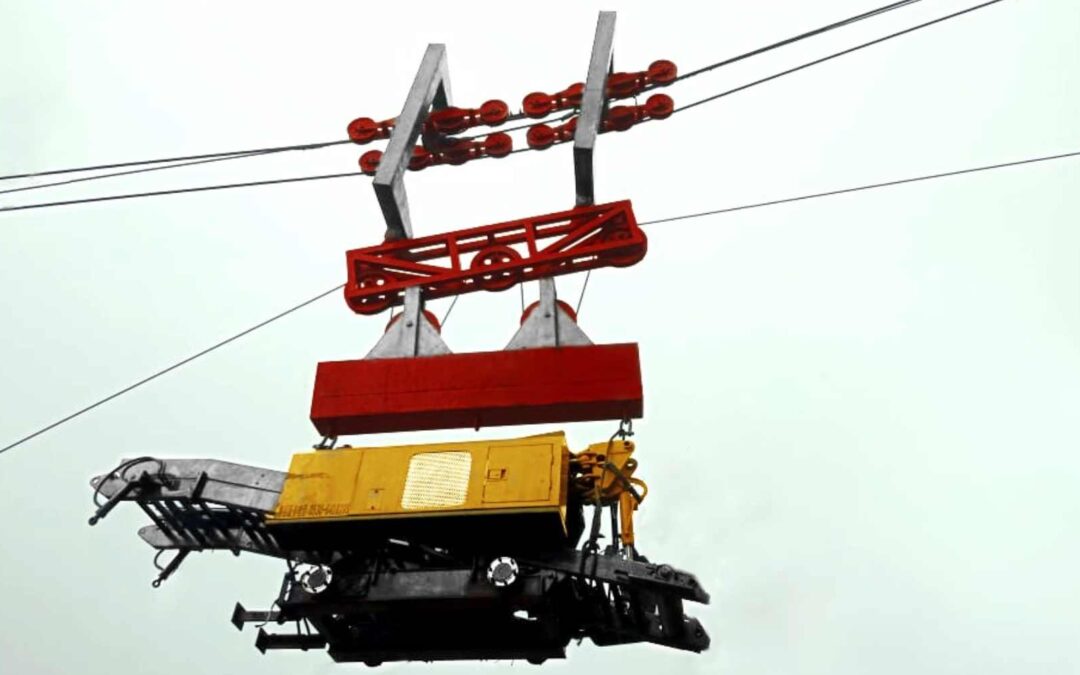
You planned everything for your ropeway project. The budget. The timeline. The equipment. Then the site survey came back and changed everything. Why?
Because the terrain is too steep. The roads? Doesn’t exist. The traditional crane you booked cannot operate here, and the project clock is already ticking. This is not a rare situation. Especially for engineers and project managers working on dams, hydropower plants, mining sites, and remote infrastructure, this is a challenge that shows up more often than anyone likes to admit. The problem is rarely the project itself. It’s choosing the wrong crane for the wrong terrain.
Understanding the real difference between cable cranes vs. traditional cranes is what separates a project that runs on schedule from one that drains time and money before the first foundation is laid. This blog is the answer you need right now.
What is a Traditional Crane?
Traditional cranes were built for a world of flat ground, paved roads, and structured job sites, and for decades, that world was enough.
The principle behind it is elegantly simple. A boom extends outward into position. A hoist pulls the load steadily upward. A hook grips and secures everything in place. Moreover, from a cab high above or a remote panel on the ground, the operator controls every single movement.
Three types dominate the industry:
- Tower Crane: The tall structure you often spot on city skyscrapers
- Mobile Crane: Mounted on wheels or tracks for on-site flexibility
- Overhead Crane: Fixed inside factories and warehouses for indoor lifting
Flat ground, prepared sites, accessible roads. This environment is where traditional cranes are completely unstoppable. But the moment that ground disappears beneath steep slopes and mountain valleys, the limitations of traditional cranes become the loudest problem on site.
What is a Cable Crane?
A cable crane is an aerial material handling system engineered to move heavy loads across valleys, rivers, gorges, and mountain slopes. All of this is possible without needing a single meter of road beneath it. Unlike traditional cranes that operate vertically within a fixed radius, cable cranes work both horizontally and vertically by covering distances and terrains that no other system can match.
The system runs on three core components:
- A track rope that supports the carrier across the entire span
- A haul rope that moves it forward and backward
- A hoist rope that lifts and lowers it at the right point
Top cable crane manufacturers engineer these systems to carry up to 10,000 kg across spans of 6,400 meters in a single drive. That is raw, unstoppable capacity.
M&M Ropeways, a trusted ropeway manufacturing company in India, has proven this across 100+ installations worldwide. Including an 18,000-foot installation on the Siachen Glacier for the Indian Army at -35 degrees Celsius. This stands as proof of what cable crane systems can actually achieve.
When the terrain says STOP. Then a cable crane keeps the project MOVING.
Quick Comparison: Cable Cranes vs Traditional Cranes
| Factor | Cable Crane | Traditional Crane |
| Road Dependency | Zero | High |
| Ideal Project Duration | Long-term | Short to medium term |
| Ground Contact | Tower foundations only | Full ground setup required |
| River or Gorge Crossing | Yes | No |
| Altitude Capability | Up to 18,000 feet proven | Low altitude only |
| Regulatory Compliance | OITAF-certified standards | Standard construction norms |
| Project Types | Dams, hydro, mining, military, tunnels | Urban buildings, ports, and warehouses |
| Setup Complexity | High upfront, low ongoing | Low upfront, high ongoing |
| Carbon Footprint | Minimal | High |
Cable Cranes VS Traditional Cranes: The Key Difference
Two cranes. Two completely different philosophies of engineering. One was built to master structure, speed, and urban precision. The other was built to make geography irrelevant. Both ropeway systems are powerful and have their own position. But putting them on the wrong project leads to consequences that show up fast in your timeline, your budget, and your bottom line.
So, here is precisely where they differ and which one wins where it’s needed most:
1. Terrain and Accessibility
Traditional cranes have one non-negotiable requirement: flat, stable, road-accessible ground. Without it, they simply cannot function. It’s not the limitation people talk about often, but on the wrong site, it becomes the biggest problem on the project.
Cable cranes were built with that exact problem in mind. They operate aerially, which means valleys, steep slopes, river crossings, and mountain gorges are just the landscape below.
For projects in locations where road construction is impactful or impossible, cable crane systems are the only viable solution.
Best For Rough Terrain: Cable Crane
2. Load Capacity and Span
Traditional cranes are genuinely impressive when it comes to lifting materials. But they work within a limited radius, and once material needs to travel beyond that range, they can’t help anymore.
Cable cranes do not have a radius problem. They carry between 100 kg and 10,000 kg across spans of up to 6,400 meters in a single drive. Also, bring a level of reach and capacity that no ground-based crane can ever match.
For large-scale infrastructure projects where both distances and weight are on the table, cable cranes are in a completely different league.
Best for Long-Distance Transport: Cable Crane
3. Installation and Mobility
Installation speed is one area where traditional cranes hold a measurable advantage. On a prepared urban site, traditional cranes are ready to work fast. No surveys. No tower installation. No complex planning. Just a roll-in and lift.
Whereas cable cranes demand more upfront. Topographic mapping, tower installation, longitudinal planning, and full commissioning all need to happen before operations begin. But that upfront investment pays back consistently.
Once commissioned, a cable crane runs without interruption for the entire project lifecycle. The setup is LONGER. And the Return? GREATER.
Best for Quick Urban Setup: Traditional Crane
4. Cost of Operation
Here is something that surprises a lot of project managers when they see it for the first time. Cable cranes require higher investment. But over the life of a long project, they almost always end up being the cheaper option.
Traditional cranes burn fuel every single day. Add regular maintenance, operator costs, and the logistics of keeping roads functional and accessible, making bills stack up faster than most budgets account for.
Cable cranes front-load the cost. But once running, the cost per tonne of material moved keeps falling as the project progresses. For long-term remote projects, the numbers speak clearly and confidently in favor of cable cranes.
Best for Long-Term Cost Efficiency: Cable Crane
5. Environmental Impact
Traditional cranes depend on roads. Roads mean land clearing, vegetation removal, and ground disruption, consequences that hit hardest in ecologically and legally protected zones.
Cable cranes operate entirely above the terrain. No roads. No clearing. Tower foundations are the only ground contact for the entire system. Everything below stays untouched.
For projects under strict environmental regulations, cable cranes deliver full operational performance without compromising compliance
Best for Eco-friendly Projects: Cable Crane
6. Performance in Extreme Conditions
High winds. Heavy snow. Sub-zero temperatures. Traditional cranes buckle under all three. Operations stop. Deadlines vanish. The project bleeds time and money.
Cable cranes do not pause. Brutal weather is not an obstacle. It is just another operating condition. Every component is built to perform where everything else shuts down.
For high-altitude zones, frozen landscapes, and storm-prone sites, cable cranes are the only option built to keep running when everything else has stopped.
Best for Harsh Environments: Cable Crane
Both systems are brilliant, but not on the same projects. As we learned, traditional cranes deliver on flat, accessible, urban sites without breaking a sweat. But take them off that ground, and they struggle fast.
A cable crane system was purpose-built for exactly that moment: remote locations, unforgiving terrain, and large-scale infrastructure. And this is where only a proven ropeway system keeps everything moving on time.
How to Choose the Right Crane for Your Project
Still unsure which crane belongs on your project? No worries, here is the simplest & even clearest way to think about it.
If your site is flat, accessible, and urban, go for a traditional crane because it sets up fast, gets to work immediately, and does the job without any kind of complications. But if your project involves remote terrain, long distances, extreme weather, or strict environmental regulations. Then a cable crane system is what your project truly needs, even if it is not what you first budgeted for.
Moving towards the end, the decision gets easier the moment you stop thinking about which crane is more familiar. And instruct yourself to start thinking about which crane fits your terrain.
So, if your next project is one of those, M&M Ropeways, a reliable cable crane manufacturer in India, is ready for you. Let us build something extraordinary together.