
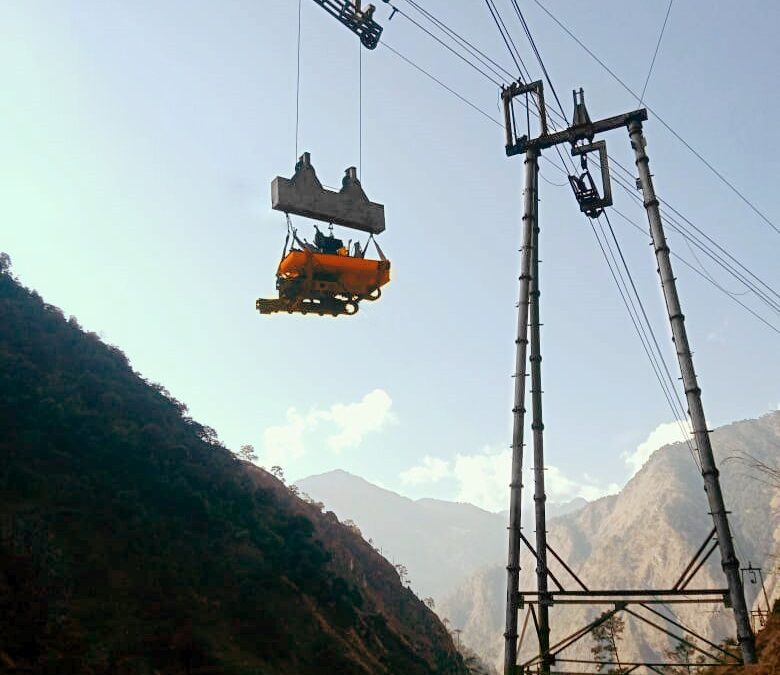
Millions of Indians start their day the same way, trapped in traffic, burning fuel, watching time disappear. Some city drivers lose over 240 hours a year to congestion. That’s ten full days. Gone. Just like that. We build more roads. The jams return. We add flyovers. The signals still overflow. The problem is not the road. The problem is we keep looking down for solutions when the answer is right above us. This is how urban ropeways save time and fuel and reduce traffic congestion by leaving the road entirely.
India’s government already sees this. Under the Parvatmala Pariyojana, India’s Ministry of Road Transport and Highways (MoRTH) has already initiated groundwork for 25 ropeway projects across 10 states. The Varanasi urban ropeway alone will carry over 96,000 passengers daily, off the roads and into the sky. No signals, no fuel, and no jams. Just a faster way forward.
What Is An Urban Ropeway? An Innovative Solution for Modern Cities
An urban ropeway is a cable-driven aerial transport system. Cabins hang from steel cables, stretched between towers, and carry passengers smoothly above the city. No road space needed, no tunnelling, and no land acquisition. It works over rivers, hills, highways, and dense city streets, wherever roads struggle the most.
Here is what makes ropeway transportation different:
- 100% electric, zero petrol or diesel.
- Direct point-to-point travel, no detours.
- Zero impact from signals, accidents, or peak-hour jams.
- Built for hills, river crossings, and dense urban areas alike.
How Ropeways Save Time, Cut Fuel, and Clear the Roads
India’s roads are overloaded. Fuel bills keep rising. Commutes keep getting longer. Also, no amount of new flyovers seems to fix the jam. Urban ropeways attack all three problems together. They run above the traffic, on electricity, with zero stops. One system. Three problems solved. Let’s break down each one, with real numbers and real examples.
#1. How Ropeways Actually Save Time
Time saved by a ropeway is life-changing. Medellín, Colombia, is the best EXAMPLE. What once took 2 hours by road now takes just 17 minutes via cable car. In La Paz, Bolivia, commuters using CABLE cars cut their travel time by 22%, saving nearly 9 minutes every single trip. Closer home, Varanasi’s urban ropeway will cover the Varanasi Junction to Godowlia route in just 16 minutes, a journey that easily eats up an hour during peak hours by road.
Why do ropeways in Indian cities SAVE so much time?
- No traffic signals: cabins never stop mid-route.
- Direct aerial route, no detours, no diversions.
- Predictable travel time, same duration every single ride.
- Reduces last-mile travel near metro and railway stations.
You can check real-world ropeway installations to see how these systems perform across different terrains and conditions.
#2. How Ropeways Help Reduce Fuel Consumption
A ropeway does not run on petrol. It does not run on diesel. It runs on electricity, and that changes everything. Ropeways avoid direct CO₂ emissions completely, powered by electricity, not fossil fuels. Along with this, here is what makes them even smarter: one single motor moves every cabin on the entire line simultaneously. No separate engine per vehicle. No fuel per trip. Just one motor, one cable – thousands of commuters moved.
Here is what makes aerial ropeways a truly fuel-efficient transport option:
- Zero petrol or diesel needed to operate.
- One motor powers the entire ropeway line.
- Reduces private vehicle trips on city roads daily.
- Fuel bill drops every single month.
This is not just zero-emission transport. Indeed, it is a system that makes the entire city cleaner, one commuter at a time.
#3. How Ropeways Reduce Traffic Congestion
Every cabin that lifts off is one less car on the road. Think about it simply. If a ropeway carries around 96,000 passengers every day, that is 96,000 fewer road trips. Fewer vehicles at signals. Fewer cars at intersections. Faster movement for everyone still on the road. India’s Varanasi urban ropeway is projected to carry over 96,000+ passengers per day with a maximum capacity of 3,000 passengers per hour per direction. That is the scale of traffic congestion relief one single ropeway line can deliver. India’s own government sees this clearly. Union Minister Nitin Gadkari stated that ropeway systems are affordable and will play a vital role in reducing traffic problems.
Here is how aerial ropeways in India directly reduce road congestion:
- Shifts thousands of commuters from road to sky daily.
- Reduces peak-hour vehicle density on major roads.
- Improves traffic flow near metro and railway stations.
- Eliminates road accidents caused by ropeway traffic entirely.
And ropeways work exactly where metros and flyovers cannot, over rivers, across hills, through heritage zones, and inside dense old cities where road widening is simply impossible. That is the real power of an urban cable car system. Urban ropeways do not fix one problem at a time. They fix all three, together, every single day. India’s cities are already moving in this direction. The question is not whether ropeways work. The question is, how soon will your city have one?
To see how these systems are designed and built for Indian conditions, explore M & M Ropeways’ ropeway installations, from hill towns to river crossings, across India.
More Than Just Fuel Savings: The Environmental Impact of Ropeways
A ropeway does not just move people. It cleans the air around them. Every commuter who shifts to an urban cable car removes one more vehicle from the road. Fewer vehicles mean less exhaust. Less exhaust means cleaner air. And cleaner air means healthier cities. Noise pollution drops, too. No road vibration or shaking nearby buildings. A ropeway cabin glides silently, and the city around it gets quieter. Then there is the land question. A metro needs massive excavation. A flyover cuts through entire neighbourhoods. A ropeway needs only small tower footprints and nothing else. No trees cut, no parks destroyed, and no green cover lost.
This is what eco-friendly transport looks like in practice. Not a promise on paper, but a daily reality that makes the city cleaner, quieter, and greener.
Why Are Ropeways Becoming Essential for Indian Cities?
India’s cities are growing faster than their roads. The urban population is exploding. Vehicles are multiplying. And the infrastructure is struggling to keep up. The government itself acknowledges this. Ropeways are now being pushed to decongest urban areas where conventional transport is saturated or simply not feasible. Here is why Indian cities cannot afford to wait any longer:
1. Metro Takes a Decade, Ropeways Take Two Years
A metro project takes 10 to 15 years from planning to operation. A ropeway is ready in 18 to 24 months. That is years of commuter relief, delivered faster. For a city transport solution that delivers results in months, not decades, ropeways are the clear answer.
2. Construction Cost Is a Fraction of Metro Rail
Metro rail costs thousands of crores per kilometre. A ropeway covers the same distance at far lower cost. The savings can fund multiple ropeway lines across multiple cities. More coverage. Less budget. Faster return on investment.
3. Works Where Roads and Metros Simply Cannot
Some Indian cities cannot be widened. Cannot be tunnelled. Rivers, hills, heritage zones, dense old neighbourhoods, they block every conventional solution. Ropeways bypass natural obstacles like rivers, buildings, ravines, and roads, providing a viable alternative where traditional infrastructure fails. This is exactly why urban mobility solutions like ropeways are built for Indian geography, where conventional infrastructure hits a wall.
4. No Displacement, No Demolition & No Disruption
Building a metro or flyover means demolishing homes and shops. It means years of construction noise, dust, and blocked roads. A ropeway needs only small tower footprints (nothing else is touched). Residents stay. Businesses stay. Life goes on below, while the ropeway goes up above.
5. Already Proven Across Indian Cities
This is not an experiment anymore. As of 2025, all 36 states and union territories of India have either existing or planned ropeways. Varanasi, Guwahati, Kedarnath, Hemkund Sahib, real projects, real results. India has already started. Now it needs to scale, and trusted ropeway manufacturers in India are ready to build every kilometre of that future.
From Siachen to Smart Cities: M&M Ropeways Leads the Way
M&M Ropeways, India’s trusted ropeway manufacturer, has spent decades designing, manufacturing, and installing ropeway systems across India and internationally, from Siachen Glacier to hydropower projects in Nepal and from cement factories to rural connectivity solutions. As India accelerates its urban ropeway ambitions under Parvatmala Pariyojana, our expertise in engineering passenger ropeway systems and aerial cable car solutions becomes ever more relevant. We understand Indian terrain, Indian cities, and the engineering challenges that come with both.
Explore our Ropeway Manufacturing capabilities or learn more about our Tourism Ropeway solutions built for India’s growing urban and pilgrimage corridors. The sky above Indian cities is no longer space. Today, it is an infrastructure waiting to be built.
Wrapping it Up
Urban ropeways are changing the game, with fewer vehicles on roads, less fuel burnt, and thousands of commuters reaching their destination faster every single day. If Indian cities are serious about beating congestion, how urban ropeways save time and fuel and reduce traffic congestion is a question every urban planner needs to answer.
M&M Ropeways has been building that answer for 35+ years, and we are just getting started. Contact Us Today, and let’s take your city above the traffic.