
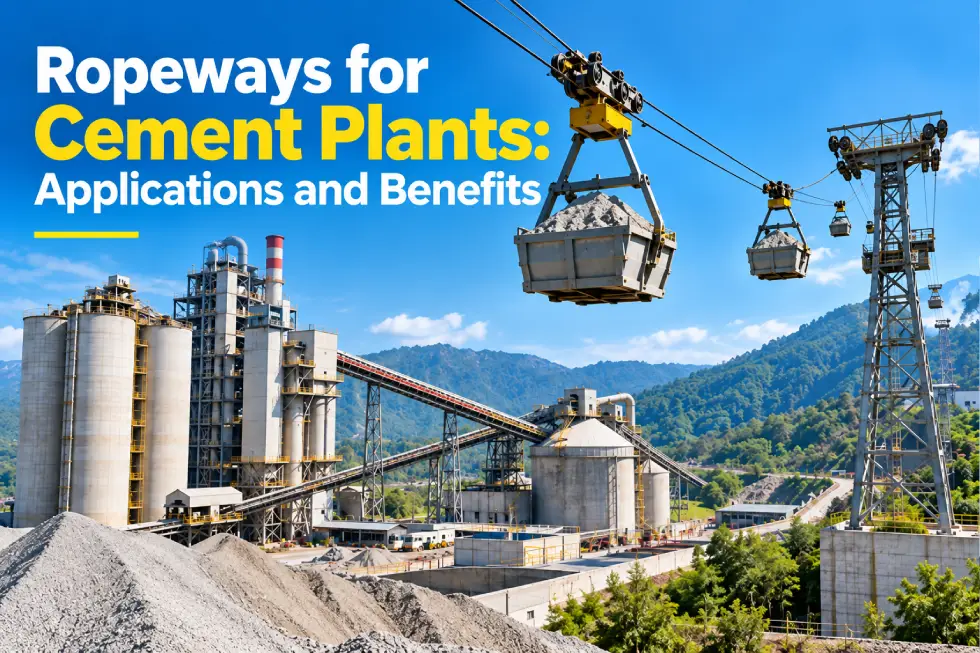
Cement plants can’t run without a constant flow of limestone. It travels from the quarry to the crusher, then to the stockyard, then into processing, day after day, with no breaks in between. The problem shows up when the quarry sits far from the plant. There might be a valley cutting through, a river in the way, thick forest, or just plain distance. Moving limestone by truck across ground like that turns slow and pricey pretty quick. That’s where material ropeways step in. Rather than fighting the land below, they just travel above it.
To get a sense of scale, India made close to 453 million tonnes of cement in FY25, a rise of 6.3% over the previous year. FY26 numbers are expected to climb near 490 million tonnes, while total installed capacity sits around 700 million tonnes a year. On a global level, the U.S. Geological Survey estimates 2025 cement output at about 3.8 billion tonnes. With figures that large, the way a plant handles its raw material isn’t just some background logistics issue anymore. It turns into one of the things that decides how smoothly the entire operation actually works.
What Exactly Is a Cement Plant Ropeway?
At its core, it’s an aerial system that carries bulk material. Mostly crushed limestone, using suspended buckets or carriers instead of trucks on a road. A single line can typically connect:
- Limestone quarry to crusher
- Quarry directly to the cement plant
- Crusher to stockyard
- Stockyard to the processing area
- Separate plant units split by rough terrain
- Remote extraction sites back to the main plant
The system itself is made up of carrying ropes (and haul ropes, depending on the configuration), towers, drive and return stations, carriers, loading/unloading points, braking systems, and controls. Even if the engineering behind it is not the same, the idea is quite simple. Skip the part where you build a road. Rather, build a route through the air instead.
Brazil offers a very strong real-world case here. A rope of 10km length now carries around 9,000 tonnes of limestone in a day to a cement plant. The task that used to demand something like 900 truck trips daily just to keep up.
That gap, between one continuous line and a small army of trucks, shows exactly what a properly engineered industrial ropeway can achieve.
Why Cement Plants Actually Need This
Limestone is the main material in cement making. It takes up to 1.5 tonnes of limestone to make one tonne of cement. That number can change depending on the mix and uses. Now count that for daily use. This is not occasional transport work. When the project is going on, it has to run non-stop. Even if a plant is near a limestone reserve, it might still struggle to reach the exact location in reality. Distance on a paper map doesn’t really tell the real requirements during transportation.
A quarry stuck behind a ridge or cut off by a valley often means building a road with heavy earthwork, drainage, bridges, and repairs that never really end. A ropeway can skin all of that and go straight to the location without needing any road.
Where Ropeways Get Used in Cement Operations
Quarry-to-plant limestone transport is the most established use case. Crushed limestone gets loaded into buckets at the quarry and carried straight to the plant’s receiving station, feeding into crushing or raw-material handling from there.
The Cement Corporation of India runs a bi-cable ropeway at its Rajban plant in Himachal Pradesh. It’s used to move crushed limestone straight to the plant. The setup is documented, and it’s a real example of this system working on the ground.
Moving material to stockyards is another common application, especially when the stockpile sits away from the quarry due to land constraints or plant layout. Several cement project documents list ropeways alongside belt conveyors as options for feeding crushed limestone into stacker-reclaimer areas.
Crossing difficult terrain is where ropeways really separate themselves from road transport. A road has to follow the contours of the land; an aerial line doesn’t. A cement works in France demonstrates this well. Its ropeway crosses the Isère River and a six-lane motorway while keeping a remarkably small footprint on the ground.
Handling other bulk materials is possible too, though it depends heavily on particle size, density, moisture content, and required throughput. Beyond limestone, ropeways can be engineered for aggregates, ore, coal, and other construction materials, with the carrier and loading setup built around what’s actually being moved.
How the System Actually Works
It’s a fairly straightforward cycle once you break it down:
- Loading – crushed material goes into buckets at the loading station.
- Transport – carriers move along the line, supported by towers spaced according to the route’s engineering.
- Control – a drive system manages speed, braking, and safety monitoring throughout.
- Discharge – material drops into a hopper, conveyor, or stockpile at the receiving end.
- Return – empty carriers head back to load again.
Longer routes often need intermediate stations to break up the line. A 13.7 km limestone ropeway in Brazil, for example, runs across multiple sections with several loading, unloading, and intermediate stations, moving around 600 tonnes an hour.
What Cement Plants Actually Gain From This
Fewer trucks on the road: Less diesel, fewer drivers to manage, less wear on roads, less traffic congestion around the plant. The longer the distance and the higher the daily tonnage, the more this adds up.
Better handling of rough terrain: Steep gradients, valleys, and rivers that would otherwise demand serious road construction simply aren’t a problem for an aerial line.
A smaller footprint on the land: Towers and stations need only a fraction of the land a full road corridor would take up, though that’s not the same as saying there’s no footprint at all. Foundations, access paths, safety clearances around the towers- all of it still needs careful planning. It’s not an impact-free option. It’s just a much lighter one.
Steadier material flow: Cement production doesn’t like interruptions, and a well-engineered ropeway gives a predictable, continuous supply rather than one that depends on truck schedules and traffic.
Less road wear and dust: Fewer trucks running back and forth also means less road damage and less airborne dust from vehicle movement, with the actual savings depending on the electricity source, distance, capacity, and how the trucks it’s replacing were being run.
More predictable running costs: Truck fleets carry a long list of variable costs: fuel, tyres, drivers, repairs, road upkeep, vehicle replacement. Ropeways have their own maintenance needs too, covering ropes, bearings, drives, carriers, and control systems, so it’s not “maintenance-free” by any means. But over a high-volume, long-term operation, the cost structure tends to be more stable and easier to forecast.
A genuinely long service life: Some systems have been running for decades. At Holcim’s Dotternhausen plant in Germany, limestone has been carried by ropeway since 1942, with a 2020 upgrade lifting capacity from 300 to 450 tonnes per hour. That’s also a good reminder that upgrading an existing line can sometimes make more sense than starting from scratch.
Ropeway vs. Truck: Quick Comparison
| Factor | Ropeway | Truck Transport |
| Difficult terrain | Handles it well | Often a real challenge |
| Continuous transport | Yes | Depends on fleet size |
| Road requirement | Minimal | Full road access needed |
| Driver requirement | Low | High |
| Traffic impact | Low | Higher |
| Land requirement | Towers and stations | Continuous road corridor |
| Initial investment | Often significant | Usually lower upfront |
| Route flexibility | Fixed | High |
Neither option wins outright- it comes down to distance, tonnage, terrain, budget, and how long the route needs to stay in service.
Before You Install One
A proper feasibility study should look at tonnes-per-hour needs, distance, elevation change, terrain, weather patterns, material characteristics, carrier capacity, tower and station placement, power availability, safety clearances, and critically, future production growth. A ropeway sized for today’s average load rather than tomorrow’s peak load is a mistake that’s expensive to fix later.
Picking the Right Configuration
There’s no universal ropeway design. Monocable versus bicable, line length, tower spacing, station layout, drive type. All of it needs to be worked out for the specific site. A cement company in Maharashtra, for instance, runs a 7.5 km bi-cable system engineered for 650 tonnes per hour of limestone. That configuration was built for that route; it wouldn’t necessarily work anywhere else.
Where M&M Ropeways Fits In
With more than 35 years in the business and over 120 completed ropeway projects, M&M Ropeways works on ropeway engineering and design built around OITAF guidelines, backed by in-house manufacturing facilities. The typical project runs through route feasibility, capacity planning, detailed engineering, fabrication, installation, commissioning, and ongoing maintenance services – which matters because a ropeway needs to integrate cleanly with a plant’s existing quarry and material-handling setup, not just get bolted on afterward.
When Does a Ropeway Actually Make Sense?
It’s worth serious consideration when the quarry sits several kilometres out, the terrain is steep or broken, road-building would mean heavy earthwork, truck traffic is becoming a real operational or environmental issue, the plant needs consistent high-volume flow, and the route is expected to run for years with room for future expansion. If the quarry is right next door with existing road access, trucks or conveyors will likely be the more economical call.
Final Word
Ropeways built for cement plants are meant to fix one problem, and fix it well: getting limestone and other bulk material from quarry to crusher to stockyard to plant, in places where roads just don’t make sense because of the terrain or the distance involved. Get the setup right, and they cut down how much you rely on trucks, keep material moving without interruption, ease the wear on local roads, and often cost less to run once you look at the long term. That last part only holds up if the engineering behind it is actually solid. If you’re thinking about this for your own plant, it’s worth reaching out to M&M Ropeways and going through the real numbers for your specific route, rather than trying to guess from a spec sheet.
FAQs
What are ropeways used for in cement plants?
Mainly to move limestone from quarries to plants or stockyards, and sometimes other bulk materials depending on the design. Their biggest strength is crossing terrain, valleys, slopes, rivers, roads, and rail lines without needing a ground-level route.
Can a ropeway carry limestone over long distances?
Yes. Capacity and length depend on the specific configuration, but existing systems already run several kilometres, including a 13.7 km line in Brazil moving 600 tonnes per hour.
Are ropeways better than trucks for cement plants?
Not always. They tend to win on high volume, continuous operation, and difficult terrain. Trucks stay more flexible for smaller or frequently changing loads. The real answer comes from comparing full lifecycle costs, not just upfront price.
How much material can a cement plant ropeway move?
It varies by design. Some systems run around 450 tonnes per hour; others reach 600-650, depending on route, carrier capacity, and operating hours.
What drives the cost of a cement plant ropeway?
Route length, elevation change, number of towers and stations, carrier type, electrical and control systems, and site accessibility all factor in, which is why a proper site survey has to come before any cost estimate.
Can M&M Ropeways handle a cement plant project end to end?
Yes, design, engineering, manufacturing, installation, and commissioning, built around OITAF guidelines, with over 35 years of experience and 120+ completed projects.