
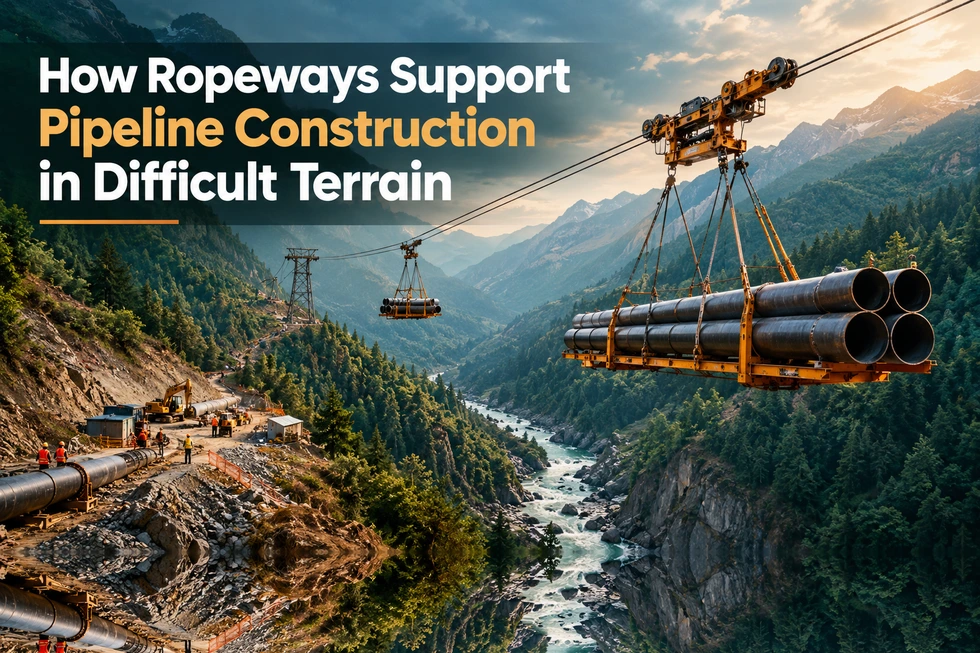
Making pipelines across areas like mountains, deep valleys, forests, or other remote locations can be really challenging and create transportation problems. There is a lot of material, including heavy pipes, welding equipment, construction machinery, concrete, and other materials, that needs to reach the construction site. It is not easy to transport these through roads. In such situations, ropeways support pipeline construction in difficult terrain by providing a route through the air for moving material across natural obstacles.
The scale of pipeline development makes efficient material transportation increasingly important. According to the Petroleum and Natural Gas Regulatory Board, India had 25,923 km of operational natural gas pipelines and another 9,954 km under construction as of September 2025. The Ministry of Petroleum and Natural Gas has also highlighted the expansion of pipeline infrastructure across different regions of the country.
For projects in sensitive areas and mountains, ropeways help to reduce the usage of roads. It helps maintain a smooth and consistent supply of construction material at the site. They can cross ravines, steep slopes, rivers, and other obstacles with limited ground infrastructure. It’s worth noting that material ropeways aren’t only used for pipeline projects either. The same idea shows up anywhere heavy material needs to move over land that roads just can’t handle well.
Why Pipeline Construction Becomes Difficult in Remote Areas
A route that a pipeline follows may look sorted on a map. But it is not as easy as it looks to construct on the ground. Mountain pipelines are a good example. The route may pass through steep gradients, unstable slopes, dense vegetation, river crossings, or areas with limited road access. Bringing a truck to every section of the alignment may require extensive temporary roads.
This creates several practical problems:
- Heavy vehicles may not be able to reach the worksite.
- Temporary roads can require significant excavation.
- Steep slopes increase transportation risks.
- Monsoon conditions can damage access routes.
- Remote sections may be several kilometres away from the nearest road.
- Moving long and heavy pipes manually can slow construction.
- Sensitive terrain may restrict conventional road construction.
These challenges can affect the entire construction schedule. A delay in material delivery can leave welding crews, excavation teams, and other workers waiting. For a large pipeline project, repeated delays can quickly increase labour and equipment costs. This is why material transportation needs to be considered during the early engineering stage rather than treated as a secondary construction issue.
How Ropeways Help Pipeline Construction
A material-carrying ropeway creates an aerial transportation route between selected loading and unloading points. Instead of depending entirely on roads, trucks can be replaced or supplemented by suspended carriers designed to transport construction materials. For pipeline projects, the system can be planned based on alignment and terrain.
Depending on project requirements, a ropeway can transport:
- Pipes and pipe sections
- Welding equipment
- Construction tools
- Cement and aggregates
- Structural components
- Fuel and supplies
- Maintenance materials
- Other heavy construction loads
The biggest advantage is that the carrying line can cross terrain that would otherwise require extensive ground access. Government sources on ropeway infrastructure also point to difficult terrain as a key use case. Ropeways can span long distances to cross rivers, ravines, roads, and built-up areas, without needing to follow the same path that ground transport would.
1. Moving Materials Across Steep Slopes
Steep terrain is one of the biggest problems in pipeline construction. Trucks need roads. And roads need a gentle slope, enough width, room to turn, and solid ground. Creating that road may require cutting into the hillside. A ropeway works differently. The supporting towers are positioned at selected locations, while the carrying rope spans the terrain between them. This allows materials to travel above steep slopes instead of being hauled along them. For a pipeline project, this can make material delivery possible in sections where conventional vehicle access would be difficult. On particularly broken or uneven ground, a self-propelled ropeway carriage, which hauls itself along the rope using an onboard engine, can also be a practical option.
2. Crossing Valleys and Ravines
Pipeline routes often encounter deep valleys and natural drainage channels. Building temporary roads across these areas may require bridges, culverts, excavation, and significant preparation. Each additional structure adds time and cost to the project. A properly engineered material ropeway can span these obstacles directly. This is particularly useful when the pipeline construction zone is narrow and materials need to be delivered from one side of a valley to another.
3. Reducing Dependence on Temporary Roads
Temporary roads are often necessary for conventional pipeline construction, but they are not always the best solution. Road construction can involve:
- Earth cutting
- Slope stabilization
- Drainage work
- Retaining structures
- Bridge construction
- Regular maintenance
In environmentally sensitive or highly mountainous areas, minimizing such work can be a major project consideration. Ropeways require comparatively limited ground infrastructure because the transportation route is primarily aerial. The Indian government has specifically highlighted the lower ground construction requirement and reduced land acquisition needs associated with ropeway systems. This does not mean that a ropeway eliminates all ground preparation. Towers, stations, foundations, access points, and maintenance facilities still need proper engineering. However, the amount and extent of ground intervention can be substantially different from creating a continuous road.
Ropeway vs. Road Transport for Difficult Pipeline Routes
The right solution depends on the terrain, load, distance, construction schedule, and available access.
| Factor | Conventional Road Transport | Material Ropeway |
| Steep terrain | Difficult | Well suited |
| Deep valleys | Requires crossing infrastructure | Can span obstacles |
| Remote sites | Access roads required | Can provide aerial access |
| Heavy materials | Truck-based | Carrier-based |
| Ground disturbance | Can be significant | Generally lower along the route |
| Weather impact | Roads may become difficult to use | Depends on system and weather limits |
| Route flexibility | Follows road alignment | Can cross terrain directly |
| Initial infrastructure | Roads and bridges may be required | Towers, stations, foundations and rope system |
The comparison does not mean ropeways should replace trucks on every pipeline project. In many cases, the most practical approach is a combination of both. Trucks can bring materials from the main road to a ropeway loading station. The ropeway can then carry those materials across the difficult section. At the other end, materials can be transferred to local vehicles or moved directly into the construction area. This creates a combined material transportation system suited to the actual terrain.
Planning a Ropeway for Pipeline Construction
A material ropeway should not be selected simply because the project is located in a mountainous area. Proper engineering is essential. Before selecting the system, project teams should evaluate:
- Pipeline alignment: Identify where road access becomes difficult and where aerial transportation would provide the most value.
- Terrain profile: Study gradients, valleys, rivers, ridges, forests, and other obstacles.
- Material requirements: Determine the weight, dimensions, quantity, and frequency of loads.
- Transport distance: Establish the required span and overall ropeway length.
- Loading and unloading points: Position stations where materials can be transferred efficiently.
- Construction schedule: Estimate the required transportation capacity per hour or per day.
- Safety requirements: Consider load control, braking, communication, emergency procedures, and inspection requirements.
This engineering stage is where an experienced ropeway manufacturer can add significant value.
M&M Ropeways brings more than 40 years of ropeway engineering experience, allowing project teams to assess the terrain, material requirements, and operating conditions before developing a suitable system. Its completed projects span pilgrimage sites, industrial sites, and difficult-terrain routes across India and abroad.
Major Applications of Ropeways in Pipeline Projects
Ropeways can support different stages of pipeline construction, from initial site preparation to the movement of materials during installation. Their role depends on the pipeline diameter, terrain, transport distance, load requirements, and project layout, and the right configuration is usually picked from a broader range of material handling products built for exactly this kind of job.
Transporting Pipes to Difficult Work Areas
Long and heavy pipe sections are among the most challenging materials to move across steep terrain. A material ropeway can carry pipe sections from a designated loading station to locations closer to the pipeline alignment. This reduces the need to move every section by truck through difficult ground conditions. The system must be designed around the actual pipe dimensions and weight. Carrier design, span length, rope configuration, loading method, and braking arrangements all need to be considered. For large projects, the transportation capacity also matters. Delivering one load occasionally is very different from supporting a continuous construction operation.
Moving Construction Equipment
Pipeline work requires more than pipes. Crews may need welding machines, generators, tools, lifting equipment, safety supplies, and other materials at different stages. In remote terrain, getting this equipment to the worksite can become a major logistical challenge. A properly designed material ropeway can help move these items between accessible points and isolated sections of the project. This is particularly useful where construction teams are working far from an existing road.
Supporting River and Valley Crossings
River crossings and deep valleys can create difficult sections along a pipeline route. A ropeway can transport materials across these natural barriers without requiring a vehicle route to follow the same path. This can reduce the need for additional temporary access infrastructure. However, each crossing needs detailed engineering. Tower locations, foundation conditions, clearance requirements, wind conditions, and the characteristics of the transported load must all be assessed before installation.
Supplying Remote Construction Camps
Large pipeline projects can have workers and equipment spread across several remote locations. Ropeways can also be used to supply these areas with construction materials and other essential loads. Instead of repeatedly sending vehicles through difficult terrain, a planned aerial transportation system can provide a more consistent supply route. This can be especially useful during phases when road construction has not yet reached a particular section of the project. Where electrical power isn’t available at a remote camp, a gravity ropeway, which runs on gravitational force alone, can be worth evaluating.
Safety Considerations for Pipeline Material Ropeways
Safety should be built into the ropeway from the design stage. A material ropeway carrying heavy pipeline components operates under different conditions from a simple material-handling system. The load, span, terrain, weather, and operating frequency all affect system design.
Important safety considerations include:
- Correct calculation of design loads
- Adequate rope and component selection, including winches sized to hold proper rope tension
- Proper tower and foundation design
- Controlled loading and unloading
- Effective braking systems
- Communication between stations
- Regular inspection and maintenance
- Emergency procedures
- Operator training
- Weather monitoring and defined operating limits
The ropeway should also be designed around the actual site conditions rather than relying only on standard assumptions. For example, wind exposure can vary significantly between two nearby valleys. Foundation requirements can also change depending on soil and rock conditions. This is why engineering, site surveys, and structural assessment are critical before manufacturing begins. M&M Ropeways approaches ropeway projects through engineering and system design rather than treating the equipment as a standard off-the-shelf product. This allows the transportation system to be developed around the project’s actual requirements.
Key Factors When Selecting a Material Ropeway
Pipeline contractors, infrastructure developers, and engineering consultants should consider several technical factors before selecting a ropeway system.
Load Capacity
The ropeway must safely handle the heaviest planned load, including the carrier and relevant dynamic considerations.
Do not select capacity based only on the average pipe weight. The design should account for the maximum expected load and operating conditions. For unusually heavy or oversized sections, a cable crane setup, where a separate hoisting rope lifts and lowers the load along the track rope, is sometimes better suited than a standard carrier.
Span and Route Length
The distance between towers affects the ropeway’s engineering requirements.
Longer spans may be useful for crossing valleys or other obstacles, but they also require careful analysis of rope sag, clearances, tower loads, and environmental conditions.
Material Dimensions
Pipe length and diameter can influence carrier design and loading arrangements.
Oversized loads may require specially designed carriers or handling systems.
Transport Frequency
A system designed for occasional material movement may have very different requirements from one expected to operate continuously throughout the construction day.
Project teams should estimate the required number of trips and material volume before finalizing the system.
Terrain and Foundation Conditions
Tower foundations are critical.
Geotechnical conditions, slope stability, rock characteristics, drainage, and accessibility must be considered when selecting tower locations.
Installation and Maintenance
A ropeway should be practical to install and maintain at the project site.
Maintenance access, inspection requirements, spare components, emergency procedures, and operator training should be considered before commissioning.
Final Takeaway
Ropeways support pipeline construction in difficult terrain by creating an aerial material transportation route where conventional road access may be expensive, disruptive, or impractical.
They can transport pipes, equipment, tools, and construction materials across steep slopes, valleys, rivers, and remote sections. Their biggest value comes when they are integrated into the project’s overall logistics plan.
The right system depends on load capacity, route length, terrain, material dimensions, transport frequency, weather, and site access.
M&M Ropeways combines ropeway engineering, manufacturing, installation, and commissioning capabilities to develop transportation systems around specific project conditions. For pipeline contractors and infrastructure developers, early feasibility and engineering assessment can determine whether a ropeway provides a practical advantage over conventional access methods. Get in touch to talk through the terrain and material requirements for your route.
FAQs
Can ropeways transport pipes for pipeline construction?
Yes. Material ropeways can be designed to transport pipes and other construction materials across difficult terrain. The carrier and system capacity need to match the pipe’s weight, length, diameter, and handling requirements. The ropeway route also needs to account for tower positions, clearances, loading arrangements, and site conditions.
Are ropeways suitable for mountainous pipeline projects?
Ropeways can be particularly useful for mountainous projects where steep slopes, valleys, rivers, or limited road access make conventional transportation difficult. They can move materials above natural obstacles instead of requiring vehicles to follow the entire terrain. However, suitability depends on the project’s load requirements, route length, terrain, weather, and available loading and unloading locations.
Can a ropeway replace trucks completely during pipeline construction?
Not necessarily. In many projects, the most practical solution is a combination of trucks and ropeways. Trucks can transport materials to a ropeway loading station, while the ropeway carries them across the difficult section. Materials can then be transferred to vehicles or construction crews at the other end. This approach allows each transportation method to be used where it works best.
What materials can a pipeline construction ropeway carry?
A suitably designed material ropeway can transport pipes, pipe sections, welding equipment, generators, tools, structural components, cement, aggregates, and other construction supplies. The system must be engineered according to the maximum load, dimensions, transportation frequency, and handling method. Oversized or unusually shaped materials may require specially designed carriers.
How does a ropeway reduce the need for temporary roads?
A ropeway transports materials through the air rather than requiring vehicles to travel continuously along the difficult terrain. This can reduce the need for extensive road construction between loading and unloading points. It does not eliminate all ground infrastructure because towers, foundations, stations, and maintenance access are still required, but the transportation corridor can be substantially different from a continuous road.
What should companies consider before installing a pipeline material ropeway?
Companies should assess terrain, route length, maximum load, pipe dimensions, transport frequency, weather conditions, tower locations, foundation conditions, loading and unloading points, safety requirements, installation access, and maintenance needs. A detailed engineering study should be completed before finalizing the system. Working with an experienced ropeway manufacturer can help identify practical design requirements early in the project.