
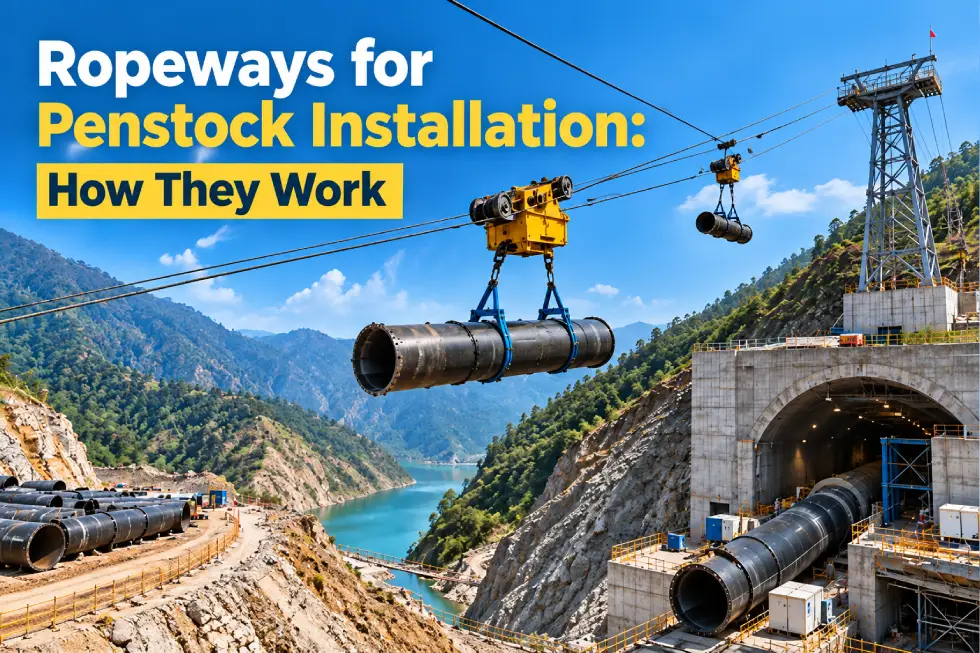
Penstock installation is one of the toughest jobs in a hydropower plant. Penstocks often run down steep mountain slopes. These sites may be far from roads and clear paths. Moving heavy penstock pipes can be very difficult.
Trucks cannot reach many such slopes. Cranes may also fail to reach the exact location. M & M Ropeways uses aerial ropeways and cable crane systems for these challenging sites. With 35+ years of experience and 120+ completed projects, the company handles penstock installation in remote areas. Its systems can also transport pipe sections safely at high altitudes.
What Is a Penstock?
A penstock in a hydropower plant is a large pipe. It carries water from a reservoir or forebay to a turbine. The water pressure turns the turbine and helps generate electricity. Penstock pipe material is usually steel or reinforced concrete. These materials can handle high pressure and heavy loads. A penstock pipe can run for hundreds of meters down a hillside. This makes penstock installation a complex job. It needs careful planning from the first site visit.
Why Penstock Sites Need Special Transport
Most hydropower projects sit in hilly or mountainous regions. Roads are often missing or too weak to support heavy trucks, and building new roads solely for installation can take many months. This also disrupts the natural slope and increases the risk of landslides in the area. On top of this, a penstock pipe comes in large, heavy sections, and each piece must reach an exact point on the slope. Cranes and trucks cannot always reach these points safely. This is exactly why penstock installation in remote terrain depends so heavily on ropeway transport. Hydropower sites generally sit near forests, rivers, or protected land. So cutting trees or grading slopes for roads can harm the local ecosystem. A ropeway system for pipe transport avoids most of this disturbance because it runs overhead, above the natural terrain. You can read more about this challenge in our post on aerial ropeways for difficult terrain construction.
Types of Ropeway Systems M&M Uses:
M & M Ropeways uses different systems depending on the site and load:
- Material ropeway system: used for moving pipe sections, tools, and general construction material
- Cable crane: handles heavier, bulkier loads across wider spans, common on large cable crane hydropower projects
- Passenger or combined ropeways: move workers alongside material transport on the same line
Each penstock ropeway uses a mix of fixed towers, moving cables, and load-bearing trolleys. The choice depends on slope angle, distance, and the weight of each section, and engineers select the right ropeway for hydropower projects after studying these site conditions closely. Some projects need more than one line, so longer routes may use relay stations along the slope for steep slope pipeline transport. This breaks the work into shorter, more manageable stages and keeps cable tension within safe limits across the full route.
How M & M Ropeway Systems Work for Penstock Installation
M & M Ropeways follows a clear process from survey to final placement. It starts with a detailed site survey, where engineers study the slope, the pipe route, and the total load requirements, and then plan the best ropeway alignment for the project, checking anchor points at the top and bottom of the slope. Once the route is fixed, teams set up loading and unloading stations at the top and bottom of the line, with strong anchor towers holding the main cables firmly in place. Every anchor point is tested for load capacity before regular use begins.
Next, the main carrying cables are strung across the slope, and a trolley or carriage system runs along these cables smoothly. This carriage holds and moves each penstock pipe section safely, while operators control the speed and load from the ground station. Each section is loaded onto the trolley at the base station, and the ropeway carries it up or down the slope steadily. Workers guide the pipe to its exact point on site, and this process repeats until all sections are in place. Before regular operation, every system also goes through load testing, where cables, anchors, and trolleys are checked for safe working limits. This step protects both the pipe and the workers on site throughout penstock installation.
Benefits of Using Ropeways for Penstock Projects
Choosing ropeways for penstock installation brings several advantages over conventional material transport:
- Faster construction timelines, since ropeways skip the need for building new roads and save weeks or months of work
- Cost efficiency, since a ropeway system for pipe transport often works out cheaper than temporary roads over the full project timeline
- Lower environmental impact, since the ground stays mostly undisturbed with fewer trees cut and less soil moved
- Access to hard-to-reach sites, since M & M systems operate at altitudes up to 18,000 feet and in temperatures down to -35°C
- Better safety for workers, since ropeways handle the heavy lifting mechanically instead of manual carrying on steep slopes
M & M Ropeways’ Track Record
M & M Ropeways has completed more than 120 projects across different terrains, including hydropower, pumped storage, and dam sites. The company is ISO certified and follows OITAF safety standards throughout. OITAF is the international organization for ropeway transport standards. This means every system used for penstock installation meets recognized safety and engineering benchmarks. With over three decades in this field, the team understands the specific demands of moving a penstock pipe through difficult terrain and works closely with project engineers from the survey stage through final placement. For related work on high-altitude hydropower construction, see our post on ropeways and cable cranes for pumped hydro projects.
Do ropeway systems need maintenance after installation?
Ropeway systems need regular checks once installation work is complete. Cables, anchors, and trolleys should be inspected on a set schedule, which keeps the system safe for any future material transport needs.
Planning a hydropower project in difficult terrain? M & M Ropeways can help with penstock installation, moving pipes and construction materials safely and efficiently across steep sites. Contact the team today to discuss your specific site requirements.
Doubts related to the Penstock ropeway? Here you go.
Q1. What is a penstock used for?
A penstock carries water from the reservoir toward the turbine, and the water pressure spins the turbine so electricity gets produced. When the penstock installation is done properly, the power plant runs more safely and also more efficiently.
Q2. Why would someone use a ropeway for penstock installation?
A ropeway is helpful because it can reach steep, remote spots without building new roads or extra groundwork. They tend to save time, reduce environmental stress, and make workers safer during the whole penstock installation process, so it becomes a practical method for hydropower landscapes.
Q3. How high can M & M ropeway systems operate?
M & M Ropeways can build ropeway systems that operate at altitudes up to 18,000 feet, and in addition, they keep working properly even when temperatures drop to -35°C, even in pretty harsh conditions.
Q4. Are ropeway systems safe when handling heavy loads?
Yes, these systems are designed for heavy loads and for repeated everyday use too. M & M Ropeways follow ISO and OITAF safety standards closely, and before regular operation, each anchor point and each cable are tested.
Q5. How long does a penstock ropeway setup take?
Project timelines vary by terrain, distance, and total load, though most ropeway setups for penstock installation take a few weeks once site surveys and planning are complete.