
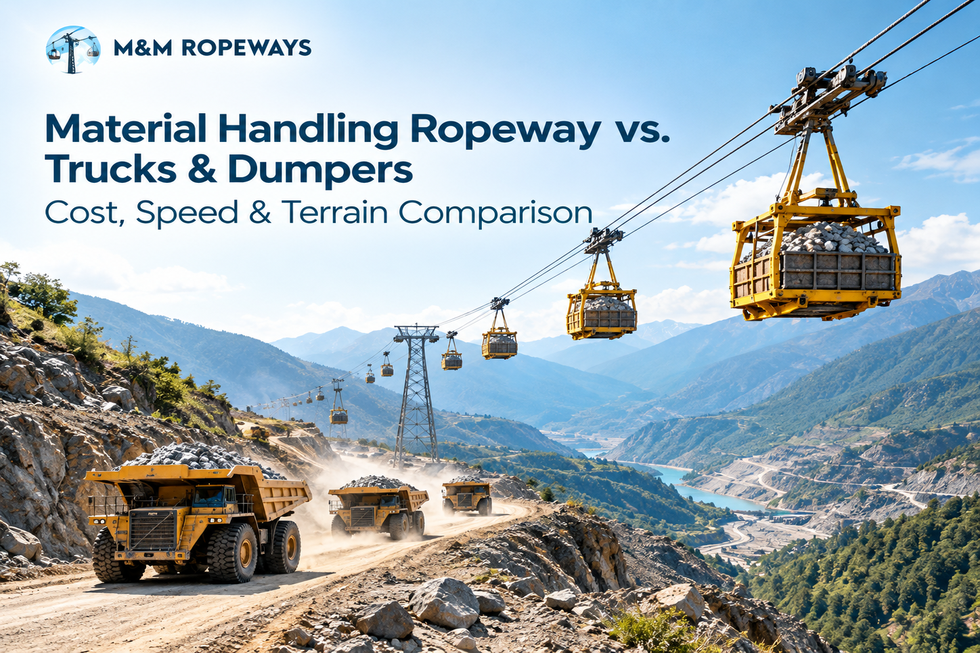
A material ropeway for mining and construction outperforms trucks and dumpers on almost any route where terrain, distance, or weather work against road transport. Trucks can still win, but only where the route is short and flat. It can also work where the tonnage is low enough that a fixed line doesn’t pay for itself. However, everything else is a question of numbers: tonnage, distance, gradient, and how many days a year your roads actually stay open.
This comparison exists because most cost sheets for mining, hydropower, and construction projects still default to trucks and dumpers without running the terrain math first. And that’s the default choice that quietly inflates operating costs for years. Below is a direct, numbers-first comparison of material handling ropeways vs. trucks and dumpers across cost, speed, and terrain. So the decision gets made on data instead of habit.
What’s the Real Cost Difference Between Ropeways and Trucks?
Is a ropeway cheaper than trucks for material transport? A ropeway carries a higher upfront cost per kilometre but a lower cost per tonne moved over its working life. Trucks REVERSE that equation completely. They are cheap to start but expensive to sustain. That first half, cheap, is easy to see on paper. A single-line material handling ropeway typically runs Rs 20 to 50 crore per kilometre to build, depending on terrain and span length, a gap that shows up clearly in any ropeway vs road vs railway cost comparison. Trucks need no fixed-route infrastructure at all. The capital cost is just the fleet, scaling linearly with tonnage, which is exactly why trucks look cheaper on day one.
That upfront gap tells only half the story, though. Diesel truck haulage cost in mining India runs higher than most budgets plan for, and government-fixed transport rates for ore in mining states. In Goa have run between Rs 12 and Rs 17 per tonne per kilometre, the kind of ropeway vs truck cost per tonne per km gap that drives fuel cost share up on every haul. That rate climbs every time diesel prices rise, and it climbs again and again on any stretch with a steep grade. Laden trucks burn noticeably more fuel per kilometre on an incline than on flat ground.
A ropeway’s running cost moves in the opposite direction. It’s mostly electricity and one operator per line, with maintenance concentrated at towers and stations rather than spread across an entire fleet and road network. Insurance, tyre wear, and driver shortages, the costs that quietly eat into a trucking budget, don’t apply here at all. Over a five- to ten-year operating window, this is usually where the total cost of ownership flips in the ropeway’s favour, even on projects where the truck fleet looked cheaper in the first year’s budget.
| Factor | Material Handling Ropeway | Trucks & Dumpers |
| Upfront cost | Rs 20–50 crore/km (cargo system, terrain-dependent) | Low per-unit cost, scales with fleet size |
| Route length | Straight line, shortest possible | Follows road alignment, often far longer |
| Running cost driver | Electricity + one operator per line | Diesel (up to 30% of budget), driver wages, tyres, road upkeep |
| Cost per tonne-km trend | Falls as volume rises | Stays high, tied to fuel price and gradient |
| Land needed | Tower foundations + terminals only | Full road width, entire route length |
How Fast Is a Material Handling Ropeway Compared to a Dumper Truck?
Haul truck vs. ropeway efficiency usually comes down to one thing: a ropeway travels in a straight line, while a road has to bend around every ridge and gorge in its path.
That bend costs more than most people realize. A hill road built around the same terrain can stretch a one-kilometer straight shot into two or three kilometers of switchbacks. And nobody puts that number on the cost sheet. It shows up quietly instead, first in the construction bill, then again on every trip a truck makes for years afterward. A ropeway skips all of it. It avoids the blind-curve overtaking and the convoy spacing that trucks have to deal with on a haul road barely wide enough for two vehicles. There’s simply no road to compete for, just a straight line on a fixed loop, getting the job done in a fraction of the time.
Trucks retain an edge in one specific scenario: irregular, one-off hauls where the pickup and drop points shift from week to week. A ropeway line is fixed between two points, while a truck fleet can be rerouted the same afternoon. For a stable, repeat haulage corridor, though, the ropeway’s straight-line route consistently wins on trip time once terrain gets involved.
Why Do Trucks Struggle on Steep or Difficult Terrain?
Trucks lose efficiency fast as gradient increases, and most mining haul roads cap the maximum grade near 8 to 12% for exactly this reason. Here is a truth too: Steeper roads don’t just slow trucks down. They burn more fuel measurably:
- Engineering studies on laden mining dump trucks show that every one percentage point increase in road grade adds roughly 20% more fuel consumption per trip.
- A route that climbs steadily through a mountain corridor compounds this penalty across every single load. Every single day, for the life of the project.
- Most mining haul roads are capped near 8 to 12% grade for exactly this reason, which limits how steep a truck route can practically go.
But here is some good news: “A material handling ropeway sidesteps this problem by design”
- Ropeway systems routinely operate on inclines well beyond what any wheeled vehicle could climb safely, since the load hangs from a cable rather than depending on tyre traction and engine torque against gravity.
- Terrain that forces a truck route into long switchbacks or steep, fuel-hungry grades is exactly where steep terrain material transport solutions like a ropeway perform at their best.
- Deep valleys, mine pits, and hydropower approach roads are exactly the gradient-sensitive sites where this advantage matters most.
This is precisely the kind of terrain where M&M Ropeways becomes directly relevant. As a leading ropeway manufacturer in India, the company carries a three-decade track record across difficult Himalayan and high-altitude terrain. Stretching all the way to the Siachen Glacier, one of the most extreme sites on the planet
Do Ropeways Keep Running When Roads Shut Down?
YES, without question. A properly engineered ropeway keeps operating through weather conditions that regularly shut down hill roads.
Mountain states lose road access every single monsoon, not occasionally, but every year, like clockwork. Landslides bury stretches of highway overnight. Waterlogging turns haul roads into unusable mud. Fog cuts visibility to nothing on blind mountain curves. In bad seasons, entire stretches of the road network in hill states like Himachal Pradesh remain blocked at once, sometimes for days, which is exactly why ropeway installation project planning treats weather resilience as a core design factor. And this is the time when truck transport begins to shut down completely. Because of this, project timelines stall, costs pile up quietly in ways that never show up on the original budget sheet. A ropeway sidesteps the failure points that bring roads to a standstill. Landslides don’t need clearing. Culverts don’t wash out. Trucks don’t queue up behind one vehicle that couldn’t make the climb. Once engineered for the local climate, a ropeway line holds its schedule right through the weeks when road transport in the same terrain shuts down completely.
What’s the Break-Even Point Between Ropeway and Truck Haulage?
There’s no single number that works for every project. The break-even point depends on three variables working together: tonnage, distance, and terrain difficulty. Here’s the practical way to think about it, instead of a flat “ropeway is always cheaper” claim that doesn’t hold up on every site:
- High tonnage, long distance, difficult terrain: ropeway almost always WINS on total cost of ownership within a few years of operation.
- Low tonnage, short distance, easy terrain: trucks usually stay cheaper since the ropeway’s fixed cost never gets paid back.
- Medium tonnage, but terrain that inflates road distance or forces steep grades: this is where ropeways typically cross the break-even line faster than expected. Why? Because the terrain penalty on trucks is what road-only cost sheets tend to miss.
The single biggest sizing error project teams make is comparing ropeway CAPEX against truck CAPEX alone, without ever running a material handling ropeway vs conveyor system comparison for the flatter stretches of the same route. The real comparison is total cost per tonne moved over the project’s working life, terrain penalty included.
Can a Ropeway Handle the Same Tonnage as a Truck Fleet?
Yes, it can, and does, routinely. A material handling ropeway can match or exceed a truck fleet’s tonnage capacity, and it does so on a fixed, predictable cycle rather than a variable one.
Capacity scales with system design: cable speed, bucket or carrier size, and the number of carriers in continuous motion. A well-designed line moves material around the clock in a steady, calculable flow, which makes production planning simpler than juggling a truck fleet’s variable cycle times, breakdowns, and driver shift changes. Scaling up tonnage on a truck fleet means buying more trucks, hiring more drivers, and widening more roads. All of which take time and add ongoing cost. Scaling up a ropeway usually means adjusting carrier spacing or cable speed on infrastructure that’s already built, which is a far smaller intervention once the line is operational. This is also where fleet risk quietly disappears. A single truck breakdown removes one vehicle’s worth of capacity from the day’s haulage. A ropeway engineered with adequate redundancy keeps moving material even during routine maintenance windows.
Ropeway vs. Trucks & Dumpers: Which Should You Choose?
Neither system WINS everywhere. The best transport option for hilly construction sites comes down to terrain, tonnage, and how long the haulage corridor will stay in use.
Choose a Material Handling Ropeway When:
- The terrain is steep, mountainous, or cut through by gorges and rivers
- The haulage route is meant to run for years, not just a few weeks
- Building a road would be expensive, restricted, or environmentally sensitive
- Monsoon and weather-driven closures are a risk that keeps coming back
Choose Trucks & Dumpers When:
- The route is short, flat, and easy to build a road on
- Pickup and drop-off points shift often, not fixed for long
- The tonnage doesn’t justify the cost of fixed-line infrastructure
- The project itself is short-term, not something built to last years
The Bottom Line
Trucks remain the practical default for short, flexible, low-volume hauls. But the moment terrain, distance, or weather enters the equation, though, that default stops making sense. A material handling ropeway usually costs less per tonne moved, runs on a faster and more predictable cycle, and keeps working through the exact conditions that shut trucks down.
M&M Ropeways has spent over three decades designing and installing industrial cableway and material handling ropeways across some of the toughest terrain on the planet. All, including high-altitude sites like the Siachen Glacier. If your project is weighing ropeway against truck haulage, talk to M&M Ropeways. You’ll get a comparison built around your actual tonnage, distance, and terrain.