
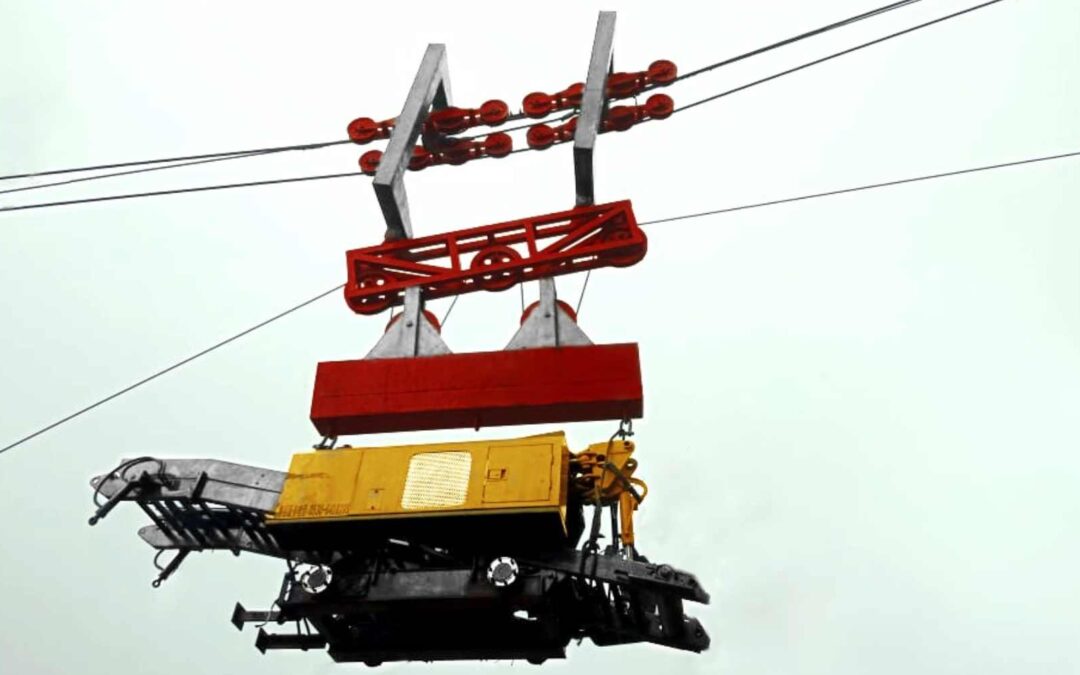
When you need to move a lot of material around sites, you usually hear about two main options: material handling ropeways and conveyor systems. These two systems have been used for some time, and they work well. You can find them in mines, cement plants, limestone plants, and construction sites. They can both handle large amounts of material and keep working for a long time.
What works well for one site might not be the best choice for another site.
Terrain, distance, elevation change, and throughput requirements all influence which system is really the best on the ground. Research published in ScienceDirect confirms that material handling costs account for 15% to 70% of total manufacturing expenses in industrial operations. If you pick the wrong system, it can cost even more.
So, between a material handling ropeway vs. a conveyor system, which one is more efficient for your operation? Let us take a look at this.
The Basics of Material Handling Ropeways and Conveyor Systems
To really get the difference between the two, we need to know what each system is used for.
Conveyor Systems
Conveyor systems are a way to move materials on the ground. They work well on land or on land that is not too steep. They keep moving in a continuous loop, taking materials from where they are taken out of the ground to where they are processed or stored.
Modern conveyor systems handle capacities between 500 TPH and 11,000 TPH. This depends on how wide the belt is and how fast it moves. They are widely used across coal, iron ore, limestone, and copper concentrate operations where the terrain is predictable and the distances are manageable.
The limitation is clear, though. Standard belt conveyors handle inclines only up to 18 degrees. Beyond that, performance drops and material spillage become a substantive issue.
Material Handling Ropeways
This design removes terrain as a barrier. Aerial ropeways work well in certain areas. They operate efficiently on slopes, when crossing rivers, in forests, and in mountains, where building infrastructure on the ground is hard or too costly.
Industrial material ropeways move a lot of material. Between 100 tons per hour and 450 tons per hour. They keep working over long distances. From 2 kilometres to over 75 kilometres. Ropeways handle material well.
For operations where ground conveyors fall short, M & M Ropeways offers the Sandwich Belt High Angle Conveyor. A system that bridges both technologies by handling inclines up to 90 degrees.
Key Differences Between Ropeways and Conveyor Systems
A ropeway vs belt conveyor comparison rarely comes down to one number. The meaningful differences sit in infrastructure requirements, land usage, and how each system handles the terrain between two points.
There are other meaningful differences. These are mainly about infrastructure needs, land use, and how each system deals with the ground between two places.
Infrastructure Requirements
Conveyor systems need a continuous ground-level structure. That means they need foundations and frames to hold them up and a clear path from the start to the end. If the ground is not flat, that is a problem, and more engineering is needed. Ropeways are different; they just need a few points to attach to and some towers to hold them up. The cable does all the work. It goes across valleys, rivers, and hills without touching the ground in the middle.
Land Usage
Conveyors take up a lot of space on the land they travel on. For every metre of the path, the land has to be cleaned up and made flat. People have to look after it. Ropeways pass over the land. They do not take up space on the ground, which makes Ropeways a lot better for places that are very sensitive to the environment or have many rules to follow.
Installation Complexity
When you are talking about Installation Complexity, you have to think about Conveyors. They need extensive civil work before you can even start installing the parts. Ropeways can be installed and commissioned in a fraction of the time, particularly on difficult terrain where road access is limited or absent entirely.
Flexibility and Scalability
Belt conveyor systems are fixed to their route. Rerouting one is a major project. Ropeways offer more adaptability. You can move loading points along the cable. You can also add carriers to increase capacity. This can be done without rebuilding the system.
At a Glance: Ropeway vs Belt Conveyor
| Factor | Material Handling Ropeway | Belt Conveyor System |
| Infrastructure | Towers and anchor points only | Full ground-level structure required |
| Land usage | Minimal (passes over terrain) | High (requires a cleared route) |
| Installation | Faster, less civil work | Extensive civil and foundation work |
| Terrain flexibility | Works on any gradient | Limited to 18 degrees incline |
| Scalability | Add carriers, adjust loading points | Rerouting requires a major overhaul |
Cost Comparison: Ropeways vs Conveyor Systems
Initial Installation Cost
Conveyor systems carry a higher upfront cost on flat terrain. A system handling 300 TPH over 1,000 feet can run between $275,000 and $400,000 in equipment and structure alone.
Maintenance and Operational Cost
Aerial ropeways are a way to cut down on costs. They can save you around 30 to 40 percent on operational costs when you compare them to conventional transport methods. With energy savings reaching up to 90 percent on descending load routes.
Long-Term ROI and Cost Per Ton
For operations running continuously over long distances and difficult terrain, ropeways deliver a lower cost per ton transported over time. Conveyors offer a stronger ROI on flat, high-volume, short-distance routes where civil work is minimal, and throughput is the priority.
The terrain between your two points determines which investment pays back faster.
Best Use Cases: When to Choose What?
Choose a Material Handling Ropeway When:
- The terrain is uneven or mountainous.
- The transport distance is long.
- Environmental or land restrictions apply.
- Projects in India’s hilly regions.
Choose a Conveyor System When:
- The terrain is flat or mildly inclined.
- The operation is high-volume and continuous.
- The distance is short to medium.
If the site is flat and the volumes are high, conveyors win. If the terrain is difficult and the distance is long, ropeways are the stronger investment.
Why Many Operations Use Both Systems Together
For most industrial sites, the choice between a ropeway and a conveyor is not binary. Many mining and bulk material operations use both.
Conveyors handle the extraction zone in a very efficient way. They do their job well. Once the material gets to the bottom of a tough area, a ropeway takes over. The ropeway carries the material across valleys and steep hills or areas where we cannot disturb the environment to the processing facility, on the side. Conveyors and ropeways do what they were made to do. Each conveyor and ropeway system does what it was built for.
The critical point in this setup is the transfer station where both systems meet. Modern automated transfer stations synchronize flow rates between the conveyor and the ropeway. Sensors monitor material volume, adjust belt speeds, and regulate carrier loading to maintain consistent throughput without delays.
M & M Ropeways offers advanced monitoring and control systems that track belt speed, material flow, tension forces, and equipment health across both systems simultaneously. For a detailed breakdown of how this integration works across mining operations, refer to our blog on Integrating Aerial Ropeways and Conveyors in Mining.
The Bottoms Up
Most operations do not get this decision wrong because of the budget. They get it wrong because no one mapped the system to the site before the order was placed.
M&M Ropeways designs both material handling ropeways and conveyor systems. Before we recommend anything, we look at your terrain, your distance, and your throughput needs.
If you are still weighing a material handling ropeway vs. a conveyor system for your project, let us make that decision easier.
Talk to M&M Ropeways. Get a site-specific recommendation.