
Picking the right transport infrastructure is never just a budget decision. In difficult terrain, it becomes a decision that shapes the entire project. Getting it wrong directly means the project bleeds money for years.
Infrastructure decisions in difficult terrain are high-stakes. A mountain railway can cost 15 to 100 times more per km than the same route done by a ropeway. A hill road doubles in cost the moment tunnels and switchbacks enter the picture. Yet most planners compare these three modes without a clear cost breakdown in front of them.
This blog fixes that. Here is a direct comparison of ropeway, road, and railway infrastructure costs across construction, land use, and long-term maintenance.
Why Terrain Changes the Cost Equation
On flat ground, roads and railways are the default option. Because they scale well, their costs are predictable. And most of the world’s existing networks were built on exactly this logic.
But when terrain changes, like in mountains, gorges, or dense urban corridors, that logic breaks down fast. Roads in hilly terrain need switchbacks. That means more kilometres of road to cover the same straight-line distance. Railways in mountains need tunnels and bridges, both slow and expensive to engineer.
But construction cost alone rarely reflects what a project actually costs. Land acquisition, maintenance, clearances, and build time all factor in. In difficult terrain, every single one of these gets heavier. That is where the real difference between the three modes shows up.
Construction Costs: What the Numbers Really Say
Costs shift based on terrain and mode. Here is what the numbers look like for all three modes of transportation in hilly areas.
Roads: The Familiar Choice That Gets Expensive Fast
A two-lane road on flat ground costs between 3 and 6 crore per km. That number feels reasonable until the terrain tilts. Now add switchbacks, retaining walls, and mountain tunnels. And see how the same road becomes a different project entirely. The four-laning of the Nerchowk-Kullu highway in Himachal Pradesh cost around 65 crore per km. That gap between 6 and 65 is what mountain terrain looks like on a budget sheet.
Railway: Reliable on the Plains, Expensive in the Peaks
Railway works beautifully on flat ground. Standard flat-terrain rail in India costs between 8 and 15 crore per km. Manageable. Predictable. Then the terrain changes. The Udhampur-Srinagar-Baramulla Rail Link tells you exactly what happens next. 272 km. 36 tunnels. 943 bridges. Nearly 5 billion dollars in total project cost. The distance stayed the same. The ground did not.
Ropeway: The Straight-Line Advantage That Changes Everything
A basic single-line ropeway system costs around 20-50 crore per km. Urban multi-station systems run higher. But here is what changes everything. Ropeways travel in a straight line. In hilly terrain, a road might need 3 km of switchbacks to cover the same distance that a ropeway connects in 1 km. That reduction in total route length is what brings ropeway infrastructure cost down on a total project basis, even when the per-km figure looks comparable.
Costs are indicative. Actual figures vary by terrain, project scope, and specifications.
Land Acquisition: The Hidden Cost
Everyone talks about construction costs. Almost nobody talks about this one: Land acquisition. And in difficult terrain, it can cost more than the construction itself before a single machine moves.
Roads need a wide right-of-way strip. In populated or forested mountain areas, that means displacement, legal clearances, and compensation costs that can run into millions before a single kilometre of construction begins.
Railways need more land still. Stations, marshalling yards, buffer zones, and level crossings all require substantial ground. In protected forest zones or steep terrain, securing that land takes years.
But ropeways are different. They only need land for tower foundations, which have a narrow vertical footprint, and for terminal stations at each end. The ground in between stays completely untouched. In environmentally sensitive or legally complex regions worldwide, this low land requirement is one of the biggest financial and regulatory advantages of ropeway infrastructure.
What It Costs to Keep It Running
Construction is a one-time expense. Maintenance runs every year.
Roads in hilly terrain need constant attention. Erosion, landslides, and seasonal damage require ongoing resurfacing. In many mountain regions, roads close for weeks or months. That creates indirect economic losses on top of the direct repair bill.
Railways carry high recurring costs. Track inspections, signal systems, rolling stock servicing, and station upkeep all run year-round. Mountain rail adds significant complexity to each of those.
Ropeways are built differently. Most maintenance happens at stations and towers. A single power plant drives the entire line. One operator can manage the full system. Fewer moving parts means less to maintain and lower annual spend.
They also run on electricity, which keeps fuel costs low and direct emissions close to zero over the operational lifetime.
A Side-by-Side Comparison
Here is how all three modes stack up across the key cost and performance factors.
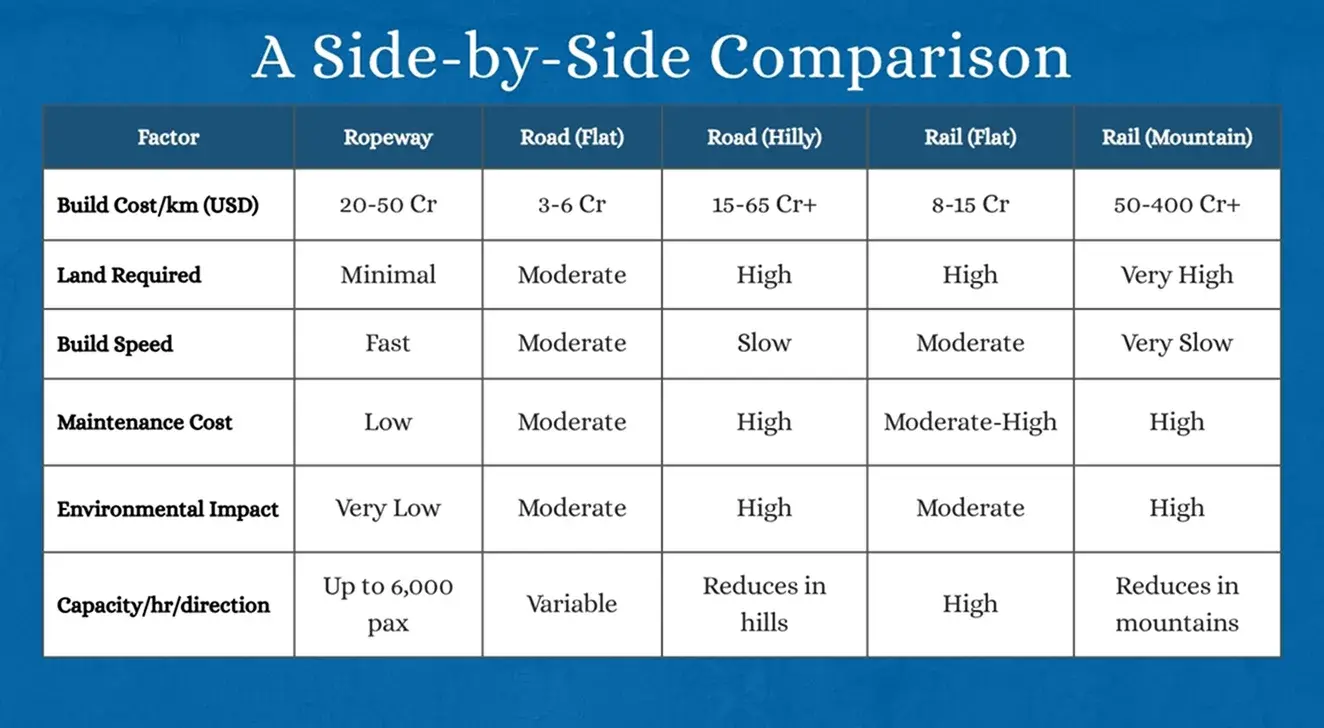
Costs are indicative figures for India in INR (crore per km). Actual figures vary by terrain, project scope, and specifications.
The Right Mode for the Right Terrain
No single mode wins every project. The right choice comes down to three things: terrain, volume, and what infrastructure already exists around the site.
Choose Ropeway When:
- Terrain is steep, mountainous, or crossed by gorges, rivers, or dense urban gaps
- Land acquisition is hard, costly, or restricted due to the environment or the law
- You need last-mile urban connectivity without digging roads or laying metro tracks
Choose Road When:
- Terrain is flat to moderately hilly, with high freight or passenger volumes
- An existing road network needs to be extended or upgraded
Choose Railway When:
- Very high volumes need to move over long, flat corridors
- Freight at scale is the priority, and an existing rail grid is nearby
The most expensive mode is not always the wrong one. And the cheapest is not always the right one. It comes down to where you are building and what you are moving.
The Projects That Prove the Point
Numbers count most only when they come from real ground. Here is what India’s own infrastructure projects show.
In Uttarakhand, the Sonprayag to Kedarnath ropeway covers 12.9 km at Rs. 4,081 crore. The alternative was a grueling multi-hour trek or a road that the terrain made nearly impossible to build safely. The ropeway cuts the journey to under 30 minutes.
Compare that to the Nerchowk-Kullu four-lane mountain highway in Himachal Pradesh. That road, 74 km long, came in at Rs. 4,800 crore, roughly Rs. 65 crore per km. A ropeway on the same terrain would have needed a fraction of the distance and far less land.
Then there is the Udhampur-Srinagar-Baramulla Rail Link. A 272 km mountain railway with 36 tunnels and 943 bridges. Total cost: nearly USD 5 billion. That is what railway infrastructure development costs look like when the terrain offers no easy path through it.
The pattern across all four is the same. In difficult terrain, ropeway systems consistently deliver more connectivity per rupee spent.
Ropeways Offer More Than Cost Savings
The financial advantage in difficult terrain is clear. But ropeway transportation benefits go beyond the numbers. Give a look at some of them that are listed below:
- They operate in weather conditions that close mountain roads
- They run at fixed, predictable speeds with no traffic congestion
- Full electric operation makes net-zero transport achievable
- They support tourism and local economic activity in scenic or remote destinations.
The Final Verdict
In flat, high-volume corridors, ROAD and RAILWAY remain practical choices. They have established supply chains, proven cost structures, and existing network connections to work with. But in difficult terrain, they can’t work smoothly.
Ropeways come out as the best solution there. Why? They need fewer kilometers, less land, shorter build timelines, and lower maintenance budgets. On a total project cost basis, they are often the most cost-effective transport infrastructure available for mountain and hard-to-reach locations.
If you’re assessing ropeway infrastructure for a project, M&M Ropeways is a prominent ropeway manufacturer in India. We have 3+ decades of ropeway industry experience that includes designing, manufacturing, and installing ropeway systems across some of the world’s most challenging terrain, like the Siachen Glaciers.
Reach out and talk with us about what your project really needs. Let’s align on the essentials, so you get a suitable arrangement.