
Moving raw materials across mountains, rivers, gorges, and remote terrain is one of the biggest logistical challenges that heavy industries face all the time. Here, trucks seem like the obvious answer until you realize they need roads. But roads need forests cleared, ecosystems disturbed, and constant upkeep that never really ends. And if the monsoon season or a snowstorm hits, then the whole supply chain simply stops.
But an industrial ropeway system changes this equation. How? By lifting material transport above the ground. The plus point is that ropeways bypass the need for a road network and cut out diesel-heavy hauling. However, they run on electricity, which is being supplied by renewable sources at an increasing rate.
The result? A modern transportation solution. That is faster, cleaner, and purpose-built. Hence, the shift to aerial transport is a smart and environmentally friendly move. Especially for industries operating across mining, hydropower, tea, agriculture, and defence, where geography is non-negotiable.
Ropeways vs. Trucks: What the Numbers Actually Show
A diesel truck emits roughly 120–150 grams of CO₂ per tonne-kilometer. An electrically powered ropeway? Between 5 and 20 grams. That is not a marginal difference. What is this really? A near-complete elimination of transport emissions over the same route.
A single ropeway tower occupies less than 2 square meters of ground. A road carrying the same load clears 8 to 12 meters of width, continuously, across every kilometer it covers.
Industries that have made the switch report operating cost reductions of 40–60% on material transport alone. And a well-built ropeway runs for 25 to 40 years, leaving the ground beneath it completely untouched throughout.
Why Ropeways Are Eco-Friendly: The Engineering Case
The question of why ropeways are eco-friendly has a concrete engineering answer. Here is what the technology actually delivers:
- Zero Road Construction: Aerial ropeways can cross over rivers, deep valleys, and steep hills without breaking a square foot of land. By avoiding the need for roads at all. This prevents soil erosion and damage from runoff, as well as deforestation.
- Electric-Powered Operation: Ropeways are operated using electricity. They can also link the material transport chain to clean energy sources, such as solar, hydropower, and wind. That makes it nearly carbon neutral.
- Low Emissions Per Tonne-Kilometre: When comparing aerial ropeway systems to truck-based road transport over the same distance. Then, Life Cycle Assessment (LCA) studies reveal that the former produces much lower carbon emissions.
- Minimal Land Footprint: The space occupied by the ropeway tower foundations is much less than that of a road. This directly means that the subsurface remains completely unchanged, so its natural topography, native vegetation, and drainage remain undisturbed.
- Reduced Noise and Air Pollution: The cableway material handling system runs much more silently, without exhaust emissions. That helps reduce air pollution and noise versus convoy trucks. Especially important in sensitive areas of the environment or close to humans.
- Reduced Resource Consumption and Waste: A well-designed ropeway can last 20–40 years on a known maintenance schedule, avoiding frequent fleet replacement.
Key Benefits of Ropeway Transport for Industries
The benefits of ropeway transport for industries go beyond environmental impact. The operational advantages are equally compelling:
| Benefit | What It Means for Your Industry |
| Continuous Operation | 24/7 material flow without driver shift limits or road restrictions |
| Terrain Independence | Crosses valleys, rivers, gorges, and steep gradients that trucks cannot navigate |
| Low Operating Cost | Fewer mechanical parts than a truck fleet; predictable, planned servicing |
| High Payload Capacity | Systems handle from 500 kg to 10,000 kg or more per carrier |
| All-Weather Resilience | Engineered to operate in high winds, sub-zero temperatures, and heavy snowfall |
| Faster Project Timelines | Continuous aerial delivery accelerates construction and mining schedules |
| Lower Carbon Footprint | Electric drive, no exhaust, minimal land use & built for sustainability targets |
Where Industrial Cable Transport Systems Have a Significant Impact
Mining Ropeway Transport
In mountainous mining regions, ore sits deep inside the mountain while processing facilities are in the valley, and no viable road exists between them. Whereas mining ropeway transport directly fills this gap. Bulk minerals are transacted nonstop between points of extraction, through aerial carriers to hub processing centres. This avoids costly road haulage with equipment wear and ensures supply flow in inclement weather or ongoing seasonal closures.
Hydropower and Dam Construction
Hydropower construction sites are often found deep in river valleys with mountains that are too steep to cut paths through. A cableway material handling system carts cement, reinforced steel, shutters, and heavy machinery right across the valley. This is often over a kilometre or more. The system is more cost-effective and quicker than any road-based option and avoids the ecological disruption of access on valley floors.
Tea Estates and Agricultural Transport
For tea estates carved into steep hillsides, taking freshly plucked leaves down to processing factories is a daily, labour-intensive trial. But a material ropeway system automates the movement of this. By optimising the time between harvest and processing, reducing strain on workers, and ensuring quality in tea by facilitating timely turnarounds.
Defence and High-Altitude Supply
In military high-altitude deployments, where roads are both absent and enemy fire will make them reliable only in terms of delivering the ‘junk’, aerial cableways provide an under-the-radar supply line. How? With food or ammunition from one end of the town to the other and construction materials transported by cable. They are also used for casualty transport in areas where ground access is impossible. Therefore, they are a key element for military logistics in extreme environments.
How an Aerial Ropeway Material Transport System Works
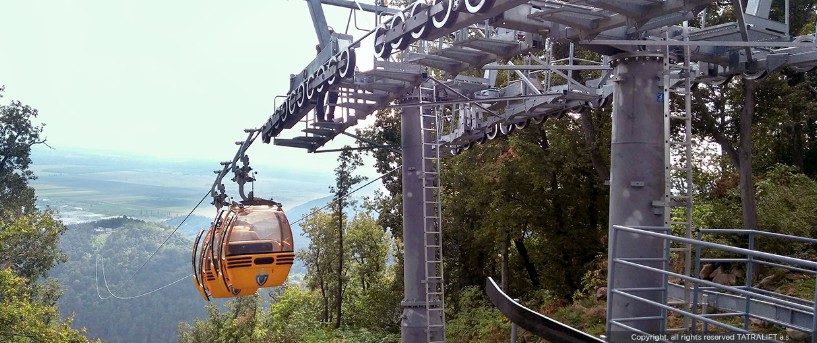
The system is simpler than most people expect. Carriers like buckets, open platforms, or enclosed cabins hang from a rope stretched between two terminal stations. This is held up along the way by a series of towers. A drive unit at one end powers the haul rope, and the carriers start moving, either continuously or in timed cycles, depending on what the operation needs.
What makes it flexible is how it is configured. Lighter loads, shorter distances, and flat terrain are ideal for monocable systems. This employs a single continuous rope for both support and movement. In a bicable system, the two roles are divided into separate ropes that are designed for specific purposes, such as carrying heavier loads, spanning greater distances, or enduring more extreme wind or gradient conditions.
Both configurations can be customised to the exact demands of a site, whether that means adjusting speed, payload capacity, span length, or gradient angles. And through all of it, the ground below stays completely untouched.
What to Look For in an Industrial Ropeway Partner
A ropeway is far above a short-term purchase. It is infrastructure that will run for decades, across terrain that leaves no room for engineering shortcuts. Hence, selecting an ideal partner from the start impacts more than most industries realize. So, you should look for:
- OITAF-compliant engineering
- In-house manufacturing
- ISO certification
- End-to-end service support
- Proven track record in extreme conditions
Here, M&M Ropeways, as a trusted ropeway manufacturer in India, checks every one of those boxes. Along with 35 years of experience, installations at 18,000 feet on the Siachen Glacier for the Indian Army. Furthermore, M&M Ropeways boasts a high payload capacity, ranging from 100 kg to over 10,000 kg.
M&M Ropeways also handled some of the most demanding projects in the world. From mining and hydropower to tea estates and defense, the expertise is real and field-proven.
The Bottom Line
So, wrapping it all up, industries that moved early on sustainability did not do it because regulations forced them. They did it because the numbers made an impact. Lower emissions, lower operating costs, zero road dependency, and a lifespan that stretches across decades. The case builds itself. The terrain is not going to get easier. Environmental regulations are not going to loosen. A well-engineered ropeway system does not just solve a logistics problem. It removes an entire category of operational risk, permanently.
However, if your industry involves difficult terrain, high material volumes, or a genuine need to cut your carbon footprint, this is worth a serious conversation.
Reach out to M & M Ropeways, a reliable ropeway partner in India, today. And get honest engineering expertise applied to your specific challenge.