
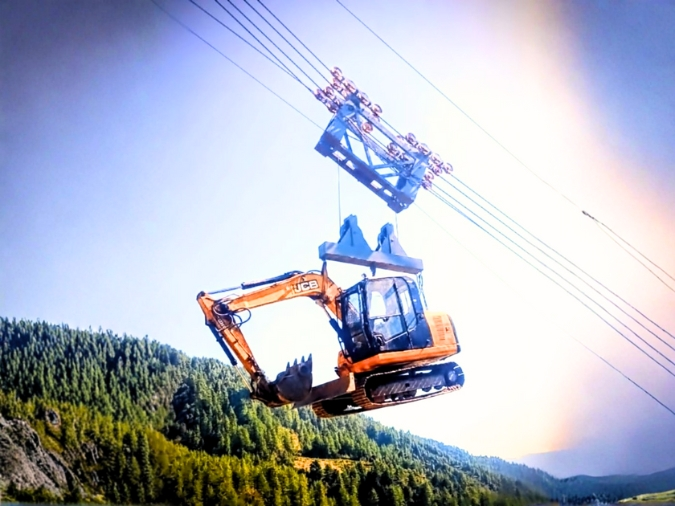
Building a hydropower plant in India’s Himalayan or northeastern states is nothing like what it looks like on a project map. The most powerful sites sit deep inside terrain where roads either do not exist or would cost more to build than the entire project budget allows. And the problem is not just access. Before any structural work can begin, millions of cubic metres of concrete, steel, and equipment need to reach locations that no truck can get to, no excavator can service, and no conventional crane can cover. Most projects stall here, not at the engineering stage, but at the logistics stage.
This is exactly the problem Cable Crane systems were designed for. They’re like the highways in the sky, spanning gorges, lifting heavy roads, and placing concrete with precision at heights and distances.
India’s hydropower sector has relied on these systems for decades. That experience is exactly what M & M Ropeways brings to every project, as one of India’s most trusted ropeway manufacturing companies with over 35 years in the field.
Why Hydropower Sites Push Conventional Logistics to Their Limits
The numbers make the challenge concrete. Road construction in these zones costs in crores per kilometre, takes months to build, washes out every monsoon, and still puts a hard ceiling on load size. Whereas, at a major dam site, where single lifts routinely exceed 20–30 tonnes, that ceiling is hit before the heaviest work even begins. Here, helicopters fill some gaps but collapse as a bulk logistics strategy the moment material volumes scale up.
What this creates is a scheduling problem as much as a logistics one. Pour schedules at dam sites are time-critical, and project teams need material movement. That is continuous, high-volume, and independent of terrain and weather, every single day.
What Cable Crane Systems Actually Do
A cable crane is a high-rise transport system that moves loads across all three axes: Horizontally, Laterally, and vertically. By using track ropes and hoisting lines stretched between anchor towers on either side of a gorge. Unlike any ground-based system, it operates completely above the site, which means terrain has no say in what it can or cannot reach.
Here’s what that looks like in practice:
- Span & Payload: Modern cable crane systems cover distances exceeding 1,600 metres and handle payloads of 30-50 tonnes per lift. That combination of reach and capacity is what makes them viable at large dam sites where no other system comes close.
- Precision Placement: GPS-integrated systems allow concrete buckets to be positioned directly onto active casting blocks with minimal human intervention at heights. This makes every cubic metre of land exactly where the pour sequence requires it.
- All-Weather Operation: Cable crane systems are designed to run continuously through monsoon rain, low visibility, and sub-zero temperatures. The pour schedule doesn’t pause for weather, and neither does the system.
You can learn more about cable crane systems in the construction of dams and hydropower project development in this blog: ‘Cable cranes for the construction of dams’.
Three Configurations for Different Dam Geometries
Not every dam site is the same, which is why cable crane systems come in three primary configurations, each suited to specific topographies and construction requirements.
| Configuration | Coverage Area | Best For |
| Radial | Circular sector | Curved dam faces and irregular valley shapes |
| Parallel | Rectangular | Straight dam faces with high concrete volumes |
| Oscillating | Rectangular | Confined zones where full runway tracks are not feasible |
For pumped storage projects, parallel or radial systems are typically combined with a material ropeway that serves the upstream reservoir independently. This ensures that both construction fronts receive supplies simultaneously, preventing one from waiting on the other.
Core Operations at a Hydropower Construction Site
At an active dam construction site, a cable crane works every single day without a break. And Workers? They mix concrete at a batching plant on accessible ground, load it into steel buckets, and the crane delivers it directly to the active casting block. There are no intermediate transfers, waiting for haul trucks, or stoppages between shifts.
The numbers matter. A high-performance cable crane system can move up to 250 cubic meters of concrete per hour. To match that throughout with trucks, you would need dozens of vehicles or terrain that cannot support even a few.
Beyond concrete, these systems carry formwork panels, reinforcing steel, penstock sections, and turbine components. Penstock installation is where cable transport proves especially valuable. The penstock route runs along the steepest slopes on site. A dedicated material ropeway follows the exact pipe alignment and places each section at its precise installation point.
The Business Case: Cost, Schedule, and Environment
Cable Crane Systems do not just solve a logistics problem. They protect three things every hydropower project cannot afford to lose.
1. Cost
A cable crane installation needs only foundation points at each anchor tower. There is no land acquisition for a road corridor, no surface maintenance budget, and no fleet of trucks burning fuel on steep gradient hauls. Over a three-to-five-year construction programme, those savings compound into a significant cost advantage over conventional road-based logistics.
2. Schedule
Every week, a project slips behind schedule and carries a real financial cost in penalties, delayed generation revenue, and extended mobilisation. But cable crane systems run through monsoon rain, snow, and night shifts without stopping. On projects where concrete pours require one continuous casting sequence, that reliability is not a performance metric. It is a construction requirement.
3. Environment
A ropeway corridor disturbs only the narrow strip between anchor towers. A road cut through the same hillside requires blasting, deforestation, and land clearance. Beyond the ecological impact, that process adds regulatory approvals and delays that push project timelines further back before construction even begins.
Choosing the Right Partner: What to Look for in a Ropeway Manufacturing Company
A cable crane installation is not a standard equipment purchase. It is essential that all systems be site-specific in order to account for factors such as valley geometry, dam dimensions, concrete volumes, and weather conditions. Here, selecting the wrong partner does not just underdeliver. This results in something worse. They create risks that the project cannot recover from.
So, here are the three things that separate a serious ropeway manufacturing company from a general supplier:
- OITAF Compliance: The non-negotiable international standard for cable crane and ropeway design
- End-to-End Capability: One team handling everything from feasibility surveys to after-sales support
- Proven Field Experience: Demonstrated performance in high-altitude, extreme-condition environments
What’s the best part? M & M Ropeways brings all three with 100+ installations across India’s most demanding terrains, OITAF-compliant engineering, and ISO 9001:2015 certification. They offer the kind of ropeway in India expertise that only comes from 35 years of working where conditions are hardest.
Make Your Move Ahead
Wrapping it all up, dam design alone will not determine the success of projects that shape India’s hydropower future. Their success will depend on how well they can transport material volumes measuring millions of cubic metres to locations. Especially ones that are inaccessible by truck, road, or traditional crane.
However, Cable Crane Systems make that execution possible. And choosing the ideal partner to engineer and install them makes the difference between a project that holds its schedule and one that does not.
M & M Ropeways brings 35 years of proven experience, 100+ installations, and end-to-end capability to every project they take on. So, call now on +91 99156 66677 or write to info@mmropeways.com. Contact M & M Ropeways today!