
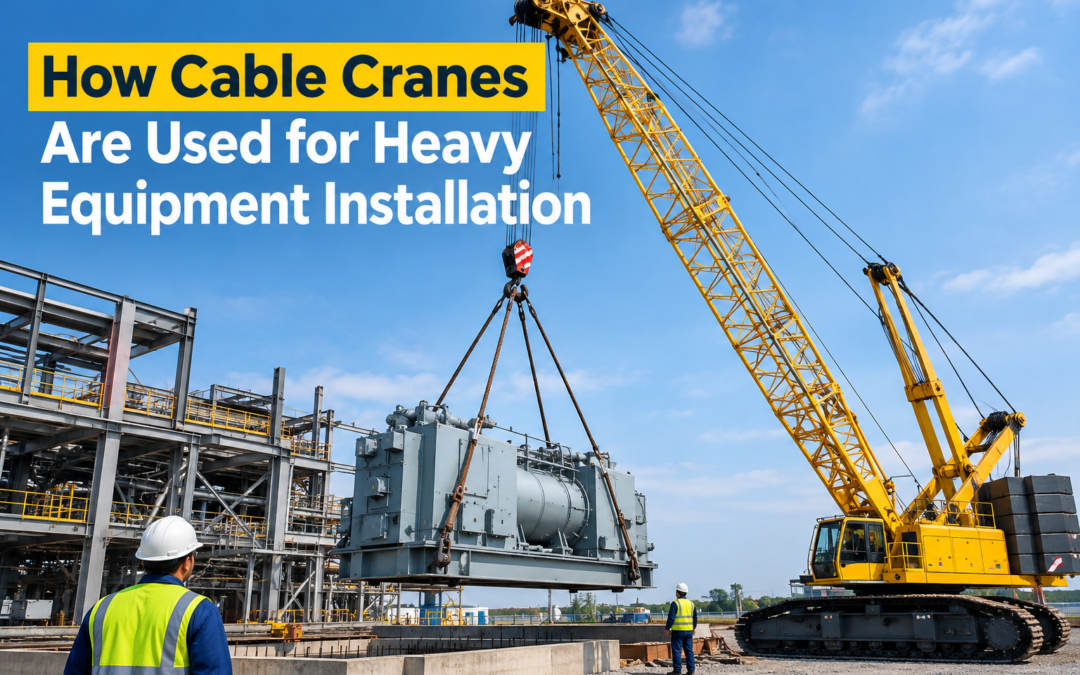
A cable crane installs heavy equipment by suspending it from a track rope stretched across a site and moving it into position using a separate hoisting rope. All without needing roads, ground, a crane pad underneath, or clearance of forest areas. This makes it the standard solution where mobile or crawler cranes simply cannot reach the installation point. This becomes especially clear on hydropower plants, dams, and tunnelling sites. Turbines, transformers, and penstock sections need to land in exact positions across valleys, gorges, or unstable slopes, and a cable crane is often the only equipment capable of making that happen.
This guide from M&M Ropeways walks through how cable cranes lift, position, and place heavy equipment on sites where conventional cranes cannot operate.
What Is a Cable Crane, and How Does It Install Equipment?
So, what is a cable crane actually? A cable crane is a ropeway system built to lift and place loads. It works through three ropes with distinct jobs. The track rope stays fixed between two towers or anchor points and acts as the overhead path. A crab, or carriage, runs along this track rope, pulled back and forth by a haul rope. A third rope, the hoisting rope, lifts and lowers the load independently of the crab’s horizontal movement. It’s this split between horizontal travel and vertical lift that gives a cable crane real control over placement, rather than just dragging the load across a fixed line. These systems are built to OITAF guidelines, the global standard body for rope transportation. OITAF is the one that sets the rules for load limits, rope tension, and structural safety across the industry.
How Does a Cable Crane Actually Lift and Position Heavy Equipment?
Installation with a cable crane follows a controlled sequence, not a single swinging lift. First, the equipment is rigged and connected to the hoisting rope at the loading point. The crane then drifts along the track rope to the precise coordinates above the install site. Once it’s in position overhead, the hoisting rope lowers the load at a controlled speed. While operators make fine adjustments to line it up with foundation bolts, mounting points, or existing structures.
This is where cable cranes offer a real advantage over conventional lifting equipment. A mobile or crawler crane lifts and places a load on a single boom and hook, which means the load can swing with wind, momentum, or ground vibration during the final approach. A cable crane separates horizontal and vertical motion into two independently controlled ropes. The crane locks the load’s position along the track before the hoisting rope even begins lowering it.
That two-stage control removes the swing risk that makes free-hook placement of delicate machinery, like a turbine runner or a transformer core, a genuinely tense moment on a conventional lift. For equipment where even a few centimetres of misalignment means rework, that difference in control matters more than raw lifting capacity.
What Types of Heavy Equipment Can Be Installed Using Cable Cranes?
Cable cranes are the ones that are made to handle a wide range of heavy machinery and structural components. Particularly on sites where equipment must travel across a valley, river, or gorge before installation.
Common examples include:
- Turbines and generator units for hydropower and pumped storage plants
- Transformers and switchgear assemblies
- Penstock pipe sections during erection
- Dam gates and hoisting mechanisms
- Prefabricated structural steel and girder sections
- Tunnelling equipment and support machinery
- Gantry and winch components for other installation systems
The common thread across all of these is weight combined with inaccessibility. If the equipment is heavy enough to need a crane and the site is remote enough to rule one out, a cable crane usually becomes the practical answer.
Cable Crane vs. Mobile/Crawler Crane: Which One Installs Equipment Better?
Neither system is universally better. The “right” pick depends a lot on the ground situation, the travel distance, and how precisely the equipment has to be positioned to land. Mobile and crawler cranes work well on graded, accessible ground with short lift radii. Cable cranes take over once terrain, distance, or ground conditions rule that option out.
| Factor | Cable Crane | Mobile / Crawler Crane |
| Site access needed | None – works over valleys, rivers, and slopes without roads | Requires graded ground and access roads |
| Effective span | Up to several kilometres in a single line | Limited to boom length and working radius, typically under 100 m |
| Load control during placement | Independent horizontal and vertical control, minimal swing | Single-point hook lift, more susceptible to swing |
| Weather resilience | Operates in most conditions across long spans | Boom lifts are more restricted by high wind at height. |
| Setup for remote sites | Higher upfront setup, but built once for the full project duration | Faster setup, but limited if terrain changes across the site |
| Best suited for | Hydropower, dams, tunnelling, pipelines, and mountain sites | Flat or accessible industrial and urban sites |
Why Are Cable Cranes Used for Equipment Installation in Hydropower and Dam Projects?
Hydropower and dam sites almost always sit in terrain that rules out conventional cranes altogether. Powerhouses are frequently built at the base of gorges or valleys, with penstocks running down steep slopes from an intake located far above. Getting a turbine, transformer, or penstock section to its exact final position often means crossing that same terrain that made road access impossible in the first place.
A cable crane set up along the project’s main axis solves this in one continuous installation rather than repeated short lifts. The system can lower a load-bearing structural section into a valley, position a transformer inside a powerhouse pit, or lower penstock segments along a slope for welding and alignment, all from one fixed track. This is also why cable cranes tend to stay in place through the full construction phase of a hydropower or PSP project, rather than being brought in for a single lift like a mobile crane would be.
How Much Weight Can a Cable Crane Lift During Installation?
Cable crane capacity really comes down to how the system is designed. But most modern setups handle loads anywhere from a few hundred kilograms to several tonnes on a single line. For heavier-duty projects built to specific requirements, that capacity goes well beyond even this. M&M Ropeways has designed, manufactured, and installed cable cranes with single-load capacities ranging from 100 kg all the way to 10,000 kg. By covering distances of up to 6,400 metres on a single drive.
That range matters because equipment installation projects rarely involve one uniform load. One hydropower project might require a cable crane for penstock parts weighing a few hundred kilos early on and later for a transformer unit or turbine component weighing several tonnes. A system engineered with headroom across that full range avoids the cost and delay of switching equipment mid-project.
Is Equipment Installation by Cable Crane Safe and Precise?
Yes, when the system is engineered to OITAF standards and operated by trained personnel, cable crane installation is both safe and precise enough for critical machinery like turbines and transformers. The independent control of horizontal and vertical movement, discussed earlier, is the core reason. Because the load’s position along the track is fixed before it descends, the final placement becomes a controlled vertical drop rather than a multi-axis swing.
This matters more for equipment installation than for bulk material transport. Moving concrete or aggregate tolerates some imprecision. Positioning a transformer onto its foundation bolts or aligning a penstock section for welding does not. ISO-certified manufacturing, combined with OITAF-compliant design, gives project engineers a documented safety and quality basis for using cable cranes on installations where the cost of a misaligned lift is measured in weeks of rework, not minutes.
How Do You Choose the Right Cable Crane Manufacturer for Equipment Installation?
Selecting a cable crane manufacturer for equipment installation should come down to five checks:
- Certification: Look for ISO 9001 and ISO 14001 compliance, plus design that meets OITAF standards
- Capacity range: A manufacturer who can actually engineer for both light and heavy loads within the same project
- Track record on difficult terrain: A proven history of installations in mountains, valleys, or other extreme conditions
- After-sales support: Not just installation, but real availability of spare parts and a fast maintenance response when something goes wrong
- Operator training: Whether the manufacturer trains your team to run and maintain the system independently
M&M Ropeways is a cable crane manufacturer in India that meets all five, with ISO 9001:2015, ISO 9000:2015, and ISO 14001:2015 certification, OITAF-compliant design, and installations ranging from standard construction sites to the Siachen Glacier at 18,000 feet, in temperatures below minus 35 degrees Celsius, for the Indian Army. That project record is a rare benchmark for what a cable crane system can be engineered to withstand.
The Final Verdict
Heavy equipment installation on difficult terrain is not a transport problem. It’s a positioning problem, plain and simple, and cable cranes exist specifically to solve it. If your project involves turbines, transformers, penstock sections, or structural components that need to reach a site no road can access, a cable crane manufacturer with proven engineering and OITAF-compliant systems can work out the right solution for your terrain and load requirements.
M&M Ropeways designs, manufactures, and installs cable crane systems for exactly this kind of project, across India and internationally.