
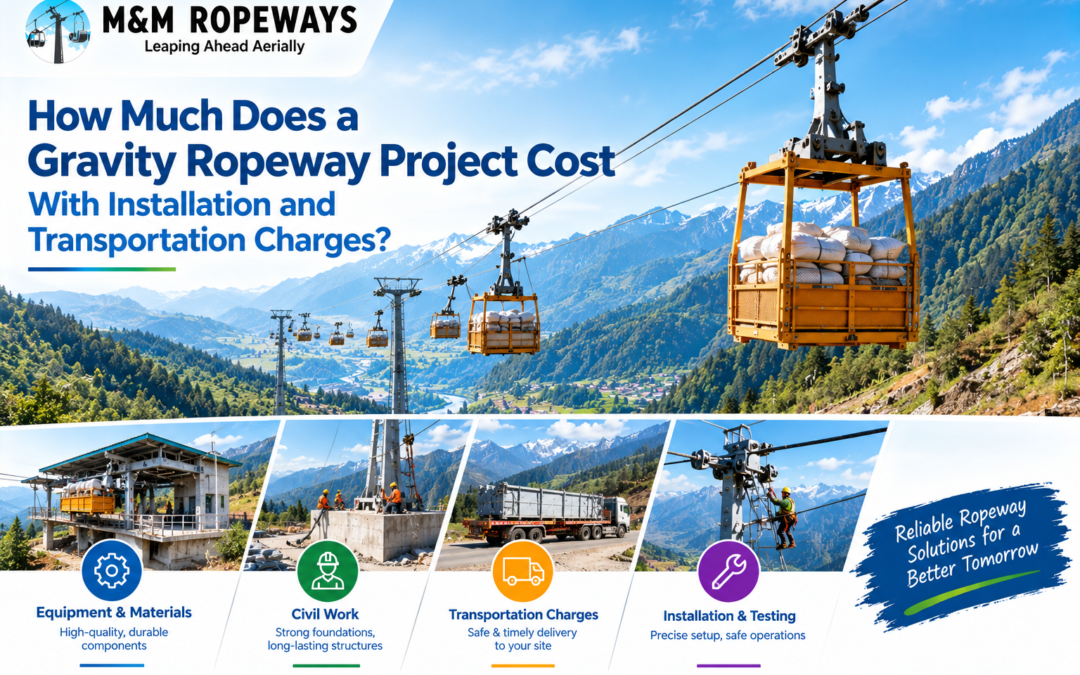
Here is something most buyers learn too late. The ropeway is rarely the costly part. The surprise comes from a truck bill, a crane hire, or a week lost to rain. So what does a gravity ropeway project cost? There is no single answer. It is a chain of small costs. Each one shifts with your site.
This guide walks through that chain. You will see what you pay for and where transportation charges hide. You will also get real benchmark figures.
What Makes a Gravity Ropeway Different?
A gravity goods ropeway system moves goods downhill using gravity alone. It needs no electricity or fuel. Two trolleys run on support tracks. One control cable joins them. When the loaded trolley goes down, the empty one comes up. That is why it costs less. There is no motor to buy. There is no power line to lay. Fewer parts also mean fewer repairs.
There are limits. Gravity ropeway systems suit shorter distances, usually under 1,500 meters. They also need a downhill slope. See how we build them on our gravity ropeways manufacturer page.
The Four Main Cost Blocks
Think of your budget as four blocks.
- Site survey and design: Engineers study the slope, soil, and route. They also check your daily load. This sets the length, tower count, and cable size. A wrong guess here costs far more than the survey.
- Equipment and materials: This is usually the biggest block. It covers:
- Track and control cables
- The trolley car and its carrier
- Pulleys and the flywheel
- Support towers
- Brakes and safety devices
Heavier loads need thicker cables and stronger towers.
- Civil work: Each end needs a station. Each tower needs a foundation. Your ropeway construction site conditions decide how much concrete, steel, and labour you need.
- Testing and handover: The system runs with a real load. Safety checks are done. Your operators get trained.
Ropeway Installation Charges
Ropeway installation covers cable laying, tower setting, alignment, and load testing. Hill sites slow the crew down. More days on site mean higher cost.
Charges rise with:
- Longer routes and bigger height gaps
- More towers
- Hard site access
- Monsoon or snow delays
Our guide on the key factors every ropeway planner must know goes deeper.
Transportation Charges: The Cost People Forget
Ropeway parts are long and heavy. They travel from the factory to your hill site. Roads are often narrow or damaged. That is where Ropway transportation charges grow.
Check these items in your quote:
- Distance from factory to site
- Weight and size of parts
- Type of vehicle
- Loading and unloading
- Last-mile movement
Sometimes the road ends before the site does. Then parts move in small lots, or by hand. That adds time and cost. Ask for a written transport plan before you sign. It should say who pays if the plan changes.
What Should Your Ropeway Quote Include?
A gravity ropeway cost quote should be clear and easy to understand. Do not look only at the equipment price. Check what the quote includes. It may cover design, civil work, installation, transport, testing, and training. Also ask about taxes, loading, unloading, and last-mile delivery. These costs can change your final budget. A detailed quote makes it easier to compare suppliers. It also helps you avoid surprise charges during installation or after the project starts.
What Pushes the Price Up or Down
- Length: more distance means more cable and towers.
- Slope: rough ground raises civil and installation work.
- Load: heavier loads need stronger parts.
- Goods: crops, timber, and cement bags need different carriers.
- Access: remote sites raise labour and transport costs.
- Safety: OITAF-compliant systems add cost. They are worth it.
Hidden Costs to Ask About
Some charges sit outside a basic quote. Ask about:
- Land or right-of-way permission
- Local approvals
- Extra work in weak soil
- Weather delays
- Insurance
- Spare parts
Yearly upkeep matters too. Before you sign, read what to check in a ropeway annual maintenance contract.
If a price looks very low, check what is missing.
Where a Gravity Ropeway Saves the Most
- Remote villages: crops and goods reach markets without a long walk.
- Hill construction: steel, cement, and equipment move without a new road.
- Forestry: timber goes downhill for very little running cost.
The savings come from what you skip. No fuel. No power. No road.
Gravity vs Other Systems
A powered aerial ropeway carries loads uphill and over longer distances. A passenger cable car adds cabins, stations, and safety systems. Both need a drive unit and power. That raises the price and upkeep.
A gravity goods ropeway system is very energy efficient. Its running cost is low. But it moves goods downhill only, and it needs the right terrain. So do not ask which is cheapest. Ask which fits your site.
New Ropeway Projects in India: Why Early Budgeting Matters
Interest in ropeways is rising. The Parvatmala Pariyojana, launched in the Union Budget 2022-23, has pushed many new ropeway projects in India into planning.
Most attention goes to passenger systems. But hills also need material lines for ropeway construction and remote supply. A clear budget speeds up approvals. If your plan needs clearance, start with the documents required for ropeway project approval.
Plan Your Budget in 6 Steps
- Define what you will move, how much, and how often.
- Share slope, length, ground type, and road access.
- Ask for a full quote with equipment, installation, transport, and commissioning.
- Check what the quote leaves out.
- Set aside a yearly maintenance amount.
- Compare on safety and support, not only price.
Get Your Site-Specific Quote
Every hill site is different. The fastest way to a real number is to share your details. Send us your route length, height difference, load per trip, and location. Our engineers will return a clear quote. It will cover equipment, installation, and transportation charges.
Ready to plan your gravity goods ropeway system? Call +91 99156 66677 or email info@mmropeways.com. And if you are curious about more products we have. You can browse our product page.
Gravity Ropeway Cost: Your Questions Answered
1. What should I budget for a gravity ropeway?
Published Nepal benchmarks point to roughly ₹10 to ₹15 lakh for a basic goods ropeway. Heavier industrial loads and stricter safety needs cost more. Your slope, length, and site access decide the final figure, so ask for a site-specific quote.
2. Why do installation charges differ from site to site?
Installation depends on route length, height difference, and tower count. Hard access and monsoon or snow delays add more days on site. More days mean higher labour costs, so a steep, remote site always costs more than an easy one.
3. Why does transport add so much to the bill?
Ropeway parts are long, heavy, and awkward to carry. Hill roads are narrow, and some end before the site does. Then parts move in smaller lots or by hand. That adds time, labour, and vehicle cost. Ask for a written transport plan.
4. How long can a gravity ropeway be?
Gravity systems generally suit shorter routes, usually under 1,500 meters. They also need a suitable downhill slope, since goods move down by gravity alone. For longer distances or uphill loads, a powered aerial ropeway may fit better.
5. Can I use a gravity ropeway at a construction site?
Yes, if the site has a downhill slope. It can move steel, cement, and equipment without a new road. Share your daily load with the manufacturer first. Heavier loads require stronger cables and towers, which increases costs.