
Signing a ropeway annual maintenance contract determines three things: what gets maintained, how fast someone shows up when it fails, and who pays for what falls outside the scope. Get any one of these wrong. See how the contract works against you. AMC should never feel like a formality, but most operators think this alike. But it’s not. Because it’s a technical and legal commitment that governs passenger safety, regulatory compliance, and operational uptime for the entire contract term.
This guide from M&M Ropeways breaks down every single clause, commitment, and RED FLAG that should be considered before an operator puts pen to an aerial ropeway AMC service agreement.
What Does a Ropeway AMC Truly Cover & What Does It Not?
A comprehensive ropeway maintenance contract covers scheduled preventive maintenance, emergency breakdown response, system inspections, and parts replacement within agreed parameters. What it does not always cover is the part that causes operators the most financial pain.
Cable car maintenance contracts typically operate on a two-tier coverage model. Routine preventive services form the base package, while structural inspections, rope replacements, and electrical overhauls are treated as billable extras unless explicitly stated otherwise. Operators who do not verify this distinction before signing carry financial exposure they may not anticipate.
Typical inclusions in a ropeway AMC:
- Scheduled preventive maintenance visits (monthly, quarterly, annual)
- Lubrication of rope, sheaves, and grip assemblies
- Inspection of haul ropes, track ropes, and tensioning systems
- Brake system testing and adjustment
- Drive unit and gearbox checks
- Control panel and safety circuit diagnostics
- Cabin (gondola) structural and suspension point inspection
Common exclusions operators miss:
- Full rope replacement (often treated as a capital expense, not AMC)
- Structural tower repairs caused by seismic events or severe weather
- Third-party electrical faults upstream of the drive system
- Upgrades, software changes, or SCADA system modifications
- Costs arising from operator misuse or overloading beyond rated
So, it would be better to ask the AMC provider to produce a line-by-line scope document before signing it. Any item not explicitly listed as included should be treated as excluded.
What is a Realistic Ropeway Preventive Maintenance Schedule?
The ropeway preventive maintenance schedule defines how often inspections occur and what each visit must accomplish. Frequency is not arbitrary here. It should be derived from OITAF guidelines, manufacturer specifications, and the operational load profile of the system.
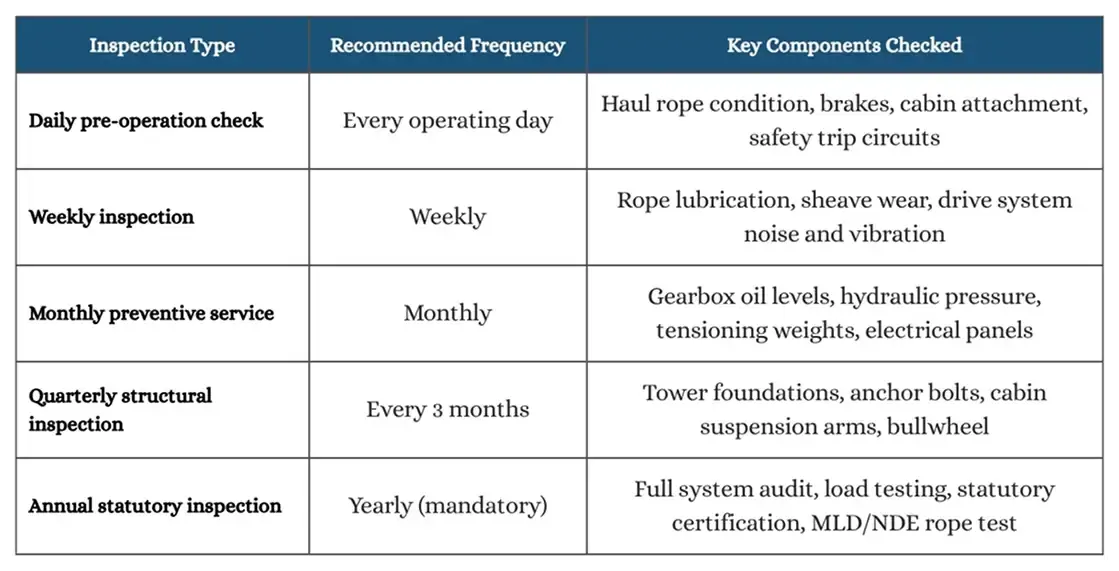
If your AMC says “periodic maintenance” and nothing more, you have no contractual basis to question how often the provider visits. That ambiguity always favors the service company. Push for explicit visit schedules in the agreement itself, and ensure that all service logs remain your documentation, not theirs.
OEM vs. Third-Party Ropeway AMC: Which One Should You Choose?
The decision between an OEM maintenance contract and a third-party service agreement is one of the most consequential choices an operator makes. For ropeway systems, the answer is less straightforward than it is for standard industrial equipment.
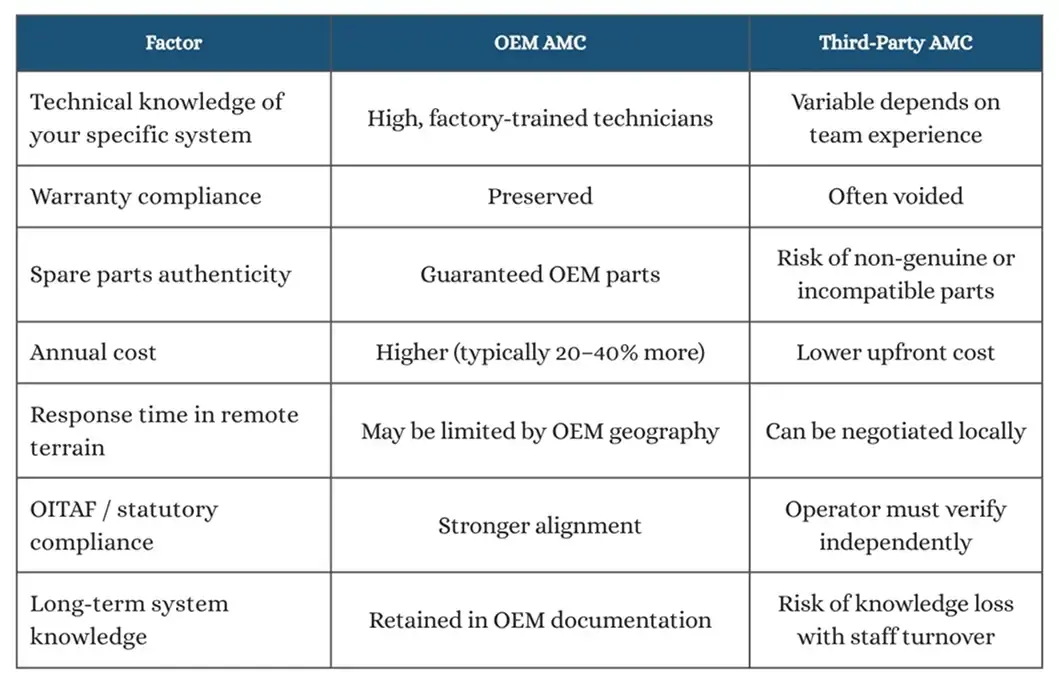
Before choosing between OEM and third-party maintenance, ask one question your comparison guide probably skipped: how long does it actually take their technician to reach your site? An OEM-based overseas or in a distant Indian city may carry every technical credential and still leave your system grounded for three days. A qualified regional provider with a realistic 6-hour SLA is worth more in practice, even if it costs more per visit.
What Should the Cable Car Downtime Response Time SLA Specify?
The Service Level Agreement (SLA) defines what the service provider must do when the system fails and how fast. Most operators skim it. Most operators regret that. Before signing any ropeway AMC, the SLA deserves more attention than any other clause in the document. A robust downtime response SLA must specify three distinct timelines:
- Acknowledgement time: How long before the provider confirms receipt of the fault report (should be under 2 hours for passenger systems)
- Technician on-site time: How long before a qualified engineer physically arrives at the installation (4–24 hours depending on location)
- System restoration time: Maximum time within which the system must be restored to operational status, or escalation triggered
If the provider misses the response window and your contract carries no penalty clause, you have no leverage and no remedy. An AMC that defines timelines without consequences is written in the provider’s favor, not yours. Liquidated damages or credit provisions must be part of the signed document before any work begins.
How Should a Ropeway Spare Parts Supply Agreement Be Structured?
Spare parts availability is the single biggest operational risk in ropeway maintenance and the most overlooked clause in most AMC agreements. The problem operators underestimate is not the cost of parts. It is how long they take to arrive.
Gearboxes, haul rope splicing materials, hydraulic control modules, bullwheel bearings, and drive motor components. Each of these carries an import lead time of 8 to 20 weeks when sourced from European OEMs. For any system that is grounded and waiting on one of these parts, that timeline is commercially catastrophic.
A well-structured ropeway spare parts supply agreement must address the following:
- Minimum on-site inventory: Which consumable and critical parts must be physically present at the installation site at all times. Rope clamps, sheave liners, and grip components are the starting point, not the complete list.
- Parts classification: Tier 1 covers consumables replaced at every service visit. Tier 2 covers wear parts on 12- to 24-month replacement cycles. Tier 3 covers critical capital components with multi-year lifecycles that must be sourced and cleared well in advance.
- Parts sourcing clarity: Whether parts supplied are OEM-genuine or equivalent-specification alternatives, and which party has approval authority when a substitution is proposed.
- Emergency supply protocol: Named contacts, defined escalation paths, and maximum lead time commitments for parts dispatch when the system is grounded.
- Parts ownership: Whether buffer stock held on-site belongs to the operator or the service provider and how costs are calculated and settled when parts are consumed.
Extended ropeway downtime in India is rarely caused by a lack of qualified technicians. In most cases, the technician arrives, identifies the fault, and then waits. The missing variable is almost always a critical spare part that was never stocked on site. Operators who treat spare parts protocols as seriously as SLA response times cut their mean time to restore significantly.
What Safety Compliance and Inspection Frequency Must the AMC Guarantee?
Inspection frequency and safety compliance are not AMC clauses to negotiate down. They are statutory requirements. Passenger ropeways in India operate under state-level regulations and OITAF guidelines where applicable. The AMC must reflect those obligations in full, not approximate them. The AMC must explicitly state:
- That all inspections will be conducted as per OITAF guidelines and applicable IS/BIS standards
- Who holds responsibility for obtaining statutory inspection clearances, whether the operator or the AMC provider
- Whether non-destructive evaluation (NDE) of ropes and structural steel is included in the annual inspection scope
- Documentation handover: all inspection reports, maintenance logs, and test certificates must remain in the operator’s custody
- That the service provider carries adequate professional liability insurance for maintenance activities
If a statutory inspection uncovers a defect that triggers a regulatory shutdown, the AMC must already define who bears the remediation cost and within what timeline. That clarity cannot be negotiated after the fact. Contracts that leave this ambiguous do not create disputes eventually. They guarantee them.
What Is the AMC Checklist Every Ropeway Operator Should Use?
Before signing any ropeway annual maintenance contract, run this checklist against the proposed agreement. Every item should have a clear, written answer in the contract document.
| Sr. No. | Checklist Item | What to Look For |
| 1 | Scope of services | Explicit list of included and excluded activities — no vague “general maintenance” language |
| 2 | Preventive maintenance schedule | Named frequencies (monthly, quarterly, annual) with visit checklists attached |
| 3 | Response time SLA | Acknowledgement, on-site arrival, and system restoration times – with penalty clauses |
| 4 | Spare parts protocol | On-site buffer inventory list, parts sourcing policy, emergency supply procedure |
| 5 | OEM vs third-party clarity | Parts authenticity declaration, warranty impact statement |
| 6 | Statutory compliance responsibility | Named party responsible for OITAF/IS compliance and statutory certificate renewal |
| 7 | Documentation ownership | All service reports, test records, and maintenance logs belong to the operator |
| 8 | Personnel qualifications | Minimum qualification and experience levels for lead technicians |
| 9 | Liability and insurance | Provider’s professional indemnity and third-party liability coverage |
| 10 | Exit and renewal terms | Notice period for termination, auto-renewal conditions, escalation caps |
Why the Manufacturer’s Role in After-Sales Matters More Than Operators Realize
The quality of a ropeway AMC is determined as much by who built the system as by who maintains it. Manufacturers with genuine after-sales infrastructure, trained service teams, accessible spare parts networks, and long-term support commitment create fundamentally lower maintenance risk from day one.
Before signing any AMC, verify that the manufacturer maintains in-house service capabilities, can supply parts for systems over a decade old, and has experience in terrain comparable to your installation.
M&M Ropeways, a leading ropeway manufacturing company, builds after-sales support into the delivery model. With over 100 systems installed across diverse and high-altitude terrain, the service infrastructure is built around where these systems actually operate.
Final Word: The AMC Is as Important as the System Itself
A ropeway is a long-life infrastructure investment, typically 20 to 30 years with proper maintenance. The AMC determines whether that lifespan is achieved or compromised. Operators who invest as much diligence in evaluating the maintenance contract as they do in evaluating the system specification will find that unplanned downtime, regulatory penalties, and premature component failure are manageable, not inevitable.
Read every clause. Negotiate every SLA. Confirm every spare parts protocol. The signature on a ropeway AMC carries weight that extends far beyond the contract term.
Need AMC guidance from people who built the system? Talk to the M&M Ropeways after-sales team. Contact us today.