by ropeway-admin | Aug 22, 2026 | Ropeways
India’s ropeway industry has become quite active. This is one of the areas of infrastructure in the country today in 2026. There are a few reasons for this. The Parvatmala Pariyojana rollout is one reason. People are also traveling to the hills a lot nowadays. There are many new hydropower and mining projects. Because of all this, the demand for ropeway manufacturers in India has gone up quickly. But not every name selling a cable car deserves a seat at the table. Some builders have installed at altitudes most engineers will never see. Others have run the same three tourism projects for twenty years.
This guide cuts through the noise and ranks the top 10 ropeway manufacturers in India on five hard criteria: sectoral reach, extreme-terrain track record, engineering partnerships, load range, and global project footprint. Let’s get started with what is most helpful to you.
How Were India’s Top 10 Ropeway Manufacturers Ranked?
The ranking uses five weighted criteria. Revenue lists reward whoever booked the biggest tourism contract. Project-count lists favour whoever built the most temple ropeways. Neither tells you which manufacturer can actually handle your site, load, or terrain.
To rank the top ropeway manufacturers in India fairly, this list scores each company on:
- Sectoral breadth – industries genuinely served (defence, hydro, mining, tourism, industrial, rural)
- Extreme-terrain track record – installations at high altitude, in sub-zero conditions, or across difficult spans
- Engineering partnerships & certifications – ISO stack, OITAF compliance, international associates
- Load and distance range – from small carriers to 10,000 kg loads, spans running into kilometres
- Global footprint – projects delivered outside India
A manufacturer strong in one area isn’t the best overall. The best ropeway companies in India hit hard on at least three.
1. M&M Ropeways
Best for: Defence, hydropower, mining, industrial ropeways in extreme terrain, and more
Only one Indian manufacturer has a working ropeway running at 18,000 feet on the Siachen Glacier in minus 35 degrees. That is M&M Ropeways. No other name on this list operates at that altitude, in that weather, for the Indian Army.
Thirty-five years in the business. 120-plus systems delivered. A 4,800 sq. yard workshop in Dera Bassi where design, fabrication, manufacture, and commissioning all happen under one roof, a level of vertical integration nobody else on this list matches. Passenger Ropeways, Material Handling Ropeways, and Cable Cranes are built for tourism, mining, tea estates, tunnelling, Army postings, and hydropower dams.
Certifications include ISO 9001:2015, 14001:2015, and 9000:2015, with design handled by European engineers under OITAF regulations. The Sandwich Belt High Angle Conveyor is manufactured with Dos Santos International, USA. Projects run in Nepal, Bhutan, Africa, and more.
2. Damodar Ropeways & Infra Ltd. (Kolkata)
Best for: Religious and tourism ropeway projects
Damodar Ropeways & Infra Ltd. (DRIL) is one of India’s older names in ropeway manufacturing, founded in 1974 and active mainly in the passenger tourism segment. Its main strength lies in mono-cable fixed-grip passenger systems, with installations delivered for temple trusts and state tourism boards across multiple Indian states. The company’s exposure to industrial, defence, or high-altitude ropeway systems is limited, so buyers with mining, hydropower, or extreme-terrain requirements usually look beyond it. For pilgrimage-site and tourism-heavy tenders, DRIL still appears on most shortlists of cable car manufacturers in India.
3. Usha Breco Ltd. (Kolkata)
Best for: Passenger ropeway operations at high-footfall sites
Usha Breco Ltd. runs well-known passenger ropeways in India under the “Udan Khatola” brand, with projects in Uttarakhand and Gujarat. The company has a background of ticketed operations at religious and tourism destinations. On the manufacturing side, the company works with OEMs for larger installations instead of making the systems itself, so buyers looking for an integrated design-and-manufacture partner usually look at other ropeway companies in India. For passenger operations, at footfall, Usha Breco is a name that most tourism boards know.
4. Conveyor & Ropeway Services Pvt. Ltd. (Kolkata)
Best for: BOOT-model passenger ropeway projects
Conveyor & Ropeway Services Pvt. Ltd. (CRSPL) has been working in the ropeway industry since 1999. The company focuses on BOOT tourism projects. BOOT stands for Build-Own-Operate-Transfer. It works on large-scale passenger ropeways. CRSPL’s edge sits in mid-scale passenger ropeways where the same team designs, builds, and then runs the system for the state or trust that awarded the tender.
The company has a narrower footprint outside passenger tourism, so material handling, mining, or high-altitude buyers usually look elsewhere. For state governments and municipal tenders structured on BOOT lines, CRSPL is a name that keeps coming up among passenger ropeway manufacturers.
5. Ropeway & Cablecar Systems Pvt. Ltd.
Best for: Mid-scale passenger and material ropeway projects
Ropeway & Cablecar Systems Pvt. Ltd. features in global market research reports as one of the Indian names covering both passenger and material handling ropeway systems. That mixed capability is its edge, letting the company sit on mid-scale projects that need more than a pure tourism build. What it lacks is the same depth of public documentation older manufacturers offer on delivered projects and engineering tie-ups, so procurement teams usually ask for expanded references before locking it into a shortlist. For mid-scale mixed-use tenders, it stays on the radar among ropeway manufacturers in India.
6. Aarconinfra Ropeways
Best for: Turnkey ropeway construction contracts
Aarconinfra is a construction house first and ropeway builder second. Turnkey is the strength. One firm surveys the site, designs the build, and puts the structure up, all under a single contract, which is exactly what state tourism departments and private developers want when they do not have the bandwidth to juggle three vendors. Component-level engineering, however, is not where the deep work happens. Projects that need proprietary drives, cabin design, or in-house electrical stack usually bring in a specialist manufacturer and slot Aarconinfra into the construction scope. For turnkey ropeway construction contracts, it is a familiar name among ropeway construction companies in India.
7. Nilkanth Engineering
Best for: Ropeway components and structural parts supply
Nilkanth Engineering operates in the ropeway ecosystem as a component and structural parts supplier rather than a full-system builder. Its work covers fabricated steel structures, tower sections, and related mechanical parts used in ropeway installations across India. The main strength here is manufacturing precision on discrete components, where OEMs and larger ropeway builders integrate its parts into their own systems. The company does not deliver end-to-end ropeway projects on its own, so buyers who need a single vendor for design, manufacture, and installation will need a primary ropeway manufacturer, with Nilkanth possibly sitting somewhere in the supply chain. For OEM component sourcing and structural steel supply, it remains a familiar name among Indian ropeway parts manufacturers.
8. Kiran Techno Services (Coimbatore)
Best for: Industrial ropeway integrations and mechanical support
Kiran Techno Services runs out of Coimbatore, handling mechanical and electrical scope on industrial ropeway builds. Their work is execution muscle. Site fitment, drive alignment, and mechanical integration for larger projects that already have the ropeway designed by someone else. In-house ropeway manufacturing is not part of the scope, so projects that need proprietary design, cabin, or drive engineering bring in a lead OEM and use Kiran on the execution side. For industrial project owners who want dependable mechanical delivery on ropeway-linked scope, Kiran remains a South Indian name in the wider ropeway ecosystem.
9. JPS Engineers (Ghaziabad)
Best for: Mechanical and electrical support for ropeway installations
JPS Engineers, based in Ghaziabad, works largely on the mechanical and electrical support side of ropeway projects, serving clients across pan-India installations. Its strength sits in contract execution on specific project scopes, including support systems, drive components, and installation-stage engineering. The company operates more as a support and services partner than as a full ropeway system manufacturer, so buyers with defence, hydropower, or high-altitude requirements will need a lead OEM handling design and system integration. For ropeway builders and EPC contractors looking for a North India-based execution partner on discrete mechanical scope, JPS features in the working ecosystem of ropeway service providers in India.
10. Modern Cable Cars
Best for: Ropeway cabins, carriers, and specialised unit fabrication
Modern Cable Cars builds cabins. That is the whole story. Passenger units, carrier assemblies, and custom fit-outs for both direct clients and the larger ropeway builders who need a specialist on cabin scope. Where they earn their spot is customisation. Seating layouts, interior finish, safety fittings, all built to what the specific project needs, whether it is a tourism ropeway with premium finish or an industrial line running rough duty. Everything past the cabin- drives, tower structures, full ropeway design- sits with someone else. A lead manufacturer runs the system, and Modern Cable Cars ships the cabins. For cabin retrofits, upgrades, and specialised carrier work, it is a name that keeps coming up in the niche corner of ropeway manufacturers in India.
How Do the Top 10 Ropeway Manufacturers in India Compare – Table Comparison
Every name on this list plays in its own lane. Some build for pilgrimage crowds, some for mines, some just for cabins. Reading it all in prose takes patience. A table does the same job in ten seconds. Here is how the top ropeway manufacturers in India stack up on headquarters, focus area, and best-fit project type.
| Rank |
Company |
Headquarters |
Core Focus |
Best Fit For |
| 1 |
M&M Ropeways |
Dera Bassi, Punjab |
Multi-sector design, manufacture, and installation |
Defence, hydropower, mining, industrial, religious, tourism, and extreme terrain |
| 2 |
Damodar Ropeways & Infra Ltd. |
Kolkata |
Passenger tourism ropeways |
Religious and pilgrimage-site projects |
| 3 |
Usha Breco Ltd. |
Kolkata |
Passenger ropeway operations |
High-footfall tourism and temple sites |
| 4 |
Conveyor & Ropeway Services Pvt. Ltd. |
Kolkata |
BOOT-model tourism ropeways |
State and municipal BOOT/PPP tenders |
| 5 |
Ropeway & Cablecar Systems Pvt. Ltd. |
India |
Passenger and material ropeway systems |
Mid-scale mixed-use projects |
| 6 |
Aarconinfra Ropeways |
India |
Turnkey ropeway construction |
End-to-end construction contracts |
| 7 |
Nilkanth Engineering |
India |
Ropeway components and structural parts |
OEM supply and structural steel |
| 8 |
Kiran Techno Services |
Coimbatore |
Mechanical and electrical integrations |
Industrial ropeway support scope |
| 9 |
JPS Engineers |
Ghaziabad |
Mechanical and electrical support services |
North Indian execution partnerships |
| 10 |
Modern Cable Cars |
India |
Cabin and carrier fabrication |
Cabin retrofits and specialised units |
How Is the Indian Ropeway Industry Growing?
The Indian ropeway industry is having its loudest run in years. Most of the noise comes from one policy: Parvatmala Pariyojana, the national ropeways development programme. It has pushed through ropeway projects in India at places nobody expected sanctions for a decade ago. Bijli Mahadev. Mahakaleshwar. Kedarnath. Hemkund Sahib. Over 50 corridors are on the target list by 2027. Approvals that used to take years are now cleared in months.
Three shifts are pushing the numbers:
- Tourism upgrades at temples, hill stations, and pilgrimage sites where road access has hit its ceiling
- Urban ropeways are now in serious planning mode, with the about 3.75 km Varanasi urban cable car currently under construction and expected to carry around 96,000 passengers per day.
- Industrial demand from hydropower, mining, and defence projects looking for terrain-friendly alternatives to trucks and haul roads
Global market numbers still vary a lot depending on who you ask, but nearly every credible report lines up on one thing: Asia-Pacific, spearheaded by India and China, is moving fastest in growth.
What Should You Look for – When Choosing a Ropeway Manufacturer in India?
Choosing the right ropeway manufacturer in India comes down to five checks. Skip these, and the vendor conversation turns into a coin toss.
- Sectoral track record. Has the manufacturer actually built for your use case (tourism, mining, hydropower, defence), or are they selling capability they have never installed?
- Certifications on paper, not just logos. ISO 9001, 14001, 45001, plus OITAF design compliance for aerial ropeways. Ask for the certificate PDF. Read the scope line.
- Terrain and altitude experience – a company that has installed at 15,000 ft in −20°C is a fundamentally different vendor from one that has only built valley-level tourism systems
- Load and distance range – check what the manufacturer has delivered at the upper end, not just the average project
- After-sales and spares – a ropeway runs for 25 to 30 years, so response time, spare availability, and remote diagnostics matter as much as the sale itself
For a deeper 12-point selection framework, see our full guide on How to Select a Ropeway Manufacturer.
Let’s Wrap it Up with a Conclusion
The Indian ropeway market has never had more room to grow, and the manufacturers listed here are the ones actively shaping it. Where each one fits depends on the project. Tourism sites lean on Damodar and Usha Breco. BOOT and PPP tenders bring CRSPL into the room. Component and cabin scope belong to the specialised names further down the list. For projects that cross into defence, hydropower, mining, or extreme terrain and demand a manufacturer with in-house design, international partnerships, and a track record at altitude, M&M Ropeways sits at the top.
Planning a ropeway project and want a manufacturer whose credentials hold up in the field? Talk to the M&M Ropeways team for a system engineered around your site, load, and terrain.
by ropeway-admin | Aug 13, 2026 | Ropeways, Uncategorized
India’s ropeway industry is heating up. Hill states have projects in the pipeline. Religious towns want them. Tourism boards are lining up bids. The Union Budget 2022-23 launched the Parvatmala Pariyojana. Under it, the government plans over 250 ropeway projects across 1,200 km in five years, as per the Press Information Bureau. A ropeway is more than steel and cable. It is soil tests, wildlife surveys, tower alignment studies, and thick files of paperwork. Design happens in offices. Approvals happen in ministries. Projects can sit for months. Sometimes years. Not because the engineering fails. Because one file is missing or wrong.
This guide breaks down the 6 Documents You Need Before Applying for Ropeway Project Approval. Each one has a job. Each one carries weight. Get these six ready, and your ropeway project in India moves fast. Miss even one, and it sits.
Why Paperwork Matters More Than the Cable
You can build a ropeway faster than you can approve one. That is where most developers get stuck. Take Nandi Hills in Karnataka. According to The Hans India, the project has faced years of delays while awaiting forest and wildlife clearances from the Centre. The Palampur ropeway in Himachal, according to The Tribune, has been pending for years despite Central approval.
The pattern is clear. Every delay eats capital. Interest keeps ticking. Contractors keep waiting. Costs go up every month. Regulators do not run on trust. They run on files. Every stage of the ropeway approval process demands hard proof. Skip a step, and the file returns. To plan smarter from day one, read our guide on key factors every planner must know. That is why solid ropeway construction starts with solid paperwork. Not the other way around.
The 6 Documents That Decide Your Project’s Fate
Not every paper matters equally. Some decide the fate of your file. Six documents sit at the top of that list. These are the ones ropeway project approval authorities check first. They cover technical, environmental, legal, and safety ground. Miss one, and the rest do not save you. Let us break each one down.
1. Detailed Project Report (DPR)
The Detailed Project Report is the backbone of every aerial ropeway project. Consultants prepare it. Regulators judge you by it. It carries the full story of your project, the route, the engineering design, the money, and the risk. Without a DPR, no file moves forward.
A strong DPR must cover the following:
- Route alignment and terrain survey.
- Traffic demand and passenger load.
- Engineering design and technical drawings.
- Cost estimates and financial model.
- Construction schedule with milestones.
- Risks and how you plan to handle them.
NHLML mandates a DPR before any Parvatmala bid. It is the first serious ropeway project document on the table. As per the Press Information Bureau, the Sonprayag-Kedarnath and Govindghat-Hemkund projects were among the first approved under Parvatmala. Yours must match that standard. Skip a section, and the file gets returned.
2. Feasibility Study Report
Feasibility comes before the DPR. It answers one question. Should this project even exist? A ropeway feasibility study looks at the land, the demand, and the numbers. If any one of these fails, the project stops here. The report must include:
- Topographical and geotechnical surveys.
- Wind, snow, and seismic load data.
- Passenger or material load forecast.
- Ridership and revenue projections.
- Preliminary alignment options.
- Environmental sensitivity mapping.
A weak feasibility leads to a weak DPR. A weak DPR leads to rejection. Every cable car project approval starts here. To understand which routes make economic sense, read our post on ropeway vs road cost comparison. Get this stage right, and the rest of the ropeway approval process becomes easier.
3. Environmental Impact Assessment (EIA)
An environmental impact assessment is required for most large ropeway projects in India. It falls under the EIA Notification, 2006. You file it through the PARIVESH portal. Your EIA must document:
- Baseline air, water, and soil data.
- Flora and fauna survey.
- Noise and vibration impact.
- Waste management plan.
- Compensatory mitigation measures.
- Public consultation records.
A public hearing usually follows. Regulators look for honest data. Clever wording does not help. Ropeways carry a lower ground footprint than roads in hill terrain. Even so, the EIA process cannot be skipped. If your data is weak, the file comes back with tough questions.
4. Forest Clearance Certificate
If your route touches forest land, this document is non-negotiable. The Forest (Conservation) Act, 1980, applies. Any aerial ropeway project through a forest area needs central government approval first.
Forest clearance moves in two stages:
- Stage I – in-principle approval
- Stage II – final diversion approval
Attach these with your application:
- Forest land diversion proposal.
- Compensatory afforestation plan.
- Wildlife mitigation report.
- NOC from Gram Sabha (where applicable).
- Biodiversity impact statement.
Even terminal stations and tower footprints need diversion approval. As per Swarajya (October 2025), the Shimla ropeway project secured Stage-I clearance for 6.19 hectares of forest land. This stage is often the slowest. For ropeway construction through difficult hilly terrain, delays get worse. Plan the file early, not late.
5. Land Acquisition and Ownership Documents
You cannot install a tower on someone else’s land. Regulators want clean title from day one. Any gap in ownership records can hold up the entire ropeway project approval file. This step sounds basic. Developers still miss it. Keep these documents ready:
- Land ownership records or lease deeds
- NOC from private landowners
- Revenue department certificates
- Panchayat or municipal permissions
- Right-of-way documents
- Site plan with survey numbers
For PPP tourism projects under Parvatmala, the government usually provides land through the concession agreement. Even then, the developer still files the full ownership trail. Land acquisition for ropeway projects gets messier in hill regions where records are often old or unclear. Sort this out early. It saves months later.
6. Statutory NOCs and Safety Clearances
This is a bundle, not a single paper. Every ropeway project approval file must carry a full stack of NOCs. Miss one, and commissioning gets frozen at the last mile. Regulators check these before green-lighting operations. Collect all of these:
- Height clearance from AAI.
- Defence clearance for border or sensitive zones.
- Consent from the State Pollution Control Board.
- Wildlife Board NOC (near sanctuaries).
- Structural safety certificate from a licensed engineer.
- Fire safety and electrical safety approvals.
- Local municipal building permits.
The Shillong Peak Ropeway is one example. As per North East News, it secured NOCs from AAI, the Air Force, and the Army before work started. That is the model to follow. Safety on the ground matters as much as safety on paper. For execution-stage protocols, read our guide on essential safety measures during ropeway installation. One missing NOC can freeze the entire ropeway approval process.
These six documents form the core of every ropeway project approval file in India. Miss the details, and delays start piling up. Get them right, and your project moves.
How M & M Ropeways Supports Your Project
M & M Ropeways is a leading ropeway manufacturer in India. The company designs, manufactures, and installs aerial ropeways and cable cranes. Single loads range from 100 kg up to 10,000 kg. Some spans reach 6,400 meters on a single drive. For the Indian Army, we installed ropeways at 18,000 feet on the Siachen Glacier. Those systems ran below minus 35 degrees Celsius. Our clients include the Indian Army, hydropower firms, state PWDs, cement majors, and tourism boards. We deliver aerial ropeway projects for hydropower construction, mining, dams, tunneling, tourism, and rural connectivity in the mountains. Where most projects trip up is paperwork. Our team supports clients through the design, manufacturing, and installation stages of every project. Planning a ropeway project in India? Contact M & M Ropeways for design, manufacturing, and delivery support.
Key Takeaways
India’s ropeway push is just picking up speed. More projects will come. More states will join. But the process stays the same. Every file goes through the same checkpoint: the 6 Documents You Need Before Applying for Ropeway Project Approval. Skip one, and the file stops.
Start early. Build the DPR carefully. Finish the feasibility with real data. File the EIA with honest inputs. Chase the forest clearance from day one. Keep land papers clean. Collect every NOC before you need it. Projects that respect paperwork move fast. The rest wait.
M & M Ropeways has built ropeways in India, Nepal, Bhutan, and Africa. Planning one? Our team can support you with design, manufacturing, and installation.
Common Questions, Clear Answers
Question 1. Who gives approval for a ropeway project in India?
Multiple authorities are involved. Here is the breakdown:
- MoRTH governs the Parvatmala Pariyojana. NHLML runs the execution.
- MoEFCC grants environmental clearance. Filing is done through the PARIVESH portal.
- MoEFCC also grants forest clearance under the Forest (Conservation) Act, 1980.
- AAI issues height clearance where applicable.
- Defence forces provide clearance near the border or sensitive zones.
- State pollution control boards issue consent to establish and operate.
- Local bodies and Gram Sabhas issue site-level NOCs.
The project owner is often a state tourism board, an urban development authority, or a central PSU.
Question 2. How long does it take to get ropeway project approval in India?
There is no fixed timeline. It shifts with location, land type, and forest coverage. There is no fixed number. As per Deccan Herald, the Sonprayag-Kedarnath and Govindghat-Hemkund projects are expected to take 4-6 years to complete after approval. Both fall under Parvatmala. Approvals alone can stretch across months or years. Forest and wildlife clearances are usually the slowest stage. The Palampur ropeway in Himachal is one clear example. As reported by The Tribune, the project has been pending for years despite central approval.
by ropeway-admin | Jul 30, 2026 | Ropeways, Uncategorized
How many ropeway projects has India identified under Parvatmala? The pipeline covers over 200 locations across hilly states and urban corridors. As of early 2026, a growing number have cleared feasibility studies, entered bidding, or reached the award stage. A ₹1.25 lakh crore investment pipeline backs this push. Yet many contractors still struggle to navigate the process. The steps stay buried under jargon. DPR, DBFOT, HAM, and EMD each represent a distinct stage, and missing any one of them can cost a bidder the entire project.
This guide walks through the practical side of how to apply for ropeway project funding under India’s Parvatmala, NHLML, and state government schemes in 2026. It breaks the Parvatmala ropeway project application 2026 cycle into clear steps, covers the NHLML ropeway project funding India routes, the indigenous content rule, and what a bidder needs to be ready for before submitting anything.
What Is the National Ropeways Development Programme?
The National Ropeways Development Programme India carries a second name. People mostly know it as Parvatmala Pariyojana, launched under the Union Budget 2022-23, with one clear aim. Build ropeway infrastructure where roads struggle.
The scale here is large. The programme targets over 250 ropeway projects. Together, they cover close to 1,200 km, backed by an investment pipeline of nearly ₹1.25 lakh crore. This is spread across a five-year horizon. The Centre backs around 60% of project costs through the PPP route. The rest, along with execution risk, sits with private developers.
Quite a few states have already signed on. Uttarakhand, Himachal Pradesh, Jammu & Kashmir, Uttar Pradesh, and Assam are among those running active routes under the Parvatmala Pariyojana ropeway state list projects. Each state has identified specific routes for development.
The National Highways Logistics Management Limited, or NHLML, executes this programme on the ground, operating as a subsidiary fully owned by the National Highways Authority of India. Some search results surface a different body here. They confuse NHLML with NHIDCL, a separate corporation that handles highways near international borders. NHLML, not NHIDCL, owns ropeway tenders, feasibility studies, and DPR contracts.
The PPP Models: DBFOT and HAM Explained
Parvatmala projects run on two main structures, both falling under the broader ropeway PPP model, the DBFOT HAM India government framework.
- DBFOT (Design, Build, Finance, Operate, Transfer): The concessionaire takes on the full load here, designing and building the ropeway while arranging its own financing. It then runs the system for a fixed period, earning revenue from user fares. The Sonprayag-Kedarnath project is a live example. Adani Enterprises secured it at ₹4,081.28 crore, with a 29-year concession running after construction wraps up.
- HAM (Hybrid Annuity Mode): This one works differently. The authority pays the developer in annuity instalments, stretched out across the operations period. This cuts the revenue risk that pure DBFOT carries. The Prayagraj ropeway used this model. It cost roughly ₹251 crore.
The choice between these two structures depends on footfall. High-traffic pilgrim routes lean DBFOT. Routes with uncertain demand often shift to HAM, where annuity payments smooth out the risk.
From Tender to Contract: The Ropeway Bidding Process
Knowing how to bid for the ropeway project in India 2026 starts with the right order of steps.
Step 1: Track the pipeline: Watch NHLML and state project lists closely. So far, thirteen states have signed MoUs, with UP, Himachal, Uttarakhand, J&K, and Assam among them.
Step 2: Monitor the DPR stage: NHLML floats a tender for the ropeway project’s DPR (detailed project report), India. It covers feasibility, alignment, and cost estimation. Recent DPR tenders carried bid security of nearly ₹5 lakh.
Step 3: Register on e-procurement portals: The NHLML ropeway tender process contractor route runs through the central e-tender system. State projects may need GeM registration too. Set accounts up early.
Step 4: Meet pre-qualification criteria: Authorities assess technical capacity, net financial worth, and bid security. Net worth bars often sit near 30% of the project cost. Firms lacking direct experience often partner with an established ropeway manufacturer in India.
Step 5: Submit the bid: Most tenders use a two-cover system. Cover one holds technical documents and EMD proof. Cover two holds the financial offer.
Step 6: Sign the agreement: Selected bidders sign a concession agreement or EPC contract. Performance security replaces the EMD. Construction typically runs four to six years.
Each step builds on the last. Skip one, and the whole bid risks rejection.
The Make in India Rule: 50% Indigenous Components
Parvatmala aligns with the Make in India ropeway 50 percent indigenous component mandate directly. The programme requires that at least half of the components in any ropeway be manufactured in India.
This shapes procurement planning in a real way. Bidders relying on overseas gondolas or drive systems need a fix. A domestic manufacturing or assembly partner helps here. Industry estimates show why this matters. Foreign OEM costs can run 60-65% of the total project cost. Local sourcing, then, becomes a real cost advantage, not just a compliance checkbox.
Firms designing and building aerial ropeways and cable cranes in-house clear this bar without scrambling for a last-minute supplier. That edge matters more as competition for Parvatmala contracts grows.
Outside Parvatmala: How State Governments Fund Their Own Ropeway Projects
Parvatmala is not the only path for state government ropeway grant hilly areas in India. Several states run their own programmes too, often working alongside the central pipeline rather than replacing it.
Three states show how this works in practice.
#1. Himachal Pradesh:
Routes projects through the Ropeways and Rapid Transport System Development Corporation (RTDC). The Shimla-Parwanoo ropeway moved through this body. So did the Shimla Urban Ropeway.
#2. Uttarakhand:
Signed its own MoU (Memorandum of Understanding) through the Uttarakhand Tourism Development Board (UTDB). Seven priority locations were identified this way, beyond the Kedarnath and Hemkund Sahib projects already underway.
#3. Sikkim:
Follows a different funding line altogether. Its ropeway projects draw on PM-DevINE (Prime Minister’s Development Initiative for North East Region), a scheme that runs separately from Parvatmala’s main budget. Routes like Pelling to Sanga-Choeling fall under this scheme.
Practical Tip: For any state-level search, check two places at once.
- The central NHLML (National Highways Logistics Management Limited) pipeline first.
- Then, the specific state tourism department or PWD (Public Works Department).
A good number of these projects end up funded from both sides at once, central and state money working together.
What Makes a Bid Genuinely Competitive: Beyond the Lowest Price
Cost alone rarely wins these tenders. Evaluation committees weigh technical strength, too.
Terrain experience matters more than general infrastructure work. Ropeway engineering is a narrow skill, covering tower design, rope dynamics, and high-altitude wind loading. OITAF (International Organization for Transportation by Rope) compliant engineering signals real credibility here.
In-house manufacturing helps in two ways. It cuts costs. And it eases the indigenous content burden. M & M Ropeways brings exactly this kind of strength. The company has over three decades of field experience. It designs, manufactures, and installs aerial ropeways and cable cranes across tough terrain, spanning Siachen Glacier installations to major hydropower sites. Developers entering the Parvatmala pipeline often need a partner like this, one that already meets BIS (Bureau of Indian Standards) and OITAF standards. Building that expertise from scratch, under tender deadlines, rarely works.
Preparing a bid? Structuring a joint venture? Evaluating a ropeway manufacturer in India for a technical partnership? Reach out to M & M Ropeways. Field-proven engineering, applied right, is often what separates a winning bid from a rejected one.
Quick Answers to Common Funding Questions
Question 1. Who is eligible to bid for a Parvatmala ropeway project?
Answer. Any company or consortium meeting the technical and financial qualification bar can bid. This usually means past cable-transit experience. Or comparable infrastructure work. It also means a minimum net worth and the ability to furnish bid security (EMD). Companies lacking direct ropeway experience often team up with an established manufacturer or technical partner to qualify.
Question 2. Is funding available for ropeway projects outside Parvatmala?
Answer. Yes. States run their own routes, too. Take Himachal Pradesh. It works through its Ropeways and Rapid Transport System Development Corporation (RTDC). Sikkim takes a different route, drawing on PM-DevINE (Prime Minister’s Development Initiative for North East Region). Plenty of projects get backed from both sides at once, with central and state funds working together.
Question 3. How long does it take to get a ropeway project approved and built?
Answer. The DPR (Detailed Project Report) and feasibility stage alone can run several months to over a year. Once a concession is awarded, construction begins. Major Parvatmala projects typically take four to six years. This depends on terrain, altitude, and technology used.
Question 4. Does a contractor need to manufacture ropeway components in India?
Answer. Yes, at least in part. The Make in India mandate requires a minimum 50% indigenous component share. Bidders without domestic manufacturing capacity usually need a partner. An Indian manufacturer helps meet this requirement and keeps the bid cost-competitive.
by ropeway-admin | Jul 27, 2026 | Ropeways
Signing a ropeway annual maintenance contract determines three things: what gets maintained, how fast someone shows up when it fails, and who pays for what falls outside the scope. Get any one of these wrong. See how the contract works against you. AMC should never feel like a formality, but most operators think this alike. But it’s not. Because it’s a technical and legal commitment that governs passenger safety, regulatory compliance, and operational uptime for the entire contract term.
This guide from M&M Ropeways breaks down every single clause, commitment, and RED FLAG that should be considered before an operator puts pen to an aerial ropeway AMC service agreement.
What Does a Ropeway AMC Truly Cover & What Does It Not?
A comprehensive ropeway maintenance contract covers scheduled preventive maintenance, emergency breakdown response, system inspections, and parts replacement within agreed parameters. What it does not always cover is the part that causes operators the most financial pain.
Cable car maintenance contracts typically operate on a two-tier coverage model. Routine preventive services form the base package, while structural inspections, rope replacements, and electrical overhauls are treated as billable extras unless explicitly stated otherwise. Operators who do not verify this distinction before signing carry financial exposure they may not anticipate.
Typical inclusions in a ropeway AMC:
- Scheduled preventive maintenance visits (monthly, quarterly, annual)
- Lubrication of rope, sheaves, and grip assemblies
- Inspection of haul ropes, track ropes, and tensioning systems
- Brake system testing and adjustment
- Drive unit and gearbox checks
- Control panel and safety circuit diagnostics
- Cabin (gondola) structural and suspension point inspection
Common exclusions operators miss:
- Full rope replacement (often treated as a capital expense, not AMC)
- Structural tower repairs caused by seismic events or severe weather
- Third-party electrical faults upstream of the drive system
- Upgrades, software changes, or SCADA system modifications
- Costs arising from operator misuse or overloading beyond rated
So, it would be better to ask the AMC provider to produce a line-by-line scope document before signing it. Any item not explicitly listed as included should be treated as excluded.
What is a Realistic Ropeway Preventive Maintenance Schedule?
The ropeway preventive maintenance schedule defines how often inspections occur and what each visit must accomplish. Frequency is not arbitrary here. It should be derived from OITAF guidelines, manufacturer specifications, and the operational load profile of the system.
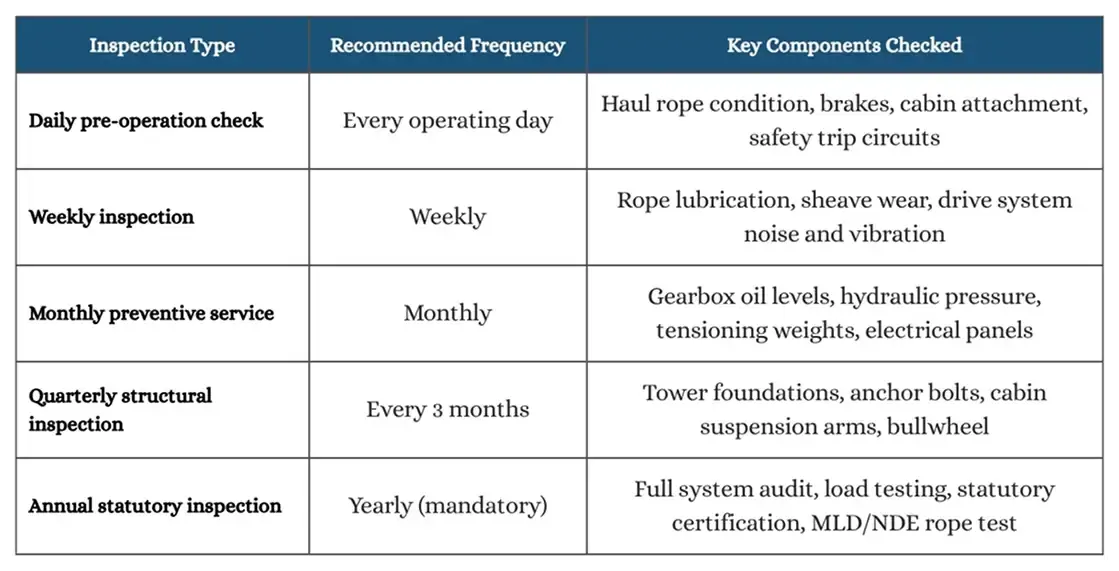
If your AMC says “periodic maintenance” and nothing more, you have no contractual basis to question how often the provider visits. That ambiguity always favors the service company. Push for explicit visit schedules in the agreement itself, and ensure that all service logs remain your documentation, not theirs.
OEM vs. Third-Party Ropeway AMC: Which One Should You Choose?
The decision between an OEM maintenance contract and a third-party service agreement is one of the most consequential choices an operator makes. For ropeway systems, the answer is less straightforward than it is for standard industrial equipment.
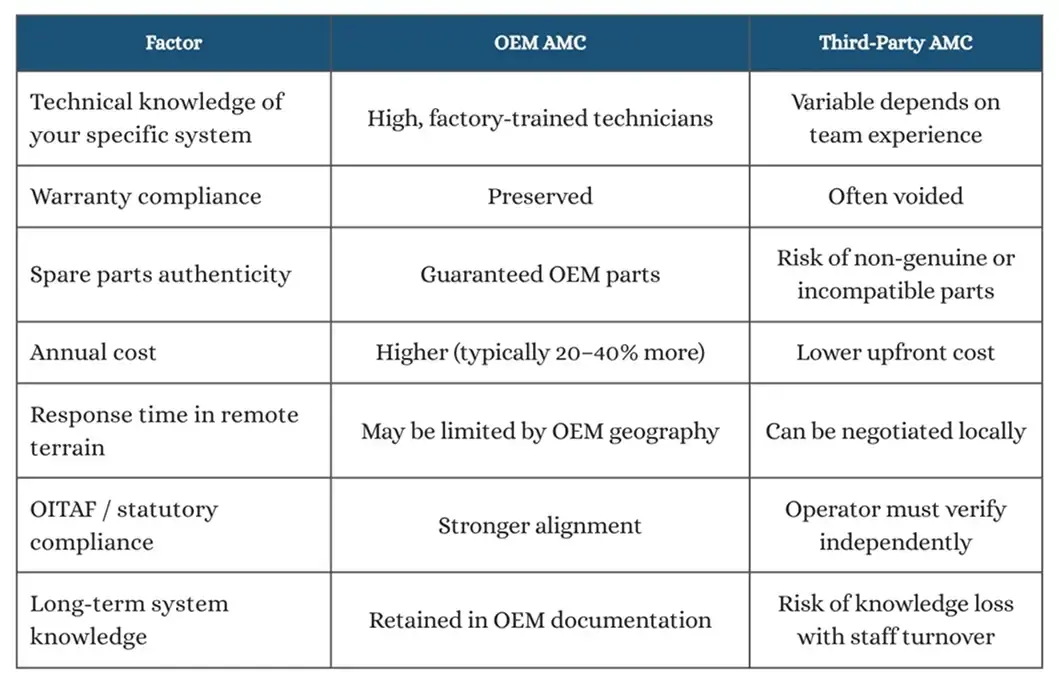
Before choosing between OEM and third-party maintenance, ask one question your comparison guide probably skipped: how long does it actually take their technician to reach your site? An OEM-based overseas or in a distant Indian city may carry every technical credential and still leave your system grounded for three days. A qualified regional provider with a realistic 6-hour SLA is worth more in practice, even if it costs more per visit.
What Should the Cable Car Downtime Response Time SLA Specify?
The Service Level Agreement (SLA) defines what the service provider must do when the system fails and how fast. Most operators skim it. Most operators regret that. Before signing any ropeway AMC, the SLA deserves more attention than any other clause in the document. A robust downtime response SLA must specify three distinct timelines:
- Acknowledgement time: How long before the provider confirms receipt of the fault report (should be under 2 hours for passenger systems)
- Technician on-site time: How long before a qualified engineer physically arrives at the installation (4–24 hours depending on location)
- System restoration time: Maximum time within which the system must be restored to operational status, or escalation triggered
If the provider misses the response window and your contract carries no penalty clause, you have no leverage and no remedy. An AMC that defines timelines without consequences is written in the provider’s favor, not yours. Liquidated damages or credit provisions must be part of the signed document before any work begins.
How Should a Ropeway Spare Parts Supply Agreement Be Structured?
Spare parts availability is the single biggest operational risk in ropeway maintenance and the most overlooked clause in most AMC agreements. The problem operators underestimate is not the cost of parts. It is how long they take to arrive.
Gearboxes, haul rope splicing materials, hydraulic control modules, bullwheel bearings, and drive motor components. Each of these carries an import lead time of 8 to 20 weeks when sourced from European OEMs. For any system that is grounded and waiting on one of these parts, that timeline is commercially catastrophic.
A well-structured ropeway spare parts supply agreement must address the following:
- Minimum on-site inventory: Which consumable and critical parts must be physically present at the installation site at all times. Rope clamps, sheave liners, and grip components are the starting point, not the complete list.
- Parts classification: Tier 1 covers consumables replaced at every service visit. Tier 2 covers wear parts on 12- to 24-month replacement cycles. Tier 3 covers critical capital components with multi-year lifecycles that must be sourced and cleared well in advance.
- Parts sourcing clarity: Whether parts supplied are OEM-genuine or equivalent-specification alternatives, and which party has approval authority when a substitution is proposed.
- Emergency supply protocol: Named contacts, defined escalation paths, and maximum lead time commitments for parts dispatch when the system is grounded.
- Parts ownership: Whether buffer stock held on-site belongs to the operator or the service provider and how costs are calculated and settled when parts are consumed.
Extended ropeway downtime in India is rarely caused by a lack of qualified technicians. In most cases, the technician arrives, identifies the fault, and then waits. The missing variable is almost always a critical spare part that was never stocked on site. Operators who treat spare parts protocols as seriously as SLA response times cut their mean time to restore significantly.
What Safety Compliance and Inspection Frequency Must the AMC Guarantee?
Inspection frequency and safety compliance are not AMC clauses to negotiate down. They are statutory requirements. Passenger ropeways in India operate under state-level regulations and OITAF guidelines where applicable. The AMC must reflect those obligations in full, not approximate them. The AMC must explicitly state:
- That all inspections will be conducted as per OITAF guidelines and applicable IS/BIS standards
- Who holds responsibility for obtaining statutory inspection clearances, whether the operator or the AMC provider
- Whether non-destructive evaluation (NDE) of ropes and structural steel is included in the annual inspection scope
- Documentation handover: all inspection reports, maintenance logs, and test certificates must remain in the operator’s custody
- That the service provider carries adequate professional liability insurance for maintenance activities
If a statutory inspection uncovers a defect that triggers a regulatory shutdown, the AMC must already define who bears the remediation cost and within what timeline. That clarity cannot be negotiated after the fact. Contracts that leave this ambiguous do not create disputes eventually. They guarantee them.
What Is the AMC Checklist Every Ropeway Operator Should Use?
Before signing any ropeway annual maintenance contract, run this checklist against the proposed agreement. Every item should have a clear, written answer in the contract document.
| Sr. No. |
Checklist Item |
What to Look For |
| 1 |
Scope of services |
Explicit list of included and excluded activities — no vague “general maintenance” language |
| 2 |
Preventive maintenance schedule |
Named frequencies (monthly, quarterly, annual) with visit checklists attached |
| 3 |
Response time SLA |
Acknowledgement, on-site arrival, and system restoration times – with penalty clauses |
| 4 |
Spare parts protocol |
On-site buffer inventory list, parts sourcing policy, emergency supply procedure |
| 5 |
OEM vs third-party clarity |
Parts authenticity declaration, warranty impact statement |
| 6 |
Statutory compliance responsibility |
Named party responsible for OITAF/IS compliance and statutory certificate renewal |
| 7 |
Documentation ownership |
All service reports, test records, and maintenance logs belong to the operator |
| 8 |
Personnel qualifications |
Minimum qualification and experience levels for lead technicians |
| 9 |
Liability and insurance |
Provider’s professional indemnity and third-party liability coverage |
| 10 |
Exit and renewal terms |
Notice period for termination, auto-renewal conditions, escalation caps |
Why the Manufacturer’s Role in After-Sales Matters More Than Operators Realize
The quality of a ropeway AMC is determined as much by who built the system as by who maintains it. Manufacturers with genuine after-sales infrastructure, trained service teams, accessible spare parts networks, and long-term support commitment create fundamentally lower maintenance risk from day one.
Before signing any AMC, verify that the manufacturer maintains in-house service capabilities, can supply parts for systems over a decade old, and has experience in terrain comparable to your installation.
M&M Ropeways, a leading ropeway manufacturing company, builds after-sales support into the delivery model. With over 100 systems installed across diverse and high-altitude terrain, the service infrastructure is built around where these systems actually operate.
Final Word: The AMC Is as Important as the System Itself
A ropeway is a long-life infrastructure investment, typically 20 to 30 years with proper maintenance. The AMC determines whether that lifespan is achieved or compromised. Operators who invest as much diligence in evaluating the maintenance contract as they do in evaluating the system specification will find that unplanned downtime, regulatory penalties, and premature component failure are manageable, not inevitable.
Read every clause. Negotiate every SLA. Confirm every spare parts protocol. The signature on a ropeway AMC carries weight that extends far beyond the contract term.
Need AMC guidance from people who built the system? Talk to the M&M Ropeways after-sales team. Contact us today.
by ropeway-admin | Jul 22, 2026 | Games, Ropeways
Building a ropeway for a pilgrimage site is very different. It is not the same as putting up a gondola for tourists on a hill station. It comes with a completely different set of challenges. You’re not just moving sightseers who chose to be there for fun. You’re carrying devotees of every age, in every season, many heading to shrines sitting above 10,000 feet, and plenty of them have never set foot in a cable car before in their lives. That changes everything about how you design the system: the weather extremes it has to survive, the sudden crowd surges during festival season, all of it. India is already taking on projects like this at its major pilgrimage sites. Talking about Kedarnath, the ropeway system that is built there is made to carry around 1,800 passengers in one single hour. That too in each direction, and it’s huge. And this way, it turns a nine-hour trek into a 36-minute time-saving ride.
Now look at Vaishno Devi. Every year, almost 90 lakh people visit here. That is a very large crowd number. The existing ropeway there already moves 800 passengers an hour, between Bhawan and the Bhairon temple. And it has been doing this for years. Numbers like these tell you something important. Pilgrimage ropeways are not just bigger or smaller versions of a regular cable car system. You cannot just scale one up or down and call it done. They are their own category altogether. That is exactly why manufacturers like M&M Ropeways treat religious site projects differently. They do not use the same playbook they would for any other job. These sites need their own approach, built from the ground up.
Why Pilgrimage Sites Need Purpose-Built Ropeways
In India, most of the religious places are at hilltops. Or deep inside mountain valleys. For centuries, devotees reached them the hard way. On foot. By pony. By palanquin.
These routes work, sure. But think about who gets left out. Older pilgrims struggle. People with disabilities cannot make the climb at all. Anyone travelling with young children faces real risk. And during peak season, things get dangerous. Large crowds moving along narrow mountain paths can become dangerous for everyone out there. This increases the risk of big accidents.
A well-planned ropeway system solves both problems at once. Every pilgrim gets a safe way up, no matter their age or physical condition. And there is another benefit too. Less foot traffic means less damage to fragile mountain trails. That helps protect the ecology around temples and gurdwaras.
This is exactly why the central government’s Parvatmala Pariyojana has made pilgrimage sites a priority. Kedarnath. Vaishno Devi. Hemkund Sahib. Sabarimala. These come before ordinary tourist destinations, and for good reason.
Core Design Considerations for a Pilgrimage Ropeway
Designing a cable car temple access crowd management system for a temple or shrine involves far more than picking towers and cabins. Every decision has to account for the specific pressures of religious tourism.
Terrain and Altitude
Some ropeways to religious places in India climb to serious altitudes. The Kedarnath ropeway reaches around 11,500 feet. That’s high. But Hemkund Sahib goes even higher. Its ropeway climbs to a gurdwara sitting near 15,000 feet. This is higher than most people ever travel.
These extreme heights make construction in these areas so much more difficult. The air gets thin. Temperatures can drop suddenly, without warning. And the terrain keeps changing too. River valleys give way to rock faces, sometimes within just a few kilometres.
Then there is tower placement. This is not simple. Engineers have to balance structural stability against something else entirely, disrupting the natural landscape as little as possible. Get it wrong, and you either compromise safety or damage the very mountains these shrines sit on.
Weather Resistance
Another thing is that holy places are usually open only for a few months in the Himalayan region. Let’s look at Kedarnath for that matter of fact. It is open from Akshay Tritiya to Diwali. This is just for 6 to 7 months. Snow, monsoon rain, and strong winds can shut down less reliable ropeway systems for days. This is why most large pilgrimage ropeways in India now use Tri-cable Detachable Gondola technology, known as 3S. The three-cable design gives far more stability in strong wind than a standard monocable system, which matters enormously on an exposed mountain ridge.
Capacity Planning
Pilgrimage sites see extreme swings in footfall. On a normal weekday, a shrine might get a few thousand visitors. Then a major festival comes along. That number can jump tenfold, almost overnight.
So, how do engineers plan for such scenarios? They calculate how many people the ropeway can carry every hour. This is called passengers per hour per direction (PPHPD) in engineers’ math.
Getting this number right matters. A lot. It is one of the most important parts of ropeway engineering for a religious site. Why? Because if you underbuild capacity, you have not actually solved the crowding problem. You have just moved it. From the trekking path straight to the ropeway queue.
Station Placement Near Temples
Station location is not just about terrain. Tradition matters just as much. Experts who plan this have to work closely with temple trusts, shrine boards, and local communities. The goal is simple to state but hard to achieve. Place the stations where they cause the least disruption. To existing pilgrim routes. To shops. To residential areas.
Take the Vaishno Devi Katra ropeway project. It ran into strong local opposition, and for good reason. The new alignment bypasses towns that have depended on foot traffic from trekking pilgrims for generations. Those businesses did not build themselves around a ropeway. They built themselves around people walking through, on foot, over years.
So good project execution means something more than engineering efficiency. It means balancing that efficiency against real livelihoods. Livelihoods built around the traditional route, over decades, by real families.
Accessibility for Elderly and Disabled Devotees
Think about senior citizens. Think about disabled devotees. What do they actually need from a ropeway? Low step heights. Secure handrails. Enough dwell time at boarding platforms, so nobody feels rushed. Staff trained to help passengers who move slowly, with patience.
Cabins need to be wide enough for wheelchairs. Station approaches need ramps, not stairs, wherever possible. Small details, all of them. But they add up to something big.
This single design consideration, getting accessibility right, is often the difference between a devotee making the pilgrimage or not. For someone who could never have managed the trek on foot, this is what makes it physically possible. Not a nice-to-have. The whole reason they get to go at all.
Crowd Management Strategies Using Ropeway Systems
A ropeway does not automatically solve crowd management. It has to be paired with the right operational systems.
Time Slot Booking and RFID
Here’s a smart move by the Vaishno Devi Shrine Board. They issue RFID cards during yatra registration. And they require pilgrims to book a specific ropeway time slot in advance. Not just show up whenever.
Why does this matter? This single step prevents something dangerous. The kind of unplanned crowd surge that overwhelms a station, all at once. Tickets are valid for a very short time. This makes arrivals spread evenly across the day, instead of everyone rushing in at the same hour.
Queue Design at Stations
Station layout matters just as much as the ropeway itself. Maybe more, honestly. Covered waiting areas. Clear signage. Medical aid posts. Separate queues for elderly or differently abled pilgrims. All of this reduces pressure at the boarding point.
Here’s the thing, though. Stations built for high footfall pilgrimage sites need far more queuing space than a standard tourist ropeway. Much more. Why? Because wait times here can stretch for hours during peak season. A tourist gondola never has to plan for that. A pilgrimage ropeway design India always does.
Peak Season Load Balancing
Think about Navratri at Vaishno Devi. Or the Char Dham season at Kedarnath. These festival periods can multiply daily footfall several times over. Not by a little. By a lot.
So how do operators cope? They extend operating hours. They add staff. Sometimes they even run cabins closer together to raise effective capacity when it matters most.
Here is the real lesson, though. You cannot plan for this swing as an afterthought. You cannot treat it as some rare exception. It has to be built into the design from day one. That is what separates a resilient pilgrimage ropeway design India from one that buckles the moment festival demand hits.
Integration with Other Transport
No single mode of transport can carry an entire pilgrim base on its own. Not even close. That is why ropeways work best when they are not standing alone. They need to be planned alongside helicopter services. Alongside battery-operated vehicles. Alongside the traditional trekking path too, for those who still want to walk.
This gives pilgrims a genuine choice. Based on their budget. Based on how much time they have. Based on physical ability.
Look at Vaishno Devi for a clear example. Helicopters carry only five to six passengers per trip. Five or six people, that is it. Which shows you exactly why a higher-capacity ropeway remains essential. Someone has to move the bulk of daily pilgrim traffic. And it is not going to be a helicopter that does that.
Case Study: Kedarnath Ropeway
The Sonprayag to Kedarnath ropeway project details are not just another infrastructure project. It is one of the most ambitious pilgrimage infrastructure projects anywhere in the world. The Cabinet approved it in March 2025, under the Parvatmala Pariyojana. The route runs 12.9 km. It will use Tri-cable Detachable Gondola technology. And here is the number that matters most. It will cut a 16 km trek from nine hours down to just 36 minutes.
Now let’s talk cost. The project carries a capital cost of roughly ₹4,081 crore. It is being built under a Design, Build, Finance, Operate, and Transfer model. Adani Enterprises is managing this, with a concession period of 29 years.
Consider the scale of demand too. Kedarnath draws around 20 lakh pilgrims. And that’s during a short operating season only. The ropeway is designed to carry 1,800 passengers per hour, in each direction. Do the math, and that works out to about 18,000 pilgrims a day.
Step back and look at what this really shows. Pilgrimage ropeway design has come a long way. This scale of religious tourism infrastructure shows how far pilgrimage ropeway design India has advanced from earlier, smaller systems.
Case Study: Vaishno Devi Ropeway
Vaishno Devi already runs one of India’s most heavily used pilgrimage ropeways. The Bhawan to Bhairon temple line opened back in 2018. It covers about 1.5 km. Ride time: three to five minutes.
Before this, a steep trek stood in the way. Many devotees simply couldn’t visit the Bhairon shrine at all. Now they can. The ropeway carries up to 800 passengers per hour, using enclosed cabins that hold 40 to 45 people each.
But that’s not the only project here. A second, larger ropeway is under construction right now. This one runs between Katra town and Sanjichhat, closer to the base of the pilgrimage route. Public-private partnership. Estimated cost: ₹300 crore. Designed to carry 1,000 passengers per hour. Expected to go live by December 2026.
Think about what that actually changes. A six-to-seven-hour trek drops to under an hour. Just a six-minute ropeway ride, then a short walk to the shrine. And the numbers behind it are staggering. Annual footfall now regularly tops 90 lakh devotees. This gondola lift project is addressing one of the busiest pilgrimage routes anywhere in the country.
Case Study: Hemkund Sahib Ropeway
Along with the Kedarnath project, the Cabinet also approved a 12.4 km ropeway connecting Govindghat to Hemkund Sahib Ji in Uttarakhand. Cost: around ₹2,730 crore.
Hemkund Sahib sits at nearly 15,000 feet. That makes it one of the highest, holiest Sikh pilgrimage sites in India.
Every year, in a brief window from May to September, it draws 1.5 to 2 lakh pilgrims. Getting there means a punishing 21 km trek. No way around it. That same trek doubles as the gateway to the Valley of Flowers, a UNESCO World Heritage Site.
Here’s what changes now. The new ropeway brings all-weather connectivity this route has never had. Not once. Which means the shrine opens up to far more devotees than the trek alone could ever carry.
The Parvatmala Pariyojana and the Future of Pilgrimage Ropeways
Let’s zoom out for a second. The National Ropeways Development Programme, known as Parvatmala Pariyojana, was announced in the Union Budget for 2022-23. Who runs it? The National Highways Logistics Management Limited, under the Ministry of Road Transport and Highways.
And the scale here is massive. The government’s long-term plan involves roughly ₹1,250 billion in public-private partnership investment, through 2030. The target is over 1,200 km of new ropeway infrastructure, spread across 200 projects.
States are not waiting around either. They have already proposed 256 ropeway projects. Uttarakhand alone has 49. Jammu and Kashmir has 18. Himachal Pradesh has five.
And it goes well beyond Kedarnath, Vaishno Devi, and Hemkund Sahib. The scheme has identified several other pilgrimage sites too. Amarnath. Sabarimala. Chamunda Devi Temple. Kunjapuri Temple. Salkanpur Wali Mata Mandir. Mahakaleshwar Temple. Shankaracharya Temple in Srinagar. Kamakhya Temple in Guwahati. Tawang Monastery in Arunachal Pradesh.
So what does this pipeline really tell us? A ropeway for religious sites across India is now a core part of national infrastructure planning. Not a one-off project. Not something limited to a handful of famous shrines. This is happening at scale, across the country.
Choosing the Right Ropeway Technology for a Religious Site
Different pilgrimage sites need different technology depending on terrain, wind exposure, and expected passenger volume. M&M Ropeways works with clients to match the technology to the site rather than pushing a single standard solution across every project.
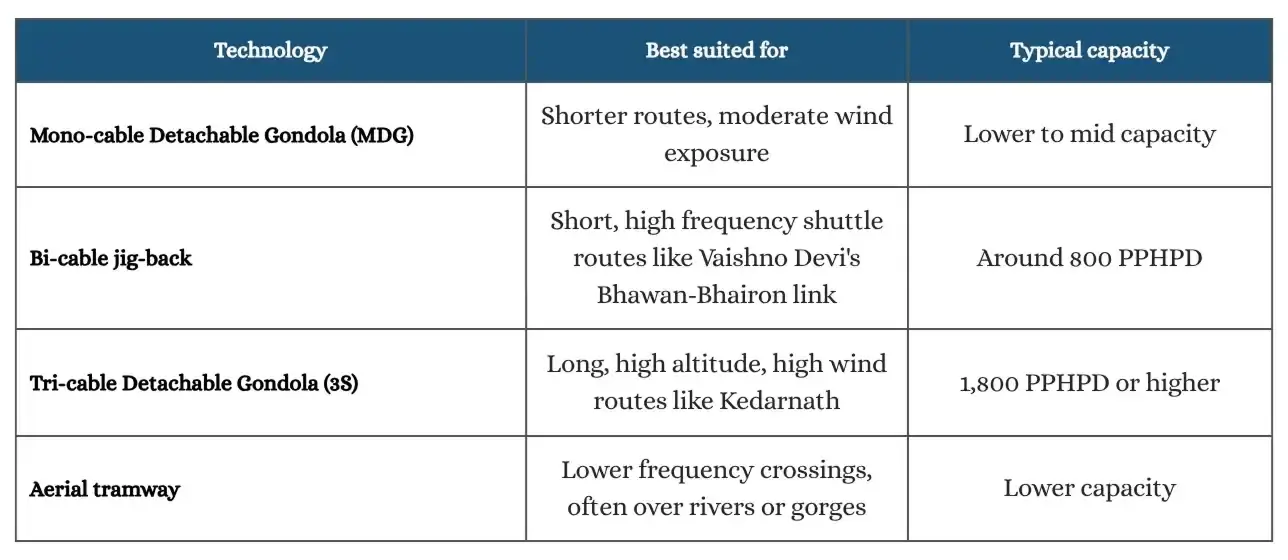 Selecting the correct system upfront avoids costly retrofits later. This is where an experienced manufacturing partner adds real value, since the wrong choice of technology can leave a project unable to meet festival season demand within just a few years of opening.
Checklist for Planning a Pilgrimage Ropeway Project
- Assess terrain, altitude, and wind exposure across the full route.
- Study historical and projected pilgrim footfall, including festival peaks.
- Set PPHPD capacity targets based on peak, not average, demand.
- Plan station locations in consultation with temple trusts and local communities.
- Build in accessibility features for elderly and disabled devotees from the start.
- Design queue and waiting areas sized for worst-case crowd scenarios.
- Coordinate with existing transport modes rather than replacing them outright.
- Plan for a multi-decade maintenance and operations model, not just construction.
M&M Ropeways works through each of these stages for clients developing pilgrimage and hill station infrastructure. With over 40 years of experience as a global ropeway manufacturer, M&M Ropeways brings design, manufacturing, installation, and commissioning under one roof, supported by international quality standards and proven projects across multiple countries. For developers and government bodies planning a ropeway for religious sites India needs in the coming decade, that end-to-end capability matters as much as the technology itself. M&M Ropeways also provides strong after-sales support, which is critical for systems that must run reliably through short, intense pilgrimage seasons year after year.
Frequently Asked Questions
What makes a pilgrimage ropeway different from a tourist ropeway?
Pilgrimage ropeways face tougher demands. Crowds swing up and down fast. Pilgrims are of all ages. Some struggle to walk. Many sites sit high up, with rough weather. Tourist ropeways just don’t see this mix.
How does the Kedarnath ropeway compare to the current trekking route?
Right now, the trek is 16 km. It takes eight to nine hours on foot. The new ropeway is just 12.9 km. It takes about 36 minutes. It uses gondola cable technology. It can carry 1,800 people an hour, each way.
What is the Parvatmala Pariyojana?
It’s a government ropeway plan. It started in the 2022-23 budget. The goal is big: over 1,200 km of new ropeways. That’s across 200 projects. All done by 2030. Hill stations and pilgrim sites come first.
by ropeway-admin | Jul 21, 2026 | Ropeways, Uncategorized
There is no such thing as “close enough” in this business. You either meet the required standards, or you just don’t. The margin for error in this business is zero. Because when a ropeway system faults, the consequences extend far beyond delays or money loss. It’s people’s lives and safety at stake. So, there’s no way you can compromise in decision-making here. Ropeway systems are not just limited to mountain areas. These are used in a wide range of environments, serving urban transit networks and industrial sites, and serving millions of passengers every year. The International Organization for Transportation by Rope (OITAF) has brought together manufacturers, operators, regulators, and research institutions from approximately 35 countries to advance global safety and engineering practices for ropeway systems.
M & M Ropeways has completed 120+ projects, including cable crane projects. 35 years of experience in the industry & the company has worked across challenging terrains and demanding industries where engineering precision, safety, and long-term performance are non-negotiable.
Why Choosing The Right Ropeway Manufacturer is Important?
A ropeway is not something you can update every other year. Pricing matters, but don’t make it your deciding factor in this case. The cheapest quote can lead to far more expensive repairs in the future, operational risk, and frequent maintenance. The right partner will give you much more than just delivering the equipment:
- Engineering customized specifically for your project
- Compliance with international safety requirements
- Reliable manufacturing quality
- Project planning and execution support
- Installation supervision
- Operator training
- Long-term maintenance assistance
- Spare parts availability throughout the system’s lifecycle
In short, it’s not just limited to purchasing ropeways; it’s your investment in a long-term safe transportation solution that should remain safe, dependable, and cost-effective not just for the initial stage but for years. Explore M&M Ropeways to see how we’ve delivered reliable ropeway systems for tourism, industrial, infrastructural, and material handling applications. Let’s crack the 12-point checklist now.
12-Point Checklist for Selecting the Right Ropeway Manufacturer
First of all, here’s a quick table version of all the important things.
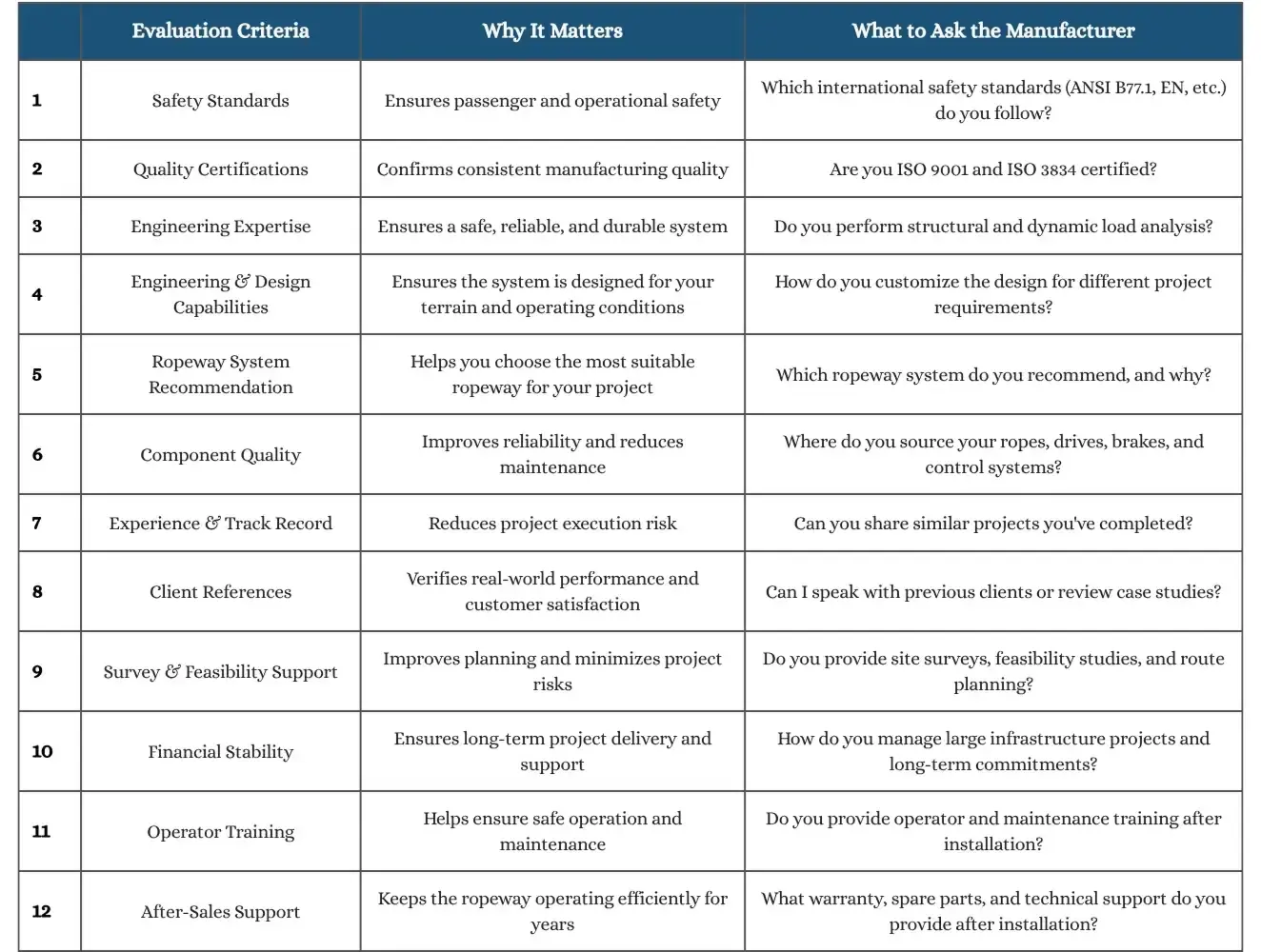
Let’s elaborate on each one, one by one.
1. Make Sure They Meet International Safety Standards
Again, as mentioned earlier, safety is not something you can compromise in this business. Always look for a manufacturer that builds systems in accordance with internationally recognized safety standards, not just local regulations. The safety standards should match throughout design, manufacturing, testing, and installation. Confirm that the system complies with standards such as ANSI B77.1 or relevant European EN standards where applicable. If they are following global safety standards, then they’ll typically offer:
- Better engineering documentation
- Thorough inspection and testing procedures
- Higher system reliability
Questions to ask:
- Which international safety standards do your systems follow?
- How are your systems tested before commissioning?
- Can you provide compliance documentation?
2. Check Their Quality Certifications
Ropeway quality comes down to one thing: how well it’s built. A solid build means better performance. It also means the ropeway lasts longer. So always check the manufacturer’s certifications first. Look for ISO 9001. This one covers quality at every stage, from design to maintenance. Check things like the inspection process. Check customer support too. Got a project with structural steel or welding? Then ISO 3834 matters as well. Together, these certifications back up quality from the first step to the last.
- ISO 9001 quality management certification
- Controlled production processes
- Strong quality control procedures
- Verified welding standards where applicable
We also serve clients across international markets.
3. Evaluate Their Engineering Expertise
Good ropeway design goes beyond manufacturing quality. They’re supposed to follow industry standards like OITAF, because these rules exist for a reason. These standards make sure your ropeway is safe, reliable, and built ot stand the test of time. Manufacturers that follow recognized engineering practices can often provide:
- Safer system designs
- Improved operational reliability
- Easier regulatory approvals
- Greater confidence for international projects
4. Evaluate Engineering and Design Capabilities
Projects are different from each other. Terrain, weather, elevation, and operating requirements of that area are all important things to consider when deciding how a system should be designed. A capable manufacturer understands this. They customize the solution based on your specific needs. They do not rely on a standard configuration. Their engineering team should be able to handle:
- Structural analysis
- Load calculations
- Tower and foundation design
- Electrical and control systems
- Mechanical optimization
- Wind and environmental assessments
Strong engineering helps ensure reliable performance in both everyday and challenging operating conditions.
5. See How They Design Ropeway Systems
The right manufacturer recommends what fits your project, not what they happen to sell. After evaluating your requirements, they may suggest:
- Monocable ropeways
- Bicable ropeways
- Gravity ropeways
- Material ropeways
- Cable crane systems
The recommendation should match your site conditions, budget, capacity needs, and future expansion plans. Explore the complete range of ropeway products.
6. Review Component Quality and Testing Procedures
The reliability of a ropeway comes down to the quality of its parts. Important components, which include wire ropes, drive systems, brakes, towers, bearings, and control systems, should meet high performance standards and undergo rigorous testing. Ask manufacturers:
- Where do you source your major components?
- How are components tested?
- Are inspections carried out before installation?
- What quality assurance process do you follow?
Those manufacturers that use trusted suppliers and hard testing generally deliver more reliable systems with lower maintenance costs.
7. Examine Their Track Record
For complex infrastructure projects, experience counts. But don’t just check years in business. That number alone means little. Look at completed projects instead. Real work tells the real story.
A strong portfolio should include experience in sectors such as:
- Tourism
- Mining
- Hydropower
- Dam construction
- Infrastructure
- Forestry
- Remote logistics
Projects completed in conditions similar to yours often indicate stronger technical expertise. We also provide ropeway solutions across South Asia and Africa, with dedicated expertise for projects in Bhutan, Nepal, and Africa.
8. Request Client References and Case Studies
You really can get a good idea about a manufacturer from previous projects. Ask for client references or case studies that demonstrate their experience and project delivery.
Speaking with previous customers can help you evaluate:
- Project execution
- Communication
- Timely delivery
- Installation support
- Equipment reliability
- After-sales service
Consistently positive feedback is usually a good sign of a dependable partner.
9. Check if They Offer Survey and Feasibility Support
Successful projects start well before manufacturing begins. An experienced manufacturer should support the planning phase by assisting with:
- Site surveys
- Route alignment
- Topographical studies
- Feasibility analysis
- Preliminary engineering
- Capacity planning
Early technical support helps reduce delays and avoids costly changes. It also improves overall project efficiency. The manufacturer should understand local environmental regulations. They should design the project to minimize ecological impact. This includes careful tower placement and reduced land disturbance. The design should also comply with environmental approvals required in your region.
10. Evaluate Financial Stability
Large projects take months and years to complete. So always check if the company is financially stable or not. These little background verifications go a long way. A company that has strong financial backing is more likely to see your project through to the end and offer you long-term support. Including honoring warranties and service commitments well into the future.
- Maintain production schedules
- Manage supply chains effectively
- Honor warranty commitments
- Supply spare parts for years
- Support future expansions
This reduces the risk of project delays and long-term service issues.
11. Confirm Training and Knowledge Transfer
Installing the ropeway is only the first step. Your operators and maintenance team should receive proper training to keep the system running safely and efficiently.
A reliable manufacturer should provide the following:
- On-site operator training
- Maintenance guidance
- Emergency procedure training
- Operating manuals
- Troubleshooting support
Well-trained teams can improve safety, reduce downtime, and extend the life of the equipment.
12. Review Their After-Sales Support and Spare Parts Service
Regular maintenance is a reality for any ropeway system, no matter how well it is built. Parts will need to be replaced over time. Make sure the manufacturer you choose offers continued technical support. This support should cover the entire lifespan of the system.
Look for:
- Comprehensive warranty coverage
- Fast technical support
- Genuine spare parts
- International parts availability
- Maintenance and inspection assistance
Good after-sales support keeps your ropeway running smoothly and reduces costly downtime over the long term.
Common Mistakes Buyers Should Avoid
Buyers usually make the same mistakes when selecting a ropeway manufacturer. And these mistakes are completely avoidable if you are aware of a few things.
- Making Money The Deciding Factor
Poor quality material, limited support, and experience can cost you more. So always try to go for quality and experience rather than going for a low-budget quote.
- Not Taking Certifications Seriously
Manufacturers without proper safety standards and quality can lead you to operational risks and compliance issues in the future. So always look for certifications and safety standards.
- Underestimating Experience
A manufacturer who has delivered projects already is always aware of what to and what not to do in serious situations. An experienced manufacturer is always better prepared to handle challenges. Go for an experienced company.
- Not Evaluating Support Services
A ropeway project is something that runs for decades. Having a good support system in maintaining and coordination in case of any inconvenience is always important.
Final Verdict
Making the right decisions about your ropeway manufacturer is something that will impact your business for years. This business is not just about making money but also building trust in the industry, as it involves people’s lives. Choosing the right partner with proven experience, certifications, international exposure, and quality manufacturing is really important. This 12-point checklist covers almost everything that you should not miss.
Looking for a ropeway manufacturer you can trust? Get in touch with M & M Ropeways. Tell us about your project. We’ll help you land on the right solution for your needs.
Frequently Asked Questions (FAQs)
What things do I keep in mind when choosing a ropeway manufacturer?
When you are choosing a ropeway manufacturing partner, look for international-level safety compliance, certifications, quality in manufacturing, good long-term sales support, and relevant project experience. If needed, they should have readily available spare parts.
Why are international safety standards important for ropeway systems?
International standards cover all important aspects of safety. You can count on passenger safety and regulatory compliance across different regions.
What should I check before choosing a ropeway manufacturer?
Always look at safety standards, certifications, past completed projects, and spare parts availability. A good manufacturing partner will help you through planning, installation, and long-term maintenance support.