by ropeway-admin | Jul 23, 2026 | Gondolas
Imagine standing at a mountain peak during a storm. The wind howls, yet a ropeway system moves visitors safely through harsh weather. This is engineering brilliance at work. When mountain regions need to move thousands of people daily, they must choose between two powerful technologies: tricable (3S) and bicable (2S) gondola systems.
For mountain resorts, pilgrimage sites, and developing regions across India, this choice is game-changing. It’s about understanding which system fits your terrain, climate, and budget. M & M Ropeways has installed 120+ Ropeway Installation Projects successfully. The right system choice makes all the difference in long-term reliability and revenue.
This guide breaks down 3S and 2S systems clearly. We’ll explain what makes tricable gondolas special and why they excel in extreme conditions. We’ll also connect these systems to India’s bold Parvatmala Pariyojana environmental initiative, launched in 2025.
Understanding The Basics
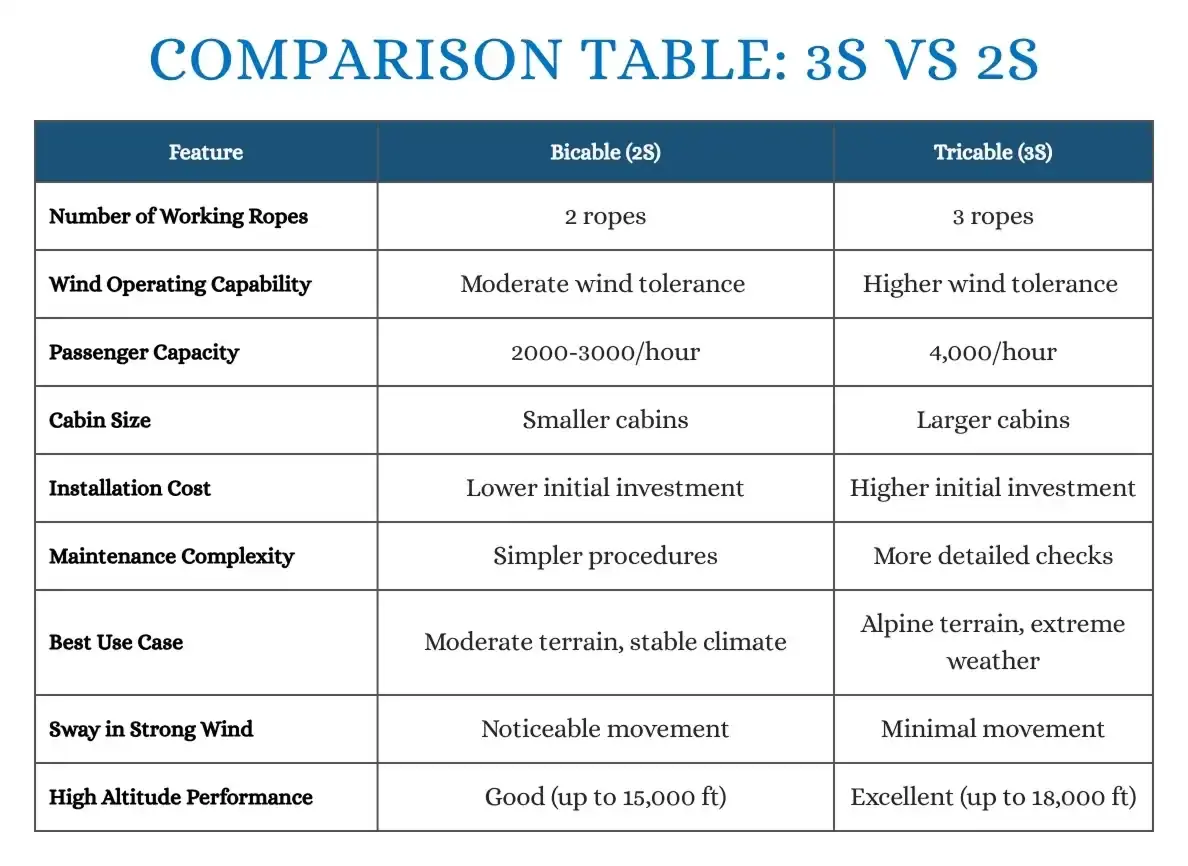
- A bicable ropeway (2S) uses two ropes but works differently. One for the load & one for the support, which acts as backup. Think of it as a main worker with an assistant standing by.
- A tricable gondola (3S) uses three ropes as a team. Two carry the load while one provides safety guidance. This setup means more support, stability, and confidence in severe weather. The “S” means “Seilbahn” in German, the technical term for rope systems.
- Bicable systems work wonderfully in moderate climates and stable terrain. However, Tricable systems break new ground. They handle extreme weather much better and move significantly more passengers per hour.
Under India’s Parvatmala Pariyojana, the Union Budget of 2022-23, the government promotes a sustainable ropeway transportation system. This National Ropeways Development Programme recognizes that roads are not the best solution for fragile mountain regions. Both systems have their place in this new vision.
Why The Tricable Gondola Lift Excels In Wind-Exposed Terrain
When we discuss tricable detachable gondola 3S technology and its wind resistance, we’re talking about real physics. The extra rope handles stronger winds without swaying or stopping. This matters greatly in exposed terrain where gusts exceed 100 kilometers per hour.
Alpine areas experience unpredictable weather shifts. At any time, snow, ice, and wind can hit suddenly. So, a particular safety measure is needed to take in these regions. Tricable 3S gondolas are an aerial cabin transportation system that is an advanced system that can carry up to 3,000 to 4,500 passengers in a single hour. In comparison, Bicable 2S gondola systems can carry between 1,500 & 2,500 per hour. For busy ski resorts or pilgrimage sites, this difference is enormous.
The Sonprayag-Kedarnath Ropeway Project shows why 3S wins. This 12.9 km tricable system (3S) will use more advanced 3S tech for the largest pilgrimage project. The advanced setup is capable of moving about 1,800 passengers per hour in just one direction. It also helps to bring the journey down from 8-9 hours to roughly 36 minutes. Altogether, pilgrims will be able to travel more easily, because Kedarnath sees around 20 lakh pilgrims every single year. This demonstrates why 3S systems are preferred for India’s most challenging routes.
Bicable Systems: Proven But Limited
Bicable ropeways are excellent systems. They’ve carried millions of passengers safely worldwide. However, they have real constraints. Bicable systems work best in spans under 2.5 kilometers. Beyond that, cables sag noticeably, requiring additional towers.
Bicable systems sway more in extreme wind conditions. In calm mountain zones, this is fine. But in exposed ridges or plateaus, passengers notice movement and feel discomfort. The cost difference matters, especially when comparing ropeway installation costs across system types. Bicable systems cost less initially. They need fewer mechanical parts and simpler engineering. For budget-conscious projects in stable climates, 2S seems attractive. But think long-term. Bicable systems shut down when winds exceed 90 kilometers per hour. In the Indian mountains during the monsoon season and winter storms, this is a serious limitation. The system stops, disappointing tourists and disrupting schedules.
The Kedarnath Success Story
The Kedarnath 3S tricable gondola lift shows modern engineering solving real challenges. Kedarnath has an elevation of 3,600 meters in the Himalayas. The current trek takes approx. 8-9 hours through steep, dangerous terrain. The new 3S ropeway changes everything. It operates safely during heavy snow and extreme wind. The three-rope design reduces dangerous sway. It maintains smooth rides even in gusts that would shut down 2S systems. This real-world success shows why 3S systems suit windy mountains. They handle altitude and exposure beautifully. They reduce reliance on weather windows. Thus, it proves that investing in better technology pays long-term dividends.
Wind Resistance And Passenger Capacity Explained
Wind resistance depends on rope arrangement. With two ropes, cabin grip depends solely on those cables. Any imbalance creates swaying & discomfort.
With three ropes, the system has built-in redundancy and stability. If wind pushes from one side, the third rope provides a counterbalance. The cabin stays steady and level. Based on 2026 testing data, monocable detachable gondolas work safely up to 60-70 km/h. Bicable systems handle 90 km/h before shutdown. Tricable systems work properly even when winds exceed 100 km/h. Passenger capacity ties to rope strength and detachable grip technology. Tricable systems allow larger cabins. Bigger cabins mean more people per trip. Higher overall throughput results.
The Varanasi Urban Ropeway is opening around August 2026. This shows how an aerial ropeway system can transform urban transportation. This is India’s first public monocable urban ropeway & can carry 96,000 passengers daily. Moreover, its maximum capacity is 3,000 passengers per hour. This is how it changes what’s possible for congested cities like Shimla and Manali.
Environmental Policy And India’s Shift
India’s infrastructure planning has shifted fundamentally. Under Parvatmala Pariyojana, the government reported more than 250 aerial ropeway projects spanning about 1,200 kilometers, and the total investment is said to touch ₹1.25 lakh crore, mainly through a public-private partnership arrangement.
This isn’t just about convenience. It’s about environmental survival. Mountain highway construction emits 1,500-2,000 tonnes of CO₂ per kilometer. When it comes to electric ropeway installation, it’s reported to release only around 250-500 tonnes per kilometer, which is a lot less than usual options.
Also, research indicates that if you swap 30% of road traffic with ropeways, transportation emissions can fall by as much as 85% in mountain regions, and well, that’s pretty significant. Highways need 3-5 hectares. Parvatmala mandates that all projects prioritize environmental sustainability. Both 2S and 3S align with this. However, 3S systems prove more valuable long-term. Superior reliability means fewer weather shutdown days. Consistent usage ensures Ropeway’s sustainable solutions deliver real environmental investment returns
Choosing Your System Rightfully
Before ropeway installation, ask honest questions about your terrain. How exposed is your mountain? What winter weather occurs? How many people need transport? What maintenance capacity exists?
For sheltered valleys with moderate winds, bicable gondola lift systems work perfectly and save money upfront. For exposed ridges with winter snow and monsoon winds, tricable systems repay extra investment through increased reliability and daily ridership. Consider passenger flow projections. Peak season creates demand spikes. Systems moving more people during peaks prevent queues and keep customers happy. Long-term revenue benefits from higher capacity. The 3S vs. 2S cost difference becomes worthwhile in five-year income projections.
What’s Next?
Choosing between a tricable gondola lift and a bicable system requires balancing many factors thoughtfully. No universal “best” answer exists. There’s the best choice for your specific 2026 situation.
Bicable systems serve stable climates well and remain economical for lower-altitude projects. Tricable systems represent the future, especially in the Himalayan regions. They align with environmental commitments and infrastructure modernization goals. Data from 2025-2026 is clear. 3S high-capacity systems experience 40% fewer downtime days. They move 60% more passengers during comparable hours. They generate greater economic returns.
M & M Ropeways brings 35 years of ropeway installation expertise. We installed systems at 18,000 feet on Siachen Glacier. We understand OITAF compliance deeply. We hold ISO certification. We build trust between mountains and people. Your project deserves analysis grounded in 2026 data. Your budget deserves wise allocation. Your passengers deserve All-weather ropeway systems even in harsh mountain weather. That’s the M & M Ropeways commitment to every client. So collaborate with us today and build a ropeway solution designed for safety, efficiency, and long-term success. You can also view our products here.
FREQUENTLY ASKED QUESTIONS RELATED TO ROPEWAYS
How feasible is it to run tricable cable cars with multiple parallel cableways for mass transit?
It’s technically feasible and already proven. Tricable systems handle high capacity and long spans well, making parallel lines viable for busy urban corridors. The main constraints are station footprint and upfront cost, not the cable technology itself. Careful route planning keeps operations efficient.
Which system does M&M Ropeways recommend for high-altitude projects above 15,000 feet?
M & M Ropeways strongly recommends 3S tricable systems for altitudes over 15,000 feet. Based on our experience on the Siachen Glacier, at 18,000 feet, we found that 3S deals with extreme cold and those unpredictable winds a bit better than 2S. In general, tricable systems give superior stability and reliability in tough alpine settings where safety is still the first concern, not something optional.
What is the typical passenger capacity difference between 2S and 3S systems installed by M&M Ropeways?
M & M Ropeways’ 3S set-ups move 3,000-4,000 passengers per hour, while our 2S systems carry about 2000-3000 passengers per hour. That noticeable gap makes 3S a pretty good fit for packed pilgrimage corridors like Kedarnath and Hemkund Sahib, too. But for those less crowded highland pockets, 2S systems provide cost-effective solutions.
How does M&M Ropeways approach wind resistance in system selection for the Indian mountains?
M & M Ropeways evaluates local wind patterns before recommending systems. M & M Ropeways 2S installations are rated for winds up to 90 km/h, while 3S systems safely operate beyond 100 km/h. We recommend 3S technology for monsoon-prone regions and exposed Himalayan ridges to maximize operational reliability.
What maintenance schedule does M&M Ropeways follow for 2S versus 3S systems?
M & M Ropeways schedules maintenance every 500 operating hours for both systems. However, 3S systems require additional rope-tension checks due to the use of three cables. Our ISO certified maintenance protocols ensure optimal safety and performance. Regular inspections prevent costly emergency repairs in both system types.
by ropeway-admin | Jul 22, 2026 | Games, Ropeways
Building a ropeway for a pilgrimage site is very different. It is not the same as putting up a gondola for tourists on a hill station. It comes with a completely different set of challenges. You’re not just moving sightseers who chose to be there for fun. You’re carrying devotees of every age, in every season, many heading to shrines sitting above 10,000 feet, and plenty of them have never set foot in a cable car before in their lives. That changes everything about how you design the system: the weather extremes it has to survive, the sudden crowd surges during festival season, all of it. India is already taking on projects like this at its major pilgrimage sites. Talking about Kedarnath, the ropeway system that is built there is made to carry around 1,800 passengers in one single hour. That too in each direction, and it’s huge. And this way, it turns a nine-hour trek into a 36-minute time-saving ride.
Now look at Vaishno Devi. Every year, almost 90 lakh people visit here. That is a very large crowd number. The existing ropeway there already moves 800 passengers an hour, between Bhawan and the Bhairon temple. And it has been doing this for years. Numbers like these tell you something important. Pilgrimage ropeways are not just bigger or smaller versions of a regular cable car system. You cannot just scale one up or down and call it done. They are their own category altogether. That is exactly why manufacturers like M&M Ropeways treat religious site projects differently. They do not use the same playbook they would for any other job. These sites need their own approach, built from the ground up.
Why Pilgrimage Sites Need Purpose-Built Ropeways
In India, most of the religious places are at hilltops. Or deep inside mountain valleys. For centuries, devotees reached them the hard way. On foot. By pony. By palanquin.
These routes work, sure. But think about who gets left out. Older pilgrims struggle. People with disabilities cannot make the climb at all. Anyone travelling with young children faces real risk. And during peak season, things get dangerous. Large crowds moving along narrow mountain paths can become dangerous for everyone out there. This increases the risk of big accidents.
A well-planned ropeway system solves both problems at once. Every pilgrim gets a safe way up, no matter their age or physical condition. And there is another benefit too. Less foot traffic means less damage to fragile mountain trails. That helps protect the ecology around temples and gurdwaras.
This is exactly why the central government’s Parvatmala Pariyojana has made pilgrimage sites a priority. Kedarnath. Vaishno Devi. Hemkund Sahib. Sabarimala. These come before ordinary tourist destinations, and for good reason.
Core Design Considerations for a Pilgrimage Ropeway
Designing a cable car temple access crowd management system for a temple or shrine involves far more than picking towers and cabins. Every decision has to account for the specific pressures of religious tourism.
Terrain and Altitude
Some ropeways to religious places in India climb to serious altitudes. The Kedarnath ropeway reaches around 11,500 feet. That’s high. But Hemkund Sahib goes even higher. Its ropeway climbs to a gurdwara sitting near 15,000 feet. This is higher than most people ever travel.
These extreme heights make construction in these areas so much more difficult. The air gets thin. Temperatures can drop suddenly, without warning. And the terrain keeps changing too. River valleys give way to rock faces, sometimes within just a few kilometres.
Then there is tower placement. This is not simple. Engineers have to balance structural stability against something else entirely, disrupting the natural landscape as little as possible. Get it wrong, and you either compromise safety or damage the very mountains these shrines sit on.
Weather Resistance
Another thing is that holy places are usually open only for a few months in the Himalayan region. Let’s look at Kedarnath for that matter of fact. It is open from Akshay Tritiya to Diwali. This is just for 6 to 7 months. Snow, monsoon rain, and strong winds can shut down less reliable ropeway systems for days. This is why most large pilgrimage ropeways in India now use Tri-cable Detachable Gondola technology, known as 3S. The three-cable design gives far more stability in strong wind than a standard monocable system, which matters enormously on an exposed mountain ridge.
Capacity Planning
Pilgrimage sites see extreme swings in footfall. On a normal weekday, a shrine might get a few thousand visitors. Then a major festival comes along. That number can jump tenfold, almost overnight.
So, how do engineers plan for such scenarios? They calculate how many people the ropeway can carry every hour. This is called passengers per hour per direction (PPHPD) in engineers’ math.
Getting this number right matters. A lot. It is one of the most important parts of ropeway engineering for a religious site. Why? Because if you underbuild capacity, you have not actually solved the crowding problem. You have just moved it. From the trekking path straight to the ropeway queue.
Station Placement Near Temples
Station location is not just about terrain. Tradition matters just as much. Experts who plan this have to work closely with temple trusts, shrine boards, and local communities. The goal is simple to state but hard to achieve. Place the stations where they cause the least disruption. To existing pilgrim routes. To shops. To residential areas.
Take the Vaishno Devi Katra ropeway project. It ran into strong local opposition, and for good reason. The new alignment bypasses towns that have depended on foot traffic from trekking pilgrims for generations. Those businesses did not build themselves around a ropeway. They built themselves around people walking through, on foot, over years.
So good project execution means something more than engineering efficiency. It means balancing that efficiency against real livelihoods. Livelihoods built around the traditional route, over decades, by real families.
Accessibility for Elderly and Disabled Devotees
Think about senior citizens. Think about disabled devotees. What do they actually need from a ropeway? Low step heights. Secure handrails. Enough dwell time at boarding platforms, so nobody feels rushed. Staff trained to help passengers who move slowly, with patience.
Cabins need to be wide enough for wheelchairs. Station approaches need ramps, not stairs, wherever possible. Small details, all of them. But they add up to something big.
This single design consideration, getting accessibility right, is often the difference between a devotee making the pilgrimage or not. For someone who could never have managed the trek on foot, this is what makes it physically possible. Not a nice-to-have. The whole reason they get to go at all.
Crowd Management Strategies Using Ropeway Systems
A ropeway does not automatically solve crowd management. It has to be paired with the right operational systems.
Time Slot Booking and RFID
Here’s a smart move by the Vaishno Devi Shrine Board. They issue RFID cards during yatra registration. And they require pilgrims to book a specific ropeway time slot in advance. Not just show up whenever.
Why does this matter? This single step prevents something dangerous. The kind of unplanned crowd surge that overwhelms a station, all at once. Tickets are valid for a very short time. This makes arrivals spread evenly across the day, instead of everyone rushing in at the same hour.
Queue Design at Stations
Station layout matters just as much as the ropeway itself. Maybe more, honestly. Covered waiting areas. Clear signage. Medical aid posts. Separate queues for elderly or differently abled pilgrims. All of this reduces pressure at the boarding point.
Here’s the thing, though. Stations built for high footfall pilgrimage sites need far more queuing space than a standard tourist ropeway. Much more. Why? Because wait times here can stretch for hours during peak season. A tourist gondola never has to plan for that. A pilgrimage ropeway design India always does.
Peak Season Load Balancing
Think about Navratri at Vaishno Devi. Or the Char Dham season at Kedarnath. These festival periods can multiply daily footfall several times over. Not by a little. By a lot.
So how do operators cope? They extend operating hours. They add staff. Sometimes they even run cabins closer together to raise effective capacity when it matters most.
Here is the real lesson, though. You cannot plan for this swing as an afterthought. You cannot treat it as some rare exception. It has to be built into the design from day one. That is what separates a resilient pilgrimage ropeway design India from one that buckles the moment festival demand hits.
Integration with Other Transport
No single mode of transport can carry an entire pilgrim base on its own. Not even close. That is why ropeways work best when they are not standing alone. They need to be planned alongside helicopter services. Alongside battery-operated vehicles. Alongside the traditional trekking path too, for those who still want to walk.
This gives pilgrims a genuine choice. Based on their budget. Based on how much time they have. Based on physical ability.
Look at Vaishno Devi for a clear example. Helicopters carry only five to six passengers per trip. Five or six people, that is it. Which shows you exactly why a higher-capacity ropeway remains essential. Someone has to move the bulk of daily pilgrim traffic. And it is not going to be a helicopter that does that.
Case Study: Kedarnath Ropeway
The Sonprayag to Kedarnath ropeway project details are not just another infrastructure project. It is one of the most ambitious pilgrimage infrastructure projects anywhere in the world. The Cabinet approved it in March 2025, under the Parvatmala Pariyojana. The route runs 12.9 km. It will use Tri-cable Detachable Gondola technology. And here is the number that matters most. It will cut a 16 km trek from nine hours down to just 36 minutes.
Now let’s talk cost. The project carries a capital cost of roughly ₹4,081 crore. It is being built under a Design, Build, Finance, Operate, and Transfer model. Adani Enterprises is managing this, with a concession period of 29 years.
Consider the scale of demand too. Kedarnath draws around 20 lakh pilgrims. And that’s during a short operating season only. The ropeway is designed to carry 1,800 passengers per hour, in each direction. Do the math, and that works out to about 18,000 pilgrims a day.
Step back and look at what this really shows. Pilgrimage ropeway design has come a long way. This scale of religious tourism infrastructure shows how far pilgrimage ropeway design India has advanced from earlier, smaller systems.
Case Study: Vaishno Devi Ropeway
Vaishno Devi already runs one of India’s most heavily used pilgrimage ropeways. The Bhawan to Bhairon temple line opened back in 2018. It covers about 1.5 km. Ride time: three to five minutes.
Before this, a steep trek stood in the way. Many devotees simply couldn’t visit the Bhairon shrine at all. Now they can. The ropeway carries up to 800 passengers per hour, using enclosed cabins that hold 40 to 45 people each.
But that’s not the only project here. A second, larger ropeway is under construction right now. This one runs between Katra town and Sanjichhat, closer to the base of the pilgrimage route. Public-private partnership. Estimated cost: ₹300 crore. Designed to carry 1,000 passengers per hour. Expected to go live by December 2026.
Think about what that actually changes. A six-to-seven-hour trek drops to under an hour. Just a six-minute ropeway ride, then a short walk to the shrine. And the numbers behind it are staggering. Annual footfall now regularly tops 90 lakh devotees. This gondola lift project is addressing one of the busiest pilgrimage routes anywhere in the country.
Case Study: Hemkund Sahib Ropeway
Along with the Kedarnath project, the Cabinet also approved a 12.4 km ropeway connecting Govindghat to Hemkund Sahib Ji in Uttarakhand. Cost: around ₹2,730 crore.
Hemkund Sahib sits at nearly 15,000 feet. That makes it one of the highest, holiest Sikh pilgrimage sites in India.
Every year, in a brief window from May to September, it draws 1.5 to 2 lakh pilgrims. Getting there means a punishing 21 km trek. No way around it. That same trek doubles as the gateway to the Valley of Flowers, a UNESCO World Heritage Site.
Here’s what changes now. The new ropeway brings all-weather connectivity this route has never had. Not once. Which means the shrine opens up to far more devotees than the trek alone could ever carry.
The Parvatmala Pariyojana and the Future of Pilgrimage Ropeways
Let’s zoom out for a second. The National Ropeways Development Programme, known as Parvatmala Pariyojana, was announced in the Union Budget for 2022-23. Who runs it? The National Highways Logistics Management Limited, under the Ministry of Road Transport and Highways.
And the scale here is massive. The government’s long-term plan involves roughly ₹1,250 billion in public-private partnership investment, through 2030. The target is over 1,200 km of new ropeway infrastructure, spread across 200 projects.
States are not waiting around either. They have already proposed 256 ropeway projects. Uttarakhand alone has 49. Jammu and Kashmir has 18. Himachal Pradesh has five.
And it goes well beyond Kedarnath, Vaishno Devi, and Hemkund Sahib. The scheme has identified several other pilgrimage sites too. Amarnath. Sabarimala. Chamunda Devi Temple. Kunjapuri Temple. Salkanpur Wali Mata Mandir. Mahakaleshwar Temple. Shankaracharya Temple in Srinagar. Kamakhya Temple in Guwahati. Tawang Monastery in Arunachal Pradesh.
So what does this pipeline really tell us? A ropeway for religious sites across India is now a core part of national infrastructure planning. Not a one-off project. Not something limited to a handful of famous shrines. This is happening at scale, across the country.
Choosing the Right Ropeway Technology for a Religious Site
Different pilgrimage sites need different technology depending on terrain, wind exposure, and expected passenger volume. M&M Ropeways works with clients to match the technology to the site rather than pushing a single standard solution across every project.
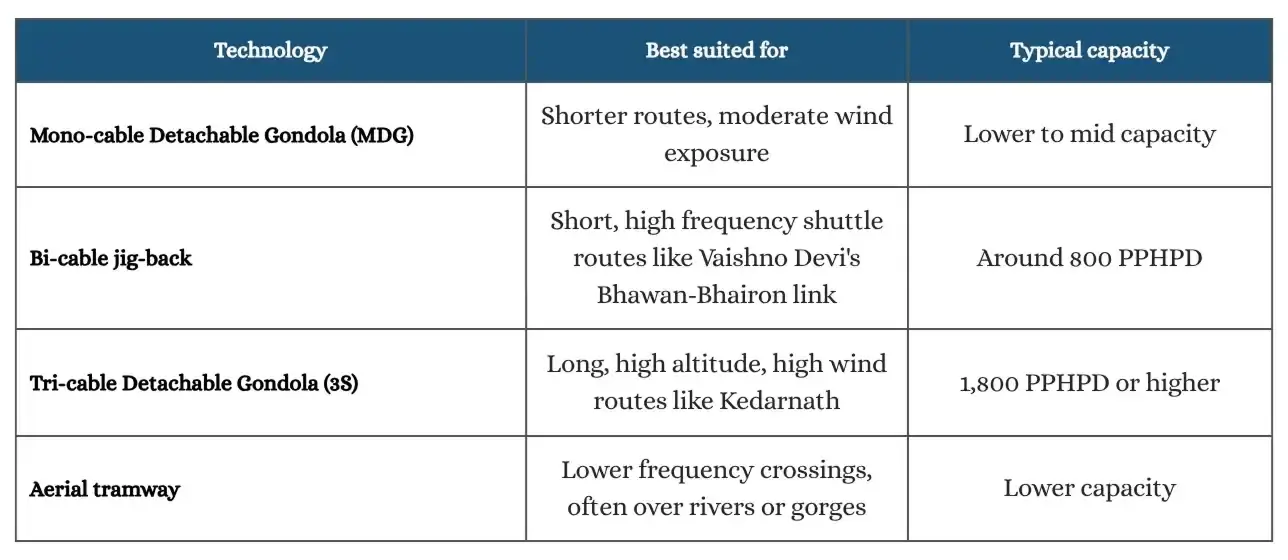 Selecting the correct system upfront avoids costly retrofits later. This is where an experienced manufacturing partner adds real value, since the wrong choice of technology can leave a project unable to meet festival season demand within just a few years of opening.
Checklist for Planning a Pilgrimage Ropeway Project
- Assess terrain, altitude, and wind exposure across the full route.
- Study historical and projected pilgrim footfall, including festival peaks.
- Set PPHPD capacity targets based on peak, not average, demand.
- Plan station locations in consultation with temple trusts and local communities.
- Build in accessibility features for elderly and disabled devotees from the start.
- Design queue and waiting areas sized for worst-case crowd scenarios.
- Coordinate with existing transport modes rather than replacing them outright.
- Plan for a multi-decade maintenance and operations model, not just construction.
M&M Ropeways works through each of these stages for clients developing pilgrimage and hill station infrastructure. With over 40 years of experience as a global ropeway manufacturer, M&M Ropeways brings design, manufacturing, installation, and commissioning under one roof, supported by international quality standards and proven projects across multiple countries. For developers and government bodies planning a ropeway for religious sites India needs in the coming decade, that end-to-end capability matters as much as the technology itself. M&M Ropeways also provides strong after-sales support, which is critical for systems that must run reliably through short, intense pilgrimage seasons year after year.
Frequently Asked Questions
What makes a pilgrimage ropeway different from a tourist ropeway?
Pilgrimage ropeways face tougher demands. Crowds swing up and down fast. Pilgrims are of all ages. Some struggle to walk. Many sites sit high up, with rough weather. Tourist ropeways just don’t see this mix.
How does the Kedarnath ropeway compare to the current trekking route?
Right now, the trek is 16 km. It takes eight to nine hours on foot. The new ropeway is just 12.9 km. It takes about 36 minutes. It uses gondola cable technology. It can carry 1,800 people an hour, each way.
What is the Parvatmala Pariyojana?
It’s a government ropeway plan. It started in the 2022-23 budget. The goal is big: over 1,200 km of new ropeways. That’s across 200 projects. All done by 2030. Hill stations and pilgrim sites come first.
by ropeway-admin | Jul 21, 2026 | Ropeways, Uncategorized
There is no such thing as “close enough” in this business. You either meet the required standards, or you just don’t. The margin for error in this business is zero. Because when a ropeway system faults, the consequences extend far beyond delays or money loss. It’s people’s lives and safety at stake. So, there’s no way you can compromise in decision-making here. Ropeway systems are not just limited to mountain areas. These are used in a wide range of environments, serving urban transit networks and industrial sites, and serving millions of passengers every year. The International Organization for Transportation by Rope (OITAF) has brought together manufacturers, operators, regulators, and research institutions from approximately 35 countries to advance global safety and engineering practices for ropeway systems.
M & M Ropeways has completed 120+ projects, including cable crane projects. 35 years of experience in the industry & the company has worked across challenging terrains and demanding industries where engineering precision, safety, and long-term performance are non-negotiable.
Why Choosing The Right Ropeway Manufacturer is Important?
A ropeway is not something you can update every other year. Pricing matters, but don’t make it your deciding factor in this case. The cheapest quote can lead to far more expensive repairs in the future, operational risk, and frequent maintenance. The right partner will give you much more than just delivering the equipment:
- Engineering customized specifically for your project
- Compliance with international safety requirements
- Reliable manufacturing quality
- Project planning and execution support
- Installation supervision
- Operator training
- Long-term maintenance assistance
- Spare parts availability throughout the system’s lifecycle
In short, it’s not just limited to purchasing ropeways; it’s your investment in a long-term safe transportation solution that should remain safe, dependable, and cost-effective not just for the initial stage but for years. Explore M&M Ropeways to see how we’ve delivered reliable ropeway systems for tourism, industrial, infrastructural, and material handling applications. Let’s crack the 12-point checklist now.
12-Point Checklist for Selecting the Right Ropeway Manufacturer
First of all, here’s a quick table version of all the important things.
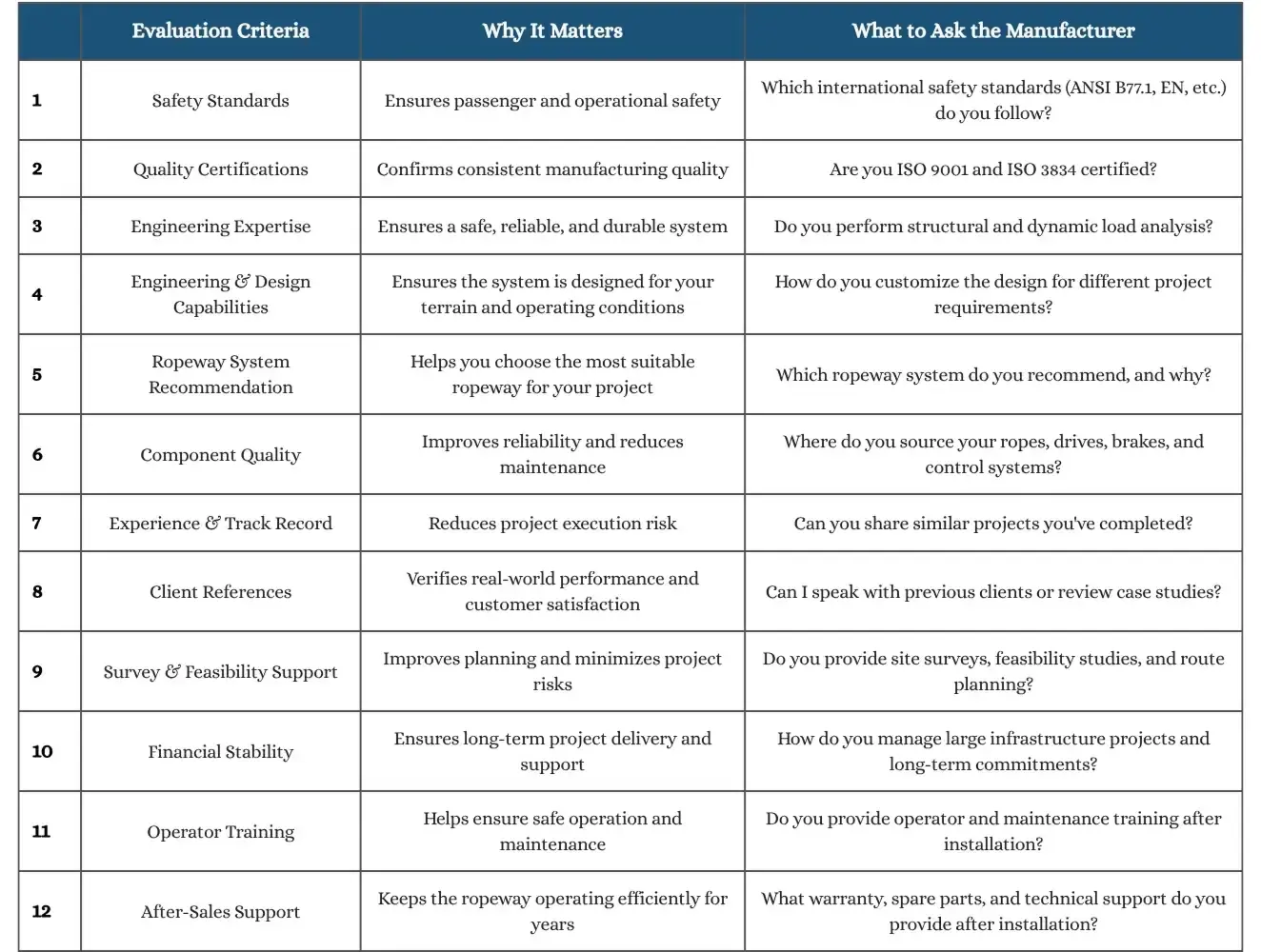
Let’s elaborate on each one, one by one.
1. Make Sure They Meet International Safety Standards
Again, as mentioned earlier, safety is not something you can compromise in this business. Always look for a manufacturer that builds systems in accordance with internationally recognized safety standards, not just local regulations. The safety standards should match throughout design, manufacturing, testing, and installation. Confirm that the system complies with standards such as ANSI B77.1 or relevant European EN standards where applicable. If they are following global safety standards, then they’ll typically offer:
- Better engineering documentation
- Thorough inspection and testing procedures
- Higher system reliability
Questions to ask:
- Which international safety standards do your systems follow?
- How are your systems tested before commissioning?
- Can you provide compliance documentation?
2. Check Their Quality Certifications
Ropeway quality comes down to one thing: how well it’s built. A solid build means better performance. It also means the ropeway lasts longer. So always check the manufacturer’s certifications first. Look for ISO 9001. This one covers quality at every stage, from design to maintenance. Check things like the inspection process. Check customer support too. Got a project with structural steel or welding? Then ISO 3834 matters as well. Together, these certifications back up quality from the first step to the last.
- ISO 9001 quality management certification
- Controlled production processes
- Strong quality control procedures
- Verified welding standards where applicable
We also serve clients across international markets.
3. Evaluate Their Engineering Expertise
Good ropeway design goes beyond manufacturing quality. They’re supposed to follow industry standards like OITAF, because these rules exist for a reason. These standards make sure your ropeway is safe, reliable, and built ot stand the test of time. Manufacturers that follow recognized engineering practices can often provide:
- Safer system designs
- Improved operational reliability
- Easier regulatory approvals
- Greater confidence for international projects
4. Evaluate Engineering and Design Capabilities
Projects are different from each other. Terrain, weather, elevation, and operating requirements of that area are all important things to consider when deciding how a system should be designed. A capable manufacturer understands this. They customize the solution based on your specific needs. They do not rely on a standard configuration. Their engineering team should be able to handle:
- Structural analysis
- Load calculations
- Tower and foundation design
- Electrical and control systems
- Mechanical optimization
- Wind and environmental assessments
Strong engineering helps ensure reliable performance in both everyday and challenging operating conditions.
5. See How They Design Ropeway Systems
The right manufacturer recommends what fits your project, not what they happen to sell. After evaluating your requirements, they may suggest:
- Monocable ropeways
- Bicable ropeways
- Gravity ropeways
- Material ropeways
- Cable crane systems
The recommendation should match your site conditions, budget, capacity needs, and future expansion plans. Explore the complete range of ropeway products.
6. Review Component Quality and Testing Procedures
The reliability of a ropeway comes down to the quality of its parts. Important components, which include wire ropes, drive systems, brakes, towers, bearings, and control systems, should meet high performance standards and undergo rigorous testing. Ask manufacturers:
- Where do you source your major components?
- How are components tested?
- Are inspections carried out before installation?
- What quality assurance process do you follow?
Those manufacturers that use trusted suppliers and hard testing generally deliver more reliable systems with lower maintenance costs.
7. Examine Their Track Record
For complex infrastructure projects, experience counts. But don’t just check years in business. That number alone means little. Look at completed projects instead. Real work tells the real story.
A strong portfolio should include experience in sectors such as:
- Tourism
- Mining
- Hydropower
- Dam construction
- Infrastructure
- Forestry
- Remote logistics
Projects completed in conditions similar to yours often indicate stronger technical expertise. We also provide ropeway solutions across South Asia and Africa, with dedicated expertise for projects in Bhutan, Nepal, and Africa.
8. Request Client References and Case Studies
You really can get a good idea about a manufacturer from previous projects. Ask for client references or case studies that demonstrate their experience and project delivery.
Speaking with previous customers can help you evaluate:
- Project execution
- Communication
- Timely delivery
- Installation support
- Equipment reliability
- After-sales service
Consistently positive feedback is usually a good sign of a dependable partner.
9. Check if They Offer Survey and Feasibility Support
Successful projects start well before manufacturing begins. An experienced manufacturer should support the planning phase by assisting with:
- Site surveys
- Route alignment
- Topographical studies
- Feasibility analysis
- Preliminary engineering
- Capacity planning
Early technical support helps reduce delays and avoids costly changes. It also improves overall project efficiency. The manufacturer should understand local environmental regulations. They should design the project to minimize ecological impact. This includes careful tower placement and reduced land disturbance. The design should also comply with environmental approvals required in your region.
10. Evaluate Financial Stability
Large projects take months and years to complete. So always check if the company is financially stable or not. These little background verifications go a long way. A company that has strong financial backing is more likely to see your project through to the end and offer you long-term support. Including honoring warranties and service commitments well into the future.
- Maintain production schedules
- Manage supply chains effectively
- Honor warranty commitments
- Supply spare parts for years
- Support future expansions
This reduces the risk of project delays and long-term service issues.
11. Confirm Training and Knowledge Transfer
Installing the ropeway is only the first step. Your operators and maintenance team should receive proper training to keep the system running safely and efficiently.
A reliable manufacturer should provide the following:
- On-site operator training
- Maintenance guidance
- Emergency procedure training
- Operating manuals
- Troubleshooting support
Well-trained teams can improve safety, reduce downtime, and extend the life of the equipment.
12. Review Their After-Sales Support and Spare Parts Service
Regular maintenance is a reality for any ropeway system, no matter how well it is built. Parts will need to be replaced over time. Make sure the manufacturer you choose offers continued technical support. This support should cover the entire lifespan of the system.
Look for:
- Comprehensive warranty coverage
- Fast technical support
- Genuine spare parts
- International parts availability
- Maintenance and inspection assistance
Good after-sales support keeps your ropeway running smoothly and reduces costly downtime over the long term.
Common Mistakes Buyers Should Avoid
Buyers usually make the same mistakes when selecting a ropeway manufacturer. And these mistakes are completely avoidable if you are aware of a few things.
- Making Money The Deciding Factor
Poor quality material, limited support, and experience can cost you more. So always try to go for quality and experience rather than going for a low-budget quote.
- Not Taking Certifications Seriously
Manufacturers without proper safety standards and quality can lead you to operational risks and compliance issues in the future. So always look for certifications and safety standards.
- Underestimating Experience
A manufacturer who has delivered projects already is always aware of what to and what not to do in serious situations. An experienced manufacturer is always better prepared to handle challenges. Go for an experienced company.
- Not Evaluating Support Services
A ropeway project is something that runs for decades. Having a good support system in maintaining and coordination in case of any inconvenience is always important.
Final Verdict
Making the right decisions about your ropeway manufacturer is something that will impact your business for years. This business is not just about making money but also building trust in the industry, as it involves people’s lives. Choosing the right partner with proven experience, certifications, international exposure, and quality manufacturing is really important. This 12-point checklist covers almost everything that you should not miss.
Looking for a ropeway manufacturer you can trust? Get in touch with M & M Ropeways. Tell us about your project. We’ll help you land on the right solution for your needs.
Frequently Asked Questions (FAQs)
What things do I keep in mind when choosing a ropeway manufacturer?
When you are choosing a ropeway manufacturing partner, look for international-level safety compliance, certifications, quality in manufacturing, good long-term sales support, and relevant project experience. If needed, they should have readily available spare parts.
Why are international safety standards important for ropeway systems?
International standards cover all important aspects of safety. You can count on passenger safety and regulatory compliance across different regions.
What should I check before choosing a ropeway manufacturer?
Always look at safety standards, certifications, past completed projects, and spare parts availability. A good manufacturing partner will help you through planning, installation, and long-term maintenance support.
by ropeway-admin | Jul 17, 2026 | Ropeways
Every morning, people in hilly areas walk for hours through forests or sloppy areas just to reach a road. On the other hand, another mountain highway gets carved through a protected forest to tackle the same need differently. Meanwhile, India keeps building roads. The conventional road infrastructure is simply not achievable in difficult hilly areas. Yet the road-building cycle continues, cutting through ecologically sensitive zones. This leaves behind eroded slopes, displaced wildlife, and rising carbon levels.
The shift is now coming from the top. Under the Parvatmala Pariyojana, the Government of India has initiated the National Ropeways Development Programme as an ecologically sustainable transport solution. This is specifically taken for rocky, hilly terrain & jammed urban centers where building conventional transport infrastructure is often difficult, costly, or impractical. Specific states like Himachal Pradesh, Sikkim, and Uttarakhand are increasingly leaning toward ropeways rather than roads for mountain connectivity. In addition, ropeways emit zero carbon emissions during operation, occupy minimal ground space, and require significantly less maintenance compared to road-based transport. The environmental impact of ropeway projects vs highways is no longer just a debate among planners. It is now a declared national policy priority.
This blog breaks down exactly why ropeways are the more sustainable transportation solution for India’s mountain regions.
What Environmental Factors Make Ropeways a Smarter Choice Than Roads?
1. Land Use and Deforestation: The Numbers Don’t Lie
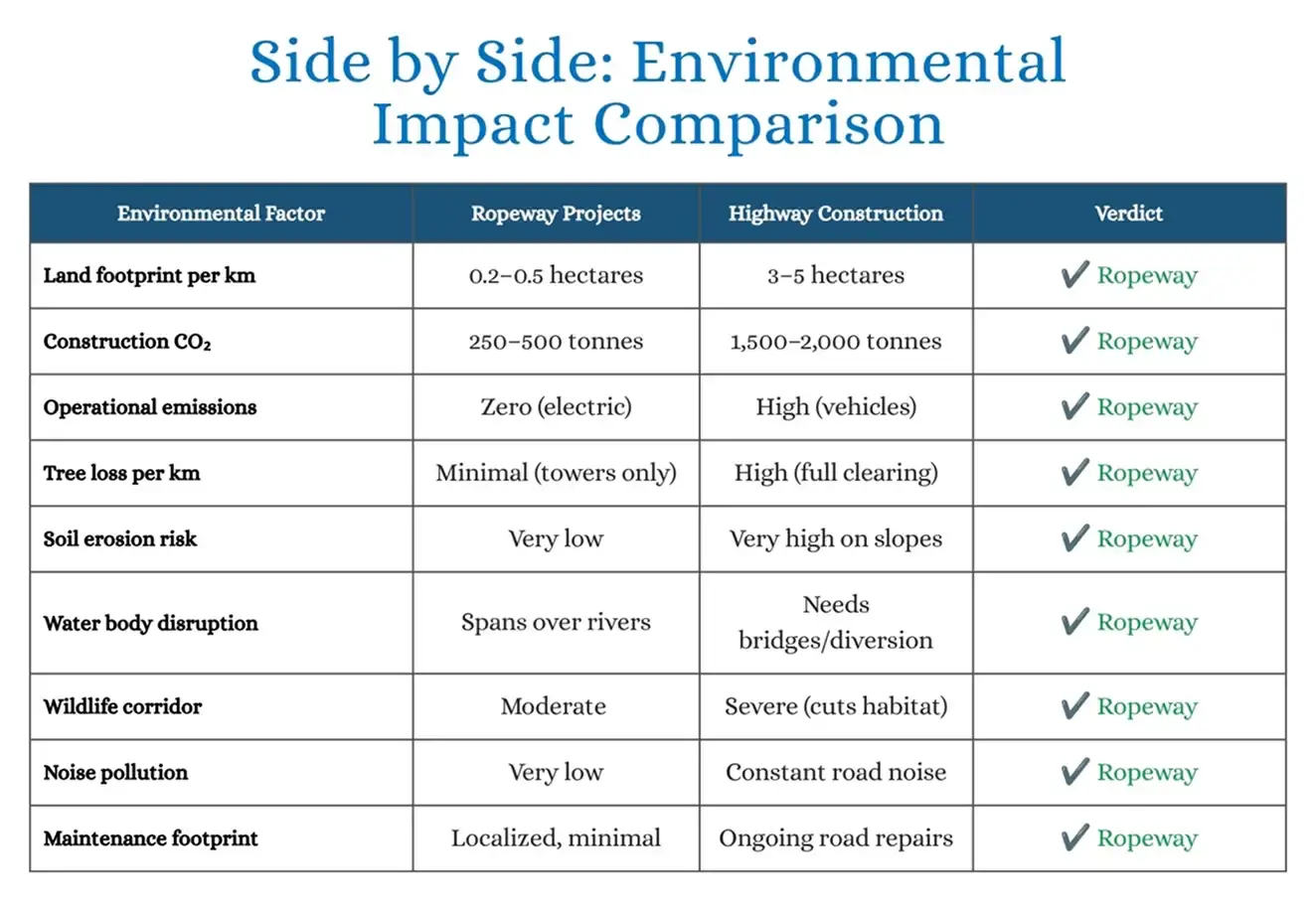
Highway construction in hilly terrain demands enormous land clearance right from the beginning. A single kms of mountain road can disturb up to 3 to 5 hectares of dense forest cover. Furthermore, road widening projects in states like Uttarakhand have displaced thousands of trees in very recent years. Ropeways specifically require only a narrow strip for towers and terminal stations. Additionally, ropeways require very little land, often using as little as 0.3 hectares per kilometer of route. Therefore, the land use comparison alone makes a strong and immediate case for green infrastructure in India today.
Moreover, highway construction on slopes triggers soil compression, surface runoff, and long-term erosion problems consistently. Ropeways leave the ground surface between towers completely undisturbed and intact naturally. Consequently, natural drainage patterns stay healthy, & forest cover continues to hold moisture for watersheds properly.
2. Carbon Emissions: A Head-to-Head Comparison
Building highways creates significant carbon emissions at every stage. From preparing the land for construction to producing the materials, all are needed for the road. Do you know how many carbon emissions roads produce while constructing 1 km? Studies suggest that constructing 1 kilometer of expressway emits approx 500 – 1,250 tonnes of CO₂ equivalents overall. However, ropeway installation emits far less because steel towers replace continuous, extensive excavation and construction work.
In addition, electric ropeways powered by renewables emit near-zero operational carbon emissions every single day. In comparison, a mountain highway sees hundreds of diesel vehicles climbing hilly terrain every hour. Consequently, the ropeway’s carbon footprint over a 30-year lifecycle is much lower than any road alternative.
Furthermore, ropeways do not create induced demand for additional vehicles on mountain roads as highways do. Once a highway is built, traffic volume grows steadily, and emissions multiply year after year. In contrast, a ropeway manages its own capacity and keeps emissions predictable and low throughout its life.
3. Side by Side: Environmental Impact Comparison
4. Real-World Evidence: The Parwanoo to Shimla, Himachal Ropeway
In Himachal, the Parwanoo–Shimla ropeway route is one of India’s most studied examples of eco-friendly mountain transport. It is also becoming the 38 km-long route, the longest in the coming years. This aerial ropeway carries tourists and daily commuters while it keeps running on grid-connected electricity that’s sourced partly from hydropower. Also, the ropeway passes over uneven terrain, where making a road would have meant clearing sensitive forest areas. And clearing can lead to lasting environmental damage, not just short-term disruption.
Operational emissions from a ropeway produce zero carbon emissions directly. But it can still produce them indirectly, and it has a very low carbon footprint. At the same time, road travel in private vehicles sits at over 1619.87 grams of CO₂ per passenger kilometer. So, in simple terms, these sustainable transportation solutions give about a 10× drop in emissions. This is the result of every trip you do with the system. Also, people are opting for ropeways over highways in the hilly areas. This leads to less congestion on the NH5 highway and prevents the construction of another highway by destroying nature.
Consequently, landslide risk zones along that stretch see fewer heavy vehicles, adding to road stress every season in Shimla, especially. This real-world case makes a clear argument for ropeway-first planning in India’s mountain corridors going forward.
5. Air Quality and Noise Pollution in India’s Hill Stations
If you have been to Manali, Mussoorie, or Ooty recently, you might have noticed that traffic jams in these places happen every day. As a result, PM2.5 levels in these popular hill destinations during the busy tourist months go above the safe WHO limits by 2 to 3 times quite regularly. Also, diesel buses and trucks, when they climb steep slopes, release an unbalanced amount of particulate matter per trip.
Switching even 30% of tourist transport to ropeways could meaningfully reduce this air quality crisis at the local level. M & M Ropeways designs electric systems that eliminate tailpipe emissions from the tourist transport equation.
Additionally, cable cars cut down on noise stress for both local wildlife and the permanent residents at the same time. So, ropeways have become one of the clearest sustainable transportation solutions for India’s iconic but fragile hill stations. More than that, quieter travel routes quietly support nearby shops, wellness tourism, and the overall everyday well-being of mountain communities. This local environmental benefit is often overlooked in wider infrastructure debates across the country.
6. Why India’s Terrain Specifically Favors Ropeways
Northeastern states in India, like the Himalayan belt and the Western Ghats, have terrain that makes building highways both costly and ecologically harmful. On top of that, road maintenance in these zones runs about 3 to 5 times higher than what you see on the plains. This happens mostly due to landslides and heavy annual rainfall, too. So the total lifecycle cost of a highway in those sensitive mountain zones is really justifiable from either an economic or an ecological perspective.
Ropeways are naturally suited to hilly terrain above 30 degrees and can span deep valleys without any ground contact easily. M & M Ropeways, for instance, has designed and installed systems covering distances up to 6,400 meters with a single drive across some of India’s most challenging terrains successfully. Furthermore, their installations serve the Indian Army on the Siachen Glacier at 18,000 feet in temperatures below -35 degrees Celsius, proving that eco-friendly mountain transport works even in the most inhospitable conditions on earth.
The Government of India’s Parvatmala Pariyojana has already recognized this advantage and is funding dozens of ropeway projects across Himalayan states under a clear green infrastructure mandate actively. M & M Ropeways serves sectors from hydropower and dam construction to rural village connectivity and tourism, demonstrating that ropeways are not a specialized solution but a scalable one. Consequently, the shift from the first highway to the first ropeway is now both a national policy direction and an on-the-ground reality.
7. Weather Conditions & Ropeway System Performance
Weather plays a far bigger role in ropeway construction. Ignoring local wind conditions can cause service disruptions, unhappy passengers, and long-term revenue losses.
What matters is that no two ropeway systems deal with wind in the same manner. Monocable gondola setups, for example, are usually considered safe only up to about 60–70 km/h. Move to a bi-cable system, and that tolerance climbs to roughly 90 km/h. Then, for the most demanding areas, especially high-altitude crossings where passenger comfort cannot be compromised, tricable systems are the more advanced option, engineered to keep working properly even when winds push past 100 km/h.
Picking the wrong system for a site’s wind profile doesn’t just make operations harder. It basically weakens the whole investment from the start. That’s why ropeway project planning should involve gathering at least 2 to 3 years of local weather data before locking in final specifications. When decisions are made on incomplete climate information, you almost always end up with a design that underperforms once it’s actually running. In an industry where uptime directly means revenue, it’s the kind of risk no project should accept.
Summary
The environmental impact of ropeway projects vs highways is honestly not a close contest by any measure. Ropeways consistently do better than highways across land use, carbon emissions, biodiversity protection, air quality, and long-term ecosystem health. Also, if they are powered by clean energy, they turn into one of the lowest-carbon ways to move through mountain terrain available anywhere right now.
For India, the case is even more urgent because the Himalayan zones are fragile ecosystems. This is why tourism demand is increasing, and climate commitments are already in this process. So, this kind of shift toward ropeways feels more necessary than before. And firms like M & M Ropeways are helping narrow the gap between connectivity needs and conservation goals practically. So yeah, choosing a ropeway instead of a highway isn’t only an infrastructure call but more like an environmental promise for the generations ahead.
Frequently Asked Questions About Ropeway Projects in India
Q1. Are ropeways better for the environment than highways?
Yes, ropeways clear far less land, emit much less carbon, and also prevent deforestation.
Q2. Do ropeways work in extreme weather conditions?
Absolutely. The systems run smoothly in heavy snowfall as well as on sloppy surfaces. It even works when it drops to minus 35°C; they work successfully in all conditions.
Q3. How long does it take to build a ropeway compared to a highway?
Ropeways often go up quicker in hilly terrain because you avoid lengthy carving/cutting, and you also skip geotechnical delays.
Q4. Are ropeways only for tourism, or do they serve local communities too?
They help local communities as well. Ropeways link distant villages, transport agricultural produce, support hydropower projects, and even serve defense installations equally.
Q5. Why should I choose M & M Ropeways for my project?
M & M Ropeways designs, manufactures, & installs complete ropeway systems throughout India. From Siachen Glacier army installations to day-to-day rural village connectivity, they deliver dependable and earth-friendly solutions consistently.
by ropeway-admin | Jul 14, 2026 | Installation, Ropeway Installation
Picking the right transport infrastructure is never just a budget decision. In difficult terrain, it becomes a decision that shapes the entire project. Getting it wrong directly means the project bleeds money for years.
Infrastructure decisions in difficult terrain are high-stakes. A mountain railway can cost 15 to 100 times more per km than the same route done by a ropeway. A hill road doubles in cost the moment tunnels and switchbacks enter the picture. Yet most planners compare these three modes without a clear cost breakdown in front of them.
This blog fixes that. Here is a direct comparison of ropeway, road, and railway infrastructure costs across construction, land use, and long-term maintenance.
Why Terrain Changes the Cost Equation
On flat ground, roads and railways are the default option. Because they scale well, their costs are predictable. And most of the world’s existing networks were built on exactly this logic.
But when terrain changes, like in mountains, gorges, or dense urban corridors, that logic breaks down fast. Roads in hilly terrain need switchbacks. That means more kilometres of road to cover the same straight-line distance. Railways in mountains need tunnels and bridges, both slow and expensive to engineer.
But construction cost alone rarely reflects what a project actually costs. Land acquisition, maintenance, clearances, and build time all factor in. In difficult terrain, every single one of these gets heavier. That is where the real difference between the three modes shows up.
Construction Costs: What the Numbers Really Say
Costs shift based on terrain and mode. Here is what the numbers look like for all three modes of transportation in hilly areas.
Roads: The Familiar Choice That Gets Expensive Fast
A two-lane road on flat ground costs between 3 and 6 crore per km. That number feels reasonable until the terrain tilts. Now add switchbacks, retaining walls, and mountain tunnels. And see how the same road becomes a different project entirely. The four-laning of the Nerchowk-Kullu highway in Himachal Pradesh cost around 65 crore per km. That gap between 6 and 65 is what mountain terrain looks like on a budget sheet.
Railway: Reliable on the Plains, Expensive in the Peaks
Railway works beautifully on flat ground. Standard flat-terrain rail in India costs between 8 and 15 crore per km. Manageable. Predictable. Then the terrain changes. The Udhampur-Srinagar-Baramulla Rail Link tells you exactly what happens next. 272 km. 36 tunnels. 943 bridges. Nearly 5 billion dollars in total project cost. The distance stayed the same. The ground did not.
Ropeway: The Straight-Line Advantage That Changes Everything
A basic single-line ropeway system costs around 20-50 crore per km. Urban multi-station systems run higher. But here is what changes everything. Ropeways travel in a straight line. In hilly terrain, a road might need 3 km of switchbacks to cover the same distance that a ropeway connects in 1 km. That reduction in total route length is what brings ropeway infrastructure cost down on a total project basis, even when the per-km figure looks comparable.
Costs are indicative. Actual figures vary by terrain, project scope, and specifications.
Land Acquisition: The Hidden Cost
Everyone talks about construction costs. Almost nobody talks about this one: Land acquisition. And in difficult terrain, it can cost more than the construction itself before a single machine moves.
Roads need a wide right-of-way strip. In populated or forested mountain areas, that means displacement, legal clearances, and compensation costs that can run into millions before a single kilometre of construction begins.
Railways need more land still. Stations, marshalling yards, buffer zones, and level crossings all require substantial ground. In protected forest zones or steep terrain, securing that land takes years.
But ropeways are different. They only need land for tower foundations, which have a narrow vertical footprint, and for terminal stations at each end. The ground in between stays completely untouched. In environmentally sensitive or legally complex regions worldwide, this low land requirement is one of the biggest financial and regulatory advantages of ropeway infrastructure.
What It Costs to Keep It Running
Construction is a one-time expense. Maintenance runs every year.
Roads in hilly terrain need constant attention. Erosion, landslides, and seasonal damage require ongoing resurfacing. In many mountain regions, roads close for weeks or months. That creates indirect economic losses on top of the direct repair bill.
Railways carry high recurring costs. Track inspections, signal systems, rolling stock servicing, and station upkeep all run year-round. Mountain rail adds significant complexity to each of those.
Ropeways are built differently. Most maintenance happens at stations and towers. A single power plant drives the entire line. One operator can manage the full system. Fewer moving parts means less to maintain and lower annual spend.
They also run on electricity, which keeps fuel costs low and direct emissions close to zero over the operational lifetime.
A Side-by-Side Comparison
Here is how all three modes stack up across the key cost and performance factors.
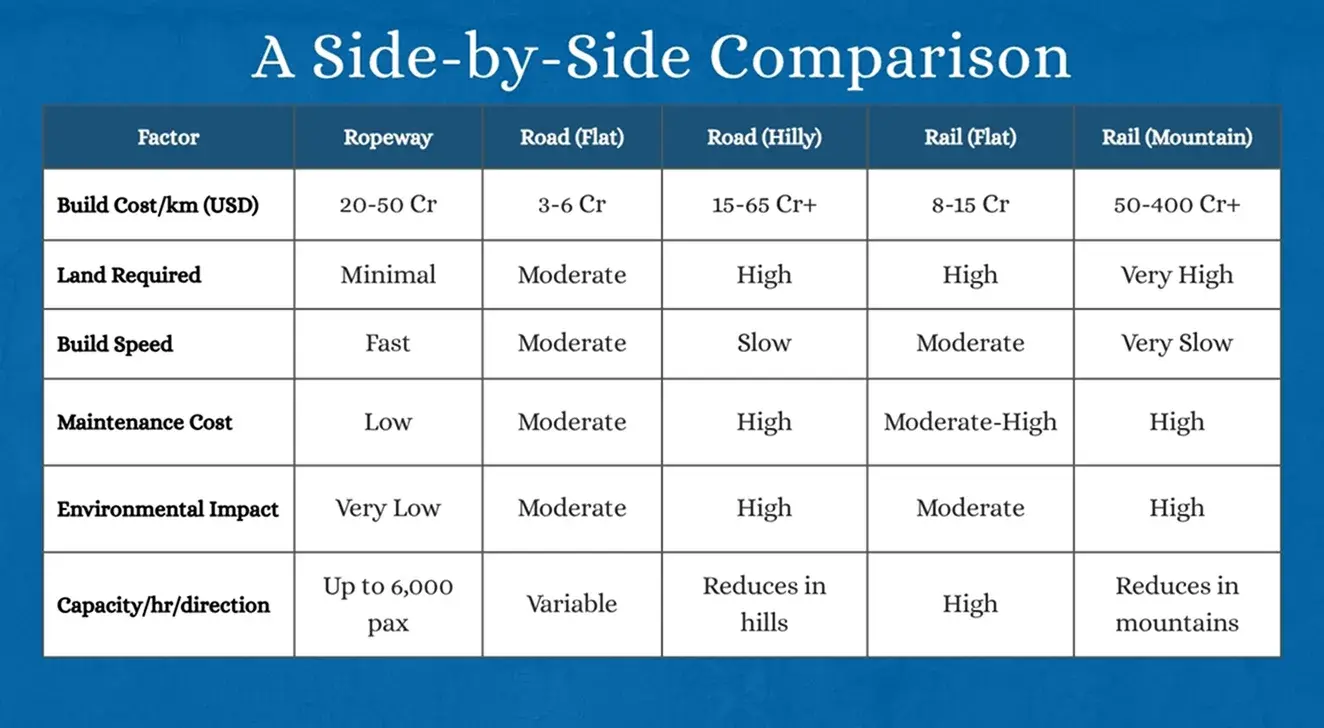
Costs are indicative figures for India in INR (crore per km). Actual figures vary by terrain, project scope, and specifications.
The Right Mode for the Right Terrain
No single mode wins every project. The right choice comes down to three things: terrain, volume, and what infrastructure already exists around the site.
Choose Ropeway When:
- Terrain is steep, mountainous, or crossed by gorges, rivers, or dense urban gaps
- Land acquisition is hard, costly, or restricted due to the environment or the law
- You need last-mile urban connectivity without digging roads or laying metro tracks
Choose Road When:
- Terrain is flat to moderately hilly, with high freight or passenger volumes
- An existing road network needs to be extended or upgraded
Choose Railway When:
- Very high volumes need to move over long, flat corridors
- Freight at scale is the priority, and an existing rail grid is nearby
The most expensive mode is not always the wrong one. And the cheapest is not always the right one. It comes down to where you are building and what you are moving.
The Projects That Prove the Point
Numbers count most only when they come from real ground. Here is what India’s own infrastructure projects show.
In Uttarakhand, the Sonprayag to Kedarnath ropeway covers 12.9 km at Rs. 4,081 crore. The alternative was a grueling multi-hour trek or a road that the terrain made nearly impossible to build safely. The ropeway cuts the journey to under 30 minutes.
Compare that to the Nerchowk-Kullu four-lane mountain highway in Himachal Pradesh. That road, 74 km long, came in at Rs. 4,800 crore, roughly Rs. 65 crore per km. A ropeway on the same terrain would have needed a fraction of the distance and far less land.
Then there is the Udhampur-Srinagar-Baramulla Rail Link. A 272 km mountain railway with 36 tunnels and 943 bridges. Total cost: nearly USD 5 billion. That is what railway infrastructure development costs look like when the terrain offers no easy path through it.
The pattern across all four is the same. In difficult terrain, ropeway systems consistently deliver more connectivity per rupee spent.
Ropeways Offer More Than Cost Savings
The financial advantage in difficult terrain is clear. But ropeway transportation benefits go beyond the numbers. Give a look at some of them that are listed below:
- They operate in weather conditions that close mountain roads
- They run at fixed, predictable speeds with no traffic congestion
- Full electric operation makes net-zero transport achievable
- They support tourism and local economic activity in scenic or remote destinations.
The Final Verdict
In flat, high-volume corridors, ROAD and RAILWAY remain practical choices. They have established supply chains, proven cost structures, and existing network connections to work with. But in difficult terrain, they can’t work smoothly.
Ropeways come out as the best solution there. Why? They need fewer kilometers, less land, shorter build timelines, and lower maintenance budgets. On a total project cost basis, they are often the most cost-effective transport infrastructure available for mountain and hard-to-reach locations.
If you’re assessing ropeway infrastructure for a project, M&M Ropeways is a prominent ropeway manufacturer in India. We have 3+ decades of ropeway industry experience that includes designing, manufacturing, and installing ropeway systems across some of the world’s most challenging terrain, like the Siachen Glaciers.
Reach out and talk with us about what your project really needs. Let’s align on the essentials, so you get a suitable arrangement.