by ropeway-admin | Jul 14, 2026 | Installation, Ropeway Installation
Picking the right transport infrastructure is never just a budget decision. In difficult terrain, it becomes a decision that shapes the entire project. Getting it wrong directly means the project bleeds money for years.
Infrastructure decisions in difficult terrain are high-stakes. A mountain railway can cost 15 to 100 times more per km than the same route done by a ropeway. A hill road doubles in cost the moment tunnels and switchbacks enter the picture. Yet most planners compare these three modes without a clear cost breakdown in front of them.
This blog fixes that. Here is a direct comparison of ropeway, road, and railway infrastructure costs across construction, land use, and long-term maintenance.
Why Terrain Changes the Cost Equation
On flat ground, roads and railways are the default option. Because they scale well, their costs are predictable. And most of the world’s existing networks were built on exactly this logic.
But when terrain changes, like in mountains, gorges, or dense urban corridors, that logic breaks down fast. Roads in hilly terrain need switchbacks. That means more kilometres of road to cover the same straight-line distance. Railways in mountains need tunnels and bridges, both slow and expensive to engineer.
But construction cost alone rarely reflects what a project actually costs. Land acquisition, maintenance, clearances, and build time all factor in. In difficult terrain, every single one of these gets heavier. That is where the real difference between the three modes shows up.
Construction Costs: What the Numbers Really Say
Costs shift based on terrain and mode. Here is what the numbers look like for all three modes of transportation in hilly areas.
Roads: The Familiar Choice That Gets Expensive Fast
A two-lane road on flat ground costs between 3 and 6 crore per km. That number feels reasonable until the terrain tilts. Now add switchbacks, retaining walls, and mountain tunnels. And see how the same road becomes a different project entirely. The four-laning of the Nerchowk-Kullu highway in Himachal Pradesh cost around 65 crore per km. That gap between 6 and 65 is what mountain terrain looks like on a budget sheet.
Railway: Reliable on the Plains, Expensive in the Peaks
Railway works beautifully on flat ground. Standard flat-terrain rail in India costs between 8 and 15 crore per km. Manageable. Predictable. Then the terrain changes. The Udhampur-Srinagar-Baramulla Rail Link tells you exactly what happens next. 272 km. 36 tunnels. 943 bridges. Nearly 5 billion dollars in total project cost. The distance stayed the same. The ground did not.
Ropeway: The Straight-Line Advantage That Changes Everything
A basic single-line ropeway system costs around 20-50 crore per km. Urban multi-station systems run higher. But here is what changes everything. Ropeways travel in a straight line. In hilly terrain, a road might need 3 km of switchbacks to cover the same distance that a ropeway connects in 1 km. That reduction in total route length is what brings ropeway infrastructure cost down on a total project basis, even when the per-km figure looks comparable.
Costs are indicative. Actual figures vary by terrain, project scope, and specifications.
Land Acquisition: The Hidden Cost
Everyone talks about construction costs. Almost nobody talks about this one: Land acquisition. And in difficult terrain, it can cost more than the construction itself before a single machine moves.
Roads need a wide right-of-way strip. In populated or forested mountain areas, that means displacement, legal clearances, and compensation costs that can run into millions before a single kilometre of construction begins.
Railways need more land still. Stations, marshalling yards, buffer zones, and level crossings all require substantial ground. In protected forest zones or steep terrain, securing that land takes years.
But ropeways are different. They only need land for tower foundations, which have a narrow vertical footprint, and for terminal stations at each end. The ground in between stays completely untouched. In environmentally sensitive or legally complex regions worldwide, this low land requirement is one of the biggest financial and regulatory advantages of ropeway infrastructure.
What It Costs to Keep It Running
Construction is a one-time expense. Maintenance runs every year.
Roads in hilly terrain need constant attention. Erosion, landslides, and seasonal damage require ongoing resurfacing. In many mountain regions, roads close for weeks or months. That creates indirect economic losses on top of the direct repair bill.
Railways carry high recurring costs. Track inspections, signal systems, rolling stock servicing, and station upkeep all run year-round. Mountain rail adds significant complexity to each of those.
Ropeways are built differently. Most maintenance happens at stations and towers. A single power plant drives the entire line. One operator can manage the full system. Fewer moving parts means less to maintain and lower annual spend.
They also run on electricity, which keeps fuel costs low and direct emissions close to zero over the operational lifetime.
A Side-by-Side Comparison
Here is how all three modes stack up across the key cost and performance factors.
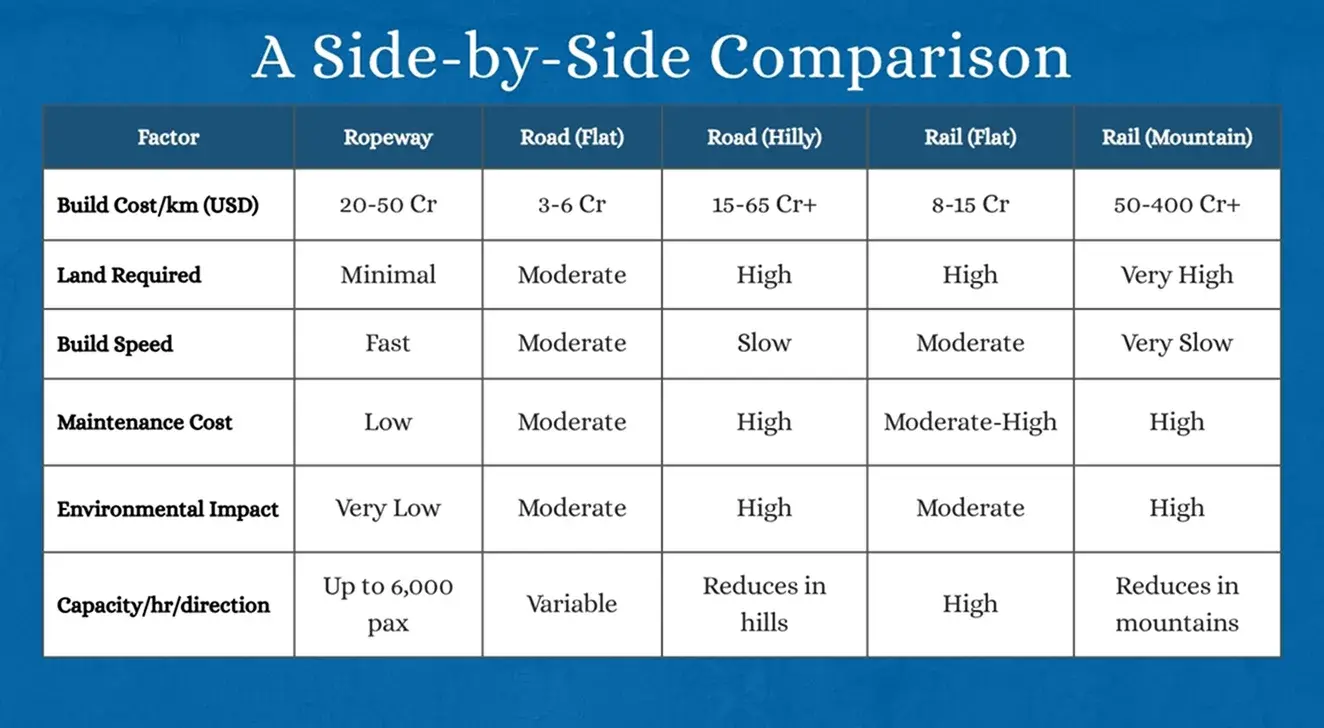
Costs are indicative figures for India in INR (crore per km). Actual figures vary by terrain, project scope, and specifications.
The Right Mode for the Right Terrain
No single mode wins every project. The right choice comes down to three things: terrain, volume, and what infrastructure already exists around the site.
Choose Ropeway When:
- Terrain is steep, mountainous, or crossed by gorges, rivers, or dense urban gaps
- Land acquisition is hard, costly, or restricted due to the environment or the law
- You need last-mile urban connectivity without digging roads or laying metro tracks
Choose Road When:
- Terrain is flat to moderately hilly, with high freight or passenger volumes
- An existing road network needs to be extended or upgraded
Choose Railway When:
- Very high volumes need to move over long, flat corridors
- Freight at scale is the priority, and an existing rail grid is nearby
The most expensive mode is not always the wrong one. And the cheapest is not always the right one. It comes down to where you are building and what you are moving.
The Projects That Prove the Point
Numbers count most only when they come from real ground. Here is what India’s own infrastructure projects show.
In Uttarakhand, the Sonprayag to Kedarnath ropeway covers 12.9 km at Rs. 4,081 crore. The alternative was a grueling multi-hour trek or a road that the terrain made nearly impossible to build safely. The ropeway cuts the journey to under 30 minutes.
Compare that to the Nerchowk-Kullu four-lane mountain highway in Himachal Pradesh. That road, 74 km long, came in at Rs. 4,800 crore, roughly Rs. 65 crore per km. A ropeway on the same terrain would have needed a fraction of the distance and far less land.
Then there is the Udhampur-Srinagar-Baramulla Rail Link. A 272 km mountain railway with 36 tunnels and 943 bridges. Total cost: nearly USD 5 billion. That is what railway infrastructure development costs look like when the terrain offers no easy path through it.
The pattern across all four is the same. In difficult terrain, ropeway systems consistently deliver more connectivity per rupee spent.
Ropeways Offer More Than Cost Savings
The financial advantage in difficult terrain is clear. But ropeway transportation benefits go beyond the numbers. Give a look at some of them that are listed below:
- They operate in weather conditions that close mountain roads
- They run at fixed, predictable speeds with no traffic congestion
- Full electric operation makes net-zero transport achievable
- They support tourism and local economic activity in scenic or remote destinations.
The Final Verdict
In flat, high-volume corridors, ROAD and RAILWAY remain practical choices. They have established supply chains, proven cost structures, and existing network connections to work with. But in difficult terrain, they can’t work smoothly.
Ropeways come out as the best solution there. Why? They need fewer kilometers, less land, shorter build timelines, and lower maintenance budgets. On a total project cost basis, they are often the most cost-effective transport infrastructure available for mountain and hard-to-reach locations.
If you’re assessing ropeway infrastructure for a project, M&M Ropeways is a prominent ropeway manufacturer in India. We have 3+ decades of ropeway industry experience that includes designing, manufacturing, and installing ropeway systems across some of the world’s most challenging terrain, like the Siachen Glaciers.
Reach out and talk with us about what your project really needs. Let’s align on the essentials, so you get a suitable arrangement.
by ropeway-admin | Jun 24, 2026 | Installation, Ropeway Installation
Ropeway installation ranks among the most technically demanding construction activities in India. You are not building on flat ground with EASY access. You are working on steep ridges, deep gorges, and high-altitude TERRAIN where a single miscalculation carries serious consequences.
India’s National Ropeways Development Programme, Parvatmala Pariyojana, has triggered over 200 NEW ropeway projects across the country. The sector is growing FAST. And with that growth comes a question every project team must answer honestly: Are we taking ropeway installation safety seriously enough? As projects multiply, safety cannot be an afterthought. It has to be the first decision made, before a single foundation is dug.
This blog covers the essential safety measures during ropeway installation projects, from pre-installation planning to final commissioning checks, so your team knows exactly what to follow at every stage.
Why Must Safety Planning Begin Before Ground Breaks?
Most ropeway installation accidents don’t happen during the actual work. They happen when someone skips the planning phase or rushes through it. The ground you build on tells you everything. A pre-installation site survey is the first non-negotiable step before any equipment arrives or any worker sets foot on the corridor. Here is what every ropeway installation safety plan must cover before work begins:
- Complete route survey: topographical and geotechnical.
- Analyse local weather: wind, snow, and rain patterns.
- Identification of underground utilities and power lines.
- Map all landslide zones, steep slopes, and weak ground.
- Load-bearing capacity test for every foundation site.
- Clearance mapping from inhabited areas and water bodies.
Skipping any one of these steps creates blind spots. And on a ropeway project in mountain terrain, blind spots cost lives. Every decision you make on paper saves lives on the ground.
Why Is Site Preparation the Most Overlooked Safety Phase?
A poorly prepared site is an accident waiting to happen. Ropeway construction safety starts with ground preparation, not cable installation. Every tower foundation site needs a secure exclusion zone. Clear the working corridor before any equipment arrives. Remove all vegetation and loose debris first, do not wait until day one of installation. Mark every excavated pit immediately after digging. Barricade every trench before the next shift starts.
Moving a cable crane into position carries real risk. Bad access paths make that risk worse. Plan every access route before work begins. Slope stabilization comes before excavation, always. Never excavate first and stabilize later. That order has caused accidents before. Temporary retaining structures on steep slopes are a requirement.
Assign a dedicated site safety officer from Day 1 of ground preparation, not Day 1 of installation. By the time installation begins, the hazards are already set. The safety officer needs to be present when the ground first breaks. Every shortcut in site prep becomes a hazard during installation. The ground tells you everything if you are willing to listen before the work begins.
Tower Erection Safety, Where Most Incidents Occur
Tower erection is where most accidents happen. Workers are at extreme heights. Locations are remote. The weather is unpredictable. One lapse in protocol at this stage costs more than time. Your safety rules must be the strictest here, with no exceptions and no shortcuts on any ropeway installation project.
Safety Rules for Tower Erection Teams:
- Verify foundation curing before erection begins: An incomplete cure is a structural failure waiting to happen. A tower erected on an incompletely cured foundation can shift under load. Always get written confirmation from the site engineer before lifting a single panel.
- Deploy only certified, experienced height workers: Height work during aerial ropeway installation requires specific training. General construction workers are not qualified for this phase.
- Conduct daily health screening before climbing: Physical fitness matters at altitude. A dizzy worker 40 feet up is a fatality waiting to happen.
- Follow the manufacturer’s assembly sequence (no shortcuts): Every tower has a specific build order. The manufacturer sets it for a reason. Change that sequence, even slightly, and the tower loses its structural balance. Follow it exactly, every step, every time. No shortcut is worth the risk.
- Zero work during high winds, rain, or low visibility: Weather delays cost time. Accidents cost lives. There is no comparison.
PPE Requirements Every Ropeway Worker Must Follow
PPE stands for ‘personal protective equipment’. Think of it as everything a worker wears on site, head to toe. Helmet, harness, gloves, boots, vest. Every single item exists for one REASON: to stand between the worker and a serious injury.
PPE for ropeway workers is not a formality. It is the last barrier BEFORE a serious injury occurs. Full-body harnesses, double lanyards, steel-toe boots, Class-A helmets, impact-resistant GLOVES, high-visibility vests, and fall-arrest devices are all mandatory on every ropeway installation site. No exceptions. The same discipline that builds a reliable aerial ropeway must protect every person installing it.
Availability is rarely the problem. Compliance is. Every morning, before the shift starts, a dedicated safety officer must inspect every worker’s PPE. Worn equipment gets replaced. The damaged gear gets pulled. Uncertified items never enter the site. A worker who skips the check does not enter the site, simple as that. This rule APPLIES to everyone. Project manager included.
Wire Rope Handling and Tensioning: Where Attention Saves Lives
Wire rope tensioning is the most technically precise operation in the entire cable ropeway installation process. Every safety error here has structural consequences that no amount of post-installation correction can fix.
Wire Rope Safety, Rules Your Team Cannot Afford to Skip:
- IS/BIS-certified ropes only, no exceptions.
- Inspect metre by metre for kinks, rust, and broken strands.
- Use calibrated tensioning tools
- No personnel in the cable corridor during stringing.
- No splicing, no repairs, and replacing the full rope.
- Document actual tension values at every anchor point.
- Never work close to energized power lines (distance saves lives).
Comparison Table: Safe Practice vs Common Mistakes
| Safety Checkpoint |
Safe Practice |
Common Mistake |
| Rope inspection |
Full metre-by-metre visual check. |
Glance at the reel surface. |
| Tensioning |
Calibrated equipment with readings. |
Manual feel-based adjustment. |
| Corridor clearance |
All personnel out before stringing. |
Workers standing near towers. |
| Rope condition |
Replace on the first sign of damage. |
Continue using the damaged rope. |
| Documentation |
Written rope tension record at every anchor point. |
Verbal confirmation only. |
| Weather check |
Suspend stringing in high winds. |
Continue work in bad weather. |
One compromised rope strand can trigger catastrophic failure under full load. The cable crane systems and drive components connected to this rope depend entirely on its integrity. Ropeway installation safety demands zero tolerance during this phase on the rope, the equipment, and the people handling it.
Important Safety Guidelines Every Ropeway Site Should Follow
Equipment does not fail people. Untrained people fail equipment. On a ropeway construction safety site, especially in remote mountain terrain, the nearest hospital can be hours away. Every worker involved in a ropeway project must hold valid safety certifications before stepping on site. Training is a continuous practice throughout the project. Below are the safety training protocols every ropeway site must follow:
#1. Mandatory Safety Certification Before Site Entry
No certificate means no entry. That is the rule. Every worker needs valid, up-to-date safety training before stepping on a ropeway installation site. Not last year’s training. Current, verified, and confirmed. A worker who cannot identify height hazards, falling objects, or equipment failure puts everyone at risk, not just himself. Check certifications before the project begins. Do not wait for the first incident to find out someone was not qualified.
#2. Daily Toolbox Talks Before Work Begins
Every morning starts the same way. Before any tool is PICKED up, the crew sits down for a short briefing. The weather that day. Tasks for the shift. Any new hazards spotted on site. The whole thing TAKES under 10 minutes. But those 10 minutes matter MORE than most teams realise. Safety fades from the mind quickly on a busy site. Toolbox talks bring it back every single morning. Sites that skip them show it in their incident reports.
#3. Mock Rescue Drills at Least Once a Month
Help will not come quickly on a mountain site. Rescue teams can take hours to arrive, sometimes longer. That gap is your crew’s responsibility to fill. Every worker must know their role the moment something goes wrong. Who makes the call for help? Who stabilises the injured person? Who keeps the rest of the site under control? Who directs the rescue team when they finally arrive? Run this drill every month. A crew that has never practised will not perform when it counts.
#4. First-Aid Kits, Stretchers, and Fire Extinguishers at Every Active Work Zone
Not at the site office. Not in the storage tent. At every active work zone, wherever workers are operating that day. The accident does not WAIT for you to walk back to the office for the first-aid kit. Stock each ZONE with a fully equipped first-aid kit, a stretcher, and at least one fire extinguisher. Check the inventory every week. An expired medicine or an empty extinguisher is as useless as no equipment at all.
#5. Emergency Contacts and Hospital Routes Posted at the Site Office
Every worker on site must know THREE things: the nearest hospital, the emergency contact numbers, and the fastest route out of the site. Do not keep this information in a file. Print it in large text and post it on the site office wall, the tool storage area, and the crew rest area. In a panic, no one has time to search for a phone number.
#6. Incident Reporting for Every Near-Miss, Documented in Writing
A near-miss is not a lucky escape. It is a sign that something is already broken. Every near-miss gets documented, including what happened, where, who was involved, and why it happened. No verbal reports. No, we will sort it later, only when it is written, signed, and filed. Then, investigate the root cause before work continues. Fix the gap, not just the symptom. Because a near-miss that goes unreported will happen again. And next time, someone will not walk away from it.
Training takes hours. An untrained mistake on a mountain site can take a life. Invest in the right one.
Why Is M & M Ropeways the Right Partner for Your Project?
M & M Ropeways has spent over 35+ years working across India’s toughest terrain. In mountains, deep gorges, river valleys, and high-altitude glaciers, the company has installed systems where most teams would not even attempt a survey. That kind of experience does not come from a brochure. It comes from solving real problems on real sites.
The company handles every stage in-house. Design, manufacturing, and installation, all under one roof. No subcontracting critical work. No gaps in accountability. When something needs to be built a specific way, the same team that designed it also installs it. That matters on a ropeway installation project where precision and safety go hand in hand.
Not many companies have worked at 18,000 feet in -35°C for the Indian Army. M & M Ropeways has. That record speaks for itself.
Final Thoughts
Ropeway installation safety does not start at one point and end at another. It runs through every decision, every day, from ground preparation to final commissioning. The essential safety measures during ropeway installation projects covered in this blog are not optional. Skip one, and the consequences follow. Every team, every site, and every worker deserves full commitment to safety. Plan right, train hard, and execute safely. Do not leave safety to chance. Connect with M & M Ropeways and build it right from day one.
by ropeway-admin | Jun 4, 2026 | Ropeway Installation
In 2025, 5 national highways and about 1,350 roads remain blocked across Himachal Pradesh in a single monsoon season. At times, the monsoon gets so severe that it just washes away roads. Still, the usual answer never really changes. It is always like building more roads. But road infrastructure comes with a price. Cutting forests and turning slopes into routes can trigger landslides. Also, large investments in infrastructure often get damaged by extreme weather. Even if a road somehow survives, trucks moving on narrow mountain stretches end up burning more fuel, over 20% compared to flat highways. The chances of an accident increase. And then, every monsoon, it’s the same loop: damage, repairs, and then damage again.
That is exactly why more organizations are turning to Ropeway Installation as a reliable, efficient, & sustainable transportation solution.
Ready to explore a ropeway for your project? Contact our team today for expert guidance.
Why Ropeways Are No Longer Optional: They Are Essential
Depending on road transport alone will not always help you. From natural calamities to emergencies or scarcity of fuel, ropeway installation will be the only solution to these problems. Stats say that approximately 22% of India’s land is hilly and mountainous terrain. These regions are mainly under mining zones, hydropower projects, pilgrimage pathways, and tourist hill stations. So many people commute in these areas regularly for their daily lives, for transportation, and for travel. But these paths are sloppy and dangerous. An aerial ropeway system, however, needs no roadways at all – it rises above the terrain entirely. “No land clearing or slope disturbance. No road maintenance budget can really cope with monsoon erosion year after year.
A ropeway can easily cross a valley in a few minutes, but trucks take more than an hour on tough roads. That’s how India now moves goods and people through its most challenging geography.
Ropeways vs. Road Transport: The Numbers Make the Case
Here is a direct, factual comparison between road-based transport and an aerial ropeway system in hilly terrain conditions:
| Factor |
Road Transport |
Aerial Ropeway System |
| Fuel Cost |
Diesel dependency makes operating costs significantly high. |
Electrically powered, with near-zero fuel cost in operation. |
| Terrain Impact on Cost |
Fuel consumption rises considerably on hilly and rough roads. |
Completely unaffected by the terrain gradient below. |
| Carbon Emissions |
Road transport contributes substantially to India’s energy-related CO₂. |
Zero operational carbon emissions. |
| Environmental Damage |
Requires tree felling, slope cutting, and land acquisition. |
No land clearing, the tower saves space. |
| Weather Dependency |
Roads flood, slip, and shut down in the monsoon season. |
Continues operation through rain, fog, and seasonal weather. |
| Travel Time in Hilly Terrain |
Several times longer on steep and winding mountain routes. |
Covers the same distance in a fraction of the time. |
| Road Maintenance Cost |
Constant repair cycle (hilly routes degrade significantly faster). |
No roads, zero maintenance. |
| Empty Return Problem |
A large share of truck journeys run empty, adding dead costs. |
No empty return, the cable system runs both ways continuously. |
| Seasonal Cost Surge |
Shipping costs spike during the monsoon and peak seasons. |
Fixed operational costs are completely unaffected by seasons. |
| Long-Term Value |
Constant road repairs and vehicle maintenance costs. |
Built for decades of use with minimal ongoing costs. |
Road transport causes 20–30% of India’s urban air pollution. Ropeways, running on electricity, produce none. The technology alone does not guarantee success, but the right ropeway project planning does.
Let’s go further to discuss the key factors that affect the ropeway installation project before you install your first ropeway project.
#1 Terrain and Topography: The Starting Point of Every Decision
In any ropeway installation project, the terrain plays the most important role. Before starting the project, every team should carefully assess the complexities of the location. Ignoring these factors can lead to high expenses later in the project.
First, look at where the land is and its condition. The size of the valley and the slope of the land are all major factors. Carefully measure the distance between two points. How many towers are needed to build the ropeway, and can the ropeway be safely built at that location? For example, a wide rocky valley may need a stronger bicable or tricable system with longer spans, while a simple monocable system can work well on smoother hill station routes.
Why is a Site Survey for Ropeway Non-Negotiable?
A professional site survey for ropeway projects is extremely crucial. It includes land surveys, soil testing, and environmental checks to support safe and smooth ropeway construction. This helps engineers make the right decisions during planning and installation. Ignoring this step can cause major ropeway construction problems later.
#2 Project Purpose and Capacity Requirements
A cable car system carrying 500 tourists daily and one moving 10 tons of mining material every hour are built on completely different engineering foundations. Getting the purpose and load capacity right from day one is not paperwork. It shapes every bolt, cable, and motor that follows. Underestimate it early, and you pay for it for years.
For a passenger ropeway, planners must calculate peak hourly passenger traffic, not just average daily numbers. A hill station that draws massive weekend crowds requires a system designed for peak load, not average load. For a material ropeway, payload weight, bucket size, and the physical nature of the material being transported all drive the mechanical specification in a fundamentally different direction.
#3 What Happens When the Weather Doesn’t Cooperate?
Weather is not just a minor factor in ropeway construction. Strong winds can damage a system if weather conditions are not considered during manufacturing. A proper ropeway system design avoids revenue loss during extremely poor weather. If not considered, it can lead to regular service interruptions, unhappy passengers, & revenue loss. Different ropeway systems handle wind differently.
For example, monocable gondola systems usually work safely only in wind speeds up to 60–70 km/h. Bicable systems can handle wind speeds up to 90 km/h. Tricable systems are the advanced ones designed for wind speeds exceeding 100 km/h. It makes the right choice for high-altitude crossings.
Collecting at least two to three years of local weather data before finalising the system specifications is a key part of professional ropeway project planning.
#4 How Much Time Are You Losing to Government Approvals?
In India, a ropeway installation that passes through forest land, near water bodies, or in ecologically sensitive zones requires clearances from multiple authorities, the Ministry of Environment, Forest and Climate Change, state forest departments, and, in some cases, tribal affairs ministries.
Urban cable car system projects need proper coordination with municipal departments, customs authorities, and traffic management agencies. Even a relatively straightforward tourism ropeway in a hill district needs state government approval under the Indian Tramways Act.
Starting the approval process with the site survey rather than after engineering is complete can save 6 to 1 year on the overall project schedule. Identifying all required clearances early is an essential part of any serious ropeway installation project timeline.
#5 Site Accessibility and Logistics Planning
One of the biggest engineering challenges is getting heavy machinery to a mountain site. Where road access is limited, heavy equipment must be transported in smaller sections to remote or high-altitude locations, and then it is reassembled on-site, which takes significant time and skilled labour. This process alone can account for 15–25% of the total ropeway installation cost. Where roads are not available, material ropeway systems are used to transport construction materials during the projects. This is one of the most important but often ignored parts of the ropeway project planning. Delays in getting access mean losing future revenue.
#6 Budget Planning Matters More Than Most People Expect
The actual ropeway installation cost is not only the cables and cabins. The final budget includes civil works, foundations of towers, shipping of goods, electrical systems, approvals, and long-term maintenance. These are all included in the final budget. Proper ropeway project planning is crucial to maintain the budget and avoid unexpected costs. This helps the system to remain efficient and financially sustainable over time.
Are You Working With a Partner Who Has “Actually” Done This Before?
M&M Ropeways is known for its strong track record and industry expertise, which speaks for itself even before a conversation starts. The company has over 120 completed projects and 35 years of hands-on experience. The team has delivered ropeway installations across some of India’s most demanding terrain regions. This includes their highest installation at 18,000 feet, with systems designed to operate in temperatures as low as -35°C. Every system is engineered by European design professionals and is fully certified under OITAF guidelines. We also hold ISO certification and meet global compliance standards.
Moreover, M&M Ropeways works on all types of projects, whether it is a government infrastructure project or a private industrial project. It brings advanced engineering methods, strong and durable systems, and also reliable warranties. This gives clients confidence not only during installation but also for many years of smooth operation.
Trusted by leading industries and government sectors, this is a partner that has genuinely done this before.
Make the Smart Choice. Secure the Future. Build It Right.
A successful ropeway installation project depends on careful planning at every stage. From terrain and capacity to weather, approvals, logistics, budget, technology, and the right project partner. All these factors are connected. A single decision only in a particular area can affect many others later in the project. So, examine the location first and make a proper strategy before starting construction.
M&M Ropeways applies decades of experience in different types of ropeway installation projects. Also, the team carefully plans every detail before the project begins, whether it is a tourism cable car in the mountains or a heavy-duty material ropeway for a construction site.
Reach out to M&M Ropeways today and talk over your project needs with our engineering team.