by ropeway-admin | Sep 17, 2026 | Uncategorized
At 18,000 feet, the mercury drops below -35 degrees Celsius, and no road climbs that high to begin with. Helicopters cannot be counted on either. Weather up here decides more than any pilot can. Yet food, fuel, ammunition, and medical support still have to reach soldiers, and they have to reach them on time. Steel cables end up solving a problem that roads and choppers cannot.
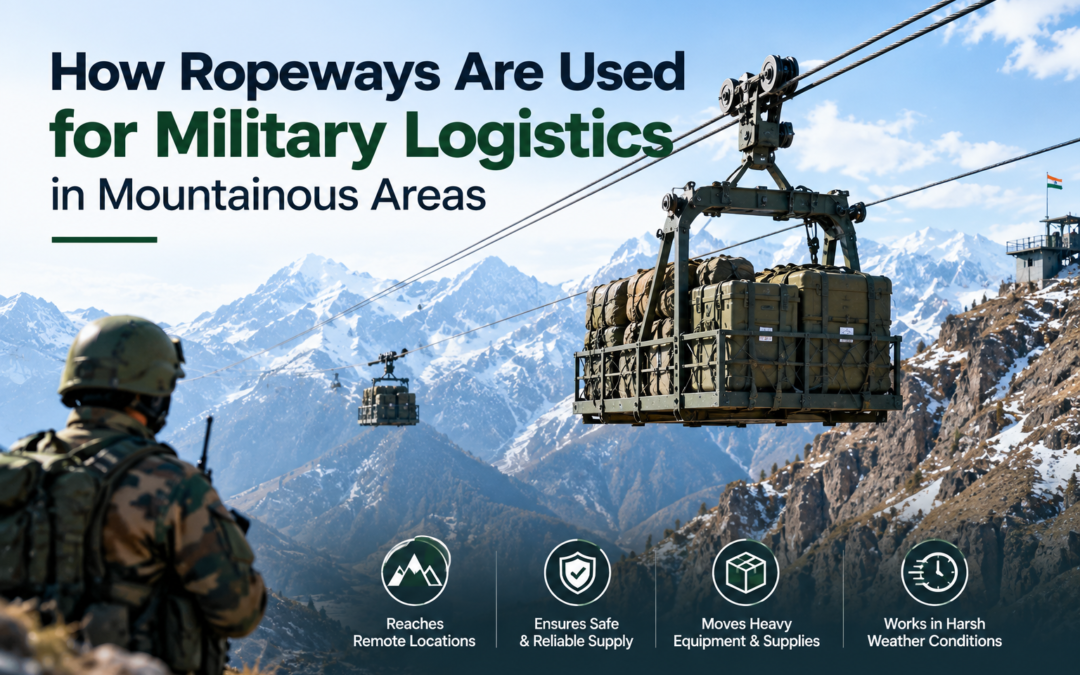
Ropeways for military logistics in mountainous areas have quietly supported armies for over a century, from the Alps in World War I to the Siachen Glacier today. These military ropeway systems carry supplies across terrain no vehicle can cross, without waiting for a road to be built or a storm to clear. For India’s Army, this is not a backup option. It is often the only reliable way to keep forward posts running.
This blog looks at how aerial cableways for army operations work, and why they remain critical in the world’s harshest battlegrounds.
Why Roads and Helicopters Fail in Mountain Warfare
Building a road through mountains is not as easy as it sounds. The sides of the mountains can collapse, and rocks can break apart. The rainy season can destroy what you built in just one big landslide. A blocked stretch means a cut-off post, sometimes for weeks at a time. In a war zone, that kind of delay does not just slow things down. It puts lives at risk.
Helicopters cover some of the gap, but not enough of it. Flying depends on clear skies. And at altitudes like Siachen, clear skies are the exception rather than the rule. Strong winds, sudden snow, and thin air all cut into how much weight a helicopter can lift safely on any given flight. Add the fuel costs and the expense of keeping a fleet running at that altitude, and every single sortie starts adding up fast.
This is where ropeway for high altitude military supply earns its place. Fog and snowfall do not stop it the way they stop a helicopter. It does not wait for a road to be cut through rock either. Once it is installed, it keeps moving supplies day after day, no matter what the weather is doing outside.
What Exactly Are Military Ropeways?
A military ropeway, often called an aerial cableway, is a fairly simple idea once you break it down. Two ropes do most of the work. One stays fixed in place and acts as the support, called the track rope. The other rope is called the haul rope- it moves back and forth. It pulls the load. The carriers move between these two ropes. They carry goods over valleys and ridges and gorges. Also, they never touch the ground. The military ropeway is different from the ropeways you see at hill stations or ski resorts. Those ropeways are for people to ride, so they need to be comfortable. They have cabins and seats. It is easy to get on, and you are protected from the weather. A military ropeway does not need all that. There are no seats. There are no cabins, like the ones you see at hill stations. The military ropeway just has trolleys or cradles. They are manufactured to carry heavy things – not people who want to see the view.
That difference in design comes from a difference in purpose. A tourist ropeway is judged by passenger experience. A military ropeway is judged by one thing only: whether it delivers the load, on time, in conditions where nothing else can.
How Armies Actually Use Ropeways for Logistics
Once a ropeway is installed at a forward post, it becomes part of daily operations, not a fallback for when everything else fails. Here is where it actually earns its place.
Supplying Rations, Fuel and Ammunition
Soldiers at high places need a constant flow of basic supplies just to stay alive, let alone to stay in their position. Food, fuel for heat, and bullets all have to go up the mountain. Carrying these things by foot takes a lot of time, makes soldiers tired, and puts them in danger before they even reach their post. A ropeway handles this on a fixed schedule instead – which saves both time and the manpower a foot supply run would otherwise eat up.
Moving Troops Safely Across Impassable Terrain
Cargo is not the only thing that travels on a ropeway. Some stretches of terrain punish a single wrong step with a fall of hundreds of feet, and crossing a valley or gorge on foot in those conditions is a real gamble. A properly built ropeway gives soldiers a safer way across, which matters even more during rotation periods when whole units need to move between posts at once.
Casualty Evacuation from Forward Posts
This use tends to get overlooked, though it may be the most critical one. When a soldier is injured at a remote post, how fast they reach medical care often decides the outcome. Roads rarely exist here, and helicopters cannot always take off. A ropeway carrier fitted for stretcher transport becomes the quickest option, and at times, the only one that works, for getting an injured soldier down to a base camp.
Transporting Construction Material for Bunkers and Outposts
Forward posts are not built overnight, and they are not built with materials found lying around at 18,000 feet. Cement, steel, timber, and fabrication materials all need to travel up from lower camps. Trying to move this by mule or manpower alone takes weeks and drains resources that could go elsewhere. A material ropeway system, similar to the ones used on hydropower and mining sites, can shift this volume of material far faster, and with far less strain on personnel.
Put together, these four uses show why ropeways are not treated as a temporary fix in mountain warfare. They become part of the supply chain itself, running alongside whatever roads or air support exist, and often filling in exactly where those two options stop working.
Case Study – Siachen Glacier and the Indian Army
Siachen Glacier is often called the world’s highest battlefield – and that title is not an exaggeration.
- Indian Army posts here sit above 18,000 feet, where the mercury drops past minus 35 degrees Celsius on a regular basis. Wheels are of no use in this terrain. No road connects most of these posts. Helicopters remain the only air option, and even they are grounded for days at a time when the weather turns.
- This is the exact environment where M & M Ropeways has worked directly with the Indian Army. Our team designed, manufactured, and installed a ropeway system at 18,000 feet on Siachen, built to function in some of the most inhospitable conditions found anywhere on earth. Every part of that system, from the cable strength to the load capacity, had to account for extreme cold, high wind, and near-constant snow cover.
What makes this case study relevant is not just the altitude record. It shows what a ropeway needs to survive and perform where almost every other transport option fails outright. Supplies, equipment, and personnel movement at Siachen depend on systems built for exactly this kind of pressure, and that experience shapes how we approach every high-altitude project since. You can see more of our defence and high-altitude work on our projects page.
Engineering Challenges of Building Ropeways in Combat Zones
Designing a ropeway for a ski resort and designing one for a military post at 18,000 feet are two completely different engineering problems. Combat zones bring a set of demands that civilian projects rarely face.
- Extreme cold resistance: At sub-zero temperatures, standard steel cables and mechanical parts can turn brittle and fail under load. Every component has to be tested and rated for conditions well below what most equipment is built to handle.
- Fast assembly: A ropeway meant for a forward post cannot take months to set up. Operational needs can shift a site overnight, so systems often need to go up quickly, using materials that can be carried by mule, air, or manpower rather than heavy trucks that these terrains simply cannot support.
- Low maintenance design: Sending a technician up to a remote post for routine repairs is not always possible. Parts have to be built for a longer service life with minimal upkeep, since a breakdown here is not a quick fix.
- Wind and avalanche exposure: High-altitude ropeways face constant wind load and avalanche risk, both of which shape how supports and anchor points are engineered.
- Access difficulty: In many cases, the site itself is barely reachable, which means construction planning has to account for the same terrain problems the ropeway is meant to solve.
Together, these factors show why building here takes a different level of engineering discipline than most other ropeway projects. Our approach to this is covered in more depth in Essential Safety Measures During Ropeway Installation.
Why Ropeways Beat Roads and Air Support in Military Terrain
Put a ropeway, a road, and a helicopter side by side in mountain terrain, and the gaps in the other two options become obvious fast.
- Weather does not stop it: Snowfall, fog, and high winds ground helicopters on a regular basis. A ropeway keeps working through most of that, since it has nothing to do with visibility or flying conditions.
- Each trip costs far less: A helicopter sortie burns fuel and needs a full aircrew every single time. Once a ropeway is up and running, moving another load costs a fraction of that.
- It does not need to stop and rest: Helicopters need refueling, crew changes, and a clear weather window before the next flight. A ropeway can keep moving loads back and forth for hours without any of that downtime.
- No slope gets cut open to build it: Roads in mountain terrain mean carving into hillsides, which raises landslide risk and can take years to finish. A ropeway skips that step and can often be running within months.
- Fuel is barely a factor: Some ropeway designs, gravity-powered ones especially, run on little to no external power, which matters a lot in places where getting fuel up the mountain is its own logistics problem.
None of this means ropeways replace roads or air support completely. In most cases, they work alongside both. But in the specific conditions mountain warfare creates, a ropeway often ends up doing the one thing the other two cannot guarantee: showing up on schedule, every single day.
We have covered this comparison in more detail in Why Ropeways Are a Sustainable Alternative to Road Expansion in Mountain Regions.
The Future of Military Ropeway Technology
Military ropeway systems are not staying static. As terrain challenges grow more complex and defence infrastructure budgets expand, the technology behind these systems keeps improving too. One shift is the move toward self-propelled systems, where carriers come with their own onboard engines instead of relying on a fixed haul rope powered from a station. This gives more flexibility in how and where a ropeway route can be set up, especially in terrain that changes often.
Sensors are quietly changing how these systems get monitored too. Cable tension, load weight, weather conditions- all of it can now be tracked in real time. This cuts down how often someone has to physically check a line at a remote post that takes hours just to reach. Power is shifting as well. Some newer setups run on a mix of gravity and electric backup, useful in locations where trucking in fuel regularly is neither easy nor cheap.
There is also growing focus on faster deployable designs. As operational needs shift quickly in border regions, ropeway systems built for rapid assembly and relocation matter more than ever. Together, these developments point toward one clear direction: ropeways built specifically for defence use are becoming smarter, faster to deploy, and less dependent on manual upkeep.
You can read more on where this is headed in The Future of Transportation With Ropeway Technology in India.
The Crux
Mountain warfare has always tested the limits of what roads and aircraft can deliver, and it likely always will. Ropeways stepped into that gap over a century ago – and they remain just as relevant today. When weather grounds helicopters and terrain rules out roads, a well-engineered ropeway keeps supplies, personnel, and support moving without pause.
For defence planners, PWD officials, and infrastructure teams working in high-altitude or border regions, the case for ropeways is not theoretical. It is proven, tested at 18,000 feet, in temperatures no other transport system handles well. M & M Ropeways has built a system for the Indian Army. Working on a project like that teaches you a lot of things that you cannot learn from a book. We use what we learned from that project when we work on sites that are high up.
If your project involves extreme terrain, tight timelines, or conditions where standard transport options fall short, get in touch with our team to discuss what a ropeway solution could look like for your site today.
by ropeway-admin | Aug 13, 2026 | Ropeways, Uncategorized
India’s ropeway industry is heating up. Hill states have projects in the pipeline. Religious towns want them. Tourism boards are lining up bids. The Union Budget 2022-23 launched the Parvatmala Pariyojana. Under it, the government plans over 250 ropeway projects across 1,200 km in five years, as per the Press Information Bureau. A ropeway is more than steel and cable. It is soil tests, wildlife surveys, tower alignment studies, and thick files of paperwork. Design happens in offices. Approvals happen in ministries. Projects can sit for months. Sometimes years. Not because the engineering fails. Because one file is missing or wrong.
This guide breaks down the 6 Documents You Need Before Applying for Ropeway Project Approval. Each one has a job. Each one carries weight. Get these six ready, and your ropeway project in India moves fast. Miss even one, and it sits.
Why Paperwork Matters More Than the Cable
You can build a ropeway faster than you can approve one. That is where most developers get stuck. Take Nandi Hills in Karnataka. According to The Hans India, the project has faced years of delays while awaiting forest and wildlife clearances from the Centre. The Palampur ropeway in Himachal, according to The Tribune, has been pending for years despite Central approval.
The pattern is clear. Every delay eats capital. Interest keeps ticking. Contractors keep waiting. Costs go up every month. Regulators do not run on trust. They run on files. Every stage of the ropeway approval process demands hard proof. Skip a step, and the file returns. To plan smarter from day one, read our guide on key factors every planner must know. That is why solid ropeway construction starts with solid paperwork. Not the other way around.
The 6 Documents That Decide Your Project’s Fate
Not every paper matters equally. Some decide the fate of your file. Six documents sit at the top of that list. These are the ones ropeway project approval authorities check first. They cover technical, environmental, legal, and safety ground. Miss one, and the rest do not save you. Let us break each one down.
1. Detailed Project Report (DPR)
The Detailed Project Report is the backbone of every aerial ropeway project. Consultants prepare it. Regulators judge you by it. It carries the full story of your project, the route, the engineering design, the money, and the risk. Without a DPR, no file moves forward.
A strong DPR must cover the following:
- Route alignment and terrain survey.
- Traffic demand and passenger load.
- Engineering design and technical drawings.
- Cost estimates and financial model.
- Construction schedule with milestones.
- Risks and how you plan to handle them.
NHLML mandates a DPR before any Parvatmala bid. It is the first serious ropeway project document on the table. As per the Press Information Bureau, the Sonprayag-Kedarnath and Govindghat-Hemkund projects were among the first approved under Parvatmala. Yours must match that standard. Skip a section, and the file gets returned.
2. Feasibility Study Report
Feasibility comes before the DPR. It answers one question. Should this project even exist? A ropeway feasibility study looks at the land, the demand, and the numbers. If any one of these fails, the project stops here. The report must include:
- Topographical and geotechnical surveys.
- Wind, snow, and seismic load data.
- Passenger or material load forecast.
- Ridership and revenue projections.
- Preliminary alignment options.
- Environmental sensitivity mapping.
A weak feasibility leads to a weak DPR. A weak DPR leads to rejection. Every cable car project approval starts here. To understand which routes make economic sense, read our post on ropeway vs road cost comparison. Get this stage right, and the rest of the ropeway approval process becomes easier.
3. Environmental Impact Assessment (EIA)
An environmental impact assessment is required for most large ropeway projects in India. It falls under the EIA Notification, 2006. You file it through the PARIVESH portal. Your EIA must document:
- Baseline air, water, and soil data.
- Flora and fauna survey.
- Noise and vibration impact.
- Waste management plan.
- Compensatory mitigation measures.
- Public consultation records.
A public hearing usually follows. Regulators look for honest data. Clever wording does not help. Ropeways carry a lower ground footprint than roads in hill terrain. Even so, the EIA process cannot be skipped. If your data is weak, the file comes back with tough questions.
4. Forest Clearance Certificate
If your route touches forest land, this document is non-negotiable. The Forest (Conservation) Act, 1980, applies. Any aerial ropeway project through a forest area needs central government approval first.
Forest clearance moves in two stages:
- Stage I – in-principle approval
- Stage II – final diversion approval
Attach these with your application:
- Forest land diversion proposal.
- Compensatory afforestation plan.
- Wildlife mitigation report.
- NOC from Gram Sabha (where applicable).
- Biodiversity impact statement.
Even terminal stations and tower footprints need diversion approval. As per Swarajya (October 2025), the Shimla ropeway project secured Stage-I clearance for 6.19 hectares of forest land. This stage is often the slowest. For ropeway construction through difficult hilly terrain, delays get worse. Plan the file early, not late.
5. Land Acquisition and Ownership Documents
You cannot install a tower on someone else’s land. Regulators want clean title from day one. Any gap in ownership records can hold up the entire ropeway project approval file. This step sounds basic. Developers still miss it. Keep these documents ready:
- Land ownership records or lease deeds
- NOC from private landowners
- Revenue department certificates
- Panchayat or municipal permissions
- Right-of-way documents
- Site plan with survey numbers
For PPP tourism projects under Parvatmala, the government usually provides land through the concession agreement. Even then, the developer still files the full ownership trail. Land acquisition for ropeway projects gets messier in hill regions where records are often old or unclear. Sort this out early. It saves months later.
6. Statutory NOCs and Safety Clearances
This is a bundle, not a single paper. Every ropeway project approval file must carry a full stack of NOCs. Miss one, and commissioning gets frozen at the last mile. Regulators check these before green-lighting operations. Collect all of these:
- Height clearance from AAI.
- Defence clearance for border or sensitive zones.
- Consent from the State Pollution Control Board.
- Wildlife Board NOC (near sanctuaries).
- Structural safety certificate from a licensed engineer.
- Fire safety and electrical safety approvals.
- Local municipal building permits.
The Shillong Peak Ropeway is one example. As per North East News, it secured NOCs from AAI, the Air Force, and the Army before work started. That is the model to follow. Safety on the ground matters as much as safety on paper. For execution-stage protocols, read our guide on essential safety measures during ropeway installation. One missing NOC can freeze the entire ropeway approval process.
These six documents form the core of every ropeway project approval file in India. Miss the details, and delays start piling up. Get them right, and your project moves.
How M & M Ropeways Supports Your Project
M & M Ropeways is a leading ropeway manufacturer in India. The company designs, manufactures, and installs aerial ropeways and cable cranes. Single loads range from 100 kg up to 10,000 kg. Some spans reach 6,400 meters on a single drive. For the Indian Army, we installed ropeways at 18,000 feet on the Siachen Glacier. Those systems ran below minus 35 degrees Celsius. Our clients include the Indian Army, hydropower firms, state PWDs, cement majors, and tourism boards. We deliver aerial ropeway projects for hydropower construction, mining, dams, tunneling, tourism, and rural connectivity in the mountains. Where most projects trip up is paperwork. Our team supports clients through the design, manufacturing, and installation stages of every project. Planning a ropeway project in India? Contact M & M Ropeways for design, manufacturing, and delivery support.
Key Takeaways
India’s ropeway push is just picking up speed. More projects will come. More states will join. But the process stays the same. Every file goes through the same checkpoint: the 6 Documents You Need Before Applying for Ropeway Project Approval. Skip one, and the file stops.
Start early. Build the DPR carefully. Finish the feasibility with real data. File the EIA with honest inputs. Chase the forest clearance from day one. Keep land papers clean. Collect every NOC before you need it. Projects that respect paperwork move fast. The rest wait.
M & M Ropeways has built ropeways in India, Nepal, Bhutan, and Africa. Planning one? Our team can support you with design, manufacturing, and installation.
Common Questions, Clear Answers
Question 1. Who gives approval for a ropeway project in India?
Multiple authorities are involved. Here is the breakdown:
- MoRTH governs the Parvatmala Pariyojana. NHLML runs the execution.
- MoEFCC grants environmental clearance. Filing is done through the PARIVESH portal.
- MoEFCC also grants forest clearance under the Forest (Conservation) Act, 1980.
- AAI issues height clearance where applicable.
- Defence forces provide clearance near the border or sensitive zones.
- State pollution control boards issue consent to establish and operate.
- Local bodies and Gram Sabhas issue site-level NOCs.
The project owner is often a state tourism board, an urban development authority, or a central PSU.
Question 2. How long does it take to get ropeway project approval in India?
There is no fixed timeline. It shifts with location, land type, and forest coverage. There is no fixed number. As per Deccan Herald, the Sonprayag-Kedarnath and Govindghat-Hemkund projects are expected to take 4-6 years to complete after approval. Both fall under Parvatmala. Approvals alone can stretch across months or years. Forest and wildlife clearances are usually the slowest stage. The Palampur ropeway in Himachal is one clear example. As reported by The Tribune, the project has been pending for years despite central approval.
by ropeway-admin | Jul 30, 2026 | Ropeways, Uncategorized
How many ropeway projects has India identified under Parvatmala? The pipeline covers over 200 locations across hilly states and urban corridors. As of early 2026, a growing number have cleared feasibility studies, entered bidding, or reached the award stage. A ₹1.25 lakh crore investment pipeline backs this push. Yet many contractors still struggle to navigate the process. The steps stay buried under jargon. DPR, DBFOT, HAM, and EMD each represent a distinct stage, and missing any one of them can cost a bidder the entire project.
This guide walks through the practical side of how to apply for ropeway project funding under India’s Parvatmala, NHLML, and state government schemes in 2026. It breaks the Parvatmala ropeway project application 2026 cycle into clear steps, covers the NHLML ropeway project funding India routes, the indigenous content rule, and what a bidder needs to be ready for before submitting anything.
What Is the National Ropeways Development Programme?
The National Ropeways Development Programme India carries a second name. People mostly know it as Parvatmala Pariyojana, launched under the Union Budget 2022-23, with one clear aim. Build ropeway infrastructure where roads struggle.
The scale here is large. The programme targets over 250 ropeway projects. Together, they cover close to 1,200 km, backed by an investment pipeline of nearly ₹1.25 lakh crore. This is spread across a five-year horizon. The Centre backs around 60% of project costs through the PPP route. The rest, along with execution risk, sits with private developers.
Quite a few states have already signed on. Uttarakhand, Himachal Pradesh, Jammu & Kashmir, Uttar Pradesh, and Assam are among those running active routes under the Parvatmala Pariyojana ropeway state list projects. Each state has identified specific routes for development.
The National Highways Logistics Management Limited, or NHLML, executes this programme on the ground, operating as a subsidiary fully owned by the National Highways Authority of India. Some search results surface a different body here. They confuse NHLML with NHIDCL, a separate corporation that handles highways near international borders. NHLML, not NHIDCL, owns ropeway tenders, feasibility studies, and DPR contracts.
The PPP Models: DBFOT and HAM Explained
Parvatmala projects run on two main structures, both falling under the broader ropeway PPP model, the DBFOT HAM India government framework.
- DBFOT (Design, Build, Finance, Operate, Transfer): The concessionaire takes on the full load here, designing and building the ropeway while arranging its own financing. It then runs the system for a fixed period, earning revenue from user fares. The Sonprayag-Kedarnath project is a live example. Adani Enterprises secured it at ₹4,081.28 crore, with a 29-year concession running after construction wraps up.
- HAM (Hybrid Annuity Mode): This one works differently. The authority pays the developer in annuity instalments, stretched out across the operations period. This cuts the revenue risk that pure DBFOT carries. The Prayagraj ropeway used this model. It cost roughly ₹251 crore.
The choice between these two structures depends on footfall. High-traffic pilgrim routes lean DBFOT. Routes with uncertain demand often shift to HAM, where annuity payments smooth out the risk.
From Tender to Contract: The Ropeway Bidding Process
Knowing how to bid for the ropeway project in India 2026 starts with the right order of steps.
Step 1: Track the pipeline: Watch NHLML and state project lists closely. So far, thirteen states have signed MoUs, with UP, Himachal, Uttarakhand, J&K, and Assam among them.
Step 2: Monitor the DPR stage: NHLML floats a tender for the ropeway project’s DPR (detailed project report), India. It covers feasibility, alignment, and cost estimation. Recent DPR tenders carried bid security of nearly ₹5 lakh.
Step 3: Register on e-procurement portals: The NHLML ropeway tender process contractor route runs through the central e-tender system. State projects may need GeM registration too. Set accounts up early.
Step 4: Meet pre-qualification criteria: Authorities assess technical capacity, net financial worth, and bid security. Net worth bars often sit near 30% of the project cost. Firms lacking direct experience often partner with an established ropeway manufacturer in India.
Step 5: Submit the bid: Most tenders use a two-cover system. Cover one holds technical documents and EMD proof. Cover two holds the financial offer.
Step 6: Sign the agreement: Selected bidders sign a concession agreement or EPC contract. Performance security replaces the EMD. Construction typically runs four to six years.
Each step builds on the last. Skip one, and the whole bid risks rejection.
The Make in India Rule: 50% Indigenous Components
Parvatmala aligns with the Make in India ropeway 50 percent indigenous component mandate directly. The programme requires that at least half of the components in any ropeway be manufactured in India.
This shapes procurement planning in a real way. Bidders relying on overseas gondolas or drive systems need a fix. A domestic manufacturing or assembly partner helps here. Industry estimates show why this matters. Foreign OEM costs can run 60-65% of the total project cost. Local sourcing, then, becomes a real cost advantage, not just a compliance checkbox.
Firms designing and building aerial ropeways and cable cranes in-house clear this bar without scrambling for a last-minute supplier. That edge matters more as competition for Parvatmala contracts grows.
Outside Parvatmala: How State Governments Fund Their Own Ropeway Projects
Parvatmala is not the only path for state government ropeway grant hilly areas in India. Several states run their own programmes too, often working alongside the central pipeline rather than replacing it.
Three states show how this works in practice.
#1. Himachal Pradesh:
Routes projects through the Ropeways and Rapid Transport System Development Corporation (RTDC). The Shimla-Parwanoo ropeway moved through this body. So did the Shimla Urban Ropeway.
#2. Uttarakhand:
Signed its own MoU (Memorandum of Understanding) through the Uttarakhand Tourism Development Board (UTDB). Seven priority locations were identified this way, beyond the Kedarnath and Hemkund Sahib projects already underway.
#3. Sikkim:
Follows a different funding line altogether. Its ropeway projects draw on PM-DevINE (Prime Minister’s Development Initiative for North East Region), a scheme that runs separately from Parvatmala’s main budget. Routes like Pelling to Sanga-Choeling fall under this scheme.
Practical Tip: For any state-level search, check two places at once.
- The central NHLML (National Highways Logistics Management Limited) pipeline first.
- Then, the specific state tourism department or PWD (Public Works Department).
A good number of these projects end up funded from both sides at once, central and state money working together.
What Makes a Bid Genuinely Competitive: Beyond the Lowest Price
Cost alone rarely wins these tenders. Evaluation committees weigh technical strength, too.
Terrain experience matters more than general infrastructure work. Ropeway engineering is a narrow skill, covering tower design, rope dynamics, and high-altitude wind loading. OITAF (International Organization for Transportation by Rope) compliant engineering signals real credibility here.
In-house manufacturing helps in two ways. It cuts costs. And it eases the indigenous content burden. M & M Ropeways brings exactly this kind of strength. The company has over three decades of field experience. It designs, manufactures, and installs aerial ropeways and cable cranes across tough terrain, spanning Siachen Glacier installations to major hydropower sites. Developers entering the Parvatmala pipeline often need a partner like this, one that already meets BIS (Bureau of Indian Standards) and OITAF standards. Building that expertise from scratch, under tender deadlines, rarely works.
Preparing a bid? Structuring a joint venture? Evaluating a ropeway manufacturer in India for a technical partnership? Reach out to M & M Ropeways. Field-proven engineering, applied right, is often what separates a winning bid from a rejected one.
Quick Answers to Common Funding Questions
Question 1. Who is eligible to bid for a Parvatmala ropeway project?
Answer. Any company or consortium meeting the technical and financial qualification bar can bid. This usually means past cable-transit experience. Or comparable infrastructure work. It also means a minimum net worth and the ability to furnish bid security (EMD). Companies lacking direct ropeway experience often team up with an established manufacturer or technical partner to qualify.
Question 2. Is funding available for ropeway projects outside Parvatmala?
Answer. Yes. States run their own routes, too. Take Himachal Pradesh. It works through its Ropeways and Rapid Transport System Development Corporation (RTDC). Sikkim takes a different route, drawing on PM-DevINE (Prime Minister’s Development Initiative for North East Region). Plenty of projects get backed from both sides at once, with central and state funds working together.
Question 3. How long does it take to get a ropeway project approved and built?
Answer. The DPR (Detailed Project Report) and feasibility stage alone can run several months to over a year. Once a concession is awarded, construction begins. Major Parvatmala projects typically take four to six years. This depends on terrain, altitude, and technology used.
Question 4. Does a contractor need to manufacture ropeway components in India?
Answer. Yes, at least in part. The Make in India mandate requires a minimum 50% indigenous component share. Bidders without domestic manufacturing capacity usually need a partner. An Indian manufacturer helps meet this requirement and keeps the bid cost-competitive.
by ropeway-admin | Jul 21, 2026 | Ropeways, Uncategorized
There is no such thing as “close enough” in this business. You either meet the required standards, or you just don’t. The margin for error in this business is zero. Because when a ropeway system faults, the consequences extend far beyond delays or money loss. It’s people’s lives and safety at stake. So, there’s no way you can compromise in decision-making here. Ropeway systems are not just limited to mountain areas. These are used in a wide range of environments, serving urban transit networks and industrial sites, and serving millions of passengers every year. The International Organization for Transportation by Rope (OITAF) has brought together manufacturers, operators, regulators, and research institutions from approximately 35 countries to advance global safety and engineering practices for ropeway systems.
M & M Ropeways has completed 120+ projects, including cable crane projects. 35 years of experience in the industry & the company has worked across challenging terrains and demanding industries where engineering precision, safety, and long-term performance are non-negotiable.
Why Choosing The Right Ropeway Manufacturer is Important?
A ropeway is not something you can update every other year. Pricing matters, but don’t make it your deciding factor in this case. The cheapest quote can lead to far more expensive repairs in the future, operational risk, and frequent maintenance. The right partner will give you much more than just delivering the equipment:
- Engineering customized specifically for your project
- Compliance with international safety requirements
- Reliable manufacturing quality
- Project planning and execution support
- Installation supervision
- Operator training
- Long-term maintenance assistance
- Spare parts availability throughout the system’s lifecycle
In short, it’s not just limited to purchasing ropeways; it’s your investment in a long-term safe transportation solution that should remain safe, dependable, and cost-effective not just for the initial stage but for years. Explore M&M Ropeways to see how we’ve delivered reliable ropeway systems for tourism, industrial, infrastructural, and material handling applications. Let’s crack the 12-point checklist now.
12-Point Checklist for Selecting the Right Ropeway Manufacturer
First of all, here’s a quick table version of all the important things.
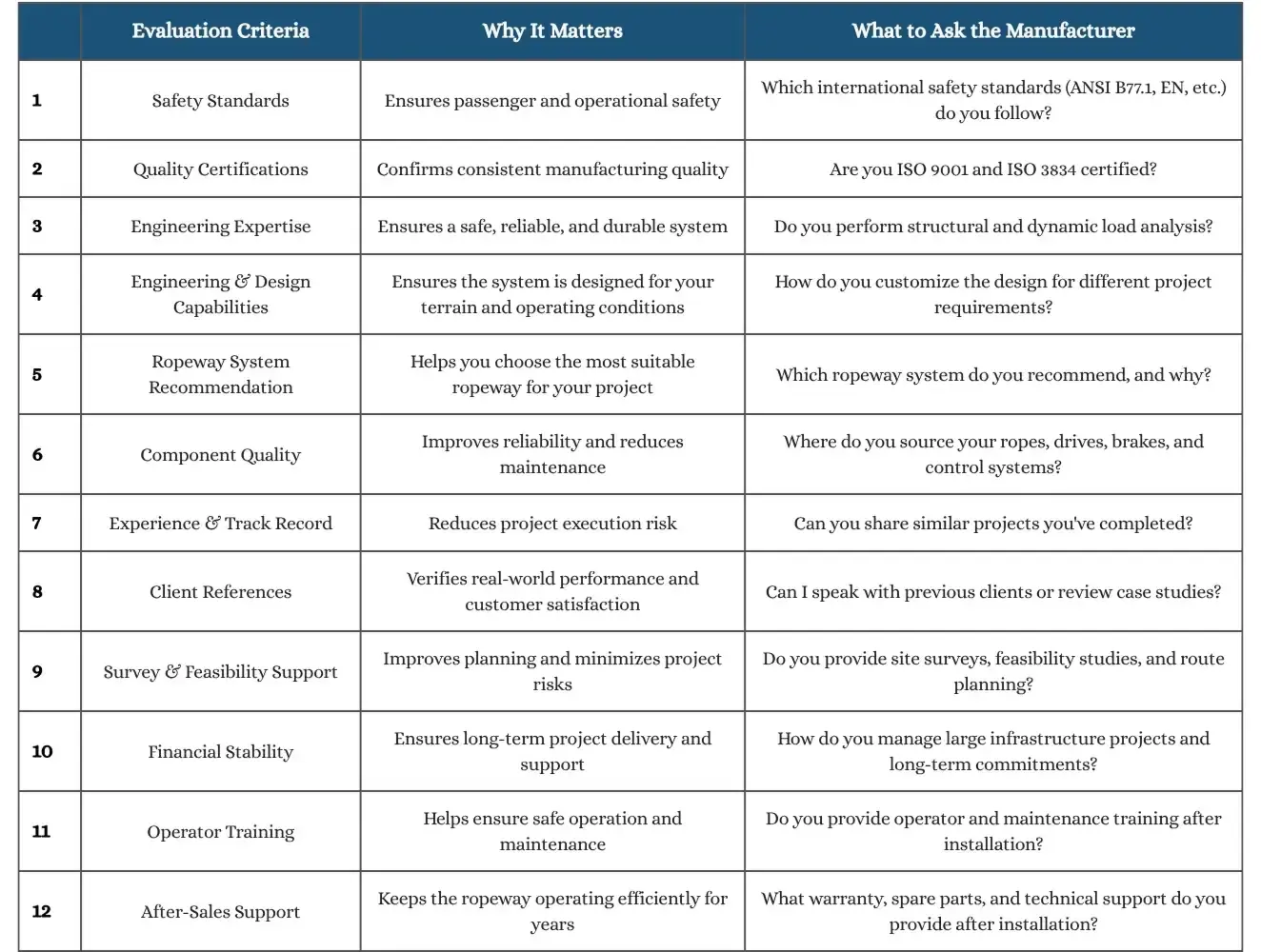
Let’s elaborate on each one, one by one.
1. Make Sure They Meet International Safety Standards
Again, as mentioned earlier, safety is not something you can compromise in this business. Always look for a manufacturer that builds systems in accordance with internationally recognized safety standards, not just local regulations. The safety standards should match throughout design, manufacturing, testing, and installation. Confirm that the system complies with standards such as ANSI B77.1 or relevant European EN standards where applicable. If they are following global safety standards, then they’ll typically offer:
- Better engineering documentation
- Thorough inspection and testing procedures
- Higher system reliability
Questions to ask:
- Which international safety standards do your systems follow?
- How are your systems tested before commissioning?
- Can you provide compliance documentation?
2. Check Their Quality Certifications
Ropeway quality comes down to one thing: how well it’s built. A solid build means better performance. It also means the ropeway lasts longer. So always check the manufacturer’s certifications first. Look for ISO 9001. This one covers quality at every stage, from design to maintenance. Check things like the inspection process. Check customer support too. Got a project with structural steel or welding? Then ISO 3834 matters as well. Together, these certifications back up quality from the first step to the last.
- ISO 9001 quality management certification
- Controlled production processes
- Strong quality control procedures
- Verified welding standards where applicable
We also serve clients across international markets.
3. Evaluate Their Engineering Expertise
Good ropeway design goes beyond manufacturing quality. They’re supposed to follow industry standards like OITAF, because these rules exist for a reason. These standards make sure your ropeway is safe, reliable, and built ot stand the test of time. Manufacturers that follow recognized engineering practices can often provide:
- Safer system designs
- Improved operational reliability
- Easier regulatory approvals
- Greater confidence for international projects
4. Evaluate Engineering and Design Capabilities
Projects are different from each other. Terrain, weather, elevation, and operating requirements of that area are all important things to consider when deciding how a system should be designed. A capable manufacturer understands this. They customize the solution based on your specific needs. They do not rely on a standard configuration. Their engineering team should be able to handle:
- Structural analysis
- Load calculations
- Tower and foundation design
- Electrical and control systems
- Mechanical optimization
- Wind and environmental assessments
Strong engineering helps ensure reliable performance in both everyday and challenging operating conditions.
5. See How They Design Ropeway Systems
The right manufacturer recommends what fits your project, not what they happen to sell. After evaluating your requirements, they may suggest:
- Monocable ropeways
- Bicable ropeways
- Gravity ropeways
- Material ropeways
- Cable crane systems
The recommendation should match your site conditions, budget, capacity needs, and future expansion plans. Explore the complete range of ropeway products.
6. Review Component Quality and Testing Procedures
The reliability of a ropeway comes down to the quality of its parts. Important components, which include wire ropes, drive systems, brakes, towers, bearings, and control systems, should meet high performance standards and undergo rigorous testing. Ask manufacturers:
- Where do you source your major components?
- How are components tested?
- Are inspections carried out before installation?
- What quality assurance process do you follow?
Those manufacturers that use trusted suppliers and hard testing generally deliver more reliable systems with lower maintenance costs.
7. Examine Their Track Record
For complex infrastructure projects, experience counts. But don’t just check years in business. That number alone means little. Look at completed projects instead. Real work tells the real story.
A strong portfolio should include experience in sectors such as:
- Tourism
- Mining
- Hydropower
- Dam construction
- Infrastructure
- Forestry
- Remote logistics
Projects completed in conditions similar to yours often indicate stronger technical expertise. We also provide ropeway solutions across South Asia and Africa, with dedicated expertise for projects in Bhutan, Nepal, and Africa.
8. Request Client References and Case Studies
You really can get a good idea about a manufacturer from previous projects. Ask for client references or case studies that demonstrate their experience and project delivery.
Speaking with previous customers can help you evaluate:
- Project execution
- Communication
- Timely delivery
- Installation support
- Equipment reliability
- After-sales service
Consistently positive feedback is usually a good sign of a dependable partner.
9. Check if They Offer Survey and Feasibility Support
Successful projects start well before manufacturing begins. An experienced manufacturer should support the planning phase by assisting with:
- Site surveys
- Route alignment
- Topographical studies
- Feasibility analysis
- Preliminary engineering
- Capacity planning
Early technical support helps reduce delays and avoids costly changes. It also improves overall project efficiency. The manufacturer should understand local environmental regulations. They should design the project to minimize ecological impact. This includes careful tower placement and reduced land disturbance. The design should also comply with environmental approvals required in your region.
10. Evaluate Financial Stability
Large projects take months and years to complete. So always check if the company is financially stable or not. These little background verifications go a long way. A company that has strong financial backing is more likely to see your project through to the end and offer you long-term support. Including honoring warranties and service commitments well into the future.
- Maintain production schedules
- Manage supply chains effectively
- Honor warranty commitments
- Supply spare parts for years
- Support future expansions
This reduces the risk of project delays and long-term service issues.
11. Confirm Training and Knowledge Transfer
Installing the ropeway is only the first step. Your operators and maintenance team should receive proper training to keep the system running safely and efficiently.
A reliable manufacturer should provide the following:
- On-site operator training
- Maintenance guidance
- Emergency procedure training
- Operating manuals
- Troubleshooting support
Well-trained teams can improve safety, reduce downtime, and extend the life of the equipment.
12. Review Their After-Sales Support and Spare Parts Service
Regular maintenance is a reality for any ropeway system, no matter how well it is built. Parts will need to be replaced over time. Make sure the manufacturer you choose offers continued technical support. This support should cover the entire lifespan of the system.
Look for:
- Comprehensive warranty coverage
- Fast technical support
- Genuine spare parts
- International parts availability
- Maintenance and inspection assistance
Good after-sales support keeps your ropeway running smoothly and reduces costly downtime over the long term.
Common Mistakes Buyers Should Avoid
Buyers usually make the same mistakes when selecting a ropeway manufacturer. And these mistakes are completely avoidable if you are aware of a few things.
- Making Money The Deciding Factor
Poor quality material, limited support, and experience can cost you more. So always try to go for quality and experience rather than going for a low-budget quote.
- Not Taking Certifications Seriously
Manufacturers without proper safety standards and quality can lead you to operational risks and compliance issues in the future. So always look for certifications and safety standards.
- Underestimating Experience
A manufacturer who has delivered projects already is always aware of what to and what not to do in serious situations. An experienced manufacturer is always better prepared to handle challenges. Go for an experienced company.
- Not Evaluating Support Services
A ropeway project is something that runs for decades. Having a good support system in maintaining and coordination in case of any inconvenience is always important.
Final Verdict
Making the right decisions about your ropeway manufacturer is something that will impact your business for years. This business is not just about making money but also building trust in the industry, as it involves people’s lives. Choosing the right partner with proven experience, certifications, international exposure, and quality manufacturing is really important. This 12-point checklist covers almost everything that you should not miss.
Looking for a ropeway manufacturer you can trust? Get in touch with M & M Ropeways. Tell us about your project. We’ll help you land on the right solution for your needs.
Frequently Asked Questions (FAQs)
What things do I keep in mind when choosing a ropeway manufacturer?
When you are choosing a ropeway manufacturing partner, look for international-level safety compliance, certifications, quality in manufacturing, good long-term sales support, and relevant project experience. If needed, they should have readily available spare parts.
Why are international safety standards important for ropeway systems?
International standards cover all important aspects of safety. You can count on passenger safety and regulatory compliance across different regions.
What should I check before choosing a ropeway manufacturer?
Always look at safety standards, certifications, past completed projects, and spare parts availability. A good manufacturing partner will help you through planning, installation, and long-term maintenance support.
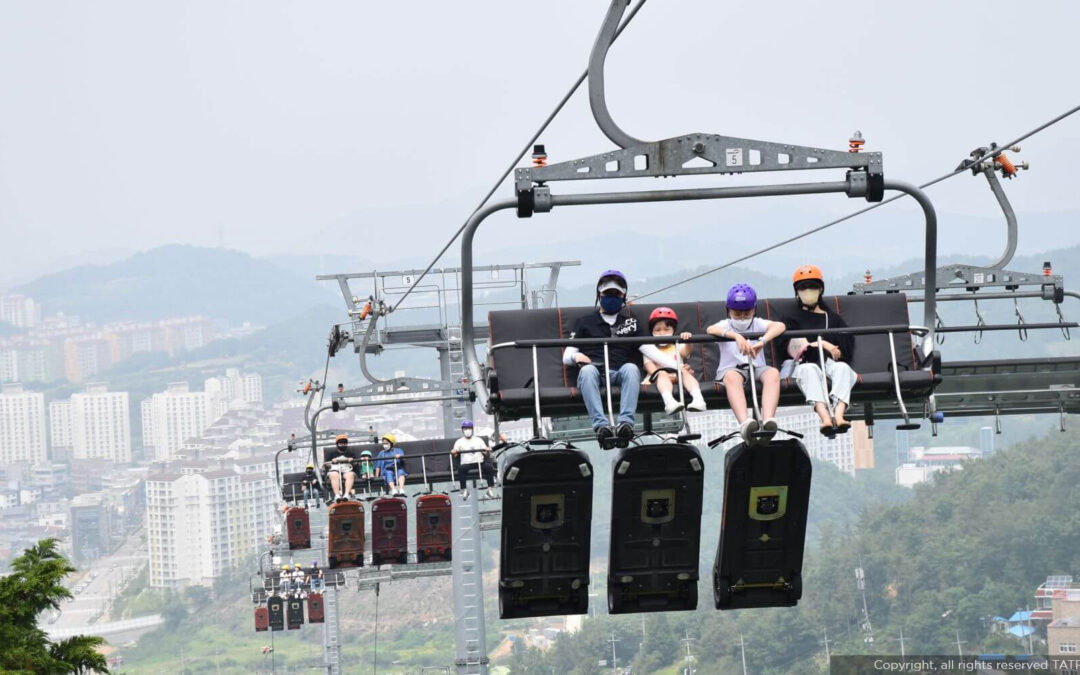
by ropeway-admin | Apr 20, 2026 | Uncategorized
India’s urban centers are jammed with traffic, while its Himalayan terrains face extreme connectivity hurdles. Traditional transport has reached its limit. The future of Indian travel is now moving from the ground to the sky. Ropeway technology is no longer just for tourists. It is a vital solution for daily commuting and rural connectivity.
Ropeway technology provides a contemporary transportation system. The cabins move through the air using strong steel cables to carry people or goods from one place to another. This may look simple, but it offers a smart way to travel over difficult terrain and crowded areas.
With 35+ years of experience and 120+ successful projects, M & M Ropeways is leading this change. We help bypass traffic and overcome mountains with smart, high-tech cable car systems.
This blog explores The Future of Transportation with Ropeway Technology in India and explains how it can support cleaner, faster, and more reliable transport connectivity across the country.
Why Ropeway Technology is India’s Problem Solver?
India’s traditional transport has hit a saturation point. Between jammed city roads and breakable mountain terrains, people need a “ Vertical Bypass”. Ropeway technology in India is an ultimate technology to take advantage of. It offers a faster, smarter way to move above the chaos. Furthermore, where road construction is impossible or fails to work, ropeway technology steps in because it requires very little ground space. Compared to the massive costs of Metro Rail, a ropeway system costs roughly 1/10th of the investment. As a result, this makes it the most cost-effective solution for a developing economy.
Key Advantages Over Traditional Transportation:
- Minimal Land Needs: The system needs minimal land space. Its towers require only small operational areas, which lets them avoid extended legal processes.
- Rapid Construction: The project achieves completion within 18 to 24 months. As a result, this provides a time advantage over standard rail development.
- All-Weather Reliability: The system maintained operational safety during severe weather conditions, which included heavy rain, fog, and snow.
- Zero Congestion: The ropeway system operates without interruptions. Because it maintains constant movement through intersections and does not encounter red traffic signals or vehicle congestion.
Major Ropeway Projects Shaping India’s Transport Network: An Overview
India is undergoing a major infrastructure transformation. Because it is replacing its existing road systems with modern aerial cable car systems. The Parvatmala Pariyojana initiative of the government drives India to develop ropeway projects from their initial planning stages into actual implementation. The project aims to achieve three specific goals, which include reducing travel time and eliminating street traffic congestion while providing access to areas that were previously inaccessible.
Highlights of Recent Developments:
- Varanasi Urban Ropeway: This project is a game-changer for urban ropeway systems in India. By launching a system that glides above the city’s dense crowds and narrow streets. It offers a high-capacity “vertical bypass” for thousands of daily commuters. This proves that ropeway transportation in India is a practical solution for heritage cities.
- Himalayan Connectivity (Himachal & Uttarakhand): The challenging mountainous terrain of the North has made ropeways essential for transportation. Mountain travel has required people to navigate hazardous roads that suffer from landslide risks and heavy snowfall. The current projects aim to establish connections between high-altitude pilgrimage sites and remote tourist hubs that lack feasible road construction options.
These ongoing Indian ropeway projects clearly show how ropeway systems are becoming an important part of India’s modern and sustainable transportation planning.
Benefits of Ropeway Systems For Modern Mobility
Ropeway technology is no longer just a secondary option. It is a primary solution for India’s complex mobility needs. Ropeways provide solutions that neither roads nor railways can deliver in both urban areas and remote village locations. The system provides three main advantages because it combines fast transportation with safe operations and economical expenses. This makes it the best solution for 2026 infrastructure development. In urban areas, this system works well and improves ropeway last-mile connectivity by reducing traffic and delays during peak hours.
Why Ropeways Are A Smart Transport Choice:
- Cost-effective infrastructure with lower construction expenses.
- Minimal land acquisition compared to roads or metro lines.
- Faster installation with less on-site disruption.
- Helps ease traffic pressure in crowded city areas.
- High reliability and steady performance during peak hours.
Partner with M & M Ropeways to deploy world-class ropeway systems for hilly regions. We combine European safety standards with deep local expertise to ensure your regions stay connected, no matter the altitude.
What Ropeway Solutions Does M & M Ropeways Offer?
M&M Ropeways designs and builds ropeway systems that solve actual transportation and connectivity problems. The company provides customized ropeway solutions. Our team has both technical knowledge and practical field experience to develop systems that meet diverse functional requirements across various terrains.
Our Ropeway Solutions:
1. Passenger Ropeways (For Cities & Tourism)
Passenger Ropeway India operates to provide rapid and comfortable transportation. Our company constructs aerial cabin cars in India that operate above both urban environments and steep mountain paths. The system converts labor-intensive walking and driving activities into a secure and picturesque travel experience, which only takes a few minutes.
These systems are designed to move heavy materials such as minerals, coal, and construction supplies. Material ropeways provide a cost-effective way to transport large loads over long distances. Especially in areas where trucks cannot operate or where road transport becomes too expensive and impractical.
3. Cable Cranes (For Large Construction)
When building massive structures like dams or bridges over deep valleys and rivers, standard cranes often can’t reach. M & M Ropeways’ high-performance cable cranes move heavy machinery and materials through the air with precision. This makes it possible to complete complex engineering projects in “IMPOSSIBLE” locations.
4. Maintenance & Modernization
M & M Ropeways doesn’t just build new systems. We make old ones better and safer. Our team reviews safety systems in detail and suggests practical technical improvements. This may include upgrading motors or adding modern monitoring sensors. These steps help existing ropeways meet current safety norms and keep them running smoothly for many years.
India focuses on building smarter and cleaner cities. Moving transport into the sky is no longer just an idea. Indeed, it has become a necessity. M & M Ropeways is the trusted name for safe and future-ready ropeway infrastructure.
Why is M & M Ropeways a Preferred Choice For Ropeway Projects?
M&M Ropeways provides reliable ropeway transport solutions. Function effectively in both crowded urban areas and challenging mountain landscapes. Our company has completed numerous projects across India. The company has worked on a wide range of ropeway installations. Their extensive knowledge comes from years of planning, engineering tasks, and construction work. The company provides safe and efficient future-ready ropeway solutions to governments, developers, and planners. Below are some points that clarify why we are the most preferred choice for ropeway projects:
- Decades of proven field experience.
- Engineering for extreme terrains.
- Global safety standards compliance.
- Project-specific customization.
Key Takeaways
The Future of Transportation with Ropeway Technology in India depends on smart and practical mobility choices. As cities expand and roads remain limited, ropeways offer a reliable way to move people without adding traffic. Ropeways work well in cities, hills, and tourist areas. When planned properly, ropeway systems deliver long-term value and support clean and efficient travel.
If you are planning a ropeway project and need expert guidance, M & M Ropeways is ready to help. The team supports projects from early planning to final commissioning. Our experts are available through a single phone call to assist you with advanced Urban ropeway systems implementation and large-scale Ropeway projects in India. The team stands ready to provide support at any time needed. You can contact us whenever you want to.