
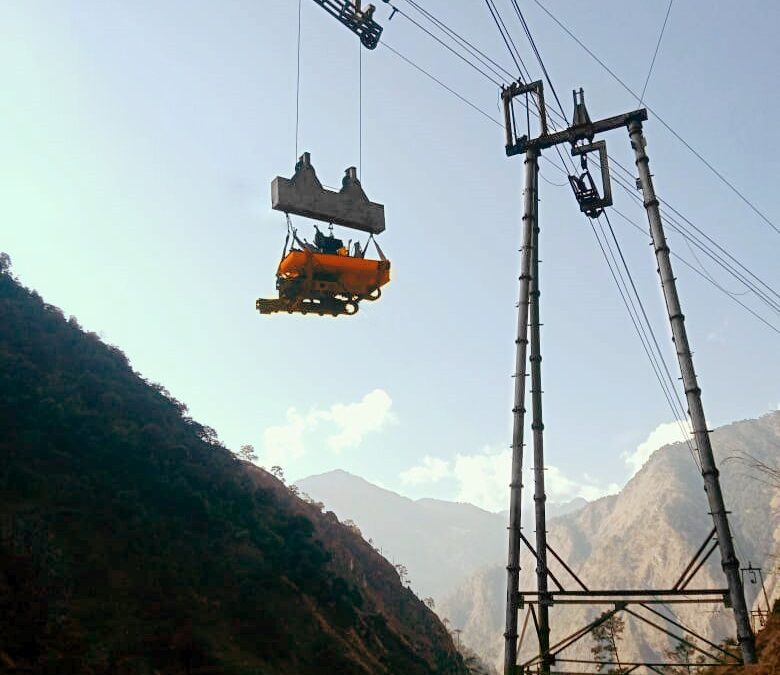
Every morning, people in hilly areas walk for hours through forests or sloppy areas just to reach a road. On the other hand, another mountain highway gets carved through a protected forest to tackle the same need differently. Meanwhile, India keeps building roads. The conventional road infrastructure is simply not achievable in difficult hilly areas. Yet the road-building cycle continues, cutting through ecologically sensitive zones. This leaves behind eroded slopes, displaced wildlife, and rising carbon levels.
The shift is now coming from the top. Under the Parvatmala Pariyojana, the Government of India has initiated the National Ropeways Development Programme as an ecologically sustainable transport solution. This is specifically taken for rocky, hilly terrain & jammed urban centers where building conventional transport infrastructure is often difficult, costly, or impractical. Specific states like Himachal Pradesh, Sikkim, and Uttarakhand are increasingly leaning toward ropeways rather than roads for mountain connectivity. In addition, ropeways emit zero carbon emissions during operation, occupy minimal ground space, and require significantly less maintenance compared to road-based transport. The environmental impact of ropeway projects vs highways is no longer just a debate among planners. It is now a declared national policy priority.
This blog breaks down exactly why ropeways are the more sustainable transportation solution for India’s mountain regions.
What Environmental Factors Make Ropeways a Smarter Choice Than Roads?
1. Land Use and Deforestation: The Numbers Don’t Lie
Highway construction in hilly terrain demands enormous land clearance right from the beginning. A single kms of mountain road can disturb up to 3 to 5 hectares of dense forest cover. Furthermore, road widening projects in states like Uttarakhand have displaced thousands of trees in very recent years. Ropeways specifically require only a narrow strip for towers and terminal stations. Additionally, ropeways require very little land, often using as little as 0.3 hectares per kilometer of route. Therefore, the land use comparison alone makes a strong and immediate case for green infrastructure in India today.
Moreover, highway construction on slopes triggers soil compression, surface runoff, and long-term erosion problems consistently. Ropeways leave the ground surface between towers completely undisturbed and intact naturally. Consequently, natural drainage patterns stay healthy, & forest cover continues to hold moisture for watersheds properly.
2. Carbon Emissions: A Head-to-Head Comparison
Building highways creates significant carbon emissions at every stage. From preparing the land for construction to producing the materials, all are needed for the road. Do you know how many carbon emissions roads produce while constructing 1 km? Studies suggest that constructing 1 kilometer of expressway emits approx 500 – 1,250 tonnes of CO₂ equivalents overall. However, ropeway installation emits far less because steel towers replace continuous, extensive excavation and construction work.
In addition, electric ropeways powered by renewables emit near-zero operational carbon emissions every single day. In comparison, a mountain highway sees hundreds of diesel vehicles climbing hilly terrain every hour. Consequently, the ropeway’s carbon footprint over a 30-year lifecycle is much lower than any road alternative.
Furthermore, ropeways do not create induced demand for additional vehicles on mountain roads as highways do. Once a highway is built, traffic volume grows steadily, and emissions multiply year after year. In contrast, a ropeway manages its own capacity and keeps emissions predictable and low throughout its life.
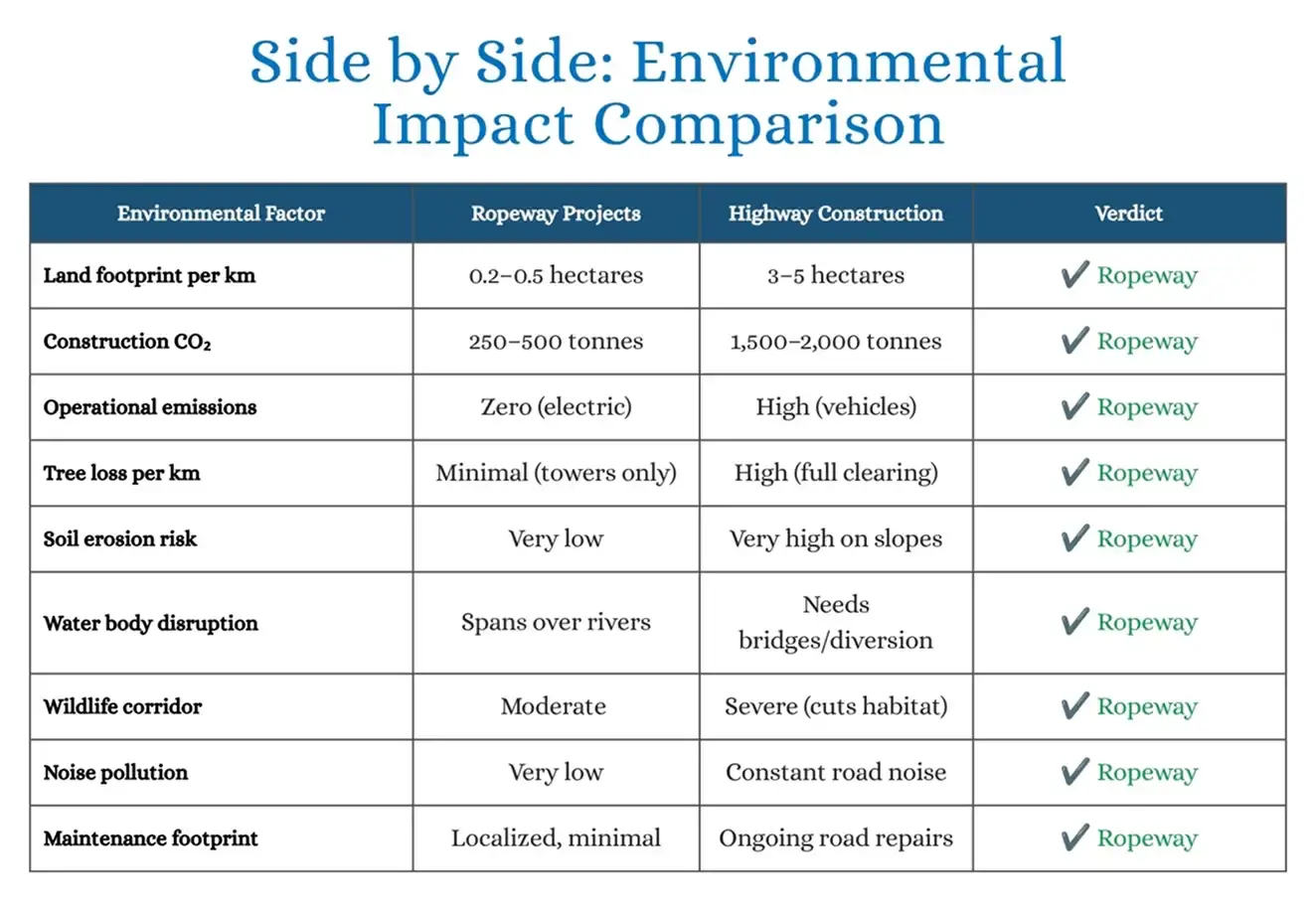
3. Side by Side: Environmental Impact Comparison
4. Real-World Evidence: The Parwanoo to Shimla, Himachal Ropeway
In Himachal, the Parwanoo–Shimla ropeway route is one of India’s most studied examples of eco-friendly mountain transport. It is also becoming the 38 km-long route, the longest in the coming years. This aerial ropeway carries tourists and daily commuters while it keeps running on grid-connected electricity that’s sourced partly from hydropower. Also, the ropeway passes over uneven terrain, where making a road would have meant clearing sensitive forest areas. And clearing can lead to lasting environmental damage, not just short-term disruption.
Operational emissions from a ropeway produce zero carbon emissions directly. But it can still produce them indirectly, and it has a very low carbon footprint. At the same time, road travel in private vehicles sits at over 1619.87 grams of CO₂ per passenger kilometer. So, in simple terms, these sustainable transportation solutions give about a 10× drop in emissions. This is the result of every trip you do with the system. Also, people are opting for ropeways over highways in the hilly areas. This leads to less congestion on the NH5 highway and prevents the construction of another highway by destroying nature.
Consequently, landslide risk zones along that stretch see fewer heavy vehicles, adding to road stress every season in Shimla, especially. This real-world case makes a clear argument for ropeway-first planning in India’s mountain corridors going forward.
5. Air Quality and Noise Pollution in India’s Hill Stations
If you have been to Manali, Mussoorie, or Ooty recently, you might have noticed that traffic jams in these places happen every day. As a result, PM2.5 levels in these popular hill destinations during the busy tourist months go above the safe WHO limits by 2 to 3 times quite regularly. Also, diesel buses and trucks, when they climb steep slopes, release an unbalanced amount of particulate matter per trip.
Switching even 30% of tourist transport to ropeways could meaningfully reduce this air quality crisis at the local level. M & M Ropeways designs electric systems that eliminate tailpipe emissions from the tourist transport equation.
Additionally, cable cars cut down on noise stress for both local wildlife and the permanent residents at the same time. So, ropeways have become one of the clearest sustainable transportation solutions for India’s iconic but fragile hill stations. More than that, quieter travel routes quietly support nearby shops, wellness tourism, and the overall everyday well-being of mountain communities. This local environmental benefit is often overlooked in wider infrastructure debates across the country.
6. Why India’s Terrain Specifically Favors Ropeways
Northeastern states in India, like the Himalayan belt and the Western Ghats, have terrain that makes building highways both costly and ecologically harmful. On top of that, road maintenance in these zones runs about 3 to 5 times higher than what you see on the plains. This happens mostly due to landslides and heavy annual rainfall, too. So the total lifecycle cost of a highway in those sensitive mountain zones is really justifiable from either an economic or an ecological perspective.
Ropeways are naturally suited to hilly terrain above 30 degrees and can span deep valleys without any ground contact easily. M & M Ropeways, for instance, has designed and installed systems covering distances up to 6,400 meters with a single drive across some of India’s most challenging terrains successfully. Furthermore, their installations serve the Indian Army on the Siachen Glacier at 18,000 feet in temperatures below -35 degrees Celsius, proving that eco-friendly mountain transport works even in the most inhospitable conditions on earth.
The Government of India’s Parvatmala Pariyojana has already recognized this advantage and is funding dozens of ropeway projects across Himalayan states under a clear green infrastructure mandate actively. M & M Ropeways serves sectors from hydropower and dam construction to rural village connectivity and tourism, demonstrating that ropeways are not a specialized solution but a scalable one. Consequently, the shift from the first highway to the first ropeway is now both a national policy direction and an on-the-ground reality.
7. Weather Conditions & Ropeway System Performance
Weather plays a far bigger role in ropeway construction. Ignoring local wind conditions can cause service disruptions, unhappy passengers, and long-term revenue losses.
What matters is that no two ropeway systems deal with wind in the same manner. Monocable gondola setups, for example, are usually considered safe only up to about 60–70 km/h. Move to a bi-cable system, and that tolerance climbs to roughly 90 km/h. Then, for the most demanding areas, especially high-altitude crossings where passenger comfort cannot be compromised, tricable systems are the more advanced option, engineered to keep working properly even when winds push past 100 km/h.
Picking the wrong system for a site’s wind profile doesn’t just make operations harder. It basically weakens the whole investment from the start. That’s why ropeway project planning should involve gathering at least 2 to 3 years of local weather data before locking in final specifications. When decisions are made on incomplete climate information, you almost always end up with a design that underperforms once it’s actually running. In an industry where uptime directly means revenue, it’s the kind of risk no project should accept.
Summary
The environmental impact of ropeway projects vs highways is honestly not a close contest by any measure. Ropeways consistently do better than highways across land use, carbon emissions, biodiversity protection, air quality, and long-term ecosystem health. Also, if they are powered by clean energy, they turn into one of the lowest-carbon ways to move through mountain terrain available anywhere right now.
For India, the case is even more urgent because the Himalayan zones are fragile ecosystems. This is why tourism demand is increasing, and climate commitments are already in this process. So, this kind of shift toward ropeways feels more necessary than before. And firms like M & M Ropeways are helping narrow the gap between connectivity needs and conservation goals practically. So yeah, choosing a ropeway instead of a highway isn’t only an infrastructure call but more like an environmental promise for the generations ahead.
Frequently Asked Questions About Ropeway Projects in India
Q1. Are ropeways better for the environment than highways?
Yes, ropeways clear far less land, emit much less carbon, and also prevent deforestation.
Q2. Do ropeways work in extreme weather conditions?
Absolutely. The systems run smoothly in heavy snowfall as well as on sloppy surfaces. It even works when it drops to minus 35°C; they work successfully in all conditions.
Q3. How long does it take to build a ropeway compared to a highway?
Ropeways often go up quicker in hilly terrain because you avoid lengthy carving/cutting, and you also skip geotechnical delays.
Q4. Are ropeways only for tourism, or do they serve local communities too?
They help local communities as well. Ropeways link distant villages, transport agricultural produce, support hydropower projects, and even serve defense installations equally.
Q5. Why should I choose M & M Ropeways for my project?
M & M Ropeways designs, manufactures, & installs complete ropeway systems throughout India. From Siachen Glacier army installations to day-to-day rural village connectivity, they deliver dependable and earth-friendly solutions consistently.