
Imagine standing at a mountain peak during a storm. The wind howls, yet a ropeway system moves visitors safely through harsh weather. This is engineering brilliance at work. When mountain regions need to move thousands of people daily, they must choose between two powerful technologies: tricable (3S) and bicable (2S) gondola systems.
For mountain resorts, pilgrimage sites, and developing regions across India, this choice is game-changing. It’s about understanding which system fits your terrain, climate, and budget. M & M Ropeways has installed 120+ Ropeway Installation Projects successfully. The right system choice makes all the difference in long-term reliability and revenue.
This guide breaks down 3S and 2S systems clearly. We’ll explain what makes tricable gondolas special and why they excel in extreme conditions. We’ll also connect these systems to India’s bold Parvatmala Pariyojana environmental initiative, launched in 2025.
Understanding The Basics
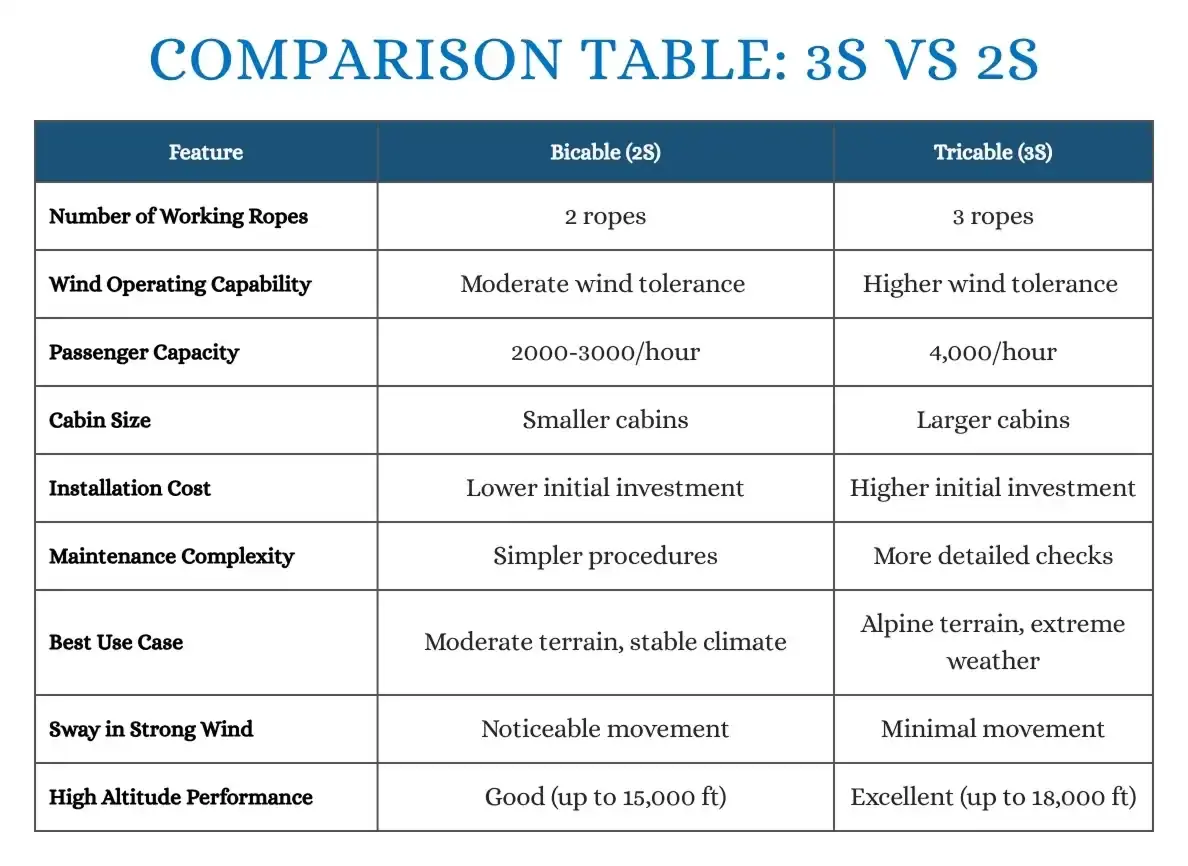
- A bicable ropeway (2S) uses two ropes but works differently. One for the load & one for the support, which acts as backup. Think of it as a main worker with an assistant standing by.
- A tricable gondola (3S) uses three ropes as a team. Two carry the load while one provides safety guidance. This setup means more support, stability, and confidence in severe weather. The “S” means “Seilbahn” in German, the technical term for rope systems.
- Bicable systems work wonderfully in moderate climates and stable terrain. However, Tricable systems break new ground. They handle extreme weather much better and move significantly more passengers per hour.
Under India’s Parvatmala Pariyojana, the Union Budget of 2022-23, the government promotes a sustainable ropeway transportation system. This National Ropeways Development Programme recognizes that roads are not the best solution for fragile mountain regions. Both systems have their place in this new vision.
Why The Tricable Gondola Lift Excels In Wind-Exposed Terrain
When we discuss tricable detachable gondola 3S technology and its wind resistance, we’re talking about real physics. The extra rope handles stronger winds without swaying or stopping. This matters greatly in exposed terrain where gusts exceed 100 kilometers per hour.
Alpine areas experience unpredictable weather shifts. At any time, snow, ice, and wind can hit suddenly. So, a particular safety measure is needed to take in these regions. Tricable 3S gondolas are an aerial cabin transportation system that is an advanced system that can carry up to 3,000 to 4,500 passengers in a single hour. In comparison, Bicable 2S gondola systems can carry between 1,500 & 2,500 per hour. For busy ski resorts or pilgrimage sites, this difference is enormous.
The Sonprayag-Kedarnath Ropeway Project shows why 3S wins. This 12.9 km tricable system (3S) will use more advanced 3S tech for the largest pilgrimage project. The advanced setup is capable of moving about 1,800 passengers per hour in just one direction. It also helps to bring the journey down from 8-9 hours to roughly 36 minutes. Altogether, pilgrims will be able to travel more easily, because Kedarnath sees around 20 lakh pilgrims every single year. This demonstrates why 3S systems are preferred for India’s most challenging routes.
Bicable Systems: Proven But Limited
Bicable ropeways are excellent systems. They’ve carried millions of passengers safely worldwide. However, they have real constraints. Bicable systems work best in spans under 2.5 kilometers. Beyond that, cables sag noticeably, requiring additional towers.
Bicable systems sway more in extreme wind conditions. In calm mountain zones, this is fine. But in exposed ridges or plateaus, passengers notice movement and feel discomfort. The cost difference matters, especially when comparing ropeway installation costs across system types. Bicable systems cost less initially. They need fewer mechanical parts and simpler engineering. For budget-conscious projects in stable climates, 2S seems attractive. But think long-term. Bicable systems shut down when winds exceed 90 kilometers per hour. In the Indian mountains during the monsoon season and winter storms, this is a serious limitation. The system stops, disappointing tourists and disrupting schedules.
The Kedarnath Success Story
The Kedarnath 3S tricable gondola lift shows modern engineering solving real challenges. Kedarnath has an elevation of 3,600 meters in the Himalayas. The current trek takes approx. 8-9 hours through steep, dangerous terrain. The new 3S ropeway changes everything. It operates safely during heavy snow and extreme wind. The three-rope design reduces dangerous sway. It maintains smooth rides even in gusts that would shut down 2S systems. This real-world success shows why 3S systems suit windy mountains. They handle altitude and exposure beautifully. They reduce reliance on weather windows. Thus, it proves that investing in better technology pays long-term dividends.
Wind Resistance And Passenger Capacity Explained
Wind resistance depends on rope arrangement. With two ropes, cabin grip depends solely on those cables. Any imbalance creates swaying & discomfort.
With three ropes, the system has built-in redundancy and stability. If wind pushes from one side, the third rope provides a counterbalance. The cabin stays steady and level. Based on 2026 testing data, monocable detachable gondolas work safely up to 60-70 km/h. Bicable systems handle 90 km/h before shutdown. Tricable systems work properly even when winds exceed 100 km/h. Passenger capacity ties to rope strength and detachable grip technology. Tricable systems allow larger cabins. Bigger cabins mean more people per trip. Higher overall throughput results.
The Varanasi Urban Ropeway is opening around August 2026. This shows how an aerial ropeway system can transform urban transportation. This is India’s first public monocable urban ropeway & can carry 96,000 passengers daily. Moreover, its maximum capacity is 3,000 passengers per hour. This is how it changes what’s possible for congested cities like Shimla and Manali.
Environmental Policy And India’s Shift
India’s infrastructure planning has shifted fundamentally. Under Parvatmala Pariyojana, the government reported more than 250 aerial ropeway projects spanning about 1,200 kilometers, and the total investment is said to touch ₹1.25 lakh crore, mainly through a public-private partnership arrangement.
This isn’t just about convenience. It’s about environmental survival. Mountain highway construction emits 1,500-2,000 tonnes of CO₂ per kilometer. When it comes to electric ropeway installation, it’s reported to release only around 250-500 tonnes per kilometer, which is a lot less than usual options.
Also, research indicates that if you swap 30% of road traffic with ropeways, transportation emissions can fall by as much as 85% in mountain regions, and well, that’s pretty significant. Highways need 3-5 hectares. Parvatmala mandates that all projects prioritize environmental sustainability. Both 2S and 3S align with this. However, 3S systems prove more valuable long-term. Superior reliability means fewer weather shutdown days. Consistent usage ensures Ropeway’s sustainable solutions deliver real environmental investment returns
Choosing Your System Rightfully
Before ropeway installation, ask honest questions about your terrain. How exposed is your mountain? What winter weather occurs? How many people need transport? What maintenance capacity exists?
For sheltered valleys with moderate winds, bicable gondola lift systems work perfectly and save money upfront. For exposed ridges with winter snow and monsoon winds, tricable systems repay extra investment through increased reliability and daily ridership. Consider passenger flow projections. Peak season creates demand spikes. Systems moving more people during peaks prevent queues and keep customers happy. Long-term revenue benefits from higher capacity. The 3S vs. 2S cost difference becomes worthwhile in five-year income projections.
What’s Next?
Choosing between a tricable gondola lift and a bicable system requires balancing many factors thoughtfully. No universal “best” answer exists. There’s the best choice for your specific 2026 situation.
Bicable systems serve stable climates well and remain economical for lower-altitude projects. Tricable systems represent the future, especially in the Himalayan regions. They align with environmental commitments and infrastructure modernization goals. Data from 2025-2026 is clear. 3S high-capacity systems experience 40% fewer downtime days. They move 60% more passengers during comparable hours. They generate greater economic returns.
M & M Ropeways brings 35 years of ropeway installation expertise. We installed systems at 18,000 feet on Siachen Glacier. We understand OITAF compliance deeply. We hold ISO certification. We build trust between mountains and people. Your project deserves analysis grounded in 2026 data. Your budget deserves wise allocation. Your passengers deserve All-weather ropeway systems even in harsh mountain weather. That’s the M & M Ropeways commitment to every client. So collaborate with us today and build a ropeway solution designed for safety, efficiency, and long-term success. You can also view our products here.
FREQUENTLY ASKED QUESTIONS RELATED TO ROPEWAYS
How feasible is it to run tricable cable cars with multiple parallel cableways for mass transit?
It’s technically feasible and already proven. Tricable systems handle high capacity and long spans well, making parallel lines viable for busy urban corridors. The main constraints are station footprint and upfront cost, not the cable technology itself. Careful route planning keeps operations efficient.
Which system does M&M Ropeways recommend for high-altitude projects above 15,000 feet?
M & M Ropeways strongly recommends 3S tricable systems for altitudes over 15,000 feet. Based on our experience on the Siachen Glacier, at 18,000 feet, we found that 3S deals with extreme cold and those unpredictable winds a bit better than 2S. In general, tricable systems give superior stability and reliability in tough alpine settings where safety is still the first concern, not something optional.
What is the typical passenger capacity difference between 2S and 3S systems installed by M&M Ropeways?
M & M Ropeways’ 3S set-ups move 3,000-4,000 passengers per hour, while our 2S systems carry about 2000-3000 passengers per hour. That noticeable gap makes 3S a pretty good fit for packed pilgrimage corridors like Kedarnath and Hemkund Sahib, too. But for those less crowded highland pockets, 2S systems provide cost-effective solutions.
How does M&M Ropeways approach wind resistance in system selection for the Indian mountains?
M & M Ropeways evaluates local wind patterns before recommending systems. M & M Ropeways 2S installations are rated for winds up to 90 km/h, while 3S systems safely operate beyond 100 km/h. We recommend 3S technology for monsoon-prone regions and exposed Himalayan ridges to maximize operational reliability.
What maintenance schedule does M&M Ropeways follow for 2S versus 3S systems?
M & M Ropeways schedules maintenance every 500 operating hours for both systems. However, 3S systems require additional rope-tension checks due to the use of three cables. Our ISO certified maintenance protocols ensure optimal safety and performance. Regular inspections prevent costly emergency repairs in both system types.