
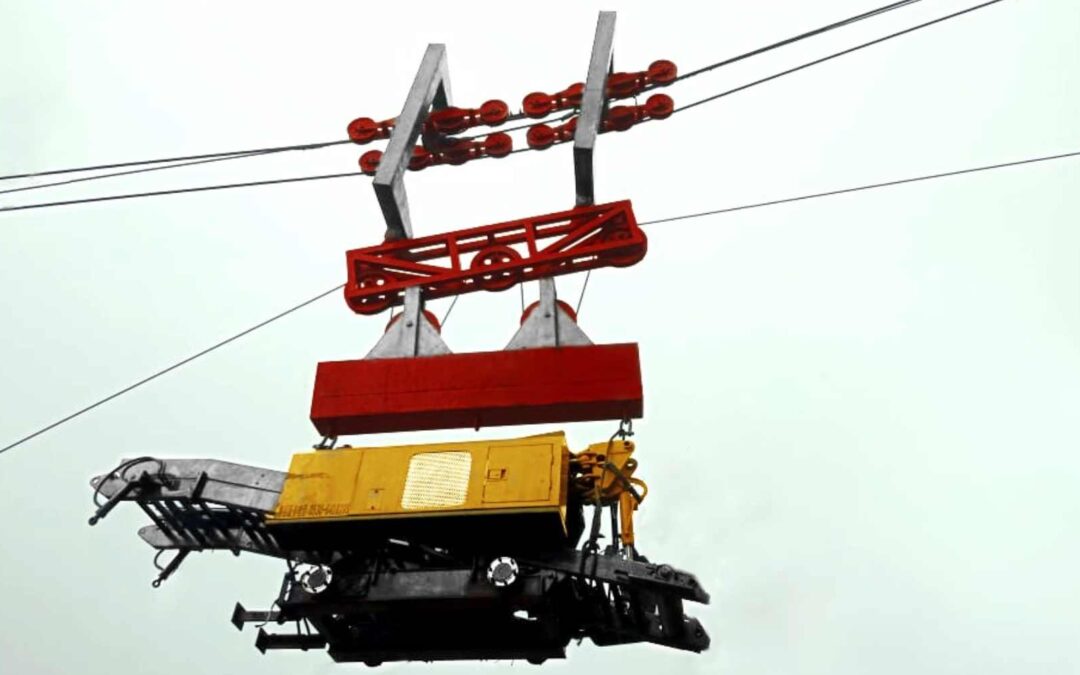
The first construction step of any project begins with road construction. The construction process faces challenges when the existing terrain does not support development. The deep Himalayan gorges and hydroelectric dam sites with their steep cliffs create a complete barrier that prevents conventional trucks and excavators from accessing these areas.
Conventional logistics systems reach their limits at this point, and innovative solutions begin to emerge. Therefore, Aerial Ropeways in Construction have become essential infrastructure elements for industrial operations that occur in extremely challenging environments on the entire planet.
Read on to see how the technology works, where it’s solving on-ground problems, and what you should look for if you’re considering one for your site.
Why Difficult Terrains Need Smarter Logistics: An Introduction
Not all construction sites are created equal. Some involve slopes so steep that vehicles cannot climb them. Others sit across river gorges where bridging costs more than the project itself. In India, these conditions define entire regions. Himachal Pradesh. Uttarakhand. Arunachal Pradesh. Sikkim. The Western Ghats. These are zones where infrastructure projects are desperately needed but brutally hard to execute.
Building a road to a remote dam site in such terrain can cost approximately ₹15–25 crore per kilometer. This is highly expensive, plus the road takes months to build. It washes out every monsoon and requires constant maintenance. And even when it is ready, it limits the size and weight of the equipment you can move.
Now you get the answer to why material transport ropeway systems for remote construction have become the default solution for projects in these regions. Let’s move on to the next discussion on how the mechanism of aerial ropeways works.
How Aerial Ropeways and Cable Cranes Work on Tough Construction Sites
The principle goes as follows:
The system uses multiple anchor points to support steel cables, which extend across the valley and gorge and the slope that connects the two endpoints of the system. A trolley or carriage moves along these cables, carrying loads suspended beneath it.
The system works in two main configurations for construction use
- Cable cranes: A cable crane is essentially a heavy-lift system suspended in the air. They are used at dam sites to carry concrete buckets directly to the pouring block. They position penstock sections. They lower the turbine assemblies into place. A cable crane can handle payloads from 10 to 50 tons with pinpoint accuracy.
- Material handling ropeway systems move materials continuously from point to point. Cable cranes place them exactly where the work is happening. Both are forms of aerial ropeways in construction, but their roles are distinct. Material handling ropeways are built for continuous, high-volume transport. The system transports cement, aggregates, steel bars, sand, fuel drums, and construction equipment between the base camp and the work site.
Both systems are engineered to match the terrain, the load type, and the project schedule. M&M Ropeways cable cranes for dam construction have been doing exactly this for 35 years.
Once you understand the behind-the-scenes mechanisms and engineering, you want to take an idea of its application, so let’s focus on the application of the most used material handling ropeway systems.
Where Are Material Handling Ropeways Used in Construction?
Hydropower and Dam Projects
Hydropower sites are almost always remote. They sit in river valleys surrounded by steep terrain. Cable crane manufacturers India solve the core challenge here: moving concrete from the batching plant to the dam face, continuously and at scale. Every cubic meter of concrete placed in the dam body passes through the crane system. There are no intermediate transfers, no waiting for trucks, and no weather delays holding up the pour.
Tunneling Projects
Tunnel construction requires simultaneous material flow in both directions. Supplies go in. Muck and excavated rock come out. A well-designed ropeway system handles both, keeping the tunnel face continuously supplied and the spoil removal on schedule.
Pipeline Construction in Mountains
Pipelines require special construction methods for their installation through mountain regions. The pipeline route follows the contour of the land. Workers and materials need to reach specific GPS coordinates on a hillside where no vehicle can go. Material transport ropeway systems deliver welding equipment, pipe sections, fuel, and worker supplies directly to each work zone along the route. Pipeline projects in Alaska, the Andes, and India’s Northeast have all relied on this method.
Bridge and Viaduct Projects
Constructing a bridge over a gorge requires workers to operate at heights that become inaccessible when scaffolding cannot be built from the ground, and its installation costs become unmanageable. The project uses ropeways to deliver steel beams, concrete segments, and reinforcement cages to the construction deck.
5 Reasons Construction Teams Prefer Aerial Ropeways in Construction Over Roads
When project managers compare logistics options for difficult terrain sites, the decision often comes down to a simple question: build a road or install a ropeway? The answer is given with the following reasons.
- Cost Efficiency: Material handling ropeway systems require only anchor foundations and cable infrastructure. Operating costs are lower, too.
- Speed of Installation: Material handling ropeways for remote construction sites can be installed and commissioned in weeks.
- Safety: The use of ropeways provides workers at ground level with protection against floods and landslides, rockfalls, and accidents involving heavy vehicles that occur on narrow mountain roads. The risk profile of the entire project improves.
- All-Weather Operation: Mountain roads wash out in the monsoon season. Snow blocks them in winter. Material transport ropeway remote construction systems run through all of it.
- Minimal Environmental Footprint: A ropeway does not require land clearing, deforestation, or hillside blasting. The ecological disturbance is limited to tower foundation points.
Why M&M Ropeways is the Preferred Ropeway Manufacturer India for Infrastructure Projects
Choosing the right engineering partner is just as critical as the technology itself. As a leading ropeway manufacturer India for infrastructure projects, we combine local terrain knowledge with global engineering standards.
Here is what defines our technical edge:
- Comprehensive Safety Protocols: Our safety standards include multiple diesel engine backup systems and dedicated rescue trolleys, which maintain safety during both power outages and emergency situations.
- End-to-End Execution: Our company provides complete project management, which starts with topographical mapping and feasibility studies and continues until we deliver staff training and after-sales support.
- The “Make in India” Advantage: All system components undergo complete design and production, and assembly processes, which take place exclusively in India. This ensures full compliance with ISO 9001:2015 and ISO 14001:2015 standards..
The Final Verdict
The success of a construction project in difficult terrain is rarely decided by the quality of the concrete alone. As we have discussed, Aerial Ropeways in Construction are not merely an alternative to roads. They are a strategic necessity that protects your budget, your timeline, and the local environment.
M&M Ropeways believes that no terrain should be a barrier to progress. Our mission is to provide the “highway in the sky” that turns impossible locations into landmark structures.
If you are ready to solve your most complex terrain challenges, M&M Ropeways is here to help. We offer end-to-end solutions ranging from feasibility studies and topographic mapping to the commissioning of high-capacity cable systems. We invite you to contact our experts at +91-9915666677 or email us at info@mmropeways.com to schedule a technical consultation.