
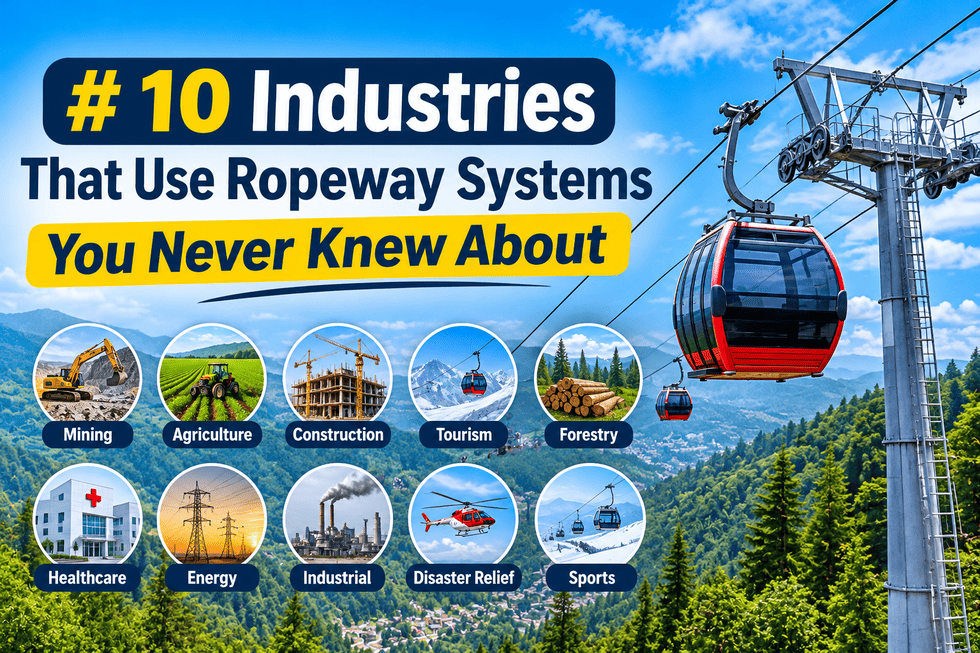
Most people think of ski lifts and tourist transport on hill stations when they HEAR of the term ROPEWAY. A better picture would be of mining pits, dams, 18,000-foot military posts, and even some inner-city transport where ropeway systems’ cars carry passengers over hundreds of meters.
Looking through the internet, one will find threads of posts on Reddit and even market analyses on ropeway infrastructure as an under appreciated topic of discussion in infrastructure these days.
Material ropeways go places that road networks and trucks can’t. A single ropeway can replace thousands of yards of switchback roads, and a lot of helicopter flights.
Here are 10 industries that depend on them, verified.
Are Ropeways Used in Mining?
Mining’s probably the biggest user of material ropeways for mining, and for a fairly blunt reason: a lot of coal, iron ore, limestone and bauxite sits in places where building a haul road would cost more than the ore is worth. So instead of a road, you string a cable from the pit to the plant and let gravity and a motor do what trucks would’ve done, minus the diesel and the washed-out mountain tracks every monsoon.
Svalbard-style Arctic mines lean on this hard, mostly because winter roads up there just stop working for months at a stretch. A line running overhead does not care about that.
For mining in India specifically, the setup usually runs through cable cranes tied to conveyor systems, which we’ve gone into more in our cable crane guide for Indian mining sites.
Do Ropeways Carry Agricultural Produce and Tea?
They do. All in places like Himachal Pradesh and parts of Nepal, they’ve been doing it for decades. Tea leaves bruise if you handle them roughly. Fruit bruises even faster. Walk a basket of either down a mountain trail for two hours and half of it is not sellable by the time you reach the road. A material handling ropeway solves this the obvious way – it carries the load down in minutes instead of hours, without anyone dropping a basket on a slope.
This is actually one of the sectors M&M Ropeways has built for directly, moving agricultural produce down from hill-top villages and through tea estate terrain where no vehicle access exists. It’s not a side use case. It’s part of the original reason these systems got built in the first place.
The Historic Sugar Plantation Ropeways
Here’s something most people genuinely don’t know. Long before mining or hydropower took over as the big industrial users, aerial ropeways were hauling sugar cane across plantations in Demerara, Jamaica, Mauritius, and Martinique. Carts handled part of the route. The ropeway handled the rest. It wasn’t high-tech by today’s standards, but it worked well enough that estates kept using it for generations.
Are Ropeways Used for Military Logistics?
At 18,000 feet on the Siachen Glacier, the temperature drops below -35°C and no road exists, built or otherwise. Helicopters can’t always fly in that kind of cold and wind. Supplies still have to reach the troops stationed there, and this is where a ropeway becomes less of a convenience and more of a lifeline.
M&M Ropeways designed and installed systems for the Indian Army at exactly this site, under conditions most equipment isn’t rated to survive. A ropeway running on a fixed line doesn’t care about visibility or wind gusts the way a helicopter does. It moves ammunition, rations, and medical supplies on a schedule that weather can’t cancel.
This isn’t a one-off case either. Mountain borders around the world face the same problem, and military forces in similarly extreme terrain use low-profile supply ropeways for the same reason: when the ground and the sky both fail you, a cable still works. More on this in how ropeways support military logistics in mountainous areas.
What Role Do Ropeways Play in Hydropower and Dam Construction?
Hydropower sites are almost never built somewhere convenient. The best locations sit deep in river canyons, exactly where trucks and cranes have no way in. Penstocks, reinforcement steel, cement, turbine parts, all of it has to get down into terrain that was chosen for its drop in elevation, not its accessibility.
This is where ropeways and cable cranes do the job a road never could. A cable crane strung across the canyon can lift material straight down to the construction face without a single meter of access road being built first. That matters because a road through that kind of terrain doesn’t just cost money. It often destabilizes the slope it’s cut into, which is the last thing you want above a dam site.
M&M Ropeways has worked on exactly this kind of project, moving construction material for hydropower and penstock installations across difficult Himalayan terrain. You can read more in the role of ropeway systems in hydropower material transport and cable cranes for dam construction.
Are Ropeways Used in Cement and Limestone Manufacturing?
Cement production facilities are almost always sited away from limestone sources. As a result, the source of a cement plant’s life is typically many kilometers from the plant. Without haulage roads and heavy equipment for transportation, building and operating a cement facility is unviable.
A ropeway for cement plants skips all of that. Limestone moves continuously, bucket after bucket, no truck rutting the ground, no driver queued up to dump a load. Plants that switch over tend to do it for the same reason every time, trucking cost scales with every tonne moved, while a ropeway’s cost per tonne drops the longer it runs.
More on how this plays out in ropeways for cement plants: applications and benefits.
Do Ropeways Support Forestry and Logging?
Dragging a felled tree through a forest does real damage. It tears up topsoil, flattens undergrowth, and leaves erosion channels that take years to heal. Loggers figured this out a long time ago, which is why skyline cable logging exists.
The idea is simple. A cable system lifts the felled log completely off the ground and carries it to a collection point, so nothing drags, nothing digs a trench, and the forest floor underneath stays mostly intact. On steep slopes, this isn’t a nice-to-have. It’s often the only way to get timber out without carving a road straight through terrain that should stay forested.
This same cable-based approach shows up in M&M Ropeways’ forestry cableway work, built for exactly this kind of steep, road-less terrain. More detail is in logging ropeways and forestry cableways.
Can Cities Use Ropeways as Public Transport?
In Medellín, La Paz, and Mexico City, cable cars aren’t a tourist attraction. They’re part of the subway system. Commuters use them every day to get from hillside neighborhoods, the kind no metro line could ever reach, down to the city center. Ankara runs something similar. None of it is marketed as scenic. It’s just how people get to work.
The reason this works is almost embarrassingly simple. A metro line through a steep, dense hillside needs tunnels, which cost a fortune and take years to dig. A cable line needs towers and a straight path through the air. Medellín picked the cable option for its poorest hillside districts, called comunas, and cut what used to be a two-hour commute down to under thirty minutes.
This use case has nothing to do with mining or construction. It’s pure public transit, solving a problem that roads and rail both struggle with on a steep slope: getting people up and down quickly, without flattening a mountainside to do it.
Are Ropeways Used for Waste Management?
Most people don’t think about the issues that hillside cities have related to garbage collection. A standard garbage truck can not get down streets that are too narrow and too steep. Some neighborhoods, in places like Medellín or La Paz, have limited to no road access at all.
A handful of these cities have solved it by attaching cargo cabins to existing cable transit lines. The same overhead system that carries commuters to work also hauls municipal waste down to collection points, on a schedule, without adding a single truck to already congested streets. It’s an unglamorous use of the technology, but it’s a genuinely practical one.
This one sits outside M&M Ropeways’ current project history, worth knowing simply because it shows how far the core idea, moving weight over terrain without a road, can stretch once a city already has the cable infrastructure in place.
What Role Do Ropeways Play in Construction and Infrastructure?
Dams and bridges share a problem that has nothing to do with the structure itself, getting heavy material across a gap before there’s anything to walk across. A crane can’t always reach mid-canyon. A truck definitely can’t.
Heavy-duty cableways, sometimes called blondins, handle this. They work like a giant aerial crane strung between two fixed points, hauling concrete, steel, machinery straight across instead of around. Large dam projects have leaned on this setup for decades, often because it’s the only way to reach a work face sitting below a cliff or across a roadless valley.
It’s a narrower use case than mining or agriculture, but on the right project, there’s no substitute for it.
Can a Ropeway Work Without Electricity? The Claughton Example
In Lancaster, England, there’s an aerial ropeway that has never needed a power connection to run. It carries roughly 300 tonnes of raw shale a day from a hillside quarry down to a brickworks mill, and it does this purely on gravity. The loaded cars going down pull the empty ones back up. No motor, no fuel, no electricity bill, just weight and a well-tensioned cable doing the work it was built to do.
It sounds almost too simple to still be running, but that’s exactly the point. A gravity ropeway uses the same basic principle M&M Ropeways builds into its own gravity-based systems: two trolleys on a shared cable, where the descending loaded car does the work of pulling the empty one back up. No external power source, no ongoing fuel cost, just physics doing what it’s always done. You can read more about how this works in gravity ropeways.
The One Thing All 10 Have in Common
Mining, tea estates, army outposts, dam sites, cement plants, forests, cities, landfills, bridges, a shale quarry in England, none of these industries have much in common on the surface. What connects them is the problem they’re all solving: terrain that roads and trucks can’t handle cheaply or safely. A ropeway doesn’t care whether the obstacle is a canyon, a hillside slum, or a glacier at 18,000 feet. It just needs two fixed points and a cable between them.
That’s the part most people miss when they picture a ropeway as a ski lift. The same engineering that carries tourists up a hill station is, with the right design, moving ore, timber, troops, and concrete through some of the most difficult terrain on earth.
If your project involves exactly this kind of terrain, M&M Ropeways has built across almost every sector on this list, from the Siachen Glacier to hill-top tea estates. You can see the full range of what we build on our products page.