
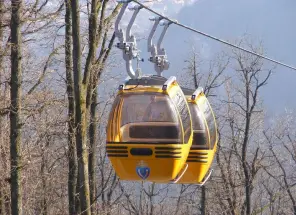
Now look at Vaishno Devi. Every year, almost 90 lakh people visit here. That is a very large crowd number. The existing ropeway there already moves 800 passengers an hour, between Bhawan and the Bhairon temple. And it has been doing this for years. Numbers like these tell you something important. Pilgrimage ropeways are not just bigger or smaller versions of a regular cable car system. You cannot just scale one up or down and call it done. They are their own category altogether. That is exactly why manufacturers like M&M Ropeways treat religious site projects differently. They do not use the same playbook they would for any other job. These sites need their own approach, built from the ground up.
Why Pilgrimage Sites Need Purpose-Built Ropeways
In India, most of the religious places are at hilltops. Or deep inside mountain valleys. For centuries, devotees reached them the hard way. On foot. By pony. By palanquin.
These routes work, sure. But think about who gets left out. Older pilgrims struggle. People with disabilities cannot make the climb at all. Anyone travelling with young children faces real risk. And during peak season, things get dangerous. Large crowds moving along narrow mountain paths can become dangerous for everyone out there. This increases the risk of big accidents.
A well-planned ropeway system solves both problems at once. Every pilgrim gets a safe way up, no matter their age or physical condition. And there is another benefit too. Less foot traffic means less damage to fragile mountain trails. That helps protect the ecology around temples and gurdwaras.
This is exactly why the central government’s Parvatmala Pariyojana has made pilgrimage sites a priority. Kedarnath. Vaishno Devi. Hemkund Sahib. Sabarimala. These come before ordinary tourist destinations, and for good reason.
Core Design Considerations for a Pilgrimage Ropeway
Designing a cable car temple access crowd management system for a temple or shrine involves far more than picking towers and cabins. Every decision has to account for the specific pressures of religious tourism.
Terrain and Altitude
Some ropeways to religious places in India climb to serious altitudes. The Kedarnath ropeway reaches around 11,500 feet. That’s high. But Hemkund Sahib goes even higher. Its ropeway climbs to a gurdwara sitting near 15,000 feet. This is higher than most people ever travel.
These extreme heights make construction in these areas so much more difficult. The air gets thin. Temperatures can drop suddenly, without warning. And the terrain keeps changing too. River valleys give way to rock faces, sometimes within just a few kilometres.
Then there is tower placement. This is not simple. Engineers have to balance structural stability against something else entirely, disrupting the natural landscape as little as possible. Get it wrong, and you either compromise safety or damage the very mountains these shrines sit on.
Weather Resistance
Another thing is that holy places are usually open only for a few months in the Himalayan region. Let’s look at Kedarnath for that matter of fact. It is open from Akshay Tritiya to Diwali. This is just for 6 to 7 months. Snow, monsoon rain, and strong winds can shut down less reliable ropeway systems for days. This is why most large pilgrimage ropeways in India now use Tri-cable Detachable Gondola technology, known as 3S. The three-cable design gives far more stability in strong wind than a standard monocable system, which matters enormously on an exposed mountain ridge.
Capacity Planning
Pilgrimage sites see extreme swings in footfall. On a normal weekday, a shrine might get a few thousand visitors. Then a major festival comes along. That number can jump tenfold, almost overnight.
So, how do engineers plan for such scenarios? They calculate how many people the ropeway can carry every hour. This is called passengers per hour per direction (PPHPD) in engineers’ math.
Getting this number right matters. A lot. It is one of the most important parts of ropeway engineering for a religious site. Why? Because if you underbuild capacity, you have not actually solved the crowding problem. You have just moved it. From the trekking path straight to the ropeway queue.
Station Placement Near Temples
Station location is not just about terrain. Tradition matters just as much. Experts who plan this have to work closely with temple trusts, shrine boards, and local communities. The goal is simple to state but hard to achieve. Place the stations where they cause the least disruption. To existing pilgrim routes. To shops. To residential areas.
Take the Vaishno Devi Katra ropeway project. It ran into strong local opposition, and for good reason. The new alignment bypasses towns that have depended on foot traffic from trekking pilgrims for generations. Those businesses did not build themselves around a ropeway. They built themselves around people walking through, on foot, over years.
So good project execution means something more than engineering efficiency. It means balancing that efficiency against real livelihoods. Livelihoods built around the traditional route, over decades, by real families.
Accessibility for Elderly and Disabled Devotees
Think about senior citizens. Think about disabled devotees. What do they actually need from a ropeway? Low step heights. Secure handrails. Enough dwell time at boarding platforms, so nobody feels rushed. Staff trained to help passengers who move slowly, with patience.
Cabins need to be wide enough for wheelchairs. Station approaches need ramps, not stairs, wherever possible. Small details, all of them. But they add up to something big.
This single design consideration, getting accessibility right, is often the difference between a devotee making the pilgrimage or not. For someone who could never have managed the trek on foot, this is what makes it physically possible. Not a nice-to-have. The whole reason they get to go at all.
Crowd Management Strategies Using Ropeway Systems
A ropeway does not automatically solve crowd management. It has to be paired with the right operational systems.
Time Slot Booking and RFID
Here’s a smart move by the Vaishno Devi Shrine Board. They issue RFID cards during yatra registration. And they require pilgrims to book a specific ropeway time slot in advance. Not just show up whenever.
Why does this matter? This single step prevents something dangerous. The kind of unplanned crowd surge that overwhelms a station, all at once. Tickets are valid for a very short time. This makes arrivals spread evenly across the day, instead of everyone rushing in at the same hour.
Queue Design at Stations
Station layout matters just as much as the ropeway itself. Maybe more, honestly. Covered waiting areas. Clear signage. Medical aid posts. Separate queues for elderly or differently abled pilgrims. All of this reduces pressure at the boarding point.
Here’s the thing, though. Stations built for high footfall pilgrimage sites need far more queuing space than a standard tourist ropeway. Much more. Why? Because wait times here can stretch for hours during peak season. A tourist gondola never has to plan for that. A pilgrimage ropeway design India always does.
Peak Season Load Balancing
Think about Navratri at Vaishno Devi. Or the Char Dham season at Kedarnath. These festival periods can multiply daily footfall several times over. Not by a little. By a lot.
So how do operators cope? They extend operating hours. They add staff. Sometimes they even run cabins closer together to raise effective capacity when it matters most.
Here is the real lesson, though. You cannot plan for this swing as an afterthought. You cannot treat it as some rare exception. It has to be built into the design from day one. That is what separates a resilient pilgrimage ropeway design India from one that buckles the moment festival demand hits.
Integration with Other Transport
No single mode of transport can carry an entire pilgrim base on its own. Not even close. That is why ropeways work best when they are not standing alone. They need to be planned alongside helicopter services. Alongside battery-operated vehicles. Alongside the traditional trekking path too, for those who still want to walk.
This gives pilgrims a genuine choice. Based on their budget. Based on how much time they have. Based on physical ability.
Look at Vaishno Devi for a clear example. Helicopters carry only five to six passengers per trip. Five or six people, that is it. Which shows you exactly why a higher-capacity ropeway remains essential. Someone has to move the bulk of daily pilgrim traffic. And it is not going to be a helicopter that does that.
Case Study: Kedarnath Ropeway
The Sonprayag to Kedarnath ropeway project details are not just another infrastructure project. It is one of the most ambitious pilgrimage infrastructure projects anywhere in the world. The Cabinet approved it in March 2025, under the Parvatmala Pariyojana. The route runs 12.9 km. It will use Tri-cable Detachable Gondola technology. And here is the number that matters most. It will cut a 16 km trek from nine hours down to just 36 minutes.
Now let’s talk cost. The project carries a capital cost of roughly ₹4,081 crore. It is being built under a Design, Build, Finance, Operate, and Transfer model. Adani Enterprises is managing this, with a concession period of 29 years.
Consider the scale of demand too. Kedarnath draws around 20 lakh pilgrims. And that’s during a short operating season only. The ropeway is designed to carry 1,800 passengers per hour, in each direction. Do the math, and that works out to about 18,000 pilgrims a day.
Step back and look at what this really shows. Pilgrimage ropeway design has come a long way. This scale of religious tourism infrastructure shows how far pilgrimage ropeway design India has advanced from earlier, smaller systems.
Case Study: Vaishno Devi Ropeway
Vaishno Devi already runs one of India’s most heavily used pilgrimage ropeways. The Bhawan to Bhairon temple line opened back in 2018. It covers about 1.5 km. Ride time: three to five minutes.
Before this, a steep trek stood in the way. Many devotees simply couldn’t visit the Bhairon shrine at all. Now they can. The ropeway carries up to 800 passengers per hour, using enclosed cabins that hold 40 to 45 people each.
But that’s not the only project here. A second, larger ropeway is under construction right now. This one runs between Katra town and Sanjichhat, closer to the base of the pilgrimage route. Public-private partnership. Estimated cost: ₹300 crore. Designed to carry 1,000 passengers per hour. Expected to go live by December 2026.
Think about what that actually changes. A six-to-seven-hour trek drops to under an hour. Just a six-minute ropeway ride, then a short walk to the shrine. And the numbers behind it are staggering. Annual footfall now regularly tops 90 lakh devotees. This gondola lift project is addressing one of the busiest pilgrimage routes anywhere in the country.
Case Study: Hemkund Sahib Ropeway
Along with the Kedarnath project, the Cabinet also approved a 12.4 km ropeway connecting Govindghat to Hemkund Sahib Ji in Uttarakhand. Cost: around ₹2,730 crore.
Hemkund Sahib sits at nearly 15,000 feet. That makes it one of the highest, holiest Sikh pilgrimage sites in India.
Every year, in a brief window from May to September, it draws 1.5 to 2 lakh pilgrims. Getting there means a punishing 21 km trek. No way around it. That same trek doubles as the gateway to the Valley of Flowers, a UNESCO World Heritage Site.
Here’s what changes now. The new ropeway brings all-weather connectivity this route has never had. Not once. Which means the shrine opens up to far more devotees than the trek alone could ever carry.
The Parvatmala Pariyojana and the Future of Pilgrimage Ropeways
Let’s zoom out for a second. The National Ropeways Development Programme, known as Parvatmala Pariyojana, was announced in the Union Budget for 2022-23. Who runs it? The National Highways Logistics Management Limited, under the Ministry of Road Transport and Highways.
And the scale here is massive. The government’s long-term plan involves roughly ₹1,250 billion in public-private partnership investment, through 2030. The target is over 1,200 km of new ropeway infrastructure, spread across 200 projects.
States are not waiting around either. They have already proposed 256 ropeway projects. Uttarakhand alone has 49. Jammu and Kashmir has 18. Himachal Pradesh has five.
And it goes well beyond Kedarnath, Vaishno Devi, and Hemkund Sahib. The scheme has identified several other pilgrimage sites too. Amarnath. Sabarimala. Chamunda Devi Temple. Kunjapuri Temple. Salkanpur Wali Mata Mandir. Mahakaleshwar Temple. Shankaracharya Temple in Srinagar. Kamakhya Temple in Guwahati. Tawang Monastery in Arunachal Pradesh.
So what does this pipeline really tell us? A ropeway for religious sites across India is now a core part of national infrastructure planning. Not a one-off project. Not something limited to a handful of famous shrines. This is happening at scale, across the country.
Choosing the Right Ropeway Technology for a Religious Site
Different pilgrimage sites need different technology depending on terrain, wind exposure, and expected passenger volume. M&M Ropeways works with clients to match the technology to the site rather than pushing a single standard solution across every project.
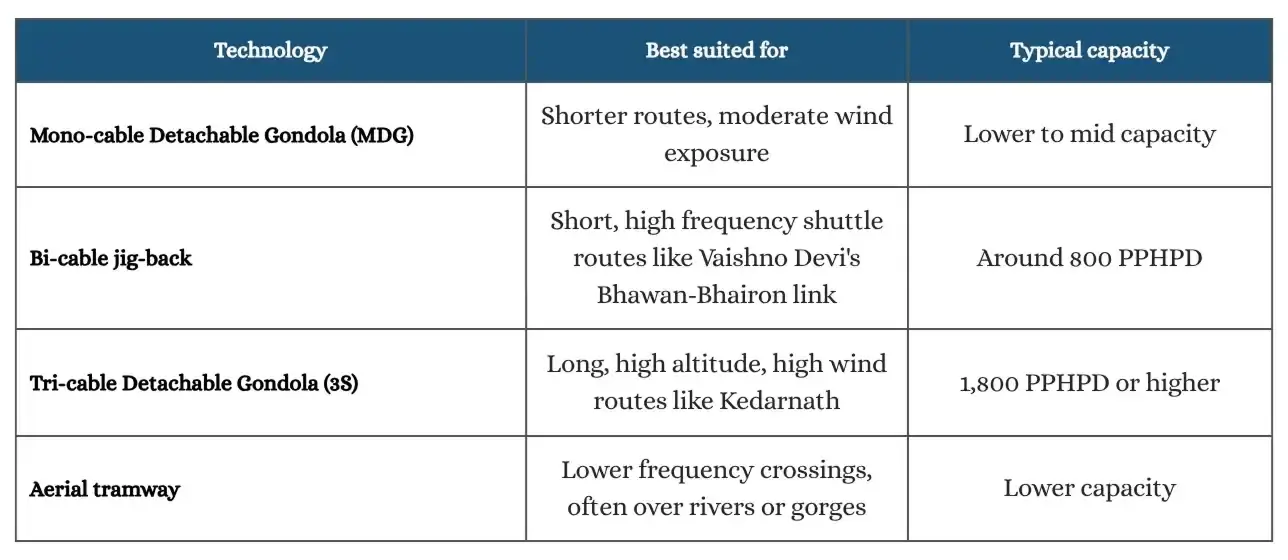 Selecting the correct system upfront avoids costly retrofits later. This is where an experienced manufacturing partner adds real value, since the wrong choice of technology can leave a project unable to meet festival season demand within just a few years of opening.
Checklist for Planning a Pilgrimage Ropeway Project
- Assess terrain, altitude, and wind exposure across the full route.
- Study historical and projected pilgrim footfall, including festival peaks.
- Set PPHPD capacity targets based on peak, not average, demand.
- Plan station locations in consultation with temple trusts and local communities.
- Build in accessibility features for elderly and disabled devotees from the start.
- Design queue and waiting areas sized for worst-case crowd scenarios.
- Coordinate with existing transport modes rather than replacing them outright.
- Plan for a multi-decade maintenance and operations model, not just construction.
M&M Ropeways works through each of these stages for clients developing pilgrimage and hill station infrastructure. With over 40 years of experience as a global ropeway manufacturer, M&M Ropeways brings design, manufacturing, installation, and commissioning under one roof, supported by international quality standards and proven projects across multiple countries. For developers and government bodies planning a ropeway for religious sites India needs in the coming decade, that end-to-end capability matters as much as the technology itself. M&M Ropeways also provides strong after-sales support, which is critical for systems that must run reliably through short, intense pilgrimage seasons year after year.
Frequently Asked Questions
What makes a pilgrimage ropeway different from a tourist ropeway?
Pilgrimage ropeways face tougher demands. Crowds swing up and down fast. Pilgrims are of all ages. Some struggle to walk. Many sites sit high up, with rough weather. Tourist ropeways just don’t see this mix.
How does the Kedarnath ropeway compare to the current trekking route?
Right now, the trek is 16 km. It takes eight to nine hours on foot. The new ropeway is just 12.9 km. It takes about 36 minutes. It uses gondola cable technology. It can carry 1,800 people an hour, each way.
What is the Parvatmala Pariyojana?
It’s a government ropeway plan. It started in the 2022-23 budget. The goal is big: over 1,200 km of new ropeways. That’s across 200 projects. All done by 2030. Hill stations and pilgrim sites come first.