
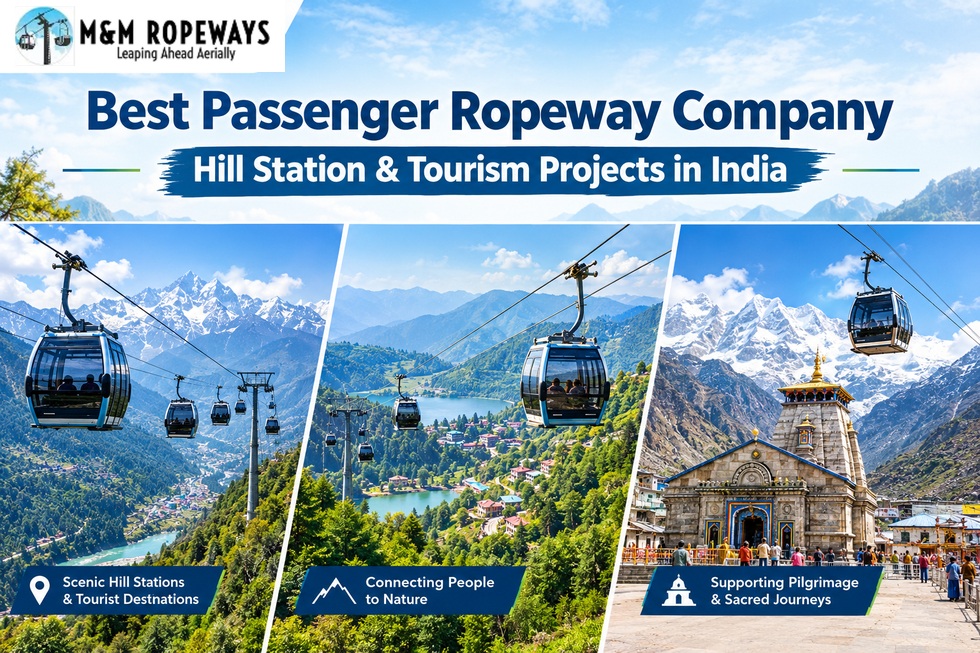
At Sonprayag, people going to Kedarnath had to walk about 16 km. The trip usually took 7 to 9 hours on foot. Many families found it hard, especially when elderly parents or small kids were with them. They often had to stop and head back before they could reach the shrine. What if that same journey took 36 minutes instead?
That question isn’t hypothetical anymore. The Sonprayag Kedarnath ropeway, sanctioned at ₹4,081.28 crore, will replace the exhausting climb with a short gondola ride, according to a PIB press release on the Parvatmala programme. This shift is happening across India’s hill stations and tourism circuits right now, and it’s why choosing the right passenger ropeway company has become one of the most important infrastructure decisions a state government or developer can make.
The Ropeway Boom: Why Every Hill Station Needs a Passenger Ropeway Company
In many hilly parts of India, the same problems repeat. Roads are often too narrow, and widening them is hard because slopes would be harmed. During the monsoon, landslides may cut off access & keep routes closed for days. After that, vehicles pile up, and the journey stops feeling easy. Ropeways can help since they move passengers above the road level. In this way, the trip does not rely only on the roads below.
Nitin Gadkari, the Union Minister, said that under Parvatmala, over 200 projects worth Rs 1.25 lakh crore have been identified for the next five years. In Uttarakhand, plans point to a network of around 50 ropeway projects. The route list includes Mussoorie, Nainital, Purnagiri, & Neelkanth. Kedarnath is also part of the plan.
What Makes a Strong Passenger Ropeway Company for These Projects
Not every ropeway contractor is built for hill station and tourism-scale work. Projects like Kedarnath and Hemkund Sahib operate at altitudes above 15,000 feet, in terrain where a road survey team can barely walk, let alone pour concrete. A capable passenger ropeway company needs three things in place before it can be trusted with a project of this size.
Engineering depth across cable systems
Tricable and bicable gondola systems behave differently under wind load, passenger volume, and terrain gradient. A contractor needs proven design experience in both, plus the ability to recommend the right system for a specific route rather than defaulting to whatever is easiest to build.
A track record in difficult terrain
Mining cable cranes, tunnel access ropeways, & construction material transport in mountainous zones all demand the same core skill. These are capable of moving heavy loads safely where roads cannot reach. A passenger ropeway company that has already solved these problems for industrial clients carries that expertise directly into tourism as well as passenger projects.
Commitment to safety & sustainability standards
Ropeways are being chosen over roads specifically because they are land-efficient and lower-impact. A contractor’s design philosophy needs to reflect that from the first survey, not just at the final safety certification stage. Safety must be built into the design, especially for pilgrimage and religious-site ropeways, where crowd surges push systems to their limits.
Real Projects Redefining India’s Tourism Infrastructure
Varanasi’s urban ropeway is the clearest proof of where this industry is headed, and one of the most closely watched new ropeway projects in India today. As of a September 2026 site inspection, the 3.85 km project connecting Cantt with Godaulia had reached 94.35 percent completion, expected to carry roughly 96,000 passengers a day and cut a 30-45 minute road journey to about 15 minutes (details on the route). It’s a strong case study in how urban ropeways reduce traffic congestion in Indian cities, and arguably the highest-profile of all ropeway construction projects in Varanasi to date.
Kedarnath and Hemkund Sahib apply the same model to pilgrimage tourism, both structured under a Design, Build, Finance, Operate, Transfer framework so private capital shares risk with the state, the kind of funding route covered under Parvatmala and NHLML schemes.
For projects like these, the deciding factor is rarely the concept. It’s whether the awarded passenger ropeway company can actually execute at altitude, on schedule, and within the safety margins these routes demand.
How to Choose the Right Passenger Ropeway Company
A few questions cut through most of the noise when evaluating vendors:
- Has the company handled aerial ropeway design for both passenger and cargo systems?
- Can it show completed aerial ropeway construction at altitude or in landslide-prone terrain?
- Does it have documented tricable or bicable experience, not just general cable transport claims?
- Can it manage the PPP or DBFOT structuring most government-backed ropeway transport projects now require?
This 12-point manufacturer checklist is worth working through before shortlisting anyone.
Cable Transport vs Roads in Hilly Terrain
Road construction in hill regions is expensive and often damaging, since it usually means cutting into slopes that were never meant to be disturbed. Ropeway transport avoids most of that; towers & stations need far less land. The system keeps running through weather that would close a mountain road for days. A closer look at the environmental impact of ropeways versus highways shows why the government has positioned ropeways as the safer, more sustainable choice for hilly connectivity.
Ready to Move Your Project Forward?
If your state, municipality, or private development needs an experienced partner for passenger ropeway planning, design, or construction, don’t wait for the next funding cycle. Reach out to M & M Ropeways to discuss route feasibility, terrain assessment, & DBFOT structuring before your competitors lock in the same engineering teams.
What to Know Before Planning a Ropeway
Q1. What does a ropeway company handle on a project?
Route feasibility, aerial ropeway design, tower and station engineering, cable system selection, construction, and safety certification.
Q2. Indian ropeway projects government-funded or private?
Most major projects use a Public-Private Partnership model, often DBFOT. So private companies fund & operate the system before it transfers back to the state.
Q3. How long does ropeway construction typically take?
The Varanasi urban ropeway, at 3.85 km, took roughly three & a half years from foundation to near completion. Higher altitude projects like Kedarnath may take longer.
Q4. Is ropeway transport safe for pilgrimage and tourism routes?
Yes. Modern systems use redundant braking and continuous safety inspection, with standards written directly into tenders for projects like Kedarnath and Hemkund Sahib.