
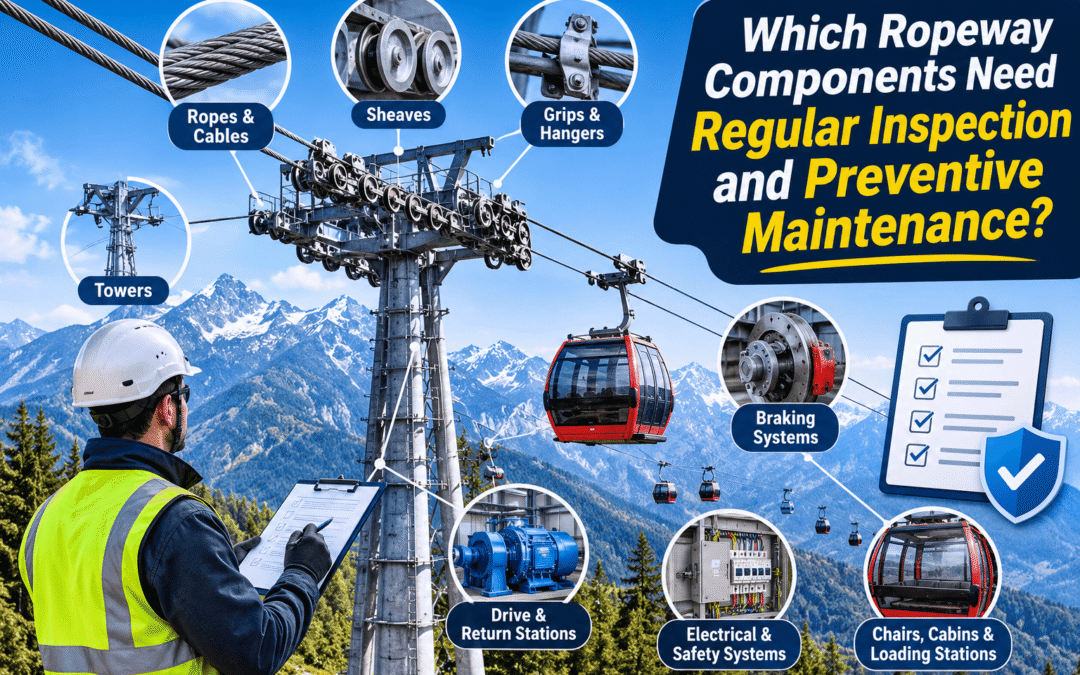
Ropeways take a beating every single day they run. Cables stretch and flex under load, grips clamp and release at every station, brakes engage over and over, and none of that stress ever really stops. A once-a-year check isn’t enough for a system working this hard.
Preventive maintenance on a ropeway ACTUALLY happens in layers. Daily visual checks during operating hours catch the obvious stuff. Monthly formal inspections go deeper. There are specialized inspection techniques, including Magnetic Rope Testing (MRT) and Magnetic Flux Leakage (MFL), that are able to detect damage that is invisible to the human eye by inspecting the interior of the wire rope.
Ignore or skip any of these layers and you are not just risking a scuffed cabin or a squeaky wheel. You’re risking the kind of failure that does not give a second warning. This guide walks through exactly which ropeway components need regular inspection, how often, and what to check at each one.
Why Does a Ropeway System Need Regular Inspection?
The answer is simple – everything on a ropeway is under tension, all the time. Ropes carry full load for hours on end. Towers hold that weight up against wind and temperature swings. Brakes have to work correctly on the very first try, every time, because there’s rarely a second chance mid-air. If you’re new to how these systems actually move people or material in the first place, our breakdown of how ropeway technology works is a good starting point before getting into maintenance specifics.
That’s why inspection is not a single task. It is a routine with different layers running at different speeds. Basic visual and working checks happen daily, before and during operating hours, catching anything that’s visibly off. Monthly checks go further, looking at wear patterns that build up slowly. And specialized testing, things like Magnetic Rope Testing and Magnetic Flux Leakage scans, happens on a longer cycle to catch internal damage that’s invisible from the outside, the kind that doesn’t show up until something breaks.
Just avoid that routine, or let it slide longer than it should, and nothing’s being saved. A failure is still coming, just on a day nobody chose.
How Often Should Wire Ropes Be Inspected?
Ropes are the single most stressed part of the entire system, so they get checked the most often. Haul ropes, track ropes, counter ropes – all of them carry full working tension nonstop, and all of them need daily visual checks at minimum.
A simple rag test catches more than people expect. Run a cloth along the moving cable and it snags on broken wires, burrs, or anything protruding that shouldn’t be there. Beyond that daily check, look for diameter changes too. If a rope has lost more than about 10% of its original diameter, or thinned past whatever limit the manufacturer or local regulation sets – it needs to come out of service.
Monthly and annual checks go deeper. This is where Magnetic Rope Testing and Magnetic Flux Leakage scans come in, since they can see internal wire breaks, corrosion, and strand distortion that a visual check simply can’t catch. One blind spot worth knowing about: poured end-sockets and splices are notoriously hard to inspect this way. Technicians often have to physically un-swage or separately inspect these sections, because they can hide damage the rest of the rope doesn’t.
Lubrication matters just as much as inspection. As a rope moves, its strands open and close slightly, and grit or foreign material gets pulled in. Left there, it accelerates internal wear. Regular cleaning followed by proper lubrication keeps corrosion out and keeps the rope’s actual working life closer to what it’s rated for.
What Maintenance Do Gondolas, Chairs, and Carrier Grips Need?
Every cabin, chair, and grip on a ropeway goes through the same brutal cycle hundreds of times a day. Clamp onto the rope. Hold through the full run. Release at the station. Repeat. That kind of repeated stress wears things out in ways a quick glance often misses.
The grips themselves need the most attention. On detachable systems, the clamping force has to be tested regularly with proper force gauges, because a grip that’s lost even a little holding strength can slip on the haul rope, and that’s not a small problem. Fixed-grip systems carry less of this particular risk since the carrier never releases the rope, though they come with their own limits on throughput and comfort, covered in our comparison of detachable vs fixed-grip ropeways. Visual checks alone aren’t enough here either. Spring fatigue and micro-fractures often show up on the inside before they’re visible on the outside, which is why technicians lean on methods like dye penetrant testing or magnetic particle testing, especially during the off-season when a system can be checked thoroughly without interrupting daily runs.
Beyond the grips, the cabin or chair body itself needs regular checks too. Hanger attachment points, pivot points, anywhere metal flexes under repeated load. Doors and locks matter just as much from a safety standpoint. A door that doesn’t latch properly isn’t a minor fix. It’s a direct risk to whoever’s riding inside. Choosing the right carrier setup in the first place also shapes how much maintenance it needs down the line, something worth factoring in early using our gondola lift system selection guide.
How Are Ropeway Tensioning Systems Maintained?
Tensioning keeps a rope from sagging on one end and snapping taut on the other. It has to hold steady through temperature swings, wind load, and shifting passenger or cargo weight, all without anyone standing there adjusting it by hand.
Counterweight-based systems rely on dead weight to keep tension correct, so regular inspection here is mostly about making sure nothing’s binding or shifted out of place. Hydraulic systems add another layer of complexity, since they depend on pressure lines and cylinders instead of plain weight. These need checks for oil leaks, pressure decay, and smooth, consistent movement along the tension carriage’s tracks. A tensioning system that’s even slightly off doesn’t fail loudly. The strain builds quietly on everything downstream, which is why this gets checked on a fixed schedule and not only when something already looks wrong.
What Checks Do Towers and Sheaves Require?
Towers are the backbone holding the entire line up, and sheaves are the wheels guiding the rope along that line. Both wear differently, so here’s what to check on each:
Towers:
- Cracks or corrosion on the steel structure
- Bolt tightness at every joint
- Foundation shift, even slight movement over time
- Overall structural integrity under sustained load
Sheaves:
- Free rotation, with no stiffness or drag
- Correct alignment with the rope’s path
- Groove depth on the rubber or polyurethane liner
- Bearing wear, since a worn bearing causes uneven lateral stress on the cable
Line clearance deserves a separate check of its own. It’s the safe distance between the moving rope and anything nearby, trees, buildings, power lines, the ground. It sounds like a formality until a branch grows into that clearance zone over a season or two, which is exactly the kind of thing a routine inspection is meant to catch before it becomes a problem. High-capacity systems carrying heavier loads, the kind compared in our breakdown of tricable vs bicable gondola systems, put even more sustained stress on towers and need inspection schedules to match.
How Are Drive, Braking, and Terminal Systems Maintained?
The drive system moves the rope, so it needs checking for the usual trouble signs. Heat where there shouldn’t be any. Oil leaks. Noise that wasn’t there before. Anything that feels off during a normal run.
Electrical and control systems also need to be included in regular checkups. This includes checking sensors, control communication lines, and safety circuits. If a sensor fails and stops sending a signal, it’s not immediately obvious that a problem exists. It’s not as noticeable as other failures that have more visible, obvious signs. Oftentimes, people will not realize a sensor has failed until some sort of downstream problem has occurred.
Braking gets more attention than most other parts, and for good reason. A ropeway usually runs on several independent layers of braking, built so one failure doesn’t become the only thing standing between safety and disaster. Service brakes, emergency brakes, and track brakes all need regular checks, and how cleanly they engage matters as much as whether they engage at all. A brake that creeps shut or drags slightly while the drive keeps pulling puts real strain on the haul rope, strain that often doesn’t show until much later.
Evacuation systems round this out. Backup diesel or auxiliary drives exist specifically for the moment main power fails, and they’re useless if nobody’s tested whether they actually start and run smoothly when needed. Regular test runs aren’t optional here. They are the only way to know the backup works before the day it has to.
Getting Maintenance Right From the Start
None of this works as a one-time effort. Ropeway maintenance only does its job when it’s treated as an ongoing routine. The installation phase is also important. Decisions made during setup affect how easy or difficult long-term maintenance turns out to be, which is covered in more depth in our guide on essential safety measures during ropeway installation.
Good ropeway equipment built to handle this kind of demand is not easy to source (especially in India), which is why choosing the right manufacturer upfront matters as much as the maintenance routine itself.
Our checklist for selecting a ropeway manufacturer walks through what to look for before signing on with anyone. M&M Ropeways manufactures ropeway systems designed for this kind of demand, and also supports operators after installation with overhauls, repairs, after-sales service, and re-installation when a system needs it. If you’re already running a ropeway and want to understand what a proper maintenance contract should cover, our guide on ropeway annual maintenance contracts walks through that or you can contact us.