
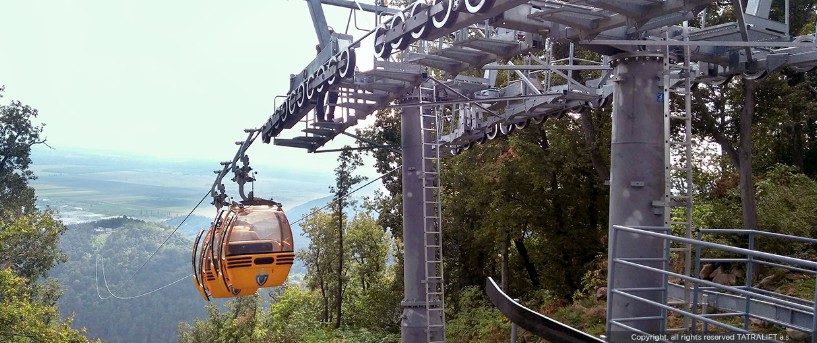
Building a road through a mountain range sounds pretty simple. Like cut, grade, pave, and all done. But what actually happens is different from that. The cut destabilizes the slope. The grade disrupts drainage. The paving holds for a season or two before erosion starts pulling it apart. All mountain regions around the world are stuck in this loop. Where roads get built, break down, and get rebuilt at a higher cost. And the terrain keeps paying for it. Sustainable ropeway transport is what breaks that loop, without excavation, slope disturbance, and monsoon resets.
What Road Expansion Is Doing to Mountain Terrain
Building roads in a mountainous region never sounds as simple as building roads on flat land. There, the terrain forces heavy excavation. Slopes get cut into. Drainage systems get disrupted. And the surrounding forest takes serious damage before a single vehicle has even used the road.
That damage is completely measurable. Research on mountain forest road construction found that bulldozers damage between 33% and 44% of surrounding trees on steep terrain. Even excavators, which are more precise, still damage 21% to 27% of trees in the same areas. The consequences go further. Disturbed slopes are unstable. Globally, deforestation and infrastructure construction triggered approximately 16% of fatal landslides.
Then construction ends, and a different kind of damage starts going on its route. Mountain roads are constantly eroded by rain and snowmelt. They wash out, crack, get repaired, and break again. Then the monsoon season comes again. The same thing happens to the mountain roads all over again.
The Carbon Cost That Often Gets Overlooked
Road construction itself carries a high carbon load. Heavy machinery, concrete, asphalt, and years of diesel vehicle use all add up. But the bigger problem is what roads enable after they are built.
The numbers tell that story quite clearly: When moving goods through rough mountainous terrain, a diesel truck releases about 120 to 150 grams of CO₂ per tonne-kilometer. In contrast, an electrically driven ropeway can complete the same route while producing only 5 to 20 grams of CO₂ per tonne-kilometer.
That is not a marginal difference. It is close to a complete elimination of transport emissions over the same route. New roads also push into terrain that was previously unreachable. Once that access exists, unplanned development follows. And in mountain regions, that kind of deforestation does not reverse itself.
How Aerial Ropeway Systems Actually Work
A ropeway moves people or cargo on cables suspended between tower points. It travels in a straight line, point to point, above the ground. It crosses gorges. It crosses rivers. It crosses ridges without touching any of them. The tower footprints are small. Land acquisition needs are minimal compared to what a road corridor demands. And because the route is a straight line, it covers difficult terrain in a fraction of the distance a winding road would need.
What makes aerial ropeway systems especially useful in mountain regions is how adaptable they are to different needs:
- Modern aerial ropeway systems come in different types depending on the need:
- Monocable detachable gondolas for passenger movement in hilly terrain
- Bicycle systems for heavier cargo loads and material transport
- Tricable detachable gondolas for high-altitude, high-capacity routes
Here is a real example of how this plays out. The Skyview Patnitop ropeway in Jammu was constructed in 2.4 years without cutting a single tree. It reduced travel time between Sanget Valley and Patnitop from 40 minutes to 10 to 12 minutes. The land stayed intact. The forest stayed intact.
Ropeway vs Road Infrastructure: Comparing What Actually Matters
The comparison between these two is not just about upfront cost. It is about the total impact over the years of operation.
| Parameter | Road Expansion | Ropeway System |
| Forest and Land Damage | High. Excavation, tree clearing, slope disruption. | Minimal. Small tower footprints, no land clearing. |
| CO₂ Emissions (operation) | 120-150 g
CO₂ per tonne-km via diesel vehicles. |
5-20g CO₂ per tonne-km via electric operation. |
| Monsoon Vulnerability | High. Erosion, washouts, and seasonal road closures. | Low. Cables are unaffected by surface water conditions. |
| Land Acquisition Cost | High. A large road corridor is required. | Low. Point-to-point, straight-line route only. |
| Landslide Risk | High. Slope disturbance and drainage disruption. | None. No surface excavation is involved. |
Yes, ropeways cost more to build per kilometre. No point hiding that. But mountain roads are not cheap either, not when you factor in land acquisition, repeated monsoon repairs, and embankment failures. The construction cost of a ropeway is the bulk of what you spend. With roads, the spending does not stop.
Benefits That Go Beyond the Environment
The environmental case for ropeways is strong. But the practical case is just as solid. And in mountain regions, the practical problems are often the ones that matter most to the people living there.
Reliability Through Every Season
Mountain roads have a bad habit of disappearing when you need them most. Heavy rain takes out the embankment. Snow blocks the pass. A landslide closes the only route for two weeks while repair crews figure out access. The road that cost crores to build sits unusable through the exact seasons that test it hardest.
Ropeways do not have a surface to wash away. The cable runs above all of it. No debris, no waterlogging, no slope failure below changes that. Communities stay connected. Goods keep moving.
Connectivity Where Roads Give Up
Some places in the Himalayas and northeastern India have been waiting for a road for decades. It is not coming. The terrain makes it physically impossible in some cases. In others, the cost per kilometre cannot be justified for the population it would serve.
Passenger ropeways close that gap. Material handling ropeways get supplies in when every road in the region is shut. For these communities, this is not about convenience. It is about not being cut off.
Tourism Access Without the Damage
Pilgrimage sites and mountain viewpoints draw visitors. Roads draw vehicles. Vehicles bring congestion, exhaust, noise, and eventually, demands to widen the roads that brought them there. That cycle quietly ruins the place it was meant to serve.
Ropeways carry the same visitors without starting that cycle. Sacred sites stay intact. Forest areas stay undisturbed. The tourism economy works without the terrain paying for it.
Local Employment That Lasts
Most large infrastructure projects bring outside workers in and take the economic activity back out when they leave.
Ropeway construction needs skilled people on the ground. Riggers, welders, civil crews, and technicians who work the site from start to finish. Once the system is running, stations need permanent staff. Maintenance and safety monitoring create ongoing roles. The hospitality and local transport that grow around a busy ropeway keep adding employment long after the build is done.
The benefit does not leave with the contractor. It stays.
India’s Parvatmala Push: Turning Policy into Infrastructure
The Parvatmala program is the clearest sign yet that India is taking ropeway infrastructure seriously and in a rather practical way. The numbers behind Parvatmala are not small. Over 200 projects. More than 1,200 km of ropeway. Rs 1.25 lakh crore has been committed. And 13 states and union territories already signed on, including Uttarakhand, Himachal Pradesh, Jammu and Kashmir, and Assam.
Two projects from early 2025 move this from policy language to actual groundwork.
- Govindghat to Hemkund Sahib Ji. 12.4 km. Rs 2,730 crore. A route that currently demands a 21-km uphill trek gets cut to a 28-minute ride.
- The Kedarnath route tells its own story. 12.9 km, Rs 4,081 crore, and a tri-cable gondola that handles 3,600 passengers per hour per direction.
Other countries got here earlier. Medellin connected its hillside communities to the city through ropeways. La Paz built an entire cable car network. Both solved a real access problem without touching their road networks.
The Final Verdict
Mountain regions have been absorbing the cost of road expansion for decades. Slope disturbance, tree loss, erosion cycles, monsoon damage, and emissions. Each one compounds the last. And once that damage sets in, the terrain does not recover on its own. At some point, the question stops being about building better roads. It becomes about whether a road is the right answer at all.
Ropeways are not a fix for every terrain problem. But where roads are expensive to build, hard to maintain, or physically not possible, ropeways are the option that actually holds up. The numbers support it. The ground-level results support it. That shift is already underway. Across India and in mountain regions elsewhere, projects are moving from planning to construction. The momentum is real.
If your site is in terrain where roads have failed or where they were never going to work, M&M Ropeways has experience building in exactly those conditions. Passenger systems, material handling, and high-altitude installations. Contact the team about what your project needs.