
In 2025, 5 national highways and about 1,350 roads remain blocked across Himachal Pradesh in a single monsoon season. At times, the monsoon gets so severe that it just washes away roads. Still, the usual answer never really changes. It is always like building more roads. But road infrastructure comes with a price. Cutting forests and turning slopes into routes can trigger landslides. Also, large investments in infrastructure often get damaged by extreme weather. Even if a road somehow survives, trucks moving on narrow mountain stretches end up burning more fuel, over 20% compared to flat highways. The chances of an accident increase. And then, every monsoon, it’s the same loop: damage, repairs, and then damage again.
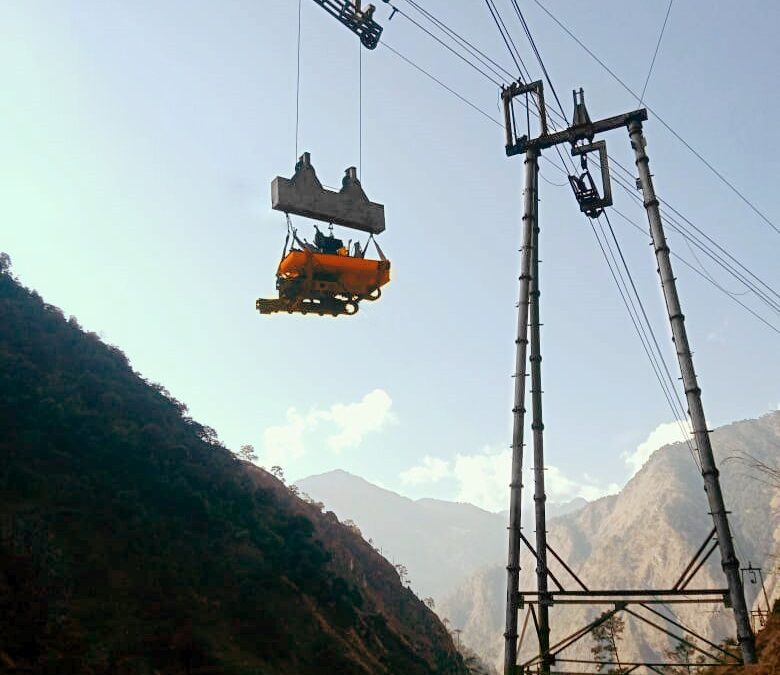
That is exactly why more organizations are turning to Ropeway Installation as a reliable, efficient, & sustainable transportation solution.
Ready to explore a ropeway for your project? Contact our team today for expert guidance.
Why Ropeways Are No Longer Optional: They Are Essential
Depending on road transport alone will not always help you. From natural calamities to emergencies or scarcity of fuel, ropeway installation will be the only solution to these problems. Stats say that approximately 22% of India’s land is hilly and mountainous terrain. These regions are mainly under mining zones, hydropower projects, pilgrimage pathways, and tourist hill stations. So many people commute in these areas regularly for their daily lives, for transportation, and for travel. But these paths are sloppy and dangerous. An aerial ropeway system, however, needs no roadways at all – it rises above the terrain entirely. “No land clearing or slope disturbance. No road maintenance budget can really cope with monsoon erosion year after year.
A ropeway can easily cross a valley in a few minutes, but trucks take more than an hour on tough roads. That’s how India now moves goods and people through its most challenging geography.
Ropeways vs. Road Transport: The Numbers Make the Case
Here is a direct, factual comparison between road-based transport and an aerial ropeway system in hilly terrain conditions:
| Factor | Road Transport | Aerial Ropeway System |
| Fuel Cost | Diesel dependency makes operating costs significantly high. | Electrically powered, with near-zero fuel cost in operation. |
| Terrain Impact on Cost | Fuel consumption rises considerably on hilly and rough roads. | Completely unaffected by the terrain gradient below. |
| Carbon Emissions | Road transport contributes substantially to India’s energy-related CO₂. | Zero operational carbon emissions. |
| Environmental Damage | Requires tree felling, slope cutting, and land acquisition. | No land clearing, the tower saves space. |
| Weather Dependency | Roads flood, slip, and shut down in the monsoon season. | Continues operation through rain, fog, and seasonal weather. |
| Travel Time in Hilly Terrain | Several times longer on steep and winding mountain routes. | Covers the same distance in a fraction of the time. |
| Road Maintenance Cost | Constant repair cycle (hilly routes degrade significantly faster). | No roads, zero maintenance. |
| Empty Return Problem | A large share of truck journeys run empty, adding dead costs. | No empty return, the cable system runs both ways continuously. |
| Seasonal Cost Surge | Shipping costs spike during the monsoon and peak seasons. | Fixed operational costs are completely unaffected by seasons. |
| Long-Term Value | Constant road repairs and vehicle maintenance costs. | Built for decades of use with minimal ongoing costs. |
Road transport causes 20–30% of India’s urban air pollution. Ropeways, running on electricity, produce none. The technology alone does not guarantee success, but the right ropeway project planning does.
Let’s go further to discuss the key factors that affect the ropeway installation project before you install your first ropeway project.
#1 Terrain and Topography: The Starting Point of Every Decision
In any ropeway installation project, the terrain plays the most important role. Before starting the project, every team should carefully assess the complexities of the location. Ignoring these factors can lead to high expenses later in the project.
First, look at where the land is and its condition. The size of the valley and the slope of the land are all major factors. Carefully measure the distance between two points. How many towers are needed to build the ropeway, and can the ropeway be safely built at that location? For example, a wide rocky valley may need a stronger bicable or tricable system with longer spans, while a simple monocable system can work well on smoother hill station routes.
Why is a Site Survey for Ropeway Non-Negotiable?
A professional site survey for ropeway projects is extremely crucial. It includes land surveys, soil testing, and environmental checks to support safe and smooth ropeway construction. This helps engineers make the right decisions during planning and installation. Ignoring this step can cause major ropeway construction problems later.
#2 Project Purpose and Capacity Requirements
A cable car system carrying 500 tourists daily and one moving 10 tons of mining material every hour are built on completely different engineering foundations. Getting the purpose and load capacity right from day one is not paperwork. It shapes every bolt, cable, and motor that follows. Underestimate it early, and you pay for it for years.
For a passenger ropeway, planners must calculate peak hourly passenger traffic, not just average daily numbers. A hill station that draws massive weekend crowds requires a system designed for peak load, not average load. For a material ropeway, payload weight, bucket size, and the physical nature of the material being transported all drive the mechanical specification in a fundamentally different direction.
#3 What Happens When the Weather Doesn’t Cooperate?
Weather is not just a minor factor in ropeway construction. Strong winds can damage a system if weather conditions are not considered during manufacturing. A proper ropeway system design avoids revenue loss during extremely poor weather. If not considered, it can lead to regular service interruptions, unhappy passengers, & revenue loss. Different ropeway systems handle wind differently.
For example, monocable gondola systems usually work safely only in wind speeds up to 60–70 km/h. Bicable systems can handle wind speeds up to 90 km/h. Tricable systems are the advanced ones designed for wind speeds exceeding 100 km/h. It makes the right choice for high-altitude crossings.
Collecting at least two to three years of local weather data before finalising the system specifications is a key part of professional ropeway project planning.
#4 How Much Time Are You Losing to Government Approvals?
In India, a ropeway installation that passes through forest land, near water bodies, or in ecologically sensitive zones requires clearances from multiple authorities, the Ministry of Environment, Forest and Climate Change, state forest departments, and, in some cases, tribal affairs ministries.
Urban cable car system projects need proper coordination with municipal departments, customs authorities, and traffic management agencies. Even a relatively straightforward tourism ropeway in a hill district needs state government approval under the Indian Tramways Act.
Starting the approval process with the site survey rather than after engineering is complete can save 6 to 1 year on the overall project schedule. Identifying all required clearances early is an essential part of any serious ropeway installation project timeline.
#5 Site Accessibility and Logistics Planning
One of the biggest engineering challenges is getting heavy machinery to a mountain site. Where road access is limited, heavy equipment must be transported in smaller sections to remote or high-altitude locations, and then it is reassembled on-site, which takes significant time and skilled labour. This process alone can account for 15–25% of the total ropeway installation cost. Where roads are not available, material ropeway systems are used to transport construction materials during the projects. This is one of the most important but often ignored parts of the ropeway project planning. Delays in getting access mean losing future revenue.
#6 Budget Planning Matters More Than Most People Expect
The actual ropeway installation cost is not only the cables and cabins. The final budget includes civil works, foundations of towers, shipping of goods, electrical systems, approvals, and long-term maintenance. These are all included in the final budget. Proper ropeway project planning is crucial to maintain the budget and avoid unexpected costs. This helps the system to remain efficient and financially sustainable over time.
Are You Working With a Partner Who Has “Actually” Done This Before?
M&M Ropeways is known for its strong track record and industry expertise, which speaks for itself even before a conversation starts. The company has over 120 completed projects and 35 years of hands-on experience. The team has delivered ropeway installations across some of India’s most demanding terrain regions. This includes their highest installation at 18,000 feet, with systems designed to operate in temperatures as low as -35°C. Every system is engineered by European design professionals and is fully certified under OITAF guidelines. We also hold ISO certification and meet global compliance standards.
Moreover, M&M Ropeways works on all types of projects, whether it is a government infrastructure project or a private industrial project. It brings advanced engineering methods, strong and durable systems, and also reliable warranties. This gives clients confidence not only during installation but also for many years of smooth operation.
Trusted by leading industries and government sectors, this is a partner that has genuinely done this before.
Make the Smart Choice. Secure the Future. Build It Right.
A successful ropeway installation project depends on careful planning at every stage. From terrain and capacity to weather, approvals, logistics, budget, technology, and the right project partner. All these factors are connected. A single decision only in a particular area can affect many others later in the project. So, examine the location first and make a proper strategy before starting construction.
M&M Ropeways applies decades of experience in different types of ropeway installation projects. Also, the team carefully plans every detail before the project begins, whether it is a tourism cable car in the mountains or a heavy-duty material ropeway for a construction site.
Reach out to M&M Ropeways today and talk over your project needs with our engineering team.