
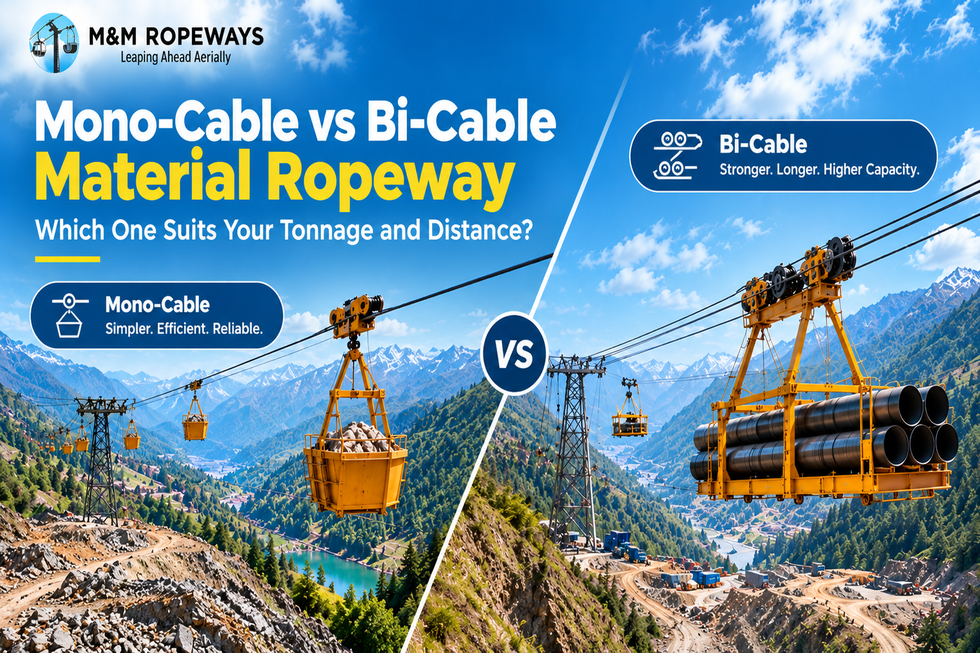
If you need to move construction materials, minerals, agricultural products, equipment, or other loads across difficult terrain, choosing between a mono-cable and bi-cable system is a major engineering decision. The right material ropeway depends mainly on your required payload, hourly tonnage, route length, span between towers, terrain, gradient, wind conditions, and operating cycle.
Published ropeway project data show how widely these systems can vary. M&M Ropeways covers quite a range, from a 500 m monocable jig-back system built for horticulture use, all the way to a 3 km monocable system capable of handling 3,000 kg per hour. Beyond that, our portfolio also features a 1,600 m ropeway rated for a 3-ton payload, along with cable cranes that can carry loads of up to 10 tons.
That range explains why there is no single answer to which system is better. A monocable system can be an efficient choice for moderate loads and suitable routes, while a bi-cable arrangement can provide advantages for heavier loads, longer spans, and demanding terrain. The following guide explains the differences so you can make an informed decision.
What Is a Material Ropeway?
Think of a material ropeway as a way to move goods through the air instead of over roads. It’s used mostly in spots where laying down a proper road just isn’t worth the money or effort, hilly terrain, mining sites, construction zones, that sort of thing. The whole setup works through ropes strung between towers, and the carrier rides along this rope line from one end to the other.
What actually gets attached to the rope changes based on what’s being moved. Sometimes it’s a simple load hanging off, other times you’ll see buckets or skips built for bulk material, and in some setups there are proper platforms too – basically whatever carrier fits the job.
Material ropeways are commonly considered for:
- Mining and quarrying
- Hydropower construction
- Cement and infrastructure projects
- Forestry
- Agriculture and horticulture
- Remote construction sites
- Mountain transport
- Industrial material handling
- Difficult or environmentally sensitive terrain
OITAF’s recommendations distinguish between material ropeways where the same rope performs carrying and hauling functions, as in a monocable system, and systems using separate carrying and hauling ropes, as in a bi-cable configuration.
For project developers, the key question is not simply which system costs less. It is which system can transport the required tonnage safely and reliably over the proposed route.
Mono-Cable vs Bi-Cable Material Ropeway: The Basic Difference
The main difference is how the rope system supports and moves the load.
Mono-Cable Material Ropeway
A monocable system uses a single rope that performs both the carrying and hauling function. Carriers are attached to the rope and move along the route.
This arrangement generally has a simpler mechanical configuration and can be suitable where the payload, route length, terrain, and operating requirements fall within the system’s design range.
M&M Ropeways has supplied and worked on monocable material systems for applications including agriculture and tea estates. Its listed projects include a 500 m monocable jig-back system and 3 km monocable systems with an hourly capacity of 3,000 kg.
Bi-Cable Material Ropeway
A bi-cable system uses separate ropes for carrying and hauling.
One rope provides the supporting track function, while another moves the carrier. This separation can provide greater stability and make the configuration suitable for heavier loads, longer spans, and more demanding routes.
Bi-cable systems are particularly useful where the engineering requirements make a single carrying-hauling rope less suitable.
Quick Comparison: Mono-Cable vs Bi-Cable
| Factor | Mono-Cable | Bi-Cable |
| Rope arrangement | Single carrying and hauling rope | Separate carrying and hauling ropes |
| Typical application | Moderate loads and suitable routes | Heavy loads and demanding routes |
| Mechanical complexity | Generally simpler | More complex |
| Long-span capability | Depends strongly on design | Generally better suited |
| Load stability | Good within design limits | Higher stability for demanding applications |
| Tower requirements | Project-specific | Can allow longer spans in suitable designs |
| Heavy material transport | Suitable within capacity limits | Often preferred for higher loads |
| Initial system complexity | Lower | Higher |
| Engineering requirement | Moderate to high | High |
| Best selection method | Payload + route + TPH | Payload + route + span + terrain + TPH |
These are general engineering tendencies, not fixed rules. A properly engineered monocable system can handle significant loads, while a bi-cable system is not automatically the better choice for every long-distance project.
When Is a Mono-Cable Material Ropeway a Better Choice?
A monocable system can make sense when your project has a moderate payload and a route that does not require the additional carrying capacity or span characteristics of a bi-cable configuration.
It may be appropriate when:
- The individual payload is moderate
If each carrier does not need to transport a very heavy load, a monocable arrangement may provide an efficient solution. - The route length is manageable
Distance alone should not determine the choice. A 3 km route may be suitable for monocable operation if the payload, terrain, tower spacing, speed, and required throughput are compatible with the design. - The terrain is challenging but manageable
Material ropeways are particularly useful where roads would require extensive excavation, bridges, retaining structures, or other major infrastructure. Read more about How Ropeway Systems Enhance Connectivity in Remote and Hilly Areas - The project prioritizes a simpler system
A simpler mechanical arrangement can make sense where the application does not require the additional characteristics of a bi-cable system. - The required throughput is moderate
For projects moving a defined amount of material per hour, the system should be designed around actual TPH requirements rather than simply choosing the largest available ropeway.
When Should You Consider a Bi-Cable Material Ropeway?
A bi-cable system becomes more attractive as the engineering requirements become more demanding.
Consider it when your project involves:
- Higher individual payloads
- Long unsupported spans
- Steep or difficult terrain
- Stronger wind exposure
- Large vertical differences
- Heavy industrial materials
- Demanding transport cycles
- Greater requirements for carrier stability
- Difficult tower installation locations
The separate carrying and hauling functions allow the system to be engineered differently from a monocable arrangement.
For example, if towers cannot be installed frequently because of a deep valley, river, forest, unstable slope, or other physical obstacle, span requirements become an important part of the system selection process.
Tonnage Is More Than Just Payload
One of the most common mistakes in material ropeway planning is looking only at the weight carried by one carrier.
A better calculation considers transport capacity per hour.
For example, imagine a project requiring:
- 2 tonnes per carrier
- 10 carriers operating in the system
- 6 complete cycles per hour
The theoretical movement would be:
2 tonnes × 10 carriers × 6 cycles = 120 tonnes per hour
However, actual system capacity depends on carrier spacing, ropeway speed, loading and unloading time, route configuration, station arrangements, availability, and operating conditions.
This is why an experienced ropeway engineering team should calculate the required throughput before selecting the ropeway type. Understand more about The Science Behind Ropeway Technology: How It Works & Why It’s Reliable
Distance Matters, But Span Matters Too
A 5 km route does not automatically require a bi-cable system.
The more useful question is:
How is that 5 km route divided into spans, and what loads must each span support?
Two projects can have the same overall length but completely different engineering requirements.
Project A
- Total route: 5 km
- Moderate gradient
- Accessible tower locations
- Moderate payload
- Suitable wind conditions
A monocable system could potentially be considered.
Project B
- Total route: 5 km
- Deep valleys
- Limited tower locations
- High wind exposure
- Heavy carriers
- Large elevation difference
A bi-cable configuration may be more appropriate.
This is why route surveys and preliminary engineering are critical before making a final selection.
Mono-Cable vs Bi-Cable for Difficult Terrain
Terrain is one of the strongest reasons companies consider aerial material transport.
A ropeway can cross terrain that would be difficult to handle with conventional vehicles. However, the terrain also affects the ropeway design.
Engineers need to evaluate:
- Elevation profile
- Gradient
- Valley crossings
- Tower foundation locations
- Ground conditions
- Maximum span
- Wind exposure
- Snow or rainfall
- Access for construction
- Loading and unloading locations
- Emergency access
- Environmental restrictions
M&M Ropeways has experience working on ropeway projects in challenging environments, including projects in India, Nepal and Africa. Its published project list includes systems ranging from hundreds of metres to several kilometres and applications involving loads from agricultural materials to multi-tonne industrial transport.
How Wind Affects Your Choice
Wind should never be treated as a secondary consideration.
Aerial carriers are exposed to wind throughout the route. Strong crosswinds can influence carrier movement, rope behaviour, station operation, and overall system design.
Bi-cable arrangements can offer greater stability because the carrying and hauling functions are separated.
However, the actual suitability depends on engineering calculations and site-specific wind data. A ropeway designed for one mountain environment should not automatically be copied for another location.
Cost: Is Mono-Cable Always Cheaper?
A monocable system can have a simpler arrangement, but it is incorrect to assume that it will always be the lowest-cost option.
The total project cost can include:
- Ropeway equipment
- Carriers
- Towers
- Foundations
- Drive system
- Tensioning system
- Stations
- Electrical systems
- Safety equipment
- Control systems
- Installation
- Civil works
- Transportation
- Testing and commissioning
- Maintenance infrastructure
A lower equipment price does not necessarily mean a lower project cost.
For example, selecting a system that cannot achieve the required throughput could force the operator to run longer hours, increase carrier frequency, or make future modifications.
The better approach is to compare the total cost of ownership against the required output.
Which Material Ropeway Is Better for Mining?
Mining projects often involve difficult terrain, heavy materials, and continuous material movement. Aerial ropeways and conveyor systems can help streamline material transportation in such environments.
The correct choice depends on:
- Material density
- Payload per carrier
- Required tonnes per hour
- Route length
- Elevation difference
- Loading conditions
- Unloading arrangement
- Span requirements
- Wind conditions
- Operating hours
For moderate loads and suitable routes, a monocable system can be considered.
For heavier loads, long spans, and demanding terrain, a bi-cable system may provide better engineering flexibility.
M&M Ropeways can evaluate the complete route rather than selecting the ropeway type from tonnage alone. This approach is particularly useful for mining, hydropower, construction, and other remote projects.
Which Is Better for Hydropower Construction?
Hydropower sites are often located in steep and remote terrain. Moving cement, steel, equipment, aggregates, and construction materials by road may require major temporary infrastructure.
A material ropeway can provide an aerial route across valleys and steep slopes, making it a practical option for transporting materials at challenging hydropower sites.
The choice between mono-cable and bi-cable depends on the specific construction requirement.
A monocable system may suit:
- Moderate material loads
- Shorter routes
- Suitable tower locations
- Temporary or project-specific transportation
A bi-cable system may suit:
- Heavier construction materials
- Larger spans
- Difficult valleys
- Greater carrier stability requirements
- Higher payload requirements
M&M Ropeways’ published projects include a 1,600 m ropeway with a 3-ton payload for a hydropower project in Nepal, demonstrating how ropeway systems can be configured for demanding construction environments.
What Should You Tell a Ropeway Manufacturer?
Before requesting a quotation, prepare the following information.
Project Information Checklist
- Total route length
- Starting and ending elevations
- Maximum gradient
- Required payload per carrier
- Required tonnes per hour
- Material type
- Material density
- Carrier loading method
- Carrier unloading method
- Operating hours per day
- Required operating days per year
- Maximum expected wind speed
- Temperature range
- Snow or rainfall conditions
- Available tower locations
- Access for construction equipment
- Power availability
- Temporary or permanent requirement
The more accurate this information is, the more accurately engineers can determine the appropriate ropeway configuration.
How M&M Ropeways Approaches System Selection
A material ropeway should be designed around the project, not selected from a standard catalogue.
M&M Ropeways combines engineering, manufacturing, installation, and commissioning capabilities to develop customized ropeway solutions for different terrain and material-handling requirements.
Its approach can include:
- Understanding the transport requirement
- Reviewing route and terrain data
- Calculating payload and hourly capacity
- Evaluating span and tower requirements
- Selecting the ropeway configuration
- Designing the mechanical and electrical systems
- Manufacturing the required components
- Installing and commissioning the system
This end-to-end approach helps ensure that the ropeway works as part of the complete project rather than as an isolated piece of equipment.
You can learn more about M&M Ropeways’ material ropeway systems and the applications they are designed for before discussing your project requirements.
Mono-Cable or Bi-Cable: A Simple Decision Guide
Use this as an initial screening tool.
Choose a Mono-Cable System if:
- Your payload is moderate
- The required TPH is within monocable capability
- Tower locations are practical
- Spans are manageable
- Wind conditions are within the design range
- A simpler configuration meets your requirements
Consider a Bi-Cable System if:
- Payload per carrier is high
- Long spans are required
- Terrain is particularly difficult
- Wind stability is a major consideration
- Tower locations are limited
- The project has demanding industrial requirements
The final decision should always come from detailed engineering rather than a simple tonnage or distance rule.
Why Engineering Matters More Than a Standard Specification
A ropeway’s performance depends on the interaction of multiple components.
Changing one parameter can affect another.
For example:
Higher payload → higher rope loads → different drive requirements → different tower and foundation loads.
Similarly:
Longer span → different sag behaviour → different tension requirements → different tower and rope selection.
That is why professional ropeway design and engineering should consider the complete system.
M&M Ropeways works with engineering teams and project requirements to develop systems around actual operating conditions rather than relying on a one-size-fits-all configuration.
Final Verdict: Which One Should You Choose?
There is no universal winner between mono-cable and bi-cable material ropeways.
A mono-cable system can be a strong option for moderate payloads, suitable distances, manageable spans, and applications where a simpler configuration meets the required throughput.
A bi-cable system becomes more attractive when the project involves heavier loads, longer spans, difficult terrain, higher stability requirements, or demanding operating conditions.
The best choice comes from calculating the complete requirement, including payload, tonnes per hour, route length, elevation, span, wind, carrier spacing, and operating cycle.
For complex projects, working with an experienced ropeway manufacturer from the survey and engineering stage can prevent costly changes later. M&M Ropeways brings more than 40 years of industry experience and provides customized solutions covering design, manufacturing, installation, commissioning, and after-sales support.
FAQs
1. What is the main difference between a mono-cable and bi-cable material ropeway?
A mono-cable system uses one rope for both carrying and hauling the carrier. A bi-cable system uses separate carrying and hauling ropes. This difference affects the system’s load capacity, stability, span capability, and overall engineering requirements. Mono-cable systems can be suitable for many moderate-load applications, while bi-cable systems are often considered for heavier loads, longer spans, and more demanding terrain.
2. Is a bi-cable ropeway better for long distances?
Not necessarily. Distance alone does not determine the ropeway type. Route length must be considered alongside payload, tonnes per hour, tower spacing, elevation difference, wind conditions, gradient, and carrier design. A long monocable system may work successfully when the engineering conditions are suitable. A bi-cable system may be preferred when the route also requires heavy loads, long unsupported spans, or greater carrier stability.
3. What payload can a material ropeway carry?
There is no single payload limit for all material ropeways. Capacity depends on the ropeway configuration, carrier design, rope characteristics, span, route profile, drive system, and operating conditions. Published industry examples range from smaller agricultural systems to multi-tonne industrial and construction ropeways. M&M Ropeways’ project portfolio includes systems with payloads of several tonnes and cable crane applications reaching 10-tonne capacity.
4. How is material ropeway capacity calculated?
Material ropeway capacity is generally determined by considering payload per carrier, carrier spacing, ropeway speed, cycle time, loading and unloading time, and system availability. The required tonnes per hour should be established before selecting the ropeway configuration. A system carrying a heavy load per carrier may still have insufficient hourly capacity if carrier frequency or loading time is too low.
5. Which ropeway is better for mining and hydropower projects?
Both configurations can be used for mining and hydropower, depending on the project. Mono-cable systems can suit moderate loads and suitable routes. Bi-cable systems may be more appropriate for heavier loads, difficult terrain, and long spans. A route survey and engineering study should evaluate payload, TPH, elevation, span, wind, tower locations, and operating conditions before the final system is selected.
6. What information does a ropeway manufacturer need before designing a system?
A manufacturer normally needs route length, elevations, gradient, payload, required tonnes per hour, material type, loading and unloading arrangements, operating hours, expected wind conditions, tower locations, power availability, and site conditions. Accurate project information allows engineers to calculate the ropeway’s mechanical, structural, electrical, and operational requirements and determine whether a mono-cable or bi-cable configuration is more appropriate.