
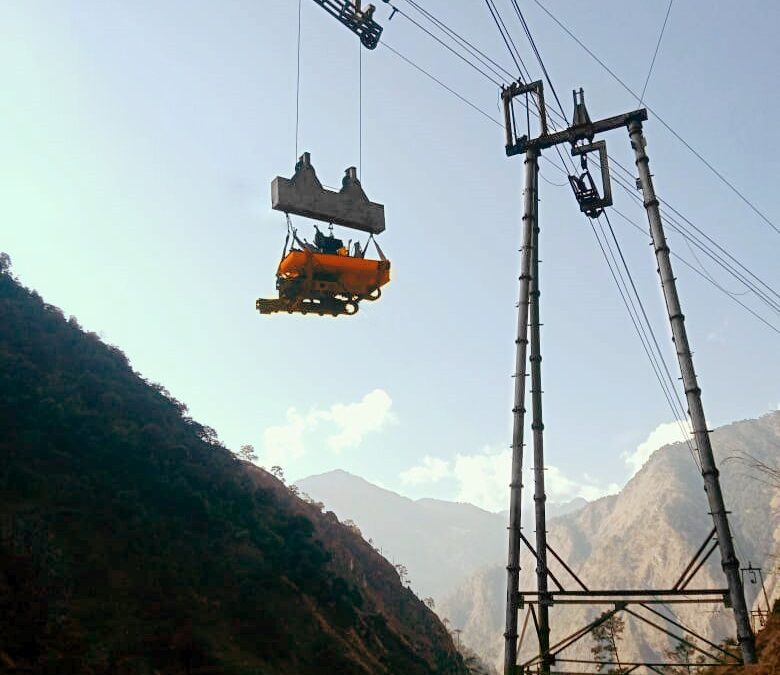
From snow-covered Alps to India’s tough Himalayas, ropeway technology connects the most impossible territories. Where roads can’t reach, and railways can’t climb, steel cables carry people and goods across valleys and mountain peaks.
Ropeway technology in 2026 has evolved from simple mining equipment to today’s sophisticated ropeway systems.
Modern applications now span tourism (cable car technology), industrial operations (material handling ropeways), and urban transit solutions that bypass traffic congestion. Ropeway manufacturers in India have played a bare-bones role in the development of the sector through advanced technology ropeways.
This article will share valuable insights into the core components of the ropeway system and future advancements in this sector. Stay till the end to know the science and engineering behind it.
Ropeway System Technology: An Overview
Earlier ropeways were mostly mechanical and manually monitored. Today, the shift toward future advanced technology ropeway systems has resulted in the implementation of automated systems, digital control, and real-time safety monitoring technology. The development of new materials and drive systems, and control technology improvements has achieved better operational performance and decreased maintenance needs.
Two Main Categories
Passenger Ropeway Systems
Cable car systems have created a fundamental change for both urban transportation networks and tourist movement through cities. Adding on, skiers use gondolas to ascend slopes, aerial tramways take pilgrims to Himalayan temples, and chairlifts provide scenic mountain vistas. Putting it briefly, the passenger ropeway systems enable cities to address their traffic issues through the safe transportation of thousands of people who need to travel each day.
Material Handling Ropeways
Industrial workhorses built for hauling. Material handling ropeways transport ore from remote mines, carry cement across quarries, and move tea leaves down Darjeeling’s steep hillsides. The system operates continuously throughout the week to eliminate unsafe truck conveyance. From hydropower construction sites to power plants, they’re India’s invisible industrial backbone.
How Ropeway Technology Works: Core Components
Understanding ropeway technology means breaking down its elegant engineering into digestible parts. Let’s understand it thoroughly in this approaching section.
Essential Components
1. Support Towers/Pylons
These steel structures hold everything together. The structure consists entirely of tubular steel. The towers require proper siting in line with natural land features to fulfill their dual function of protecting nature. A single foundation might occupy just 10 square meters. It allows the surrounding area to remain mostly untouched.
2. Steel Wire Ropes/Cables
The backbone of cable car technology. Each rope consists of 6-8 strands twisted around a core, with each strand containing dozens of high-tensile galvanized steel wires. This construction provides redundancy. If one wire breaks, others carry the load. Depending on configuration, cables support over 100 tons while resisting weather and decades of use.
3. Drive Station (Power House)
The heart of ropeway technology. An electric motor turns a massive bullwheel (4-6 meters in diameter) that propels the cable loop continuously. Modern systems feature variable speed control and allow detachable grips to slow cabins at stations. It simultaneously maintains high line speeds.
4. Return/Tension Station
Located opposite the drive station, this facility uses counterweights or hydraulic systems to maintain optimal cable tension. It automatically adjusts for temperature changes and cabin loads. Tension station ensures smooth, safe operation.
5. Carriers/Cabins
Passenger ropeway systems use enclosed gondolas, open chairs, or large tram cabins holding 2-200 people. Material handling ropeways employ buckets, platforms, or ore carriers. Additionally, grip mechanisms are crucial: fixed-grip clamps attach permanently to cables and detachable grips release at stations for easy boarding.
6. Safety & Control Systems
Multiple protection layers include service brakes for normal operations and emergency brakes that activate automatically. Sensors monitor cable speed, position, tension, and weather conditions. Remote control rooms oversee systems in real-time, ready to intervene instantly.
The Ropeway Reliability at a Glance
- Built-In Redundancy: Engineers use multiple safety systems to design aerial ropeway systems, which they develop through their engineering work. Moreover, the bicable and tricable systems incorporate backup cables. It is used to maintain cabin safety during haul rope failures through support ropes.
- Real-Time Monitoring Technology: Automated sensors form the nervous system of modern ropeways. Their primary function is to detect cable tension variations within milliseconds, flag speed deviations instantly, and continuously monitor the weather.
- Mechanical Simplicity: Ropeway technology consists of fewer moving parts. It means fewer failure points. Compared to road or rail systems, ropeway systems rely on elegant mechanical simplicity. Modern systems achieve 99%+ uptime and operate continuously.
- Advanced Materials & Construction: High-tensile steel ropes undergo testing at five times their operational load. Galvanized coating resists corrosion for decades. UV-resistant carrier materials withstand constant exposure to sunlight. Modern ropeway manufacturer facilities follow international standards. Therefore, quality is verified at every manufacturing stage.
Applications: Passenger vs. Material Handling Systems
Ropeway technology serves two distinct worlds. First, moving people and second, moving goods. Further, each application demands different engineering, yet with a similar aim: to provide exceptional value. Let’s learn about their applications in different sectors.
Passenger Ropeway Systems Applications
- Tourism Sector
- Urban Transportation
Material Handling Ropeways Applications
- Mining and Quarrying
- Hydropower & Dam Construction
- Tea Estates & Agriculture
- Industrial Logistics
The next section will take you to the future advancements coming in the ropeway sector.
The Future of Ropeway Technology and Infrastructure Development
Urban infrastructure is under increasing pressure. The reason is the expansion of cities and massive population mobility across territories. In this context, ropeways are gaining supreme attention. The shift toward future advanced technology ropeway systems is driven by measurable improvements in engineering and operations.
Modern ropeways incorporate
- automated control systems
- condition-based monitoring
- energy-optimized
Innovation is also pushing ropeway design toward greater durability and scalability. Moreover, advances in cable manufacturing, structural optimization, and predictive maintenance are extending system life.
To make a long story short, ropeway technology is set to play a defined and practical role in next-generation transport and logistics planning.
Conclusion
Ropeways have come a long way from basic cable systems to the sophisticated networks we see today. Ropeway systems have quietly become essential infrastructure across India and abroad.
Moving further, ropeway system engineering has also matured in the past few years. What used to need constant manual oversight now runs on automated controls and predictive maintenance. In the contemporary era, modern ropeways handle extreme weather, steep gradients, and heavy loads more confidently than in earlier times.
If you’re evaluating ropeway systems for tourism, industry, or urban transport, MM Ropeways is the prime ropeway manufacturer near you.
Contact the team to know more about the services and how the company applies each technology to provide the best value in terms of revenue and transportation.