
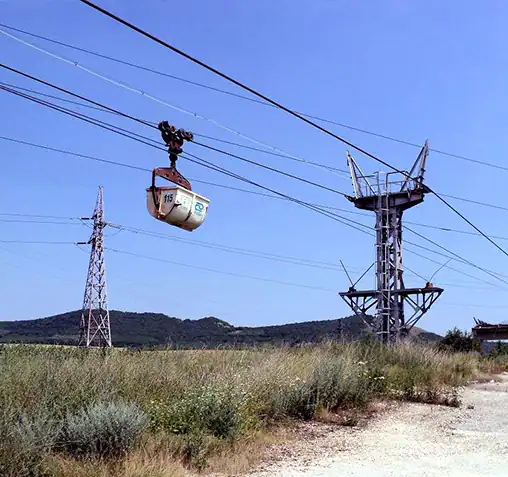
Mining industries face a complex challenge. Traditional truck transport consumes up to 30% of operational budgets through fuel costs alone. The presence of steep terrain requires mining companies to spend additional resources on equipment maintenance and repair work. Environmental regulations require businesses to achieve reduced emission levels. Moreover, infrastructure for mountain crossings can cost millions before the first ton moves.
The answer lies in integrating aerial ropeway conveyor systems for mining operations. This method combines the strength of conveyor systems in flat areas and the capacity of ropeway systems to function in challenging environmental conditions.
The outcome? The result delivers three benefits:
- Lower costs,
- Reduced environmental impact, and
- Flexible operations.
The current article demonstrates how this integration functions to improve material handling operations in the modern mining industry.
Core Technologies Overview: Aerial Ropeways and Conveyors in the Mining Sector
Conveyor Systems
Conveyors form the backbone of bulk material transport in mining operations across all continents. These systems excel on relatively flat or mildly inclined terrain. It operates by creating a continuous flow of materials that starts at extraction points and ends at processing facilities and transfer stations.
Modern mining conveyors operate at capacities between 500 TPH and 11,000 TPH, which depends on the specific belt width and speed requirements. They serve as efficient transport mechanisms for various materials, including coal, iron ore, copper concentrate, limestone, and overburden. However, conveyors lose their operational capacity because the terrain prevents their full use.
Standard belt conveyors typically handle inclines up to 18 degrees. But M & M Ropeways provides advanced ropeway conveyor technology, including its flagship product: the Sandwich Belt High Angle Conveyor. This specialized system can handle angles up to 90 degrees by gently hugging material between two belts.
Aerial Ropeway Systems
These material-handling solutions mining industry professionals deploy when the terrain gets difficult. The aerial ropeway equipment used in mining operations can handle material volumes of 100-450 TPH. What’s more? They maintain their operational efficiency between 2 and 20 kilometers, although there are installations that operate at distances exceeding 75 kilometers throughout the world. The vertical-rise capability enables systems to traverse elevation changes that reach several hundred meters without needing switchbacks for their operation.
Moreover, systems can generate power through regenerative braking when loads descend, which results in some systems generating more than 200 kWh of energy each day. This energy offsets operational costs plus reduces the carbon footprint.
Key Components Of Successful Integration
Automated Transfer Stations
The handoff point between conveyors and ropeways determines system efficiency. Modern automated transfer stations manage this critical junction. These stations synchronize flow rates automatically. Sensors monitor material volume and adjust belt speeds or carrier loading to maintain consistent throughput. For operations moving 500 to 1,000 TPH, this synchronization eliminates the production delays that once plagued multi-system installations.
Advanced Monitoring and Control Systems
M & M Ropeways offers advanced monitoring and control systems that synchronize operations. These platforms simultaneously track belt speed, material flow, tension forces, and equipment health across both conveyors and ropeways. Wireless sensors continuously monitor critical components.
The system issues alerts to operators when a take-up pulley detects unusual vibrations or a drive motor exceeds normal temperature limits. Equipment lifespan increases because the predictive maintenance approach reduces unscheduled repairs.
Scalability and Adaptability
Mining plans change as deposits evolve. Integrated systems adapt. Conveyor sections can extend or contract as extraction zones move. Ropeway loading points adjust along the belt axis to meet new requirements. This flexibility protects capital investment.
Operators can expand their operational capabilities through additional conveyor installations or extra ropeway carriers, without needing to implement system replacements, as their production capacity grows from 800 TPH to 1,200 TPH.
Advanced Safety Features
Emergency pull cords positioned at strategic locations along conveyors enable operators to stop the system immediately whenever they require. Audible and visible warning systems signal system startup and prevent accidents from unexpected movement. Additionally, ropeways can serve as a primary emergency evacuation path that miners can use during dangerous situations. It provides a quick, efficient exit from mining areas during emergencies. Automated systems that handle material operations automatically reduce worker contact with moving equipment. What’s more? Compliance with MSHA safety standards becomes simpler with properly designed integrated systems.
M & M Ropeways’ Sandwich Belt Technology: Setting New Standards
Sandwich Belt High Angle Conveyor handles inclines up to 90 degrees (vertical). This capability transforms what’s possible in challenging terrain applications. The technology has been developed in a collaborative partnership with the American company Dos Santos International. This partnership created an engineering magic that works by gently hugging material between two belts. It creates enough friction to move bulk materials straight up steep slopes or even vertically.
Furthermore, it put forward key advantages for mining operations:
- Handles Up to 90-Degree Inclines: It moves material vertically or along steep slopes. Indeed, it eliminates the need for gradual ramps or spiral routes that conventional conveyors require.
- Minimal Excavation Requirements: It is a fact that deep open-pit operations elevate material directly along pit walls rather than building expensive ramps. Hence, it preserves ore recovery potential and reduces earthwork costs.
- Proven Global Track Record: Mining operations worldwide have successfully used M & M and Dos Santos International and built “Sandwich Belt systems” that have proven their dependability across different operational capacities and vertical heights.
- Gentle Material Handling: The best part of this system has been till now. Despite steep angles, the system maintains gentle pressure on materials. It prevents degradation of friable materials or damage to valuable products like diamonds during elevation.
- Lower Operational Costs: Conventional conveyor components ensure fast replacement part delivery and straightforward maintenance comparable to standard conveyors. Therefore, it costs you less and saves you money.
The Bottom Line
Cutting a long story short, integrating aerial ropeway and conveyor systems for mining delivers measurable advantages across mining operations. The massive benefits you get are: cost reductions reach 30-40% compared to truck transport. Second, energy consumption drops by 90%. The technology is triumphantly being adopted across many sites and business operations.
If you want to improve your mining operations. Then, reach out to M & M Ropeways. The leading ropeway manufacturer India and worldwide brings in-house design, manufacturing, and commissioning capabilities to your project.
Contact M & M Ropeways for a technical evaluation and customized system design.