
Ask a project engineer what a ropeway is. Then ask what a cableway is. Chances are, you get the same answer for both. Most people, tourists, planners, and even industry professionals, treat these two words as identical. Sometimes that works. Often it does not.
And honestly? That confusion is obvious.
Both systems move people and materials through the air using steel cables. Both hang from towers. Both cross terrain that roads and railways cannot touch. So the overlap is real.
Cableway vs Ropeway: What’s the Difference? In India, that answer changes depending on who is reading the document. A government tender says ROPEWAY. A mining contract says CABLEWAY. Use the wrong one, and the confusion that follows is the least of your problems.
This guide clears it up. You will understand exactly what each system is, how they differ, and which one your project actually needs. We will start with the foundation, what an aerial ropeway is, and where it ends, and where a cableway BEGINS.
What Is a Ropeway? Moving People and Goods Through the Air
A ropeway is a cable-based transport system where carriers hang from steel cables supported by towers. A separate haul rope drives the movement. The terrain below does not matter: valleys, rivers, and steep gradients are all CROSSABLE from the air.
Every ropeway falls into one of two categories.
- Passenger ropeways carry people. Gondola cabins, chairlifts, and cable cars, all built around the rider. Vaishno Devi, Kedarnath, Gangtok – these systems already move millions across terrain that roads struggle to serve.
- Material handling ropeways carry goods. Mining sites, hydropower projects, and dam construction zones use a material handling ropeway to move ore, concrete, and timber across terrain where trucks cannot go.
What Is a Cableway? An Industrial Transport System Explained
An aerial cableway is also a cable-suspended transport system. On the surface, it sounds identical to a ropeway. But in technical practice, the word carries a more specific meaning.
A cableway is built for work, not for passengers.
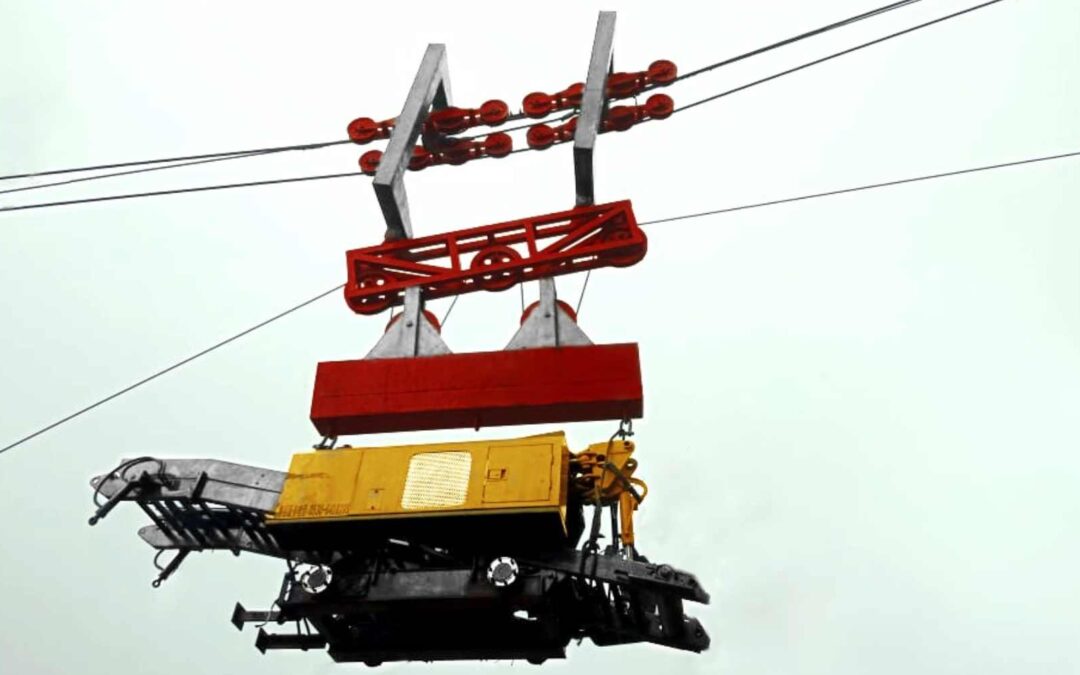
The classic aerial cableway system uses a stationary track rope for support and a moving haul rope for propulsion. The carriers are open trolleys, buckets, or cradles. NO SEATS. No boarding GATES. Just heavy material moving efficiently across impossible terrain.
This is why industrial cableway systems appear in mining operations, cement factories, dam construction sites, and hydropower supply lines. A cableway for bulk material handling can carry thousands of kilograms per trip, across distances no road-based equipment can match.
Nothing illustrates this better than the Siachen Glacier. The Indian army operates at 18,000 feet in temperatures that drop to minus 35 degrees Celsius. No road connects those posts. Helicopters lose reliability at that altitude and in those weather conditions. Aerial cableways step in and do what nothing else can: keep supplies MOVING when everything else STOPS.
Explore: Aerial Cableways in the Army & Industrial Cableway Systems
Cableway vs Ropeway: Understanding The Core Differences
Both systems use cables. Both hang carriers in the air. But the similarities stop there. Here is where cableway vs ropeway actually separates.
| Parameter | Ropeway | Cableway |
| Terminology | Broader, globally used umbrella term. | Leans towards industrial, military, and European engineering contexts. |
| Primary Use Case | Tourism, pilgrimage, ski resorts, rural connectivity, urban transit. | Mining, dam construction, hydropower, cement, and bulk material transport. |
| Load Capacity | Designed for people and lighter goods. | Heavy tonnage, up to 10,000 kg per haul. |
| System Design | Enclosed cabins, ergonomic seating, boarding stations, and passenger safety systems. | Open trolleys, load buckets, and cradles are built for operational efficiency. |
| Cable Configuration | Mono-cable or bi-cable ropeway setups. | Stationary track rope + moving haul rope, aerial cableway system. |
| India Naming | Dominant public terms, Parvatmala Yojana, tourism boards, and state tenders. | Used in technical docs, military contracts, mining, and forestry projects. |
Choosing the wrong system for your terrain and load requirement is an expensive mistake. M&M Ropeways has spent decades getting that decision right, across dam sites, hill stations, army deployments, and hydropower corridors. Talk to our team before your next project.
Why Everyone Gets These Two Terms Mixed Up
Here is the honest answer: Both are cable-based aerial transport systems built on the same core engineering principle. Towers, steel cables, suspended carriers, and haul rope. The foundation is identical.
So yes, a single system can be called either, depending on who is writing the document. A project engineer might call it a cableway. The tourism board promoting it will call it a ropeway. Both are technically acceptable.
Regional naming makes it worse. In Japan, both systems are called ‘ropeway’. In Britain, the cable car vs the ropeway is a common debate. In America, “aerial tramway” is the preferred term. Same physical system, four different names depending on which country you are standing in.
In India’s infrastructure world, context settles it faster than any dictionary. Tourism project? Ropeway. Mining contract? Cableway. Military deployment? Cableway. Hill station gondola? Ropeway. The application determines the word, not the other way around.
That is why working with an experienced ropeway manufacturer in India matters. They know which term belongs in which document, which system suits which terrain, and which configuration delivers what the project actually needs.
Real-World Applications in India: Where Roads Stop, Ropeways and Cableways Begin
Understanding the difference becomes clearer when you see both systems at work. Here is where aerial ropeway types in India actually show up.
#1. Tourism and Pilgrimage
Not every pilgrim can trek. Not every mountain allows a road. That is exactly where passenger ropeways fill the gap. At VAISHNO DEVI, Kedarnath, and Girnar, gondola systems and chairlifts carry millions of visitors each year across terrain that no vehicle can navigate safely. They have become the backbone of India’s religious tourism infrastructure.
#2. Dam and Hydropower Construction
Some terrain does not allow trucks. In Himachal Pradesh, Uttarakhand, and Nepal, deep river valleys, steep slopes, and monsoon conditions make road-based logistics nearly impossible. Industrial cableway systems cut through that problem directly. Concrete, steel reinforcement, and heavy equipment, all moving across the valley continuously, without a single road being built. No road needed. No delay waiting for one to be built.
#3. Military Supply Lines
At 18,000 feet on the Siachen Glacier, it gets really cold. The temperature can drop. 35 degrees Celsius. There are no ROADS. The only way to get to the Siachen Glacier is by helicopter. You can only take a helicopter when the WEATHER is good, which does not happen very often. For India’s army, aerial cableways are not a backup plan. They are the only plan. Food, ammunition, and critical equipment move this way because nothing else gets through.
#4. Agriculture and Rural Connectivity
For farmers on HILLSIDES in Himachal Pradesh and Northeast India, the problem has never been growing produce. It has been getting it down. Roads took decades to promise and longer to build. A material handling ropeway system helps move produce. It skips WAITS. This system carries produce from fields to collection points faster than walking.
Want to understand why more infrastructure projects in India are choosing ropeways over roads? The advantages speak for themselves.
The Bottom Line
Cableway or Ropeway: both terms describe systems that do something no road, bridge, or railway can. They move people and materials through the air, across terrain that stops every other form of transport cold.
The label matters less than the engineering behind it.
Whether the project calls for a passenger ropeway at a hill station, an industrial cableway at a dam construction site, or a material handling ropeway for a mining corridor, the system has to be designed right, built right, and installed for the conditions it will actually face.
That is what M&M Ropeways does. We design, manufacture, and install both passenger ropeways and industrial cableways, from Siachen Glacier to sea-level construction zones. Contact us when you are ready to build.