
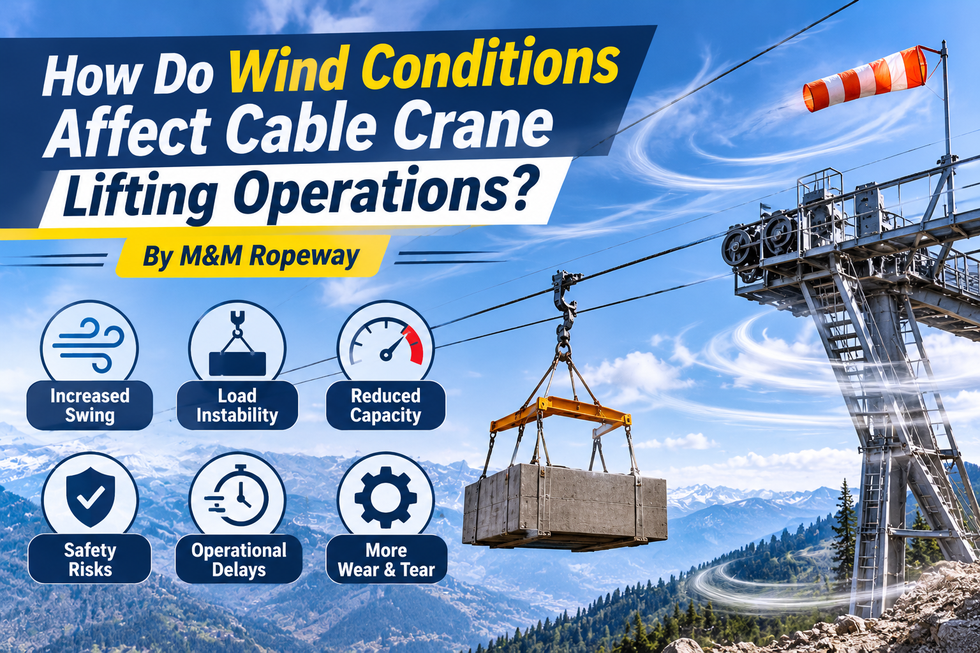
Most people don’t think about wind until they are watching a load swing somewhere it should not. Wind does not just shake a cable crane a little. It hits stability, load control, and the whole structure at once, and a lift that looked fine ten minutes ago can turn risky fast. Gusts push on the cables, the towers and every anchor point holding the system together and workers nearby are the ones who carry that risk when a load starts swinging.
This covers what truly happens when wind gets involved, what speeds are safe to work in, and what keeps a lift steady when the weather doesn’t cooperate.
What Is a Cable Crane and How Does It Work?
A cable crane moves heavy loads across ground where trucks and other equipment can’t go. Many people also call it an aerial cable crane. It works with ropes, winches, and pulleys. Each part does its own job.
The thick steel wires stretched between two anchor points are called track ropes. They carry the weight of the load. A trolley on a hauling rope slides the carrier side to side, pulled by its own winch. A third rope, the hoist rope, runs through pulley blocks to lift the load straight up, spreading the weight across several pulleys so no single point takes all the strain.
Power comes from diesel or electric, and remote controls handle carrier speed, how the hook comes down, and where the load gets placed. Our cable crane systems are built to design and safety guidelines set by OITAF, the international body for rope-transport standards, and we hold ISO 14001:2015, ISO 9001:2015, and ISO 9000:2015 certification. That groundwork gets tested the moment wind starts pushing on every part of this system.
How Does Wind Affect Cable Crane Operations?
Three things happen, often at the same time.
First, the load catches wind like a sail would. A panel, a frame, a flat sheet – anything with a wide surface drifts off course, and it’s not the operator’s fault.
Second, the load loses control and starts swinging. Wind pushes it like a pendulum, and strong gusts can even spin the hook. That makes it hard to place the load correctly, and it can swing into terrain, structures, or people close by.
Third, the cables themselves bend under pressure. Wind pushing against the main ropes throws off tension and position, and that stress travels straight down into the anchors, winches, and towers.
What Factors Determine Wind Risk for a Cable Crane Lift?
Not every lift faces the same risk in the same wind. A few things decide how bad it gets:
- Wind speed and direction. A light breeze usually isn’t a problem. Fast wind can swing the load and cables hard enough to put the whole crane at risk, and direction decides which way it drifts.
- Gusts and turbulence. A sudden gust can shift the load, cables, or towers with no warning, and that’s much harder to plan for than steady wind.
- The load itself. Shape, size, weight, surface area- all of it is important. Loads that are large, hollow, or light act like sails and get hard to control fast.
- Terrain and elevation. Mountain gaps and valleys speed up wind well beyond what you would feel on the ground, and that’s exactly the kind of terrain cable cranes often work in, dam sites and hydropower projects included. It’s also why choosing between a tricable and bicable gondola system matters so much in wind-exposed terrain. The right configuration changes how much wind risk a system can absorb.
- Manufacturer limits. Every cable crane has a rated wind speed from its manufacturer, and that number should always come before any guess about what feels safe.
What Kind of Loads Are Most Affected by Wind?
Some loads don’t care how strong the wind is. Others become almost impossible to control the moment wind picks up, and knowing which category a load falls into before the lift starts makes a real difference.
High surface area loads sit at the top of that risk list. Frames, beams, metal sheets, prefabricated wall sections – anything with a wide, flat face.
Everything on that list starts to act like a giant sail. The larger the surface, the more the wind pushes against it, and the more likely the load is to start rotating, swaying, or veering off course long before it’s unsafe to operate in that level of wind.
Hollow or lightweight loads carry a different kind of risk. They hold a lot of volume without enough weight to anchor them down, so even moderate wind, the kind that wouldn’t bother a dense, compact load, can throw them badly off balance.
Suspended loads add height into the equation, and height changes everything. Wind speed and turbulence both get stronger the higher you go, so a load swinging at the top of a tall cable span deals with forces that the crew standing on the ground below never actually feels. That gap between what’s happening at height and what’s happening at ground level is exactly why relying on how the wind feels standing below isn’t enough on its own. This is also part of why military logistics operations in mountainous terrain depend so heavily on wind monitoring, high-altitude supply routes see wind conditions that ground teams never anticipate.
At What Wind Speed Should a Cable Crane Stop Operating?
Most operations follow a simple three-tier guideline, matching common manufacturer documentation and published safety standards from groups like the US Occupational Safety and Health Administration.
| Wind Speed | Risk Level | What It Means |
| 0–12 mph (0–19 kph) | Safe | Normal lifting can continue |
| 13–31 mph (20–50 kph) | High-risk zone | Use caution, keep monitoring wind, reduce load if needed |
| 32+ mph (50+ kph) or gusts over 30–40 mph | Severe | Stop operations, secure the cable |
The numbers above are for guidance only. Please consult the equipment manufacturer for the true cable crane wind speed limit. Any equipment that is rated lower than this guide should use its own equipment ratings and guidelines.
What Safety Precautions Should Be Followed Before and During a Lift?
Good wind safety starts long before the crane moves anything.
- Plan around the load. Loads with a lot of surface area need a lower wind limit than the crane’s general rating, even if overall wind speed looks fine.
- Check the forecast. Stay in touch with local wind updates before any big or critical lift, so storms or sudden spikes get caught early instead of mid-lift.
- Set up live wind monitoring. A calibrated anemometer at the highest open point on the crane gives real wind data at the height that truly is important.
Once the lift starts, different precautions take over:
- Use tag lines. Ropes tied to the load let ground crew guide and steady it from a safe distance. Nobody stands directly under a suspended load, tag line or not.
- Move slowly. Jerks, sharp turns, sudden stops – all of it adds stress to a system already fighting the wind.
- Keep communication open. Riggers, signal staff, ground crew, and the operator all need a reliable way to talk through the lift, whether that’s hand signals or radio. If that breaks down, the lift stops until it’s fixed.
- Watch the wind the whole time. The anemometer needs attention through the full lift, not just one check before starting.
How Does a Wind Monitoring System Improve Cable Crane Safety?
A wind monitoring system does more than show a number. It gives operators and ground crew a steady, accurate read on speed and direction, better than guessing from how the wind feels on the ground.
It also catches trouble early. A sudden gust or shift in direction can trigger a warning before things turn dangerous, giving the crew time to pause, wait, or keep going based on real data instead of reacting after something already happened. Live updates mean the crew always knows what the wind is doing at the crane’s working height – not what it was doing ten minutes ago.
The Conclusion
Wind doesn’t go away on open terrain. Mountain gaps, valleys, high-elevation sites – that’s just part of the job. What decides whether it turns dangerous is the crane itself, how it’s rated, how closely the wind gets tracked, and whether the design was built for this kind of terrain in the first place.
Our cable cranes are built to OITAF regulations and ISO-certified manufacturing, which counts most on sites like dam construction in deep valleys or hydropower and pumped storage projects, where terrain pushes wind risk well past anything a ground-level site sees. The same care goes into our cable cranes working mining sites across India’s toughest terrain.
Ready to Plan Your Next Lift?
Wind conditions are only one part of the equation. Terrain, load type, site elevation – all of it shapes what kind of cable crane setup actually works for a project. Our engineering team has handled this across some of India’s toughest sites, from deep valleys to high-altitude borders, and we can walk through what your specific site needs before you commit to anything.
Get in touch with our team to talk through your project. We are happy to help figure out the right system for your terrain and conditions.
Have More Questions? Get Your Answers
At what wind speed should a cable crane stop operating?
Winds between 20 and 25 km/hr are generally safe for crane operations. Gusts past 30 to 35 km/hr should be avoided, since they put a heavy load on the crane. The manufacturer’s own wind speed limit always comes first over general numbers.
Why do cable cranes stop working in strong wind?
Wind adds extra stress to the crane’s structure and load capacity, pushing the system past what it’s built to handle. Go beyond the manufacturer’s wind or load limit and the risk shifts to mechanical or structural failure (including a dropped load).
What happens if a crane reaches a maximum wind speed?
Operations stop right away. The crane gets secured or stowed following the manufacturer’s guidelines. Pushing past the rated maximum puts real stress on the crane, its load, and its structure, and that is where serious accidents happen.