
By early September 2025, 869 roads were blocked across Himachal Pradesh. Three were national highways. Landslides had buried them. Apple growers were stuck on the road with their fruit.
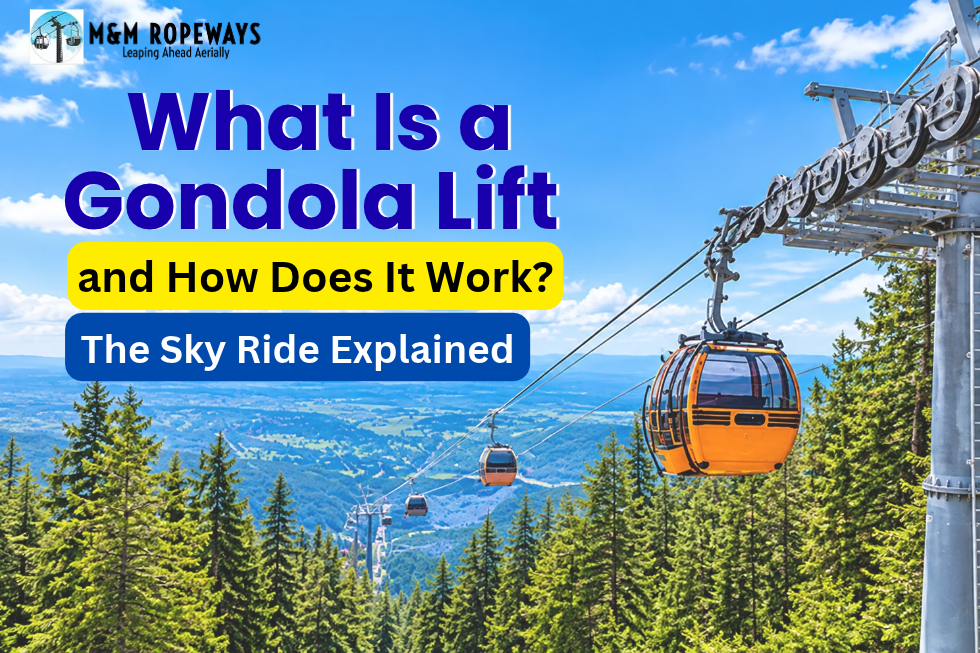
Now think of a ride that skips the road. A gondola lift hangs closed cabins from a steel rope. They glide above the slide, the river, and the jam below. Riders cross in minutes.
It is an aerial cable transport system. A motor in the station pulls the rope in a loop. The cabins follow, one after another, all day long.
So what keeps the cabins safe in wind and snow? And how do you build one on a mountain? This guide answers both. M & M Ropeways walks you through the parts, the types, & a real ride in Gulmarg.
How Does It Work? The Rope Loop Behind Every Ride
The idea is simple. One loop, one motor, many cabins.
- A motor turns a big wheel in the main station.
- The wheel pulls the steel rope in a loop.
- A clamp called a grip holds each cabin to the rope.
- In the station, the grip lets go. The cabin slows to walking speed. You step in.
- On the line, the cabin speeds up. Many modern systems move at about 5 to 6 metres per second.
- Towers hold the rope up along the route. At the far end, the cabin slows down again.
This detachable grip is the clever part. The rope never stops, but you board slowly. So many people can ride each hour. Kids, older people, & skiers with gear can board with ease.
Want more detail? Our guide to how modern ropeway technology works goes deeper.
Key Parts of a Gondola System
Every system has the same core parts. You can see our full range on the products page.
| Part | What it does |
| Passenger cabins | Closed cars that usually hold 4 to 10 riders |
| Haul rope | Steel rope that moves the cabins |
| Grip | Clamp that joins each cabin to the rope |
| Drive station | Motor, gearbox, & big wheel that power the loop |
| Towers | Steel posts that hold the rope over the land |
| Terminals | Stations where riders get on and off |
| Safety systems | Brakes, backup motor, rope checks, & rescue gear |
Three Types: Monocable, Bicable, & Tricable
- Monocable: One rope holds and moves the cabin. It costs less. It suits medium routes.
- Bicable: A fixed rope carries the weight. A second rope moves the cabin. It handles longer spans better.
- Tricable (3S): Two fixed ropes and one moving rope. It carries the most people. It stays steady in wind.
Wind can change your choice. We compare the two big options in tricable vs bicable gondola systems.
Gondola Ski Lift vs. Gondola Mountain Lift
Most people meet this ride on a ski trip. A gondola ski lift uses closed cabins. Riders stay warm & dry. Skis go in racks outside. Open chairlifts leave you in the cold.
A gondola mountain lift serves more people. In summer, hikers, families, pilgrims, & tourists ride it. It can also link villages to towns when roads shut.
India’s ski scene is still small. Our note on the ski industry in India explains why. Year round tourism helps a mountain project pay off.
Gondola vs. Chairlift vs. Aerial Tramway
| Feature | Gondola | Chairlift | Aerial tramway |
| Carrier | Small closed cabins | Open seats | One or two big cabins |
| Shelter from weather | Yes | No | Yes |
| Rider flow | Nonstop | Nonstop | In waves |
| Best for | Ski, tourism, city links | Ski slopes | Steep, long spans |
The Gondola Ride in Gulmarg Case Study
Gulmarg, Jammu and Kashmir has a highly appreciated two phase cable car route. It has 2 phases.
- Phase 1 starts in Gulmarg and ends at Kongdoori.
- Phase 2 runs at a very high elevation, roughly 3980 meters near Apharwat Peak, with 18 towers and 36 cabins each with a 6 person seating capacity. Phase 2 moves 600 people per hour.
By November 2023, 900,000 riders used the cable car in greater Kashmir. Each year, J&K Cable Car Corporation shuts the rides for a week for inspection. After completing their safety checks they increased the capacity of Phase 1, to eliminate weekend waiting lines.
What planners can learn:
- High demand is expected from tourists, plan for this.
- Rides at very high elevations require high frequency of safety checks.
- Capacity increase can be done very easily during design, by planning for future demand.
Gondola Lift Construction: How a System Gets Built
Builders follow a clear order:
- Survey the route and test the soil.
- Pour the bases and raise the towers.
- Build the stations.
- Pull, join, & tighten the ropes.
- Run load tests & safety checks before opening.
Remote sites often have no roads. Crews then use material ropeways to lift steel and concrete to the tower spots. Read more about integrating material ropeways into passenger ropeway construction.
Gondola lift used in construction can mean something else. On city building sites, a “gondola” is a hanging work platform for wall jobs. That is a different machine from a passenger cabin system.
Why Choose a Gondola for Mountain Travel?
Roads cut into slopes and take months to build. A ropeway needs only small spots for towers & stations. Most of the hillside stays as it is.
- Less land use: Only tower & station sites need clearing.
- Steady flow: Cabins arrive often, so lines move.
- Cleaner running: Electric motors make no exhaust on the route.
- Reliable access: Monsoon damage does not shut a cable route the way it shuts roads.
We cover this in our blog on the environmental impact of ropeways vs. highways.
Planning a Gondola? What Buyers Should Check
An aerial lift lasts for years. Check these first:
- Land and route: It is the crucial step before buying a gondola. First, note the slope. Then note the span and see where towers can stand.
- Peak rush: Plan for the busiest weekend, as this will benefit you more than planning it on an average day.
- Wind and weather: Check local wind & snow records. Then choose the type.
- Power and backup: Power cuts happen. Have a backup motor & a rescue plan.
- Approvals and funding: Each state has its own rules. So, consider asking early asap.
- Upkeep: Agree on service terms early. Remember to put it in writing before you buy.
India is backing ropeways. The Parvatmala programme aims to build over 250 ropeway projects covering 1,200 km within five years, says the Press Information Bureau. Our gondola system selection guide helps you compare options.
Ready to Plan Your Gondola Lift Project?
A gondola lift is a rope loop, a motor, & closed cabins. The right design depends on your land, your wind, and your peak crowds.
M & M Ropeways designs, makes, & installs aerial ropeways across India. Our team has installed systems at 18,000 feet on the Siachen Glacier for the Indian Army. Every route is different. We start with your site, not a catalogue. Share your route, rider numbers, & goals. We will help you shape the right system.
Contact M & M Ropeways to discuss your specific requirements and get your questions answered. Call +91 99156 66677 or email info@mmropeways.com.
Clear Your Doubts About Ropeway Projects
Q1. What is the difference between a gondola & a chairlift?
A gondola has closed cabins. A chairlift has open seats. Cabins shield you from weather. Chairlifts usually cost less.
Q2. Is a gondola the same as a cable car or aerial tramway?
People use the terms loosely. Strictly, a gondola has many small cabins on a moving loop. An aerial tramway has one or two big cabins that go back & forth.
Q3. How safe are ropeways & gondola lifts?
Systems have extra brakes, backup motors, and rope checks. Regular inspections & trained staff keep riders safe.
Q4. Can a gondola run in strong winds?
All gondola systems have an upper limit. The best gondola systems are the ones that use tricable designs, as they have the best handling of higher wind gusts. Staff have the ability to slow the gondola line down, or even stop it completely, depending on the wind speed.
Q5. How much does a gondola cost?
It depends on length, land, size, & type. Only a route survey gives a real number.