
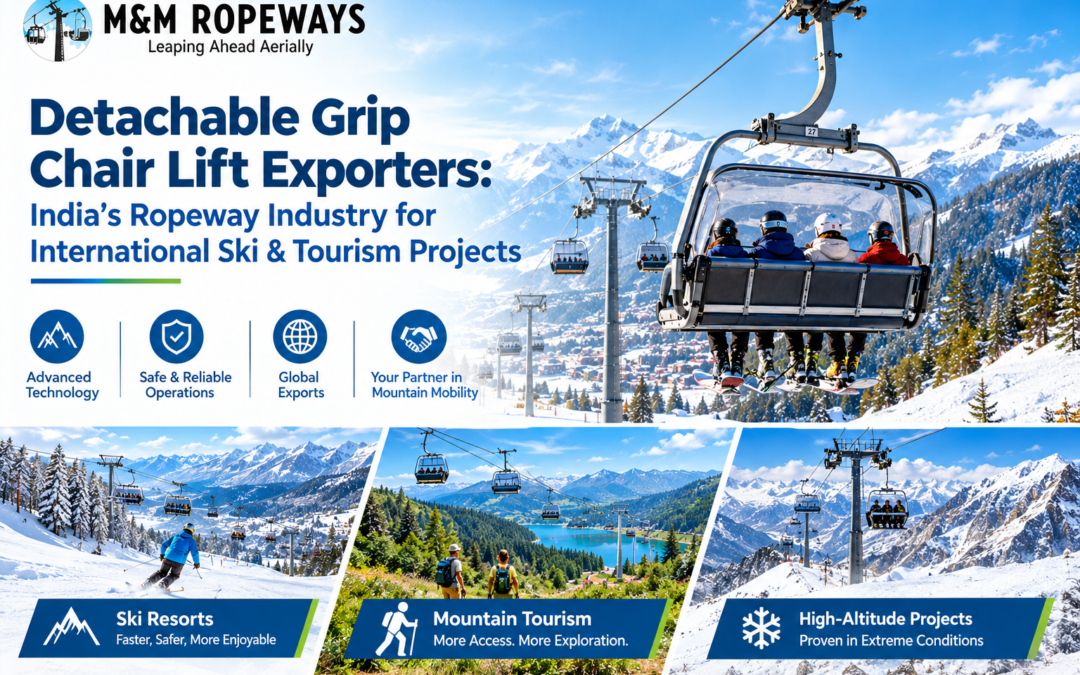
Planning a ski area or a mountain tourism project? Then you need a lift that moves people fast and feels safe. That is why many developers pick detachable grip chair lifts. And more of them now ask a new question. Can an Indian exporter supply it, in short – YES? And this guide gives that answer. You will also see how the technology works, what Indian exporters offer, and what to check before you buy.
What Is a Detachable Grip Chair Lift?
A chair lift is a simple idea. Chairs hang from a steel rope that never stops moving. In a fixed grip chairlift, each chair stays clamped to the rope. In a detachable chairlift, it does not. Each chair has a spring-loaded grip. The grip opens when the chair enters the station.
How the Grip Works
Here is the problem. The rope moves too fast for people to board safely. The detachable grip fixes that. At the station, the chair lets go of the rope. It then rolls along a slow rail. Riders sit down at about 1 m/s. Once they are seated, the chair speeds up. It clamps back onto the rope and heads uphill.
Out on the line, a detachable lift usually runs at about twice the speed of a fixed grip lift. So you get a gentle start and a quick ride. That mix is the whole appeal.
Here is what else you gain:
- Easy boarding for children, beginners, and older riders
- A shorter trip uphill
- The option to take chairs off the line in bad weather, which eases the load on rope and towers
- Bubble covers that keep out wind and snow
None of this is new. The first high-speed detachable quad chair lift opened at Breckenridge, Colorado, in 1981. The design has had over 40 years to improve.
Where These Lifts Are Used
Ski resorts are the classic home. But chair lifts do more. In summer, they carry hikers and mountain bikers. They also serve scenic parks and tourist spots. Many projects mix them with gondolas and surface lifts.
What Decides Capacity?
Rope speed is only one piece. Drive power matters too, and so do the gap between chairs and the height the lift climbs. Riders also need time to sit down. That means chairs need at least five seconds between them. Seat count counts as well. A six-seat chair carries more people than a four-seat chair at the same spacing. A good planner weighs all of this against the visitors you expect.
Why Buyers Look to Indian Detachable Grip Chair Lift Exporters
Demand for mountain lifts is strong. Skiing had a record year in 2024/25. The world logged 399 million skier visits. The old record was 392 million, set in 2018/19. Those numbers come from the International Report on Snow & Mountain Tourism.
The same report series counts 68 countries with outdoor ski areas. It lists India among the smaller, emerging destinations. Turkey, Morocco, & Greece are on that list too. New destinations need reliable lifts. They also watch their budgets. Indian manufacturers can speak to both needs.
Then there is proof. M & M Ropeways installed ropeways at 18,000 feet on the Siachen Glacier. Temperatures there fall below minus 35 degrees Celsius. That kind of job tests every part of a system. A supplier who delivers there knows cold, altitude, and hard logistics.
India’s Home Market Keeps the Industry Busy
A busy home market builds skills, and India’s market is very busy. In January 2024, Union Minister Nitin Gadkari spoke about the Parvatmala Pariyojana. He said more than 200 projects, worth ₹1.25 lakh crore, had been identified for the next five years. He also said the government gives 60 percent construction support under the hybrid annuity mode. And it wants ropeway parts made in India.
What does that mean for a buyer? More projects should mean more engineers, fabricators, and installers with real site experience. That helps any buyer, at home or abroad.
What to Check Before You Choose an Exporter
A brochure tells you very little. Ask these questions early:
- Standards. Which guidelines does the design follow? OITAF is a common reference. ISO certification is another good sign.
- Local approvals. Rules differ from country to country. Will the exporter help with documents and inspections?
- In-house work. What do they design, fabricate, and commission themselves?
- Tough sites. Have they installed lifts at altitude, in snow, or in remote areas?
- Spares and training. A lift runs for decades. Get parts supply and staff training in writing.
- Warranty. Ask about response times and what the warranty covers.
Our 12-point checklist for selecting a ropeway manufacturer goes deeper on each point. Also see this list of documents needed for ropeway project approval. It helps you plan the paperwork early.
Detachable or Fixed-Grip? Know the Trade-Offs
Detachable lifts do not suit every site. They are more complex. Chairs must sit farther apart because of the station design. Industry guides note that many high-speed lifts need replacing after 30 to 40 years. Wind and ice can also shut them down more often than a fixed grip lift.
Fixed-grip lifts still make sense. Think short routes, beginner slopes, and lighter traffic. Some projects use both types. Your choice depends on visitor numbers, terrain, climate, and budget. Our guide on detachable vs fixed-grip ropeways compares them in detail.
Beyond Skiing: Tourism Projects That Suit Chair Lifts
Snow is only one use. Mountain tourism now runs through most of the year. A ski chairlift can reach a viewpoint, a trailhead, or a bike park. It can link a village to a resort base. A high speed quad ski lift adds pace to that mix. Riders sit in the open air. They enjoy the view as they climb.
Tourism developers usually ask three things. How many guests will come on a peak day? How will the lift cope with wind, snow, or heat? What will it cost to run each year? A good exporter helps you answer all three before the design is fixed. For a look at a young ski market, read our post on the ski industry in India.
Planning for Weather and Terrain
Every mountain has its own moods. Wind, ice, and heavy snow all affect a chair lift. So plan for them early.
Start with the site survey. Note where the wind builds and where snow piles up. Then think about how the lift will run on bad days. Detachable chairs can leave the line when storms hit. Bubble covers protect riders on cold, windy rides. And a good station layout keeps loading smooth even in deep snow.
Altitude adds another layer. Thin air and extreme cold affect materials, lubricants, and electrical parts. That is why a supplier’s record at height matters. Ask to see it. Ask about the worst conditions a lift has faced, and how it coped.
How an Export Order Usually Works
Every project is different. Most follow the same path:
- Site survey: The team studies terrain, snow, wind, and visitor demand.
- Design: Engineers set the line, towers, stations, and chair type.
- Manufacturing. Parts are built and checked before dispatch.
- Shipping: Equipment travels to the site with the right papers.
- Installation: The lift is erected, tested, and approved for use.
- Handover: Operators and maintenance staff learn the system.
- After-sales care: Spares and service keep the lift running.
How M & M Ropeways Helps
M & M Ropeways designs, makes, and installs aerial ropeways. The base is in Dera Bassi, Punjab. The team has over three decades of experience and more than 120 installations.
Its detachable chair lifts come in four-seat and six-seat versions. Chairs can have a bubble cover and a folding backrest. Designs follow OITAF guidelines, and the company is ISO-certified. Design, fabrication, and commissioning all happen in-house. Customer staff gets free training on operation and maintenance. Spare parts are easy to get.
As a detachable grip chair lift exporter, the company also serves buyers in Nepal, Bhutan, and Africa. Want to know more? Read about our chair lift manufacturing and our tourism ropeway solutions.
Plan Your Chair Lift Project With M & M Ropeways
Planning a ski area, a tourism route, or a lift upgrade? Talk to our engineers early. Share your terrain, visitor numbers, & timeline. We will help you shape the right system. Request a quote or book a project consultation on the M & M Ropeways contact page today.
Frequently Asked Questions
Q1. What is the difference between detachable and fixed grip chair lifts?
A detachable chair lets go of the rope at each station and slows down for loading. A fixed grip chair stays clamped to the rope the whole time.
Q2. Can a detachable chair lift run outside the ski season?
Yes. In summer, it can carry hikers, bikers, and sightseers. That gives the lift more months to earn.
Q3. What should I look for in a detachable grip chair lift exporter?
Look for recognised design standards, in-house manufacturing, a proven record in harsh terrain, & solid after-sales support.
Q4. How do I start an export enquiry?
Send your site details, expected daily visitors, climate data, and target dates. A good exporter will use these to suggest a suitable system and a realistic schedule.