
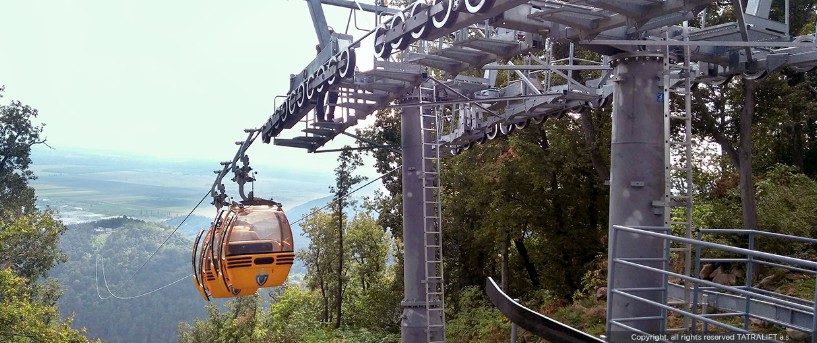
India’s mountain tourism is growing fast. More travelers are heading to hill stations, pilgrimage sites, and high-altitude destinations every year. But getting visitors there, safely and efficiently, is still a challenge most developers underestimate.
Roads take years to build. Plus, they disturb ecosystems. And in many terrains, they simply are not feasible. That is where aerial infrastructure steps in.
Chairlift systems for tourism are becoming a serious part of how India plans and develops its scenic and religious destinations. They are a cost-effective option, reliable to operate, and designed for areas where traditional transport cannot go.
Fixed chair lifts (in particular) are proving to be one of the most practical tools in this space. From pilgrimage hilltops to mountain resorts, a well-installed chairlift ropeway for scenic tourist destinations does more than move people. It opens up entire zones for tourism development.
This blog breaks down exactly how fixed chair lifts fit into tourism infrastructure and what developers need to know before they invest.
Decoding Chairlifts Systems in Tourism
A chairlift system is an aerial transport solution. It moves passengers along a fixed cable route, suspended above the ground. Chairs or cabins are attached to a steel haul rope that runs continuously between two terminals, carrying visitors from one elevation to another with minimal infrastructure on the ground.
There are two broad types:
- Fixed grip chairlifts have chairs that are always attached to the cable. These chairlifts move at the same speed all the time.
- Detachable chairlifts are different. They let the chairs come off the cable when they get to the stations. This means the chairs can slow down. It is easier for people to get on the detachable chairlift.
Both serve tourism infrastructure. But for different terrain profiles and budget brackets.
To understand which system suits your project, explore M&M Ropeways’ Ropeway Systems page and our dedicated Chairlift Product page.
Why Tourism Infrastructure Needs Fixed Chair Lifts
India’s tourism industry is growing into areas that our current infrastructure cannot handle well. Many of the country’s amazing places are on hilltops, mountain ridges, and high areas where building roads is very costly, damages the environment, or just can’t be done. To solve this issue, fixed chair lifts are being used more and more.
Access to Remote and High-Altitude Destinations
A chairlift ropeway for scenic tourist destinations can link a base point to a hilltop viewpoint or religious site in a matter of minutes. The route, which used to require an hour of hard work, now provides an enjoyable journey through beautiful scenery. The destination now becomes accessible to elderly visitors and families with young children, and people who normally would not visit.
Visitor Flow and Crowd Management
Fixed chair lifts run at a constant, predictable speed. Developers need to understand that system dependability stands as their most vital requirement. Uncontrolled crowd movement at pilgrimage sites and popular hill stations creates major problems for safety and visitor experience. The fixed chairlift system operates as a permanent visitor flow mechanism that delivers controlled passage for people who travel in both directions. People can walk around the area because the way they move forms into two patterns of foot traffic.
Eco-Friendly Footprint
Fixed chairlifts run without fuel emissions. Their installation footprint is tower-based. It means far less ground disturbance compared to cutting a mountain road. India’s government is already acting on this logic. The Parvatmala Pariyojana targets 200 new ropeway projects by 2030, built specifically to create sustainable access in mountain regions.
Ropeway solutions for hill stations are no longer supplementary. They are becoming the foundation of how tourism infrastructure gets planned in India today.
Key Benefits of Fixed Chair Lifts in Tourism Development
Tourism developers need to answer one specific question before they proceed with their infrastructure development plans. What do we actually get out of this? With fixed chair lifts, the answer is more layered than most expect.
Cost-Effective to Install and Maintain
Fixed grip systems operate as the least expensive chairlift system for tourism. It possesses fewer operational components than detachable systems, while its mechanical operations are less complex than those of gondola systems. That simplicity translates directly into lower installation costs and a lighter maintenance burden over time. For state tourism boards and private resort developers working within tight project budgets, that financial headroom matters. You receive a dependable system that lasts for many years without paying extra for unnecessary advanced features
Year-Round Operational Flexibility
Fixed chair lifts are not seasonal equipment. That is a common misconception worth addressing. While they are well known in ski environments, they serve summer hiking trails, pilgrimage routes, and nature tourism circuits just as effectively. A destination that runs its chairlift through all twelve months gets far more return on its infrastructure investment than one that operates only in peak season.
Compact Terminal Design
The loading and unloading stations of a fixed chair lift require very little ground space. That compact footprint opens up installation possibilities in terrain-sensitive and ecologically protected zones where larger infrastructure would never receive environmental clearance. It is a practical advantage that often makes the difference between a project getting approved or stalling indefinitely.
Longer Visitor Dwell Time and a Stronger Local Economy
This is the benefit that tourism economists pay close attention to. When visitors can access more of a destination without physical strain, they stay longer. They visit more sites, eat more meals, and spend more money locally. A fixed chairlift effectively extends the tourist circuit within a destination. That ripple effect on the local economy is one of the strongest arguments for the benefits of chair lifts in tourism development, and it is one that project planners should be putting in front of their stakeholders.
Fixed Chair Lift vs Gondola: Which One Does Tourism Need?
| Parameter | Fixed Chair Lift | Gondola |
| Cost | Lower | Higher |
| Best For | Open scenic terrain, short-to-medium routes | Weather-sensitive, family-heavy, long routes |
| Terrain Fit | Gentle to moderate slopes | Steep, exposed, extreme altitude |
- When looking at fixed chair lift vs gondola tourism decisions, cost is usually the first filter. Fixed chair lifts come in at a noticeably lower installation and maintenance cost.
- Terrain is the second filter. Fixed chair lifts perform well on gentle to moderate slopes with open, scenic profiles. Gondolas are better suited for steeper, more exposed routes where enclosed cabins protect passengers from harsh weather.
- The third thing to consider is the kind of people who will be visiting. If a lot of your visitors are families with kids, or where weather conditions are unpredictable, a gondola is a good idea.
- A fixed chair lift is better when people want to feel like they’re outside, and that is part of the fun.
The thing is, neither system is better for everyone. You have to think about the terrain you are dealing with, how much money you have to spend, and what kind of people are going to be visiting you.
Safety Standards and Maintenance
Safety is always on our minds when making infrastructure decisions. Operators might not always say it, but it plays a huge role in choosing vendors and approving projects.
- In India, the rules for fixed chairlift systems are set by the Bureau of Indian Standards and the Ministry of Road Transport and Highways (MoRTH).
- On the technical side, fixed chair lifts come equipped with redundant braking systems that activate automatically if the primary drive fails. Rope speed is monitored continuously during operation.
With proper upkeep, a well-installed fixed chairlift has an operational lifespan of 30 to 50 years. For a tourism destination, it is a long-term infrastructure with a serious return on investment.
The Bottom Line
Fixed chair lifts are not a new idea. But the role they play in tourism infrastructure is being rediscovered at exactly the right time. It opens destinations that roads cannot reach. They manage visitor flow without complicated systems. The equipment has a service life between 30 and 50 years, and its maintenance requirements allow operation in distant areas. For any serious tourism infrastructure plan, ignoring them is leaving real value on the table.
The benefits of chair lifts in tourism development extend beyond their function to transport people between two locations. They reshape how a destination functions, who it can welcome, and how long visitors choose to stay.
The choices we make today about infrastructure will decide how our hill station project, pilgrimage route, or scenic tourism circuit turns out in the future.
If you are thinking about starting a project, we can help you make choices. Get in touch with our team of experts now.
Chair lifts are really good for tourism. They do not just take people from one place to another. Chair lifts change the place. They help decide who can come and how long people want to stay.
The things we do now will affect our hill station project, pilgrimage route, or scenic tourism circuit, on.
If you want to start something, we can help you make good decisions. You can talk to our team of experts now.