
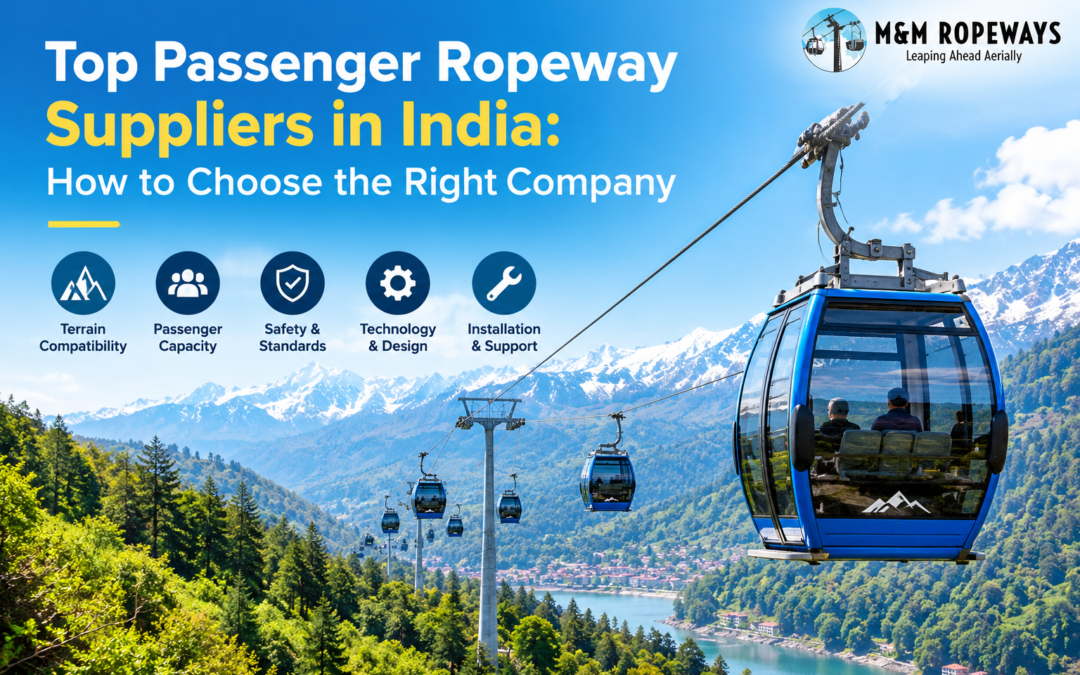
Suppose a hill station where hundreds of visitors arrive every morning. But the roads can handle traffic only up to a certain point. Or a pilgrimage route where it takes hours on foot to reach the point. Now ask a simple question: “Can a passenger ropeway move people faster without needing a new road through difficult terrain?”
India is already going that way. In March 2025, the Government of India approved the 12.9 km Sonprayag Kedarnath ropeway. It uses Tri cable Detachable Gondola technology. It is set up to move 1,800 passengers per hour in each direction. The plan also aims to handle as many as 18,000 passengers each day.
The opening is there. Still, one more point needs attention. How do you choose the right passenger ropeway supplier in India?
The answer is not simply to compare prices. A passenger ropeway is long-term infrastructure. And the supplier you choose must understand your Terrain, Passenger Volume, Safety Requirements, Technology, Installation Conditions, & Maintenance Needs.
You will further study it in more detail in the later sections of the blog. Read more.
Why Choosing the Right Passenger Ropeway Supplier Matters
Generally, a ropeway moves passengers over hills and down into valleys. But it can also cross forest areas and lead into crowded tourist spots. In other cases, it must handle rough mountain ground. Because of that, picking a supplier is an engineering task, not only a buying task.
A capable ropeway company should be able to support several stages of the project, including:
- Site and route assessment
- Ropeway system selection
- Engineering and design
- Capacity planning
- Equipment and component selection
- Manufacturing or supply coordination
- Installation and commissioning
- Safety inspections
- Operator training
- Maintenance and after sales support
If a supplier has an attractive quotation, it does not always make it suitable for your project. The most important thing is whether the company delivers a ropeway system designed for your site’s exact conditions.
What to Check When Comparing Passenger Ropeway Suppliers in India
There are several factors that can help project owners, tourism authorities, developers, EPC companies, and government bodies compare suppliers more effectively.
1. Look at Actual Project Experience
Start with the supplier’s project history. Do not only ask how many years the company has been operating. Ask what kind of ropeway projects it has actually completed.
Check whether the company has experience with:
- Tourism and hill stations
- Pilgrimage destinations
- Urban passenger transport
- Mountain connectivity
- High-altitude installations
- Difficult weather conditions
- Large passenger capacities
- Government infrastructure projects
M & M Ropeways has handled many kinds of ropeway and cable crane work. This includes aerial ropeways and cable crane systems. They have also supported hydropower jobs, mining sites, rural links, tourism needs, & defense facilities. Their background across these areas matters. Each site is different. The land, the goal, the number of riders, & the way the system must run can all change what is needed.
- Check Engineering and Design Capabilities
A passenger ropeway should be designed to suit the site, not follow a fixed design. The terrain, elevation, route length, wind, passenger demand, tower locations, stations, & operating needs all affect the final design.
A strong engineering team should be able to evaluate:
- Route alignment
- Ropeway capacity
- Tower positioning
- Rope span requirements
- Drive systems
- Structural requirements
- Passenger evacuation considerations
- Electrical and control systems
- Weather and environmental conditions
M & M Ropeways states that its ropeway engineering is carried out with European design associates according to OITAF guidelines and regulations. For a buyer, this is an important point to verify before selecting a passenger ropeway manufacturer.
3. Understand the Ropeway Technology Being Offered
Not every passenger ropeway system is designed for the same purpose. Depending on the project, suppliers may recommend technologies such as
- Mono-cable ropeways
- Bi-cable ropeways
- Gondola systems
- Detachable chairlifts
- Fixed-grip chairlifts
- Surface lifts
- Other aerial transportation systems
M & M Ropeways offers a range of ropeway systems. It’s product portfolio includes passenger carrying ropeways, gondolas, detachable and fixed grip chairlifts. Not only this, Mono cable & Bi cable ropeway systems are also included. The right technology depends on passenger capacity, route conditions, travel distance, terrain, boarding requirements, operating speed, & project objectives. Therefore, do not start with the question, “Which ropeway is cheapest?” Start with, “Which ropeway system fits this site?”
4. Verify Safety & Quality Standards
Passenger transport depends on safety. For ropeway companies in India, request clear details on what rules they use for the design, building, setup, checks, and start-up.
Look for:
- Quality management certifications
- Relevant ropeway safety standards
- Documented inspection procedures
- Engineering calculations
- Testing and commissioning procedures
- Emergency and evacuation planning
- Maintenance procedures
According to M & M Ropeways, its systems are designed in accordance with OITAF guidelines. The company is also ISO certified, including ISO 9001:2015 & ISO 14001:2015. A responsible buyer should always verify the current certificates & their scope instead of relying only on claims made in marketing material.
5. Consider Terrain and Weather Experience
A ropeway operating at a tourist destination with moderate weather faces different engineering demands from a system operating at extreme altitude. This is where a supplier’s field experience becomes particularly important.
M & M Ropeways reports installations reaching 18k feet, including systems installed for the Indian Army on the Siachen Glacier. The temperatures can fall there below -35°C. This shows that why buyers should ask suppliers about their previous work in conditions similar to their own project.
If your project is located in a mountainous area, ask:
- Have you worked at similar elevations?
- Have you handled strong winds or heavy snowfall?
- How are foundations and towers planned for difficult terrain?
- What maintenance access is required?
- How are emergency situations handled?
Past experience does not replace site specific engineering, but it can help demonstrate whether the supplier understands the environment.
6. Check Passenger Capacity and System Performance
Capacity planning is another major part of supplier selection. A system designed for a small tourist attraction may not be suitable for a high footfall pilgrimage site or urban transport corridor.
Before selecting a supplier, check these:
- Passengers per hour
- Peak passenger demand
- Operating hours
- Journey time
- Number of cabins or carriers
- Station capacity
- Seasonal demand
- Future expansion requirements
This helps suppliers propose a system that can handle real operating conditions rather than simply meeting an average daily demand.
7. Look Beyond Installation: Ask About After Sales Support
The project does not end when the ropeway starts operating. Passenger ropeway systems require regular inspections, maintenance, spare parts, & technical support throughout their operating life.
Ask the supplier about:
- Preventive maintenance
- Emergency support
- Spare parts availability
- Safety inspections
- Operator training
- Troubleshooting
- Technical documentation
- Warranty terms
- Long-term maintenance support
M & M Ropeways states that it provides maintenance & safety inspection services for tourism ropeway systems. It also provides support after sales. Check these services before signing a contract. Good support can help keep the ropeway running during busy seasons.
Passenger Ropeway Supplier Comparison Checklist
Before shortlisting a company, use this simple checklist:
| Factor | What to Verify |
| Experience | Years in business and completed projects |
| Project Type | Tourism, pilgrimage, urban, or other passenger applications |
| Engineering | In-house capabilities and specialist design support |
| Technology | Gondola, mono cable, b -cable, or other suitable systems |
| Safety | Applicable standards, inspections, & documentation |
| Terrain | Experience with similar elevation and weather |
| Capacity | Passengers per hour and peak demand |
| Installation | Commissioning & project execution support |
| Maintenance | Spare parts, inspections, & technical support |
| References | Previous projects and verifiable client experience |
Why M & M Ropeways Is Worth Evaluating
If you are looking into passenger ropeway suppliers in India, then M & M Ropeways comes up as a ropeway manufacturer with long experience. They handle work for both passenger transport and material handling. The firm also states it has over 35 years of experience & has completed 120+ projects. Its capabilities cover design, manufacturing, supply, installation, & project support across different sectors.
For passenger ropeways, they list gondola systems, mono cable, bi cable setups, chairlifts, & other cable transit options. The company also works across demanding sectors such as tourism, hydropower, defense, mining, tunnelling, & rural connectivity. For owners, this range may matter when a passenger ropeway must run in hard terrain or near difficult infrastructure.
M & M Ropeways has publi, its ropeway blogs and industry resources cover topics such as ropeway selection, passenger transportation, safety, project approvals, & related infrastructure.
Final Thoughts: Choose the Supplier Around the Project
Pick a passenger ropeway supplier in India by first considering your project needs. A good check should include engineering experience, technology, safety, terrain, passenger capacity, installation capability, & long term support. Cost matters too, but you should not treat it as the only factor.
India is putting more money into ropeway projects. That makes the supplier choice more important. Large public ropeway work, like the Sonprayag Kedarnath and Govindghat to Hemkund Sahib ropeway, shows how large and planned these efforts can be.
If your goal is tourism, pilgrimage service, city travel, or links in hilly areas, begin by spelling out key basics. Map your route. Estimate passenger demand. Note the terrain. List your operating conditions. After that, pick a ropeway partner that can engineer a system that fits those details.
Planning a passenger ropeway project in India? Speak with M & M Ropeways. Share your requirements, your site conditions, the capacity you need, & the type of ropeway solution you want.