
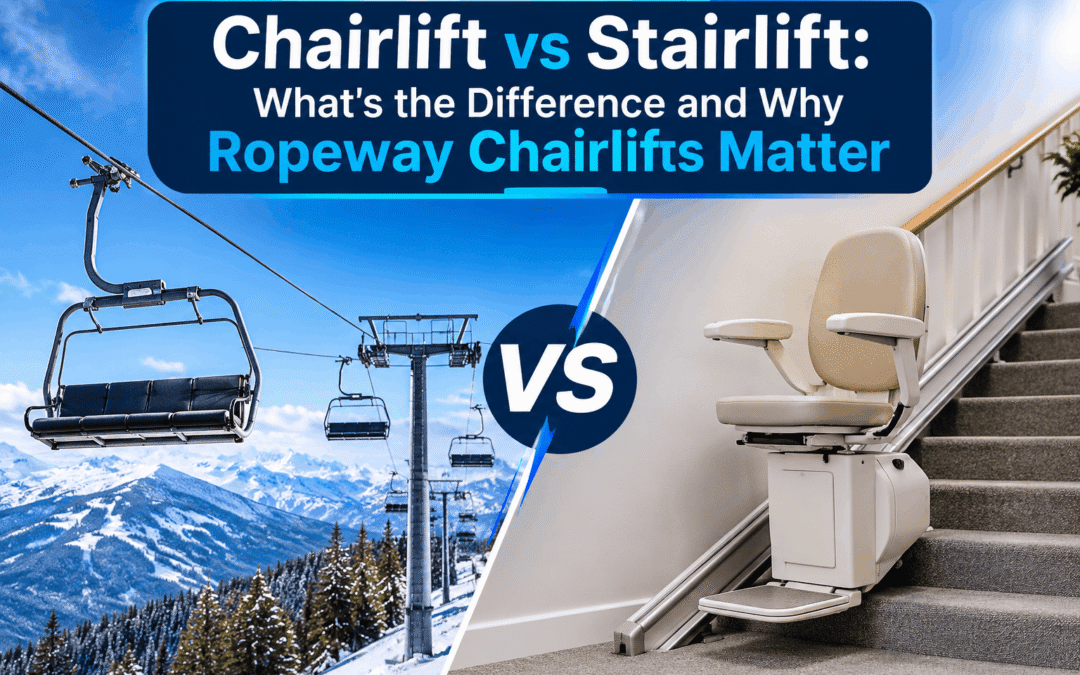
Is a chairlift just a bigger stairlift? Plenty of people think so, and it’s an easy mistake. Both have a seat. Both move you uphill. Both have “lift” in the name. That’s where the similarity ends.
One helps someone get upstairs at home. The other carries lots of people up a mountain, over trees and valleys. One is a household aid. The other is a full transport system. Mixing them up is like mixing up a bicycle & a train.
If you’re planning a tourism or hill access project, this difference matters. Pick the wrong one & you lose time and money. So let’s break it down. We’ll start with the stairlift. Then we’ll spend most of our time on the ropeway chairlift.
What Is a Stairlift?
A stairlift is a motorized chair which runs along a track that is fixed to a staircase. You’ll find it in homes. A stairlift assists in helping those with limited mobility. This includes the elderly, handicapped, or sick people. It allows them to travel between floor levels independently.
A stairlift transports one person at a time for a relatively short distance along the stairs & matches the curve of the stairs. Stairlifts utilize a small electric motor. Basically, it makes life at home easier, but it isn’t a transport system. It’s a helper for one staircase, not a way to move a crowd.
What Is a Ropeway Chairlift?
A ropeway chairlift is an aerial passenger system. A continuous loop of steel wire rope runs between two terminals, often supported by towers along the way. Chairs hang from this moving rope and carry passengers up a slope, well above the ground.
Chairs can seat one, two, three, four, or even six people. The grip that holds each chair to the rope also matters:
- Fixed grip: The chair stays clamped to the rope for the whole journey. These systems are simpler & well suited to many routes.
- Detachable grip: The chair releases from the rope at each terminal. Passengers board slowly, while the rope itself runs faster. Rope speed can be roughly double that of a fixed grip system.
The drive terminal holds the motor and the main braking system. Many chairs also carry a safety bar for extra comfort and security. Unlike a stairlift, a chairlift is a full transport system, built and operated to strict engineering and safety standards. You can explore M & M’s ropeway products to see what such systems involve.
To see how fixed and detachable systems are built, explore M & M Ropeway’s range as a chair lift manufacturer in India.
Chairlift vs Stairlift: Key Differences
The gap between the two is wide. This table shows it at a glance.
| Feature | Stairlift | Chairlift |
| Where it runs | Indoors, on a home staircase | Outdoors, over slopes, valleys and mountains |
| How it moves | Motorised seat on a fixed rail | Chairs hanging from a moving steel rope |
| Passengers | One at a time | Many chairs in continuous circulation, one to six seats each |
| Distance | A few metres | Hundreds of metres or more |
| Typical users | Individuals and families | Tourists, skiers, pilgrims and local communities |
| Setup | Fitted to a single staircase | Terminals, towers and rope planned around the site |
| Purpose | Personal mobility | Public transport and tourism |
So a stairlift helps one person climb a few steps. A chairlift moves many people across ground that roads struggle to reach.
Which One Do You Need?
The answer depends on the problem you want to solve. Choose a stairlift if you need to help a family member move between floors at home. It is a household product. It suits private use.
Choose a chairlift if you want to carry visitors up a mountain, link a hill village to the valley below, or open a scenic route to tourists. These are public scale needs. They call for engineered ropeway systems, not home equipment.
If your project falls in the second group, the benefits below will matter to you.
Benefits of a Ropeway Chairlift
Chairlifts at resorts & hill stations are common for good reason.
- Traversing steep inclines: Compared to roads, ropeways easily handle steep grades by being able to pass above obstacles & gaps.
- Occupies less ground: Ropeways only touches the ground at its terminals & towers. The rest of the route stays in the air. So it can cross rivers, rocks and even forests without any trouble.
- A lesser impact on the environment: Compared to ropeways, building roads results in significantly higher disturbance of the ground. This has led many to label ropeways as the most environmentally friendly transportation method.
- Passenger efficiency: Continuous flow of chairs results in no wait time for passenger transportation.
- Enhance the potential of tourism: A chairlift provides easy accessibility for users to various points of interest as well as access to different services. Ease of access increases customers to different businesses.
- Provides a unique experience: The travel time itself becomes an experience that enhances the trip. In addition, the open air nature provides a great view not found in most other modes of transportation.
Provides better links for remote communities: With ropeways, settlement areas on the top of the mountains can be connected to facilities like markets & schools.
Where Are Chairlifts Used?
Ski resorts are the most familiar example. Chairlifts serve many other settings. Hill station tourism, pilgrimage routes, adventure parks & scenic mountain trails all rely on them. To see how these systems support visitor flow and local growth. Read about the role of fixed chair lifts in tourism infrastructure. In rugged regions, chairlifts also act as a lifeline between remote villages and the towns below.
Why Choose M & M Ropeways?
Every ropeway is made for its own site. The slope, wind and load change from place to place. So pick your supplier with care.
M & M Ropeways started as a family owned company in India. It has now become one of the top companies in the business. M & M Ropeways specializes in designing and installing aerial ropeways and cable cranes in some of the most extreme environments in the world. Their portfolio includes the installation of ropeway systems at Siachen Glacier for the Indian Army, at the height of 18,000 feet and temperature at minus 35 degrees Celsius.
M & M Ropeways can be the one stop solution for the entire ropeway system of your project, including the design, manufacturing and installation. What is even better is that each system is designed specifically for your project and is not based on any standard designs.
Ready to Plan Your Ropeway Chairlift Project?
A stairlift solves a home problem. A chairlift solves a mountain-sized one. If you are planning a tourism, hill-access or community transport project, the right partner makes all the difference.
Speak to the M & M Ropeways team today. Contact us to discuss your site, your route & your passenger needs.
Frequently Asked Questions
Q1. How is a chairlift different from a stairlift?
They are not the same. Stairlifts help people to move along a track over the stairs in their home. Chairlifts, on the other hand, can transport several people over hilly, mountainous, and elevated terrain.
Q2. Are chairlifts a type of ropeway?
Yes, they are. They are elevated ropeways with passenger seating. Chairlifts have chairs which hang on a steel cable running between two terminals and are constantly moving.
Q3. What is the difference between a chairlift that has fixed grips and one with detachable grips?
The chairlift which has fixed grips does not have chairs which can be disconnected from the rope. In contrast, the chairlift that has detachable grips has the ability to release each chair at its end points. This is done to achieve a quicker speed and facilitate easier loading of the chairs.
Q4. Is there such a thing as summer operation of a chairlift?
Yes. Chairlifts are used to carry people like hikers and tourists in summer. They are a good way for businesses and towns to earn money throughout the year.
Q5. Are ropeway chairlifts safe?
Yes, when built and maintained well. M & M designs to OITAF guidelines, and the drive terminal holds the main brake. Many chairs also have safety bars.
Q6. How many people sit on one chair?
Fixed grip chairs usually seat two or four people. Detachable grip chairs usually seat four or six.