
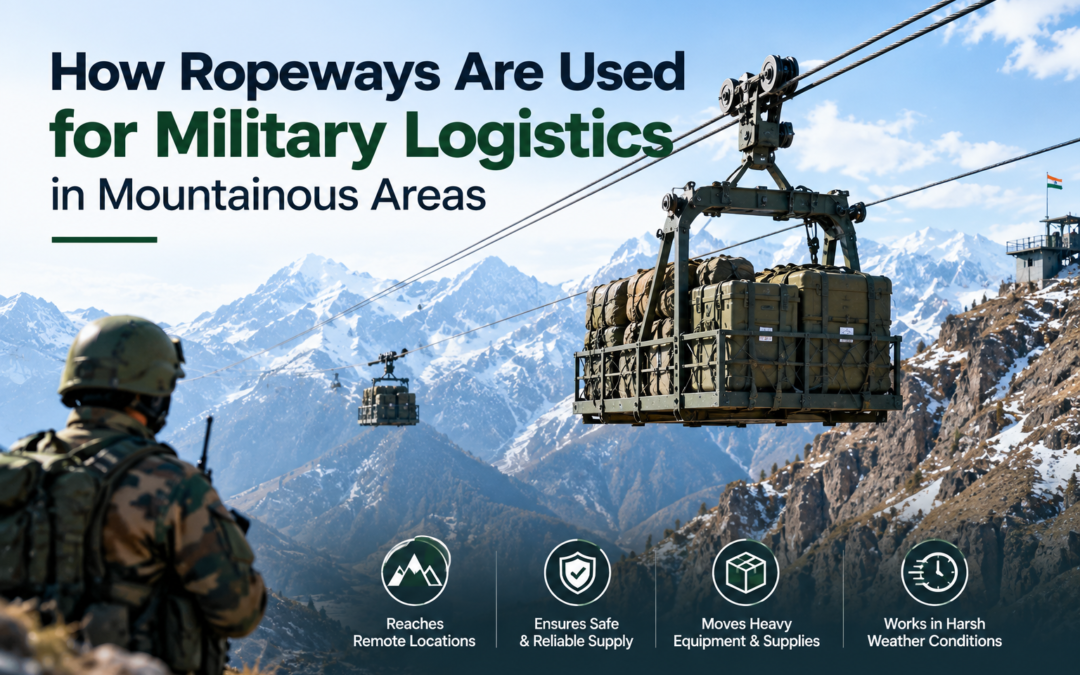
At 18,000 feet, the mercury drops below -35 degrees Celsius, and no road climbs that high to begin with. Helicopters cannot be counted on either. Weather up here decides more than any pilot can. Yet food, fuel, ammunition, and medical support still have to reach soldiers, and they have to reach them on time. Steel cables end up solving a problem that roads and choppers cannot.
Ropeways for military logistics in mountainous areas have quietly supported armies for over a century, from the Alps in World War I to the Siachen Glacier today. These military ropeway systems carry supplies across terrain no vehicle can cross, without waiting for a road to be built or a storm to clear. For India’s Army, this is not a backup option. It is often the only reliable way to keep forward posts running.
This blog looks at how aerial cableways for army operations work, and why they remain critical in the world’s harshest battlegrounds.
Why Roads and Helicopters Fail in Mountain Warfare
Building a road through mountains is not as easy as it sounds. The sides of the mountains can collapse, and rocks can break apart. The rainy season can destroy what you built in just one big landslide. A blocked stretch means a cut-off post, sometimes for weeks at a time. In a war zone, that kind of delay does not just slow things down. It puts lives at risk.
Helicopters cover some of the gap, but not enough of it. Flying depends on clear skies. And at altitudes like Siachen, clear skies are the exception rather than the rule. Strong winds, sudden snow, and thin air all cut into how much weight a helicopter can lift safely on any given flight. Add the fuel costs and the expense of keeping a fleet running at that altitude, and every single sortie starts adding up fast.
This is where ropeway for high altitude military supply earns its place. Fog and snowfall do not stop it the way they stop a helicopter. It does not wait for a road to be cut through rock either. Once it is installed, it keeps moving supplies day after day, no matter what the weather is doing outside.
What Exactly Are Military Ropeways?
A military ropeway, often called an aerial cableway, is a fairly simple idea once you break it down. Two ropes do most of the work. One stays fixed in place and acts as the support, called the track rope. The other rope is called the haul rope- it moves back and forth. It pulls the load. The carriers move between these two ropes. They carry goods over valleys and ridges and gorges. Also, they never touch the ground. The military ropeway is different from the ropeways you see at hill stations or ski resorts. Those ropeways are for people to ride, so they need to be comfortable. They have cabins and seats. It is easy to get on, and you are protected from the weather. A military ropeway does not need all that. There are no seats. There are no cabins, like the ones you see at hill stations. The military ropeway just has trolleys or cradles. They are manufactured to carry heavy things – not people who want to see the view.
That difference in design comes from a difference in purpose. A tourist ropeway is judged by passenger experience. A military ropeway is judged by one thing only: whether it delivers the load, on time, in conditions where nothing else can.
How Armies Actually Use Ropeways for Logistics
Once a ropeway is installed at a forward post, it becomes part of daily operations, not a fallback for when everything else fails. Here is where it actually earns its place.
Supplying Rations, Fuel and Ammunition
Soldiers at high places need a constant flow of basic supplies just to stay alive, let alone to stay in their position. Food, fuel for heat, and bullets all have to go up the mountain. Carrying these things by foot takes a lot of time, makes soldiers tired, and puts them in danger before they even reach their post. A ropeway handles this on a fixed schedule instead – which saves both time and the manpower a foot supply run would otherwise eat up.
Moving Troops Safely Across Impassable Terrain
Cargo is not the only thing that travels on a ropeway. Some stretches of terrain punish a single wrong step with a fall of hundreds of feet, and crossing a valley or gorge on foot in those conditions is a real gamble. A properly built ropeway gives soldiers a safer way across, which matters even more during rotation periods when whole units need to move between posts at once.
Casualty Evacuation from Forward Posts
This use tends to get overlooked, though it may be the most critical one. When a soldier is injured at a remote post, how fast they reach medical care often decides the outcome. Roads rarely exist here, and helicopters cannot always take off. A ropeway carrier fitted for stretcher transport becomes the quickest option, and at times, the only one that works, for getting an injured soldier down to a base camp.
Transporting Construction Material for Bunkers and Outposts
Forward posts are not built overnight, and they are not built with materials found lying around at 18,000 feet. Cement, steel, timber, and fabrication materials all need to travel up from lower camps. Trying to move this by mule or manpower alone takes weeks and drains resources that could go elsewhere. A material ropeway system, similar to the ones used on hydropower and mining sites, can shift this volume of material far faster, and with far less strain on personnel.
Put together, these four uses show why ropeways are not treated as a temporary fix in mountain warfare. They become part of the supply chain itself, running alongside whatever roads or air support exist, and often filling in exactly where those two options stop working.
Case Study – Siachen Glacier and the Indian Army
Siachen Glacier is often called the world’s highest battlefield – and that title is not an exaggeration.
- Indian Army posts here sit above 18,000 feet, where the mercury drops past minus 35 degrees Celsius on a regular basis. Wheels are of no use in this terrain. No road connects most of these posts. Helicopters remain the only air option, and even they are grounded for days at a time when the weather turns.
- This is the exact environment where M & M Ropeways has worked directly with the Indian Army. Our team designed, manufactured, and installed a ropeway system at 18,000 feet on Siachen, built to function in some of the most inhospitable conditions found anywhere on earth. Every part of that system, from the cable strength to the load capacity, had to account for extreme cold, high wind, and near-constant snow cover.
What makes this case study relevant is not just the altitude record. It shows what a ropeway needs to survive and perform where almost every other transport option fails outright. Supplies, equipment, and personnel movement at Siachen depend on systems built for exactly this kind of pressure, and that experience shapes how we approach every high-altitude project since. You can see more of our defence and high-altitude work on our projects page.
Engineering Challenges of Building Ropeways in Combat Zones
Designing a ropeway for a ski resort and designing one for a military post at 18,000 feet are two completely different engineering problems. Combat zones bring a set of demands that civilian projects rarely face.
- Extreme cold resistance: At sub-zero temperatures, standard steel cables and mechanical parts can turn brittle and fail under load. Every component has to be tested and rated for conditions well below what most equipment is built to handle.
- Fast assembly: A ropeway meant for a forward post cannot take months to set up. Operational needs can shift a site overnight, so systems often need to go up quickly, using materials that can be carried by mule, air, or manpower rather than heavy trucks that these terrains simply cannot support.
- Low maintenance design: Sending a technician up to a remote post for routine repairs is not always possible. Parts have to be built for a longer service life with minimal upkeep, since a breakdown here is not a quick fix.
- Wind and avalanche exposure: High-altitude ropeways face constant wind load and avalanche risk, both of which shape how supports and anchor points are engineered.
- Access difficulty: In many cases, the site itself is barely reachable, which means construction planning has to account for the same terrain problems the ropeway is meant to solve.
Together, these factors show why building here takes a different level of engineering discipline than most other ropeway projects. Our approach to this is covered in more depth in Essential Safety Measures During Ropeway Installation.
Why Ropeways Beat Roads and Air Support in Military Terrain
Put a ropeway, a road, and a helicopter side by side in mountain terrain, and the gaps in the other two options become obvious fast.
- Weather does not stop it: Snowfall, fog, and high winds ground helicopters on a regular basis. A ropeway keeps working through most of that, since it has nothing to do with visibility or flying conditions.
- Each trip costs far less: A helicopter sortie burns fuel and needs a full aircrew every single time. Once a ropeway is up and running, moving another load costs a fraction of that.
- It does not need to stop and rest: Helicopters need refueling, crew changes, and a clear weather window before the next flight. A ropeway can keep moving loads back and forth for hours without any of that downtime.
- No slope gets cut open to build it: Roads in mountain terrain mean carving into hillsides, which raises landslide risk and can take years to finish. A ropeway skips that step and can often be running within months.
- Fuel is barely a factor: Some ropeway designs, gravity-powered ones especially, run on little to no external power, which matters a lot in places where getting fuel up the mountain is its own logistics problem.
None of this means ropeways replace roads or air support completely. In most cases, they work alongside both. But in the specific conditions mountain warfare creates, a ropeway often ends up doing the one thing the other two cannot guarantee: showing up on schedule, every single day.
We have covered this comparison in more detail in Why Ropeways Are a Sustainable Alternative to Road Expansion in Mountain Regions.
The Future of Military Ropeway Technology
Military ropeway systems are not staying static. As terrain challenges grow more complex and defence infrastructure budgets expand, the technology behind these systems keeps improving too. One shift is the move toward self-propelled systems, where carriers come with their own onboard engines instead of relying on a fixed haul rope powered from a station. This gives more flexibility in how and where a ropeway route can be set up, especially in terrain that changes often.
Sensors are quietly changing how these systems get monitored too. Cable tension, load weight, weather conditions- all of it can now be tracked in real time. This cuts down how often someone has to physically check a line at a remote post that takes hours just to reach. Power is shifting as well. Some newer setups run on a mix of gravity and electric backup, useful in locations where trucking in fuel regularly is neither easy nor cheap.
There is also growing focus on faster deployable designs. As operational needs shift quickly in border regions, ropeway systems built for rapid assembly and relocation matter more than ever. Together, these developments point toward one clear direction: ropeways built specifically for defence use are becoming smarter, faster to deploy, and less dependent on manual upkeep.
You can read more on where this is headed in The Future of Transportation With Ropeway Technology in India.
The Crux
Mountain warfare has always tested the limits of what roads and aircraft can deliver, and it likely always will. Ropeways stepped into that gap over a century ago – and they remain just as relevant today. When weather grounds helicopters and terrain rules out roads, a well-engineered ropeway keeps supplies, personnel, and support moving without pause.
For defence planners, PWD officials, and infrastructure teams working in high-altitude or border regions, the case for ropeways is not theoretical. It is proven, tested at 18,000 feet, in temperatures no other transport system handles well. M & M Ropeways has built a system for the Indian Army. Working on a project like that teaches you a lot of things that you cannot learn from a book. We use what we learned from that project when we work on sites that are high up.
If your project involves extreme terrain, tight timelines, or conditions where standard transport options fall short, get in touch with our team to discuss what a ropeway solution could look like for your site today.