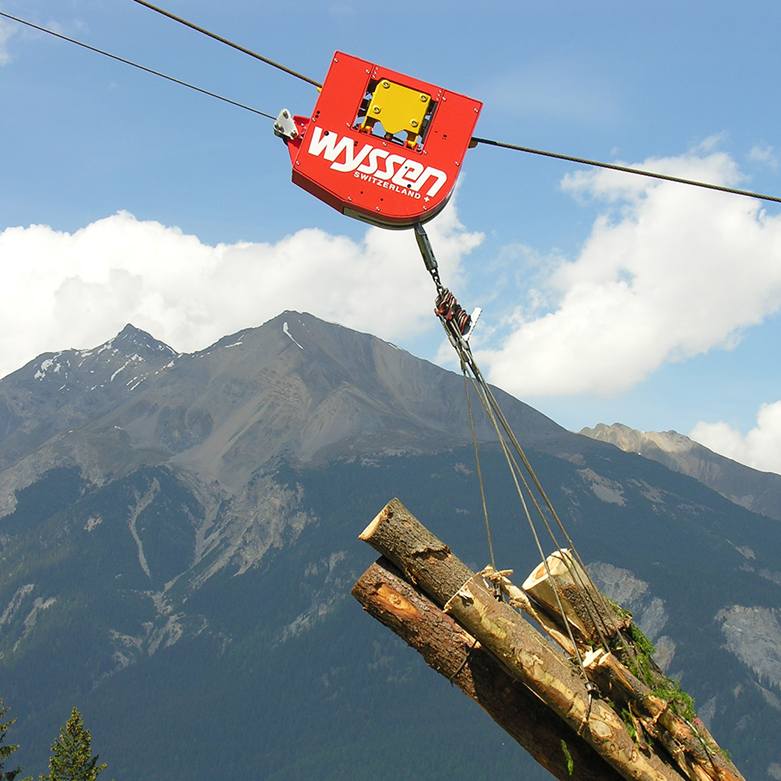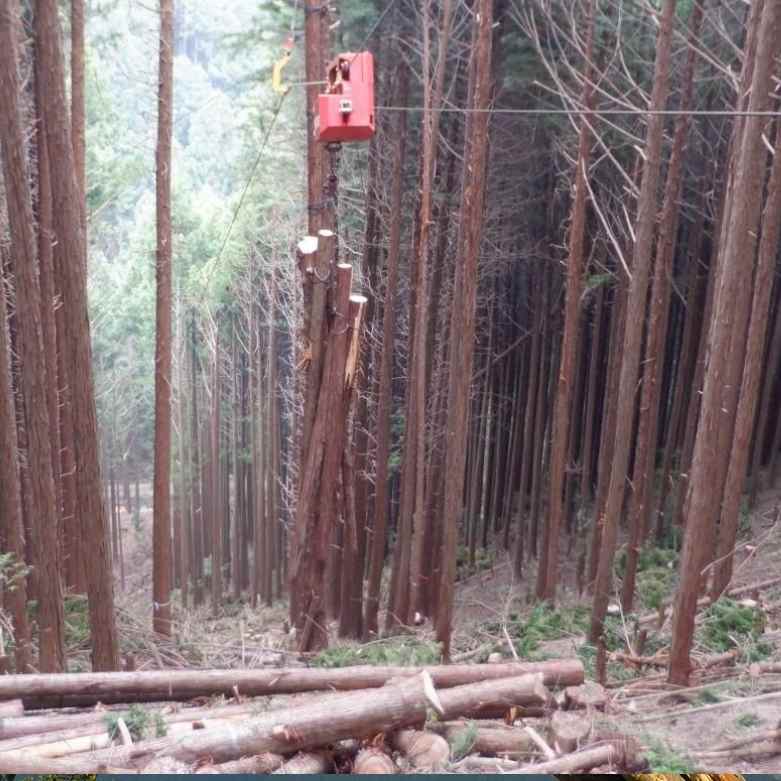

Logging Ropeways, also known as Forestry Cableways, are systems used to transport felled timber from forest areas to processing or collection points, particularly in challenging terrains like mountainous or densely forested regions. These systems utilise cables and carriages to move logs, offering a more efficient and environmentally friendly alternative to traditional methods like ground-based skidding, especially in areas with sensitive ecosystems or steep slopes.
The core principle involves suspending a load of logs from an overhead cable or a system of cables, which are then moved by a central machine called a ‘yarder’ or ‘winch’. Advanced Cableways include remote control functionality. These systems ensure fast and precise operations, reducing execution times and lowering operating costs.
Types of Logging / Forestry Cableways
The classification of Forestry Ropeways often revolves around the configuration of their cables and how the load is suspended and moved. M & M Ropeways, in cooperation with a Swiss Cableway manufacturing company, Wyssen Seilbahnen AG, offers Cableways for the Logging Industry in India. Wyssen has been a manufacturer of high-quality material Cableways since 1926. The invention of the Cable Crane in 1939 ushered in a new era in mountain forest management. Even today, Wyssen remains the market leader in the field of Cable Cranes and material Cableways. Here are the primary types of Forestry / Logging Cableways:
Highlead System:
Description: This is one of the simpler and older cable logging methods. It uses a single main line (haul-in line) running through a pulley block at the top of a spar tree or yarder tower, extending down to the logs. A ‘haul-back line’ pulls the main line and rigging back to the woods.
Operation: Logs are primarily dragged along the ground, with some lift provided as they approach the yarder or if the terrain allows.
Suspension: Minimal to partial suspension.
Advantages: Relatively simple to set up, lower initial cost than full suspension systems.
Disadvantages: Causes more ground disturbance due to dragging, less effective in very rough terrain or over obstacles.
Standing Skyline System (Fixed Skyline):
Description: This system uses a heavy, fixed skyline (support cable) stretched between the yarder and a tail-hold. A carriage travels along this stationary skyline. A separate ‘mainline’ pulls the carriage towards the yarder, and a ‘haul-back line’ pulls it back into the forest.
Operation: The carriage moves along the fixed skyline with logs attached to it. The operating lines (mainline and haul-back) control the carriage’s horizontal movement and can also be used to lift and lower the load.
Suspension: Can achieve partial or full suspension of logs, depending on the terrain and skyline profile.
Advantages: Good control over log movement, reduces ground disturbance, suitable for steep slopes.
Disadvantages: Setup can be a little time-consuming, less flexible for lateral yarding (pulling logs from the side of the corridor) compared to running skylines.
Running Skyline System:
Description: Instead of a fixed skyline, this system uses a continuous loop of cable (the running skyline) that functions as both a support and a hauling line. The carriage is directly attached to this running loop.
Operation: The running skyline itself is tensioned and moves, and the carriage (often with a slack-pulling system) can be moved in both directions along the corridor. This allows for more dynamic control and often enables better lateral yarding.
Suspension: Typically provides partial or full suspension of logs.
Advantages: Highly versatile, excellent for minimising ground disturbance, good for lateral yarding (pulling logs from either side of the cable corridor to the main line), and can be used on a wider range of terrain.
Disadvantages: More complex rigging and operation than highlead.
Live Skyline System:
Description: This is a variation of the standing skyline system where the tension on the skyline can be dynamically varied during operation.
Operation: The ability to slacken and tighten the skyline allows the carriage to lower or lift the load at any point along the line, offering precise control over log suspension and negotiation of obstacles.
Suspension: Excellent for full suspension.
Advantages: High degree of control, minimal environmental impact due to full suspension capabilities.
Disadvantages: More complex and typically higher cost than a simple standing skyline.
Multi-Span Skyline System:
Description: Used for very long distances or highly irregular terrain, this system employs intermediate supports (such as extra towers or ‘lift trees’) along the skyline. This helps maintain the desired height and tension of the skyline over vast stretches or over dips and rises in the topography.
Operation: Functions similarly to standing or running skylines but with additional support points.
Suspension: Can achieve full or partial suspension.
Advantages: Extends the reach of cable logging over long distances and very challenging terrain.
Disadvantages: Complex and costly to set up due to the need for multiple support structures.
Gravity Ropeways:
Description: In specific steep terrain, these systems can utilise gravity to move loads downhill. A haul-back line might still be used to pull the empty carriage back uphill.
Operation: The weight of the load and the natural slope provide the primary motive force for downhill transport.
Advantages: Very energy efficient, low operating costs and environmentally friendly.
Disadvantages: Limited to downhill transport and requires specific terrain.
Beyond Logging / Forestry Cableways:
It’s important to note that the term ‘Ropeways’ in a broader sense applies to systems for transporting various materials like mining ore, construction materials, agricultural produce or even people in tourist gondolas over difficult terrain. While the underlying principles of cables and carriages are similar, the specific components and load-handling mechanisms are adapted for different purposes.
Logging/Forestry Ropeways are a specific application of this broader technology, focused on timber extraction.
M & M Ropeways was incorporated with the intent to provide alternate transportation solutions that are viable, cost-effective and eco-friendly for both Passengers as well as Material Handling.
With many years of experience in the domain, our team of deft Engineers, Designers, Technocrats and Skilled Personnel provide customised solutions to clients for designing, manufacturing, commissioning and operating in accordance with their variegated Aerial transportation requirements in both plains and mountainous terrain. Above all, we are recognised appreciably by our clients for completing and delivering the assignments in a stipulated period.
Since its inception, M & M Ropeways has attracted industry attention by winning prestigious projects in rapid succession and by setting new records for the highest Ropeways. With over a hundred systems installed, we are constantly discovering and learning about innovations and designs.
Also Read: Ropeway Manufacturer in India | Cable Crane Manufacturer in India